
 C.K. Gupta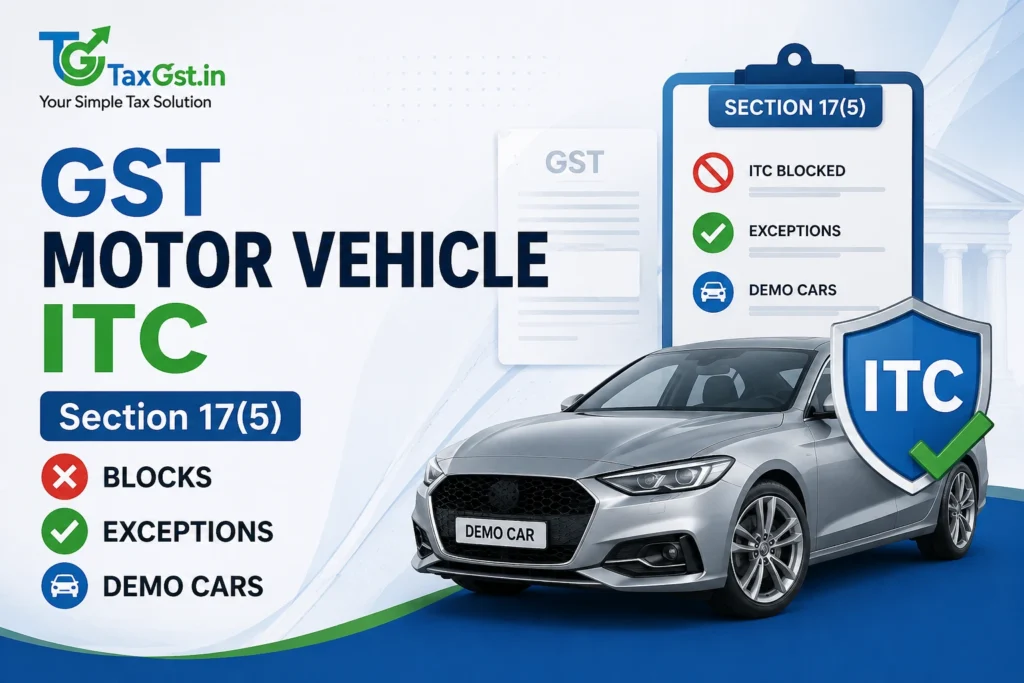
Section 17(5)(a) of the CGST Act blocks Input Tax Credit (ITC) on motor vehicles for the transportation of persons with an approved seating capacity of not more than 13 (including the driver). However, the law carves out three specific exceptions: further supply of such vehicles, transportation of passengers, and imparting driving training. For authorised dealers, “demo vehicles” used to promote sales now qualify for ITC under the “further supply” exception (clarified by CBIC Circular No. 179/11/2022-GST), provided the dealer takes ownership and sells the vehicle on its own account.
Quick Summary: GST Motor Vehicle ITC Rules
- ITC is blocked on passenger vehicles with an approved seating capacity of 13 or fewer (including the driver) under Section 17(5)(a).
- Three narrow exceptions unblock credit: further supply, passenger transportation, and driving training.
- Goods carriages (trucks, tractors) and buses with 14+ seats fall outside the block entirely.
- Circular No. 179/11/2022-GST confirms “demo cars” qualify under the “further supply” exception for dealers.
- If the vehicle’s ITC is blocked, the ITC on its related expenses (insurance, servicing, repairs) is also blocked under Section 17(5)(ab).
What Does Section 17(5)(a) Actually Block on Motor Vehicle Purchases?
The blockade under Section 17(5)(a) of the CGST Act targets a precise category: motor vehicles for the transportation of persons having an approved seating capacity of not more than thirteen persons (including the driver). A five-seat sedan purchased for a director’s office commute falls squarely within the block because none of the exceptions apply.
A 32-seat bus clears the seating threshold and sits outside the clause entirely. A goods carriage — a truck or tractor designed principally for transporting goods under HSN 8701 or HSN 8704 — is untouched by this provision because it is not built to carry persons.
The seating capacity recorded on the vehicle’s Registration Certificate (RC) is the determining factor, not how the vehicle happens to be used on any given day. The accounts team cannot look through to actual usage and conclude credit is admissible because the car is “mostly for business.” If the vehicle falls within the seating threshold and none of the three exceptions in sub-clauses (A), (B) or (C) apply, the credit is irrevocably lost.
How Do the Three Exceptions Unblock ITC?
Section 17(5)(a) provides three tightly worded exceptions, and each maps to a specific business model.
- Exception A (Further Supply): Protects the automotive supply chain. Manufacturers, wholesale distributors, and authorised retail dealers who buy vehicles as stock-in-trade for onward sale fall here. This also covers “demo vehicles” as clarified by CBIC Circular No. 179/11/2022-GST.
- Exception B (Transportation of Passengers): Requires a commercial contract for carriage where a fare or tariff is charged. A taxi operator running a fleet of sedans or a municipal bus service qualifies.
- Exception C (Imparting Driving Training): Covers driving schools and commercial training institutes that use their fleet as the core delivery mechanism for a taxable service.
How Does Section 17(5)(ab) Block ITC on Insurance, Servicing, and Repairs?
The blockade does not stop at the purchase invoice. Section 17(5)(ab) of the CGST Act extends the restriction to general insurance, servicing, repair, and maintenance services insofar as they relate to a vehicle already caught under clause (a). A taxpayer who correctly identifies that the car purchase GST is blocked but then claims credit on the annual insurance renewal has only solved half the problem.
The two clauses operate as a pair — the purchase block and the running-cost block must be read together. However, the proviso to Section 17(5)(ab) creates a mirror image of the exceptions. Where the vehicle itself qualifies for ITC (because it is a demo car, a taxi, or a trainer car), the related insurance, servicing, and repair credits become equally available. If the car is blocked, the insurance is blocked. If the car is creditable, the insurance is creditable.
| Scenario | Vehicle Purchase ITC 17(5)(a) | Running Costs ITC 17(5)(ab) | Why |
|---|---|---|---|
| Five-seat sedan for director’s office use | Blocked | Blocked | Seating capacity ≤ 13; no exceptions apply. |
| Demo car used by authorised dealer | Allowed | Allowed | Qualifies as “further supply” per Circular No. 179/11/2022-GST. |
| Fleet of sedans operated as metered taxis | Allowed | Allowed | Falls under “transportation of passengers” exception. |
| 32-seat staff bus purchased by manufacturer | Allowed | Allowed | Seating > 13; falls outside the 17(5)(a) block entirely. |
| Goods carriage truck (HSN 8704) | Allowed | Allowed | Designed for goods, not persons; outside scope. |
Worked Example: The Cost of a Blocked Sedan
PQR Limited purchases a five-seat sedan for its Managing Director at an invoice value of ₹20,00,000 plus GST of ₹5,60,000 (at the prevailing rate of 28%). During the year, the company pays ₹75,000 for annual insurance plus GST of ₹13,500, and ₹50,000 for servicing plus GST of ₹9,000.
The total GST incurred across the purchase and running costs is ₹5,82,500. Because the vehicle is for the director’s personal office use and none of the three exceptions apply, the entire ₹5,82,500 is blocked — ₹5,60,000 on the purchase under clause (a) and ₹22,500 on the insurance and repairs under clause (ab).
If the exact same vehicle were instead a demo car capitalised by an authorised dealer, the entire ITC of ₹5,82,500 would be admissible, provided all conditions of Circular No. 179/11/2022-GST are met.
How Do Dealers Claim ITC on Demo Vehicles Under Circular No. 179/11/2022-GST?
The circular’s opening of ITC on demo vehicles is not unconditional. The dealer must demonstrate, with contemporaneous documentation, that the vehicle is genuinely deployed to promote the sale of similar models and that the dealer itself makes the onward supply.
The first condition is ownership. Where the dealer purchases the vehicle from the manufacturer against a tax invoice and the risk and title transfer to the dealer, the “further supply” exception is engaged. Where the dealer acts merely as a marketing agent and the manufacturer invoices the customer directly, no further supply is made by the dealer, and the credit remains blocked.
The second condition is use. The vehicle must be earmarked for customer test drives. Once the dealer diverts the vehicle to staff or management transport, the protection falls away. Maintaining a vehicle logbook with the date, purpose, driver name, and kilometre reading for every trip is the minimum evidentiary standard to satisfy a GST audit.
The third condition concerns capitalisation. Recording the demo vehicle as a fixed asset in the books of account does not disqualify ITC because the vehicle falls within the definition of “capital goods.” However, Section 16(3) of the CGST Act provides that if the registered person claims Income Tax depreciation on the GST component, the ITC is disallowed. The dealer must ensure depreciation under Section 32 of the Income-tax Act is claimed only on the ex-GST component.
What Happens When a Blocked or Demo Vehicle Is Sold? (Section 18(6) & Margin Scheme)
The GST consequences on the eventual sale of a motor vehicle depend entirely on whether ITC was originally claimed.
Where ITC was NEVER availed (because the vehicle was blocked under 17(5)(a)), the seller may use the margin scheme under Notification No. 8/2018-Central Tax (Rate). The value of supply for the used vehicle is the margin (Sale Price minus Purchase Price), and GST is charged only on that margin. If the margin is negative, no GST is payable.
Where ITC WAS validly claimed (e.g., on a demo vehicle), the margin scheme is not available. The sale is a forward charge supply. Additionally, Section 18(6) of the CGST Act read with Rule 44(6) applies. The dealer must pay tax on the higher of the tax on the transaction value OR the ITC originally availed reduced by 5 percentage points per quarter of a year.
Worked Example: Section 18(6) Reversal
An authorised dealer purchases a demo vehicle for ₹25,00,000 and claims ITC of ₹7,00,000 at 28%. After 18 months of use, the dealer sells the vehicle for ₹18,00,000.
- Reduced ITC calculation: 18 months = 6 quarters. The reduction is 30% (6 x 5%). 30% of ₹7,00,000 = ₹2,10,000. The reduced ITC figure is ₹4,90,000.
- Tax on transaction value: 28% of ₹18,00,000 = ₹5,04,000.
The dealer must pay the higher of the two figures. Therefore, the GST payable on the sale is ₹5,04,000.
How Does Section 17(5)(b)(i) Treat Renting, Leasing, and Hiring?
Section 17(5)(b)(i) blocks ITC on the supply of “leasing, renting or hiring of motor vehicles” that have an approved seating capacity of 13 or fewer. A company that hires cars from a leasing company for its executives faces this block directly.
However, Circular No. 172/04/2022-GST clarified a massive exception: Where an employer is obligated under any law to provide transport facilities to employees — such as under a state Shops and Establishments Act requiring transport for women working night shifts — ITC on the renting or hiring is available even if the vehicles fall within the seating threshold.
Furthermore, Circular No. 177/09/2022-TRU distinguishes between “renting” and “passenger transportation.” If a company contracts a bus operator for a point-to-point employee shuttle and pays per trip/passenger, this is “transportation of passengers” (which is an exception to the block), not renting.
What Should You Do Next?
- Review every motor vehicle purchase made during the year and classify each by the seating capacity recorded on the RC. The threshold of 13 seats determines if the block applies at all.
- For demo vehicles claiming ITC, institute a mandatory, contemporaneous logbook recording every customer test drive to satisfy GST audit requirements.
- Report blocked ITC under Section 17(5) as a permanent reversal in Table 4(B)(1) of GSTR-3B. Do not merely reduce the auto-populated figure in GSTR-2B.
- Where ITC on motor vehicles has been wrongly availed and utilised in prior periods, reverse it voluntarily and pay the 18% interest computed under Rule 88B to minimise penalty exposure under Section 73/74.
- Map every insurance, servicing, and repair invoice to its specific vehicle. If the vehicle purchase was blocked under Section 17(5)(a), the corresponding running-cost credit is blocked under Section 17(5)(ab).
Frequently Asked Questions (FAQs)
What are the GST implications when a demo vehicle is sold?
If ITC was availed on the demo vehicle, the concessional margin-scheme rate (Notification No. 8/2018) is not available. The sale is a forward charge supply. Under Section 18(6) of the CGST Act, the dealer must pay the higher of the tax on the transaction value OR the ITC originally availed reduced by 5% per quarter.
Is ITC available on leasing or renting of buses with seating capacity above 13?
Yes. Section 17(5)(b)(i) restricts renting only for motor vehicles with an approved seating capacity of not more than 13 persons. Hiring or renting a 14-seater bus falls outside the block entirely, and ITC is available.
How should blocked ITC on motor vehicles be reported in GSTR-3B?
Circular No. 170/02/2022-GST requires that ITC blocked under Section 17(5) be reported as a permanent reversal in Table 4(B)(1) of GSTR-3B. It should not be netted off against the auto-populated GSTR-2B figures.
What is the interest penalty for wrongly availed motor vehicle ITC?
Where ITC is wrongly availed and utilised, interest accrues at 18% per annum under Section 50(1) from the date of utilisation until the date of reversal. This interest is payable even if the error was a genuine mistake and not fraud.
Is there a difference between renting a motor vehicle and passenger transportation for ITC?
Yes. Circular No. 177/09/2022-TRU clarifies that renting a vehicle to a customer who drives it himself is a leasing service (ITC blocked if ≤ 13 seats). A contract for carriage where the supplier operates the vehicle for a fare is “transportation of passengers” (ITC allowed under exceptions).
Sources & References
- CBIC — Section 17 of the CGST Act, 2017
- CBIC Circular No. 179/11/2022-GST dated 03.08.2022 (Clarification on Demo Vehicles)
- CBIC Circular No. 172/04/2022-GST dated 06.07.2022
- Notification No. 8/2018-Central Tax (Rate)
Article Information
Published: August 29, 2026
Last Reviewed: August 29, 2026
Category: GST Compliance & ITC
Regulatory Body: Central Board of Indirect Taxes and Customs (CBIC)
Written by C.K. Gupta, M.Com & Tax Editor at TaxGST.in — assisting MSMEs and corporate dealerships with ITC reconciliation, Section 17(5) compliance, and GST assessments since 2017.
Official Resources
Disclaimer: This article provides a technical interpretation of Section 17(5) of the CGST Act, 2017, and related CBIC Circulars. The eligibility of ITC on motor vehicles and related expenses is highly fact-specific and depends heavily on internal documentation (like test drive logbooks). Always consult a practicing Chartered Accountant before claiming ITC under the exceptions.
Related Reading
- New E-Way Bill Rules 2026: Mandatory Ship-To GSTIN & Closure Facility
- Invoice Management System (IMS) Explained: How to Reconcile ITC
- Simplified GST Registration Under Rule 14A: Step By Step Detailed Guide
Try the free GST calculator for instant figures.
ITR, GST returns, notices and registrations — fixed fees, human support, on-time filing.
Discover more from TaxGst.in
Subscribe to get the latest posts sent to your email.
Never Miss a Tax Deadline Again
Due-date alerts, GST updates and tax tips — free on the app you already use.
event Next: GSTR-1 (IFF) · 13 Oct