
 C.K. Gupta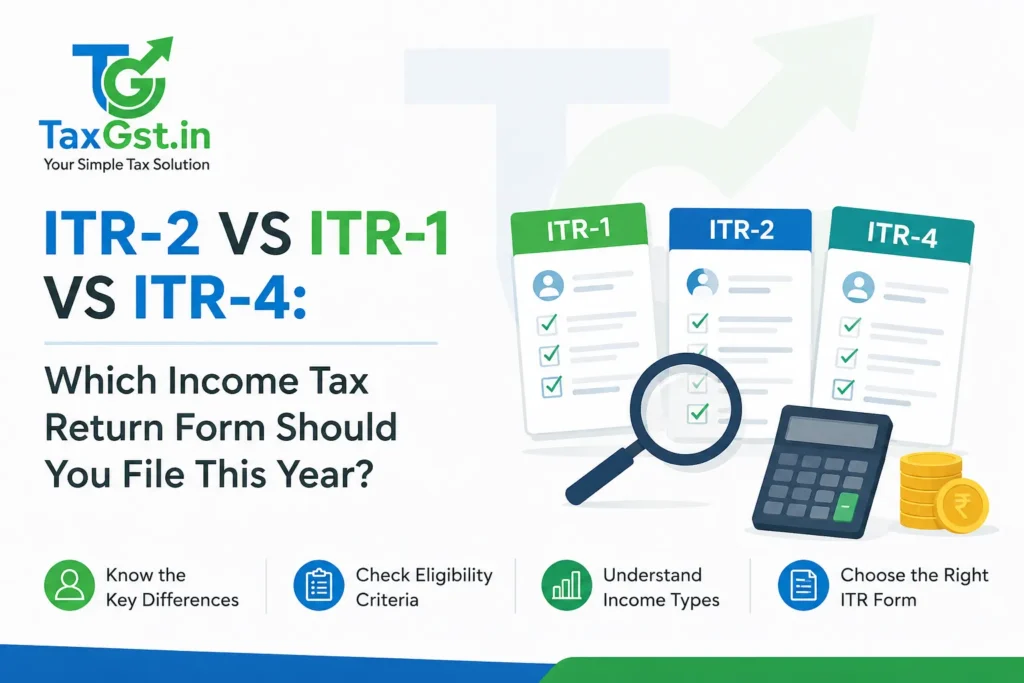
You have very few days left to comply with this crucial requirement for most individual taxpayers. The due date for filing your Income Tax Return (ITR) for Assessment Year 2026-27 (Financial Year 2025-26) for non-audit cases is July 31, 2026, or August 31, 2026, as per the due dates specified for AY 2026-27. Miss this deadline, and you could face a late fee of ₹5,000 (or ₹1,000 if your total income is up to ₹5 lakh) under Section 234F, along with interest under Section 234A of the Income-tax Act, 1961, at 1% per month on unpaid tax, as outlined for filing after the due date but before December 31, 2026. Choosing the correct ITR form is the very first, and arguably most critical, step in ensuring a smooth tax filing process.
Filing an incorrect form can lead to your return being treated as defective under Section 139(9) of the Income-tax Act, 1961, potentially leading to further complications and delays. This guide will walk you through the essential considerations for selecting between ITR-1, ITR-2, and ITR-4 for AY 2026-27.
Confused About Choosing the Right ITR Form?
Filing an incorrect form can lead to your return being flagged as defective under Section 139(9). Avoid automated direct tax notices or processing delays with an accurate financial review.
Quick Summary: Which ITR Form is For You?
The Income Tax Department has notified seven ITR forms for AY 2026-27 (corresponding to Financial Year 2025-26), each tailored to specific taxpayer categories. Here’s a quick decision tree to help you identify the primary forms discussed:
(Source: TaxGuru – ITR Forms for AY 2026-27; Income Tax Department – Returns and Forms Applicable to Individual having Income from Business / Profession)
Master Comparison Table: ITR-1 vs ITR-2 vs ITR-4
To quickly evaluate the legal differences, maximum criteria limits, and explicit exclusions across the most common forms, review this comprehensive comparative breakdown:
| Feature / Criteria | ITR-1 (Sahaj) | ITR-2 | ITR-4 (Sugam) |
|---|---|---|---|
| Income Limit | Up to ₹50 Lakh | No Upper Limit | Up to ₹50 Lakh |
| Business/Profession Income | No | No | Yes (Presumptive Only u/s 44AD, 44ADA, 44AE) |
| House Properties Allowed | Exactly One Property | Multiple Properties | Exactly One Property |
| Capital Gains Reporting | LTCG u/s 112A up to ₹1.25L only | Yes (Full details allowed) | LTCG u/s 112A up to ₹1.25L only |
| Foreign Assets (Schedule FA) | No | Yes (Mandatory disclosure) | No |
| Residential Status | Resident Only | Resident / RNOR / NRI | Resident Only |
1. Before You Start Filing: Essential Preparations
Before you even select an ITR form, gather and reconcile your financial data. This proactive step can prevent common errors and ensure accurate reporting.
Required Documents Checklist
- Permanent Account Number (PAN) and Aadhaar Number: Mandatory for filing.
- Form 16: Issued by your employer, detailing salary income and TDS.
- Form 16A/16B/16C/16D: For TDS on income other than salary (e.g., interest, rent, property sale).
2. Gathering Your Documents: A Deeper Dive
Beyond the basic Form 16 and PAN, a comprehensive set of documents ensures you capture all income and deductions accurately, preventing future discrepancies. This meticulous approach is especially vital given the expanded scope of information collected by the Income Tax Department through the Annual Information Statement (AIS) and Taxpayer Information Summary (TIS).
Key Documents to Have Ready
Required Documents List:
- Form 26AS: Your consolidated tax statement, showing all tax deducted/collected at source and advance tax paid. Access this on the e-filing portal.
- Annual Information Statement (AIS) & Taxpayer Information Summary (TIS): These provide a comprehensive view of your financial transactions during the year, including interest, dividends, mutual fund transactions, and more. Reconcile these carefully with your own records.
- Bank Statements/Interest Certificates: For interest income from savings accounts, fixed deposits, and recurring deposits.
- Dividend Income Statements: From companies or mutual funds.
- Capital Gains Statements: From brokers or mutual fund houses, detailing sales of shares, mutual funds, or property. This is crucial for ITR-2 filers.
- Rent Receipts/Agreement: If you claim HRA exemption (under the old regime) or have rental income from property.
- Loan Statements: For home loan interest (Section 24(b)) or education loan interest (Section 80E), if opting for the old tax regime.
- Investment Proofs: For deductions under Chapter VI-A (e.g., Section 80C, 80D, 80G) if you are choosing the old tax regime.
- Aadhaar Card: For linking with PAN, if not already done.
- Details of all Bank Accounts: Including dormant ones, held in India at any time during the previous year, as required in ITR forms (e.g., ITR-4, Part A-General Information, D21).
Understanding the Paradigm Shift: Income-tax Act, 1961 vs. 2025
Taxpayers filing returns in mid-2026 face a unique legal transition. On April 1, 2026, the newly enacted Income-tax Act, 2025 officially replaced the legacy 1961 framework, systematically shrinking direct tax rules from 819 clauses down to 536 streamlined sections. However, because tax returns are filed retrospectively, your return for AY 2026-27 (covering income earned in FY 2025-26) is still processed under the provisions of the old Income-tax Act, 1961.
A significant structural reform introduced by the 2025 Act is the absolute elimination of the dual “Previous Year” and “Assessment Year” terminology. Moving forward into upcoming cycles, filings will be tracked under a single “Tax Year” timeline. For this current cycle, ensure you match your exemptions against the 1961 Act parameters to clear processing blocks.
3. Deciphering ITR-1, ITR-2, and ITR-4 Eligibility
The core of correct filing lies in choosing the right form. Here’s a detailed breakdown of who can and cannot use ITR-1 (Sahaj), ITR-2, and ITR-4 (Sugam) for Assessment Year 2026-27, as per the Income-tax Rules.
ITR-1 (Sahaj): The Simplest Form
ITR-1 is designed for the most straightforward taxpayers.
- Who Must Use It: Resident individuals (other than not ordinarily resident) having total income up to ₹50 lakh from:
- Income from Salaries/Pension.
- Income from one House Property.
- Income from Other Sources (e.g., interest, family pension, dividend).
- Long-term capital gains under Section 112A up to ₹1.25 lakh.
- Agricultural income up to ₹5,000.
- Who Cannot Use It: As per the Income-tax Rules, you cannot file ITR-1 if you are:
- A Non-Resident (NRI) or Resident Not Ordinarily Resident (RNOR).
- A Director in a company.
- Have invested in unlisted equity shares.
- Have income from business or profession.
- Have agricultural income exceeding ₹5,000.
- Have assets (including financial interest in any entity) located outside India.
- Have income-tax deferred on ESOPs.
- Have TDS deducted under Section 194N.
- Have total income exceeding ₹50 lakh.
- Have income from more than one house property.
- Have carry-forward losses from previous years.
- Have capital gains other than long-term capital gains under Section 112A up to ₹1.25 lakh.
ITR-4 (Sugam): For Presumptive Business/Profession
ITR-4 is a simplified form for small businesses and professionals opting for presumptive taxation.
- Who Must Use It: Individuals, Hindu Undivided Families (HUFs), and Firms (other than Limited Liability Partnerships – LLPs) being a resident, having total income up to ₹50 lakh, and having income from business and profession computed under Section 44AD, Section 44ADA, or Section 44AE of the Income-tax Act, 1961. It also covers long-term capital gains under Section 112A up to ₹1.25 lakh, as per the Income-tax Rules. This form can also be used if you have salary/pension, one house property, other sources (interest, dividend, family pension), and agricultural income up to ₹5,000.
- Who Cannot Use It: As per the Income-tax Rules, you cannot file ITR-4 if you are:
- A Non-Resident (NRI) or Resident Not Ordinarily Resident (RNOR).
- A Director in a company.
- Have invested in unlisted equity shares.
- Have agricultural income more than ₹5,000.
- Have assets (including financial interest in any entity) located outside India.
- Have income-tax deferred on ESOPs.
- Have total income exceeding ₹50 lakh.
- Have income from more than two house properties.
- Do not opt for presumptive taxation under Section 44AD, 44ADA, or 44AE (i.e., maintaining regular books of accounts and claiming actual expenses).
- An LLP.
- Have income taxable at special rates (e.g., winnings from lottery, racehorses).
- Have short-term capital gains or long-term capital gains other than those under Section 112A up to ₹1.25 lakh.
- Have carry-forward losses.
ITR-2: For Individuals/HUFs without Business/Profession Income (but more complex cases)
ITR-2 is the default choice for individuals and HUFs who do not have business or professional income but have more complex income structures than allowed in ITR-1.
- Who Must Use It: Individuals and HUFs who are NOT eligible to file ITR-1 or ITR-4, and do NOT have income from profits and gains of business or profession. This includes:
- Income from salary/pension.
- Income from more than one house property.
- Capital gains (short-term or long-term, including those from shares, mutual funds, or property). Note that Schedule CG in ITR-2 now separately captures LTCG on listed equity shares/equity mutual funds exempt up to ₹1,25,000 (taxable at 12.5% above threshold) and STCG on listed equity/equity MF now at 20% (increased from 15%, effective 23 July 2024).
- Income from Other Sources (e.g., interest, dividend, lottery winnings, income from racehorses).
- Foreign income or foreign assets (Schedule FA and Schedule FSI have been expanded).
- Being a Director in a company.
- Having invested in unlisted equity shares.
- Being a Non-Resident (NRI) or Resident Not Ordinarily Resident (RNOR).
- Agricultural income exceeding ₹5,000.
- Total income exceeding ₹50 lakh.
- Who Cannot Use It: Individuals or HUFs having income from profits and gains of business or profession. Such taxpayers must use ITR-3 or ITR-4.
Crucial Foreign Asset Reporting Alert: The FAST-DS 2026 Relief
For taxpayers required to use ITR-2 due to foreign holdings, Schedule FA demands complete disclosure of global assets, including overseas tech stock options (ESOPs) or foreign bank accounts. Under old assessment setups, minor errors or unintentional omissions of global fractional stocks routinely triggered draconian penalties under the Black Money Act.
To resolve this, the government introduced the Foreign Assets of Small Taxpayers Disclosure Scheme, 2026 (FAST-DS 2026). This system grants a critical amnesty window to small retail investors. If the aggregate value of your undisclosed foreign equity holdings or fractional shares remains under ₹20 Lakh, the budget provides absolute immunity from criminal prosecution and severe structural penalties, simplifying reconciliation during the current return cycle.
Next Steps Checklist
Once you’ve identified your correct ITR form, follow these steps to ensure a smooth filing experience:
- Finalize Your Tax Regime Choice: Decide between the Old and New Tax Regimes. If you have business income and wish to opt for the Old Regime, ensure Form 10-IEA is filed by the due date under Section 139(1). For non-business income, the option can be exercised directly in the ITR.
- Reconcile All Financial Data: Cross-verify Form 26AS, AIS, TIS, Form 16/16A, and your personal records for all income and TDS entries. Address any discrepancies immediately with the deductor or by updating your records.
- Gather All Supporting Documents: Ensure you have all proofs for income, deductions, and exemptions readily available. This includes bank statements, investment proofs, capital gains statements, and rent receipts.
- Accurately Fill the ITR Form: Use the e-filing portal’s online utility or download the offline utility to meticulously fill in all relevant schedules. Pay close attention to new disclosures like expanded capital gains reporting in ITR-2/3 or GST turnover details in ITR-4.
- Calculate Your Tax Liability: Ensure your tax calculation is correct, including any advance tax paid, self-assessment tax, and interest under Section 234A, 234B, or 234C.
- Submit and E-Verify: File your return electronically and then e-verify it within 30 days of filing. Without e-verification, your return is not considered valid.
Common Pitfalls to Avoid
Based on our experience, here are the mistakes taxpayers often make:
- The “Previous Employer” Trap – If you change jobs mid-year, Form 12B must be filed with your NEW employer to ensure they carry forward your previous salary details into the final consolidated Form 16. Without this, your Form 16 will only show half the story, leading to a massive tax demand when you file your return.
- Missing the deadline – Always file or respond before the due date. Late submissions often have limited recourse and attract penalty fees under Section 234F.
- Incomplete documentation – Ensure you have all required documents ready before filing or responding to notices.
Frequently Asked Questions
How do I choose between the Old and New Tax Regimes, especially if I have business income?
For individuals and HUFs without business income, the option to choose between the Old and New Tax Regimes can be exercised every year directly in the ITR form itself, provided the return is filed on or before the due date specified under Section 139(1) of the Income-tax Act, 1961. The New Tax Regime under Section 115BAC(1A) is the default regime.
For eligible taxpayers having income from business or profession, if you wish to opt out of the default New Tax Regime and choose the Old Tax Regime, you must furnish Form 10-IEA on or before the due date under Section 139(1) for furnishing the return of income. Once this option is exercised, it remains applicable for subsequent assessment years. If you wish to re-enter the New Tax Regime, you must again furnish Form 10-IEA on or before the due date under Section 139(1).
What happens if I file the wrong ITR form?
Filing the incorrect form (such as using ITR-1 when you have business income) will result in your return being flagged as “Defective” under Section 139(9). You will receive a notice from the tax department giving you 15 days to rectify the error by filing the correct form. If you fail to do so, your return is treated as invalid, leading to penalties and interest.
Do I need to report dividend income if it’s below ₹5,000?
Yes. Dividend income is fully taxable in the hands of the investor, regardless of the amount. Even if it is a minor sum and no TDS was deducted, it must be declared under the “Income from Other Sources” schedule in your ITR.
Which form should I use if I traded in Cryptocurrencies or Virtual Digital Assets (VDAs)?
Any income generated from the transfer of Virtual Digital Assets (such as cryptocurrencies or NFTs) must be reported using **ITR-2** or **ITR-3**. The simplified ITR-1 or ITR-4 cannot be used for declaring VDA transactions. VDA income is taxed at a flat 30% under Section 115BBH.
I have agricultural income of ₹10,000. Can I use ITR-1?
No. The ITR-1 (Sahaj) form only permits the declaration of agricultural income up to a maximum limit of ₹5,000. If your agricultural income exceeds this threshold, you are legally required to file using **ITR-2**.
Can a Non-Resident Indian (NRI) file ITR-1?
No, Non-Resident Indians (NRIs) and Resident Not Ordinarily Residents (RNORs) are explicitly barred from filing ITR-1. They must use **ITR-2** (or ITR-3 if they have business income in India) to report their Indian-sourced income.
What is the late fee structure if I need to file a revised return?
Under the updated procedural fee structures, taxpayers can submit a revised return completely free of charge up to 31st December 2026. If you require error corrections after December but before the final 31st March 2027 closing window, the new Section 234I rule levies a fixed fee of ₹5,000 (reduced to ₹1,000 if your net taxable income is below ₹5 Lakh).
Article Information
Published: May 30, 2026
Last Reviewed: May 30, 2026
Category: Income Tax
Regulatory Body: CBDT (Central Board of Direct Taxes)
Written by C.K. Gupta, M.Com & Tax Editor at TaxGST.in — helping 500+ clients navigate IT notices, GST audits, and ITR filings across Delhi NCR since 2009.
Official Resources
Disclaimer: This article is for informational purposes only. For legal advice, consult a qualified tax professional. Always refer to the original source document for authoritative information.
Discover more from TaxGst.in
Subscribe to get the latest posts sent to your email.

Never Miss a Tax Deadline Again
Due-date alerts, GST updates and tax tips — free on the app you already use.
event Next: GSTR-1 (IFF) · 13 Oct