
 C.K. Gupta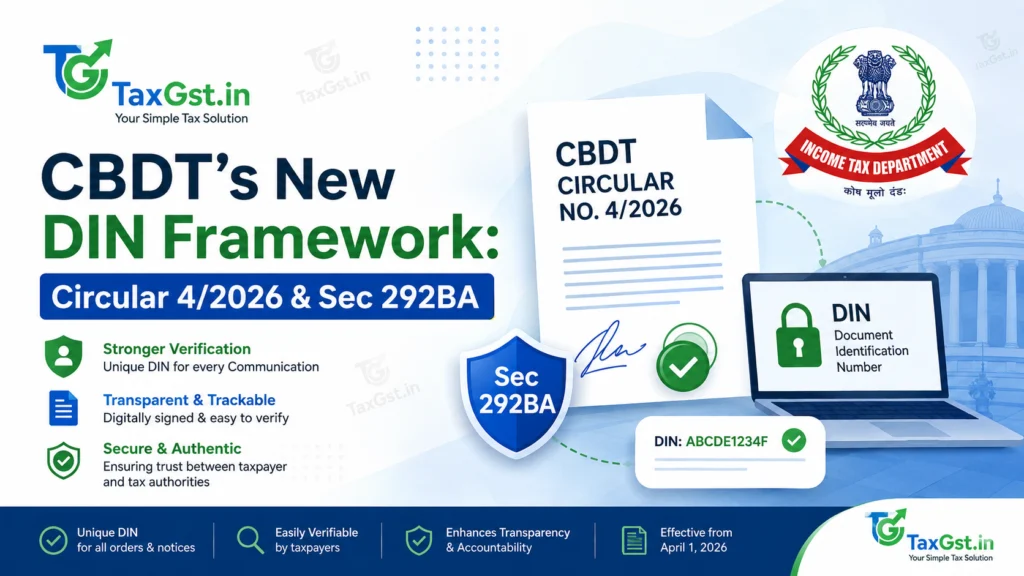
The CBDT has overhauled the DIN framework through Circular No. 4/2026 dated 31st March 2026, which supersedes Circular No. 19/2019. Under the revised framework, every notice, order, summons, letter, or correspondence issued by an income-tax authority referred to in clauses (aa) to (h) of section 116 of the Income-tax Act, 1961 must be referenced by a computer-generated Document Identification Number. Critically, the DIN need not appear in the body of the communication itself, but can be referenced in any manner, such as in an attachment or email correspondence. The Finance Act 2026 has simultaneously inserted section 292BA into the Income-tax Act, 1961, clarifying that no assessment shall be invalid merely because of a mistake, defect, or omission in quoting the DIN, provided the assessment order is referenced by such number in any manner.
Also Read – EPS 2026: EPS 1995 and EFPS 1971 Beneficiaries Will Keep Receiving Pension Under New Scheme
Quick Summary
- Circular No. 4/2026 dated 31st March 2026 supersedes Circular No. 19/2019 with effect from its date of issue.
- DIN referencing can be in the body, a separate attachment, email correspondence, or any other manner — every page need not carry it.
- Public communications such as guidelines and FAQs are explicitly exempt from the DIN requirement.
- Section 292BA, inserted by the Finance Act 2026 with retrospective effect from 1st October 2019, protects assessment orders from being voided due to DIN defects.
- Communications issued without DIN in exceptional situations require post-facto approval from a competent authority within 15 days and must be uploaded with DIN within 15 working days for specified categories.
What is the Document Identification Number Requirement Under CBDT Circular No. 4/2026?
The revised DIN framework mandates that any communication — including notices, letters, orders, draft orders, and summons — issued by an income-tax authority referred to in clauses (aa) to (h) of section 116 of the Income-tax Act, 1961 must be referenced by a computer-generated Document Identification Number. This requirement applies to communications issued to any person who is not an officer or authority under the Income-tax Act or any other law.
Critically, Circular No. 4/2026 relaxes the manner of referencing. As per paragraph 2(b) of the circular, referencing by DIN includes mentioning the DIN in the communication itself, attaching a separate document that mentions the DIN, referencing it in email correspondence, or any other manner. Paragraph 2(c) further clarifies that where a communication is referenced by DIN in any manner, it is not required that every page of that communication also carries the DIN. This is a significant departure from the earlier regime.
Public communications — such as guidelines, frequently asked questions, and similar generic communications — are explicitly exempt from the DIN requirement under paragraph 2(d) of Circular No. 4/2026. The circular also preserves an exception mechanism for situations where referencing by DIN is not possible, such as technical difficulties, field situations where the officer is outside the office, delays in PAN migration, non-availability of PAN, or non-availability of system functionality.
How Does the New DIN Framework Differ From the Earlier Circular No. 19/2019 Regime?
The earlier Circular No. 19/2019 dated 14th August 2019 took a stricter approach. It mandated that DIN be “duly quoted in the body of such communication” and treated any communication not conforming to this requirement as invalid and deemed never to have been issued. This rigidity led to several High Court assessments being annulled on technical grounds — such as DIN not appearing on every page or not in the body — even where the DIN was lawfully generated and referenced elsewhere.
Circular No. 4/2026 shifts the focus from form to substance. The new test is whether the communication is “referenced by DIN in any manner,” not whether it appears in a specific location. This administrative shift is backed by the statutory insertion of section 292BA through the Finance Act 2026, which clarifies that no assessment shall be invalid on the ground of any mistake, defect, or omission in quoting DIN if the assessment order is referenced by such number in any manner. Notably, this amendment applies retrospectively from 1st October 2019.
However, Circular No. 4/2026 itself is not retrospective — it supersedes Circular No. 19/2019 only from 31st March 2026. For communications issued before this date, the stricter regime of Circular No. 19/2019 continues to apply as the governing administrative framework at the time of issuance. A parallel amendment to section 522 of the Income-tax Act, 2025 takes effect from 1st April 2026, ensuring consistent interpretation across both tax codes.
When Can an Income-Tax Authority Issue Communication Without DIN?
Circular No. 4/2026 recognizes that genuine operational situations exist where referencing a communication with DIN at the time of issuance is not feasible. Paragraph 3 of the circular enumerates five exceptional situations where communication may be issued without DIN reference, subject to strict procedural safeguards being followed by the issuing authority.
These exceptional situations include: (a) technical difficulties in referencing DIN or in electronic issuance; (b) field situations where the income-tax authority is outside the office and needs to issue enquiry or verification communication for discharging official duties; (c) delays in PAN migration causing PAN to remain with a non-jurisdictional Assessing Officer; (d) non-availability of the assessee’s PAN; and (e) non-availability of system functionality to issue the communication. In all such cases, the communication must explicitly state that it is being issued without DIN due to the specified exceptional situation, as per paragraph 4 of Circular No. 4/2026.
Paragraph 4 further mandates that every communication issued without DIN requires post-facto approval from a competent authority within 15 days of issuance, based on reasons recorded in writing by the issuing authority. For authorities below the rank of Joint Commissioner or Joint Director, the competent authority is the Joint Commissioner, Joint Director, Additional Commissioner, or Additional Director of Income-tax. For all other cases, the competent authority is the Chief Commissioner or Director General of Income-tax, as specified in paragraph 5 of the circular.
Comparison: DIN Framework Under Circular No. 19/2019 vs Circular No. 4/2026
| Aspect | Circular No. 19/2019 | Circular No. 4/2026 |
|---|---|---|
| Manner of DIN referencing | DIN must be quoted in the body of the communication | DIN may be referenced in any manner — body, attachment, email, or otherwise |
| Every page requirement | DIN required on every page (as interpreted by courts) | Every page need not carry DIN if referenced in any manner |
| Public communications | Not specifically addressed | Explicitly exempt from DIN requirement |
| Approval for manual communication | Prior written approval of Chief Commissioner / DGIT required | Post-facto approval within 15 days from competent authority |
| Regularization of manual communications | Within 15 working days for specified categories | Within 15 working days for para 3(a), 3(b) and 3(c) situations |
| Consequence of non-compliance | Treated as invalid and deemed never issued | Governed by Section 292BA for assessment orders |
Practical Example: Field Enquiry Notice Issued Without DIN
Consider an income-tax inspector conducting a survey under Section 133A of the Income-tax Act, 1961 at a business premises in a remote location. The inspector issues a letter requiring the taxpayer to produce books of account and documents, but due to a lack of network connectivity, the system cannot generate a DIN at that moment. Under paragraph 3(b) of Circular No. 4/2026, this qualifies as an exceptional situation where access to electronic means for referencing DIN is not possible.
The inspector issues the letter manually, clearly stating on the letter: “This communication is issued manually without DIN due to field situation — access to electronic means not available at survey location.” Within 15 days of returning to the office, the inspector records reasons in writing and obtains post-facto approval from the Joint Commissioner. Subsequently, within 15 working days, the letter is uploaded on the system with appropriate DIN referencing. Had this same situation arisen before 31st March 2026, the stricter regime of Circular No. 19/2019 would have applied, requiring prior approval and treating any deviation as rendering the communication invalid.
What Should You Do If You Receive an Income Tax Notice Without a DIN?
When you receive any communication from the Income Tax Department, the first step is to verify whether it carries a Document Identification Number or is referenced by one in any manner. Under paragraph 2(b) of Circular No. 4/2026, referencing includes mention in the body, a separate attachment, an accompanying email, or any other manner. Check the covering letter, the email through which the document was received, and any annexures attached to the communication.
If the communication is issued without a DIN, check whether it explicitly states the exceptional reason for doing so. Paragraph 4 of Circular No. 4/2026 mandates that every communication issued without DIN must state that it is issued without DIN in view of the specified exceptional situation. If this statement is absent and no DIN reference exists anywhere, the communication may be treated as non-conforming with the prescribed framework.
For communications received on or after 31st March 2026, the relaxed standard of Circular No. 4/2026 applies — meaning the DIN need only be referenced in any manner, not necessarily in the body. However, for communications issued between 1st October 2019 and 30th March 2026, the stricter regime of Circular No. 19/2019 governed at the time of issuance. If you are challenging a pre-March 2026 communication on DIN grounds, the applicable benchmark is whether DIN was quoted in the body of that communication as required by the 2019 circular.
If you believe a communication has been issued without proper DIN and without valid exceptional circumstances, you can raise this objection before the assessing officer or the relevant appellate authority. Document your objection in writing and retain proof of submission for future reference.
How Does Section 292BA Affect Communications Other Than Assessment Orders?
Section 292BA, inserted by the Finance Act 2026 with retrospective effect from 1st October 2019, provides protection only for assessment orders. The statutory language is specific: “no assessment under any of the provisions of this Act shall be invalid or shall be deemed to have been invalid on the ground of any mistake, defect or omission in respect of quoting of a computer generated Document Identification Number, if the assessment order is referenced by such number in any manner.” This protection does not automatically extend to other communications such as penalty notices, summons, approval letters, sanction orders, or demand notices.
This distinction is critical for taxpayers with pending litigation. If a penalty notice, a summons, or a show-cause notice was issued without proper DIN referencing before 31st March 2026, the stricter requirements of Circular No. 19/2019 would apply. Under that circular, any communication not conforming to the DIN requirement was treated as invalid and deemed never issued. The retrospective amendment through Section 292BA does not independently validate such non-assessment communications.
The Notes on Clauses to the Finance Bill 2026 clarify that the amendment aims to cure defects “in respect of quoting” a DIN where the assessment order is nonetheless referenced by such number in any manner. This means the Department must still demonstrate that some DIN reference exists — whether in the order itself, a covering communication, or the system records. If the Revenue cannot produce any DIN reference at all, the statutory condition under Section 292BA may fail on facts, even for assessment orders.
For non-assessment communications, the absence of any DIN reference remains a stronger ground for challenge. In practical terms, taxpayers should not assume that Section 292BA is a blanket cure for all DIN-related defects. The amendment narrows the scope of challenge for assessment orders where DIN exists somewhere in the communication chain, but it does not eliminate the DIN requirement altogether.
What Are the Limitations of Section 292BA’s Retrospective Protection?
Section 292BA provides that no assessment shall be invalid on the ground of any mistake, defect, or omission in quoting a computer-generated DIN — but only if the assessment order is “referenced by such number in any manner.” This statutory protection, while significant, is narrower than it appears at first reading.
The amendment cures only defects “in respect of quoting” a DIN. It does not validate a complete absence of DIN reference. If the Revenue cannot produce a DIN-bearing covering email, a DIN-bearing attachment, a system-generated communication trail, or an upload and regularisation record, the statutory condition fails. The amendment is a shield against imperfect display, not against total non-reference.
Further, Section 292BA applies only to “assessment” orders. It does not extend to notices under Section 148, Section 148A(b), Section 148A(d) orders, penalty notices under Section 271, penalty orders, show-cause notices, approval or sanction communications, or demand notices under Section 156. A notice issued under Section 148 without any DIN reference remains vulnerable to challenge independent of Section 292BA.
What Section 292BA Covers vs. What It Does Not Cover
| Covered by Section 292BA | Not Covered by Section 292BA |
|---|---|
| Final assessment orders under Section 143(3), 144, 147, or 153A where DIN is referenced in any manner | Notice under Section 148 (reassessment initiation) |
| Rectification orders under Section 154 where DIN defect is only in quoting manner | Order under Section 148A(d) for formation of belief |
| Assessment orders where DIN appears in attachment or email but not in body | Penalty notice under Section 271(1)(c) or penalty order |
| Assessment orders issued between 01.10.2019 and 31.03.2026 with DIN referenced in any manner (retrospective protection) | Show-cause notices, approval communications, demand notices |
How Should Taxpayers Evaluate a Communication That Lacks DIN or Has a DIN Defect?
When a taxpayer receives a communication from the Income-tax Department, the first step is to examine whether a DIN is referenced anywhere — in the body, in a separate attachment, in the covering email, or in any accompanying document. Circular No. 4/2026 treats all these modes as valid referencing. If a DIN is found in any form, the communication is generally compliant for assessment orders, and Section 292BA provides additional statutory protection against technical challenges.
If no DIN is referenced at all, the next step is to check whether the communication falls within the exceptional situations enumerated in paragraph 3 of Circular No. 4/2026. The communication must explicitly state that it is issued without DIN due to the exceptional situation. If this disclosure is absent, the communication is prima facie non-compliant.
Worked Example: Penalty Notice Issued Without DIN After 31st March 2026
Consider a case where the Assessing Officer issues a penalty notice under Section 274 read with Section 271(1)(c) of the Income-tax Act, 1961 on 15th April 2026. The notice does not carry a DIN in the body, no separate attachment mentions a DIN, and the email transmitting the notice also contains no DIN reference. The notice does not state any exceptional situation for issuing without DIN.
In this scenario, the taxpayer has strong grounds to challenge the validity of the penalty notice. First, the communication was issued after 31st March 2026, so Circular No. 4/2026 governs the issuance. Second, no DIN is referenced in any manner. Third, the exceptional situation disclosure required under paragraph 4 is absent. Fourth, Section 292BA does not apply because this is a penalty notice, not an assessment order. The notice is therefore non-compliant with the mandatory DIN framework and the taxpayer can raise this jurisdictional defect before the assessing authority and appellate tribunal.
What Should You Do Next?
- Verify the DIN on every communication you receive from the Income Tax Department — check the body, any separate attachment, or the accompanying email correspondence.
- For communications issued before 31st March 2026, confirm whether DIN was quoted in the body as required under the stricter Circular No. 19/2019 regime.
- If a communication lacks DIN, check whether it explicitly states the exceptional reason for issuance without DIN.
- For assessment orders received, confirm that the order is referenced by DIN in any manner to ensure protection under section 292BA.
- Maintain an organized record of all DIN-referenced communications, including screenshots of email correspondences and attached DIN documents.
Frequently Asked Questions
Is a notice invalid if the DIN is not mentioned in the body of the communication?
Under Circular No. 4/2026, a notice is not invalid solely because DIN does not appear in the body. As per paragraph 2(b), referencing by DIN includes mention in a separate attachment or email correspondence. However, for communications issued before 31st March 2026, Circular No. 19/2019 governed and required DIN to be quoted in the body.
What happens if an income-tax authority issues a communication without DIN?
The communication must explicitly state that it is issued without DIN due to an exceptional situation. The issuing authority must obtain post-facto approval from the competent authority within 15 days, based on reasons recorded in writing. The communication must also be uploaded on the System with appropriate DIN referencing within 15 working days.
Does Section 292BA protect all types of communications from being invalidated due to DIN defects?
No. Section 292BA, inserted by the Finance Act 2026, specifically protects assessment orders. It does not extend this protection to notices, summons, penalty proceedings, or other non-assessment communications, which remain subject to the general validity requirements under the applicable circular.
Are public communications from the Income Tax Department required to carry a DIN?
No. As per paragraph 2(d) of Circular No. 4/2026, public communications — such as guidelines, frequently asked questions, and similar generic communications — are explicitly exempt from the DIN requirement.
How should a taxpayer verify whether a DIN quoted on a notice or order is genuine?
The Income Tax Department has provided a verification utility on the official e-filing portal where taxpayers can enter the DIN mentioned on a communication and confirm its authenticity against departmental records. If the DIN does not verify, the taxpayer should bring this to the notice of the assessing officer.
Article Information
Published: August 8, 2026
Last Reviewed: August 8, 2026
Category: Income Tax & CBDT Compliance
Regulatory Body: CBDT (Central Board of Direct Taxes)
Written by C.K. Gupta, M.Com & Tax Editor at TaxGST.in — helping professionals navigate IT notices, tax litigation, and CBDT compliance updates across India since 2009.
Official Resources
Disclaimer: This article is for informational purposes only and does not constitute legal counsel. Tax litigation is highly fact-specific. Always consult a qualified Chartered Accountant or tax attorney before challenging the jurisdictional validity of an Income Tax notice.
Try the free income tax calculator for instant figures.
ITR, GST returns, notices and registrations — fixed fees, human support, on-time filing.
Discover more from TaxGst.in
Subscribe to get the latest posts sent to your email.


Never Miss a Tax Deadline Again
Due-date alerts, GST updates and tax tips — free on the app you already use.
event Next: GSTR-1 (IFF) · 13 Oct