
 C.K. Gupta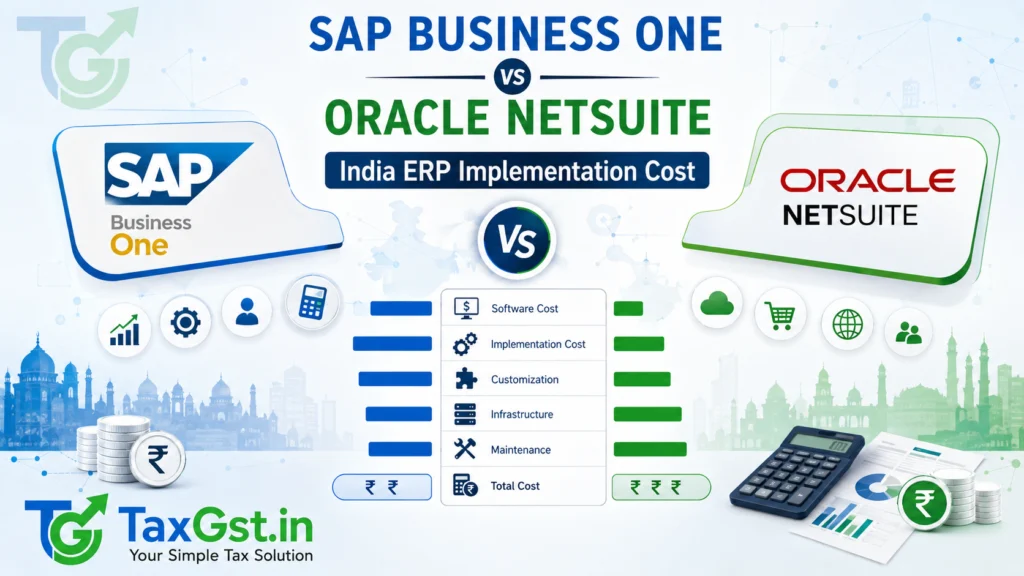
SAP Business One is purpose-built for Indian SMEs with lower upfront implementation costs and simpler compliance workflows, while Oracle NetSuite targets mid-market and enterprise businesses requiring multi-subsidiary consolidation and advanced global compliance — making the choice dependent on your company’s scale, complexity, and MCA audit trail obligations under the Companies (Accounts) Amendment Rules, 2021.
Also Read- Marg ERP vs Vyapar: Inventory + Billing Software for Retail MSMEs
Quick Summary
- SAP Business One typically suits small and medium enterprises with straightforward statutory reporting requirements under the Companies Act, 2013.
- Oracle NetSuite is positioned as a unified cloud ERP for businesses requiring multi-GSTIN consolidation and real-time compliance tracking.
- Both platforms satisfy the mandatory audit trail requirement under Rule 3(1) of the Companies (Accounts) Rules, 2014 as amended in 2021 (effective from April 1, 2023).
- Implementation cost varies significantly based on user count, module selection, and the need to comply with Rule 46(8) of the Income-tax Rules, 2026, which mandates daily backups of electronic books of account on servers physically located in India (effective from April 1, 2026).
- MCA annual filing forms such as AOC-4 and MGT-7 require accurate financial data extraction — your ERP must support seamless statutory reporting, including the new reporting requirements for electronic books under the tax audit report (Form 3CD/Form 26) applicable from Assessment Year 2027-28.
What Makes SAP Business One a Preferred ERP for Indian SME Compliance?
SAP Business One has established itself as a practical compliance backbone for small and medium enterprises registered under the Companies Act, 2013. The platform addresses the core statutory requirement under Section 128(5) of the Companies Act, which mandates that books of accounts be retained for not less than eight financial years. With the Companies (Accounts) Amendment Rules, 2021 coming into effect from April 1, 2023, every company using accounting software must ensure the software records an audit trail of each transaction and creates an edit log of every change — a requirement SAP Business One satisfies through its built-in audit trail feature.
For Indian private limited companies and OPCs filing Form AOC-4 annually on the MCA V3 portal, SAP Business One provides structured financial statements that map to the required schedules. The platform supports Indian statutory requirements including GST return data, TDS computation, and depreciation as per the Companies Act.
When a company’s small company status changes — thresholds revised to paid-up capital of ₹10 crore and turnover of ₹100 crore as per the Companies (Amendment) Act, 2021 — the ERP must adapt its reporting accordingly. SAP Business One handles this transition without requiring a system overhaul, which is critical when a company shifts from filing Form MGT-7A to Form MGT-7 or vice versa.
Why Do Mid-Market Companies Choose Oracle NetSuite Over Traditional ERPs?
Oracle NetSuite positions itself as the leading cloud ERP for businesses that have outgrown standalone accounting tools and require a unified platform spanning finance, inventory, CRM, and compliance. For Indian companies with multiple GST registrations across states, NetSuite offers real-time consolidation that simplifies the preparation of consolidated financial statements required under Schedule III of the Companies Act, 2013. This becomes particularly relevant when a company must file Form AOC-4 with consolidated figures and the auditor needs to verify inter-branch transactions through a reliable audit trail.
The platform addresses Rule 46(8) of the Income-tax Rules, 2026, which requires that books of account maintained in electronic mode remain accessible in India at all times and that daily backups be kept on servers physically located in India. NetSuite’s data center infrastructure and backup protocols are designed to meet this requirement, providing the documentation a tax auditor needs when reporting on electronic books and server location under the new tax audit report applicable from Assessment Year 2027-28.
For companies undergoing cost audit under Section 148(3) of the Companies Act, 2013 and filing Form CRA-2 for cost auditor appointment, NetSuite’s ability to generate granular cost records by product line and service category simplifies the entire cost audit workflow.
How Do Implementation Costs Compare Between SAP Business One and Oracle NetSuite for Indian Companies?
The total cost of ownership diverges sharply between the two platforms once you factor in MCA compliance requirements, statutory reporting complexity, and the data localization mandate under Rule 46(8) of the Income-tax Rules, 2026. SAP Business One follows a perpetual licensing model with lower entry costs, making it attractive for companies with straightforward AOC-4 and MGT-7 filing obligations. Oracle NetSuite operates on a subscription model with higher per-user monthly charges but eliminates the need for separate infrastructure to maintain the audit trail accessibility required under Rule 3(1) of the Companies (Accounts) Rules, 2014.
For companies required to retain books of account for eight financial years under Section 128(5) of the Companies Act, 2013, the long-term storage and retrieval costs differ significantly. SAP Business One deployments often require on-premise server infrastructure or third-party hosting within India to satisfy the server location requirement, adding to capital expenditure. NetSuite’s cloud-native architecture includes India-based data center options as part of its subscription, reducing the compliance burden but increasing recurring operational expenditure.
| Parameter | SAP Business One | Oracle NetSuite |
|---|---|---|
| Licensing Model | Perpetual license (one-time) + annual maintenance | Monthly/annual subscription per user |
| Typical Implementation Duration | 8–14 weeks for single-entity Indian SME | 12–20 weeks for multi-subsidiary setup |
| Audit Trail Compliance (Rule 3(1), Companies Accounts Rules 2014) | Built-in; requires on-premise or India-hosted deployment | Built-in; cloud infrastructure with India data residency |
| Server Location Compliance (Rule 46(8), Income-tax Rules 2026) | Customer-managed; backup server must be physically in India. | Included in subscription with India data center option |
| MCA Form AOC-4 Data Extraction | Standard Indian statutory templates available | Customizable reporting; native consolidation across entities |
| Cost Audit Readiness (Section 148(3), Companies Act 2013) | Requires customization for granular cost records | Native multi-dimensional cost tracking by product/service |
| Estimated First-Year Cost (5 users, single entity) | ₹4,00,000 – ₹8,00,000 (license + implementation) | ₹6,00,000 – ₹12,00,000 (subscription + implementation) |
Consider a practical example: a private limited company in New Delhi with paid-up capital of ₹5 crore and turnover of ₹45 crore — qualifying as a small company under the revised thresholds as per the Companies (Amendment) Act, 2021 — evaluating both platforms. Under SAP Business One, the company would incur approximately ₹5,50,000 as a one-time license and implementation cost plus ₹1,10,000 annual maintenance, totaling ₹6,60,000 in year one. Under Oracle NetSuite, the same company would pay approximately ₹18,000 per user per month for five users (₹10,80,000 annually) plus implementation fees of ₹4,00,000, totaling ₹14,80,000 in year one.
Over an eight-year retention period mandated under Section 128(5) of the Companies Act, 2013, the cumulative cost differential becomes substantial, though NetSuite’s elimination of server infrastructure and IT staffing costs partially offsets the higher subscription fees. The choice ultimately hinges on whether the company anticipates crossing the small company thresholds — triggering a shift from Form MGT-7A to Form MGT-7 — or expanding into multi-GSTIN operations that demand real-time consolidation.
What Documents and Configurations Are Required for MCA Audit Trail Compliance in Each ERP?
Under Rule 3(1) of the Companies (Accounts) Rules, 2014, every company using accounting software must ensure the software records an audit trail of each transaction, creates an edit log of every change made to books of account along with the date of such change, and ensures the audit trail cannot be disabled. When implementing SAP Business One, companies must configure the “Audit Trail” module to log all financial document changes, user-level access modifications, and master data alterations. For Oracle NetSuite, the platform’s native system notes and user audit trails must be enabled at the subsidiary level and configured to capture the specific edit logs that satisfy this rule.
Beyond the audit trail feature itself, Rule 46(8) of the Income-tax Rules, 2026 imposes a distinct infrastructure requirement: books of account maintained in electronic mode must remain accessible in India at all times, and daily backups must be kept on servers physically located in India. This has direct implications for ERP deployment architecture. SAP Business One deployments typically require either on-premise hosting within India or engagement with an India-based cloud service provider.
Oracle NetSuite offers India data center residency as part of its subscription, but companies must explicitly confirm this configuration during implementation and obtain written documentation from the vendor. The tax auditor, when reporting on electronic books and server location under the tax audit report, will require details including the name of the accounting software, the cloud storage provider, the IP address and country where storage is situated, and the address of the backup server in India. Both your ERP vendor and hosting provider must furnish a technical certificate confirming these details.
How Should Companies Evaluate ERP Vendors Against MCA Filing Obligations?
Vendor evaluation must extend beyond feature checklists to assess how effectively the ERP supports your specific MCA annual filing workflows. For Form AOC-4, the vendor must demonstrate that the system can generate financial statements mapped to Schedule III of the Companies Act, 2013 — including the balance sheet, statement of profit and loss, and notes to accounts in the exact format required for MCA upload. SAP Business One offers pre-built Indian statutory templates that align with AOC-4 requirements, while Oracle NetSuite provides customizable reporting that requires initial configuration to match the prescribed format.
The small company threshold revision introduces a critical evaluation criterion. If your company’s status may shift between small and normal company classification, the ERP must handle the corresponding form transition seamlessly. A small company files Form MGT-7A instead of Form MGT-7.
When a normal company becomes small, it must first file Form AOC-4 to update the small company flag as ‘Yes’ before filing Form MGT-7A. Verify that your vendor’s implementation includes automated flag detection and form routing based on the latest thresholds.
For companies subject to cost audit under Section 148(3) of the Companies Act, 2013, the ERP must generate granular cost records by product and service category to support Form CRA-2 (cost auditor appointment) and Form CRA-4 (cost audit report) filings. SAP Business One typically requires customization to achieve this granularity, while Oracle NetSuite offers native multi-dimensional cost tracking. Evaluate whether the vendor’s implementation timeline accounts for the CRA-2 filing deadline — within 30 days of the board meeting or 180 days from the financial year’s commencement — and whether the cost audit reporting module is operational before your first quarterly close.
Companies in regulated sectors face additional statutory requirements. NBFCs filing Form AOC-4 NBFC must maintain detailed loan-level records and provisioning matrices — SAP Business One requires significant customization for this, while NetSuite’s financial reporting engine handles complex provisioning schedules more readily.
For companies with foreign direct investment filing Form FC-GPR or FC-TRS on the MCA portal, the ERP must capture share allotment and transfer details with precision. SAP Business One’s share management module handles basic capital structure changes but may require workarounds for complex FDI transactions. Oracle NetSuite’s multi-currency and multi-subsidiary architecture naturally accommodates cross-border equity movements, reducing the risk of discrepancies between MCA filings and actual shareholding patterns.
| Compliance Scenario | SAP Business One Approach | Oracle NetSuite Approach |
|---|---|---|
| Multi-GSTIN consolidation for AOC-4 | Requires add-on or manual consolidation | Native multi-subsidiary consolidation |
| Cost audit records for CRA-2 compliance | Customization needed for product-wise cost sheets | Dimensional accounting captures cost data natively |
| Eight-year data retention under Section 128(5) | Customer-managed archiving; additional storage costs | Included in cloud subscription with automated retention |
| Tax audit clause 14 reporting | Requires technical certificate from hosting provider | India data center documentation provided by Oracle |
| Small company to normal company transition | Manual flag update in MCA forms; ERP reporting unchanged | Automatic adjustment of reporting templates based on entity classification |
The decision ultimately hinges on your company’s growth trajectory and compliance complexity. A single-entity SME with straightforward AOC-4 and MGT-7A obligations will find SAP Business One’s lower upfront cost and simpler implementation more aligned with its needs. A multi-entity company approaching or exceeding the small company thresholds — or one with cost audit obligations — will benefit from Oracle NetSuite’s native consolidation and dimensional reporting, despite the higher subscription cost.
What Should You Do Next?
- Map your MCA filing requirements first. Determine whether your company files Form AOC-4 standalone or consolidated, and whether you qualify as a small company (₹10 crore paid-up capital and ₹100 crore turnover). Your ERP must generate financial data in the exact format required for these filings.
- Verify audit trail compliance explicitly. Request written confirmation from the ERP vendor that the software records an audit trail of each transaction and creates an edit log of every change that cannot be disabled, as per Rule 3(1) of the Companies (Accounts) Rules, 2014.
- Confirm data residency for Rule 46(8) compliance. Ensure daily backups are kept on servers physically located in India. If evaluating Oracle NetSuite, confirm the India data center option. For SAP Business One, verify your hosting partner maintains backup servers within India.
- Calculate total cost of ownership over eight years. Section 128(5) of the Companies Act mandates the retention of books of account for eight financial years. Compare the cumulative costs of both platforms over this required period.
- Assess multi-entity consolidation needs. If your company operates through multiple branches or GST registrations, evaluate whether the ERP can generate consolidated financial statements for Form AOC-4 without manual intervention.
Frequently Asked Questions
Does SAP Business One satisfy the audit trail requirement under the Companies (Accounts) Rules?
Yes. SAP Business One includes a built-in audit trail feature that records every transaction and creates an edit log of each change made to the books of account. This satisfies the requirement under Rule 3(1) of the Companies (Accounts) Rules, 2014, provided companies ensure the feature remains enabled and cannot be disabled.
Can Oracle NetSuite comply with Rule 46(8) of the Income-tax Rules for server location in India?
Yes, Oracle NetSuite offers an India data center option. Companies must specifically opt for this configuration and obtain written documentation confirming the physical server location to satisfy the tax auditor when reporting under clause 14 of the tax audit report.
Which ERP is more cost-effective for a small company filing Form MGT-7A?
For a small company (paid-up capital up to ₹10 crore and turnover up to ₹100 crore), SAP Business One is generally more cost-effective. The perpetual licensing model results in lower cumulative expenditure over the eight-year retention period mandated by the Companies Act, whereas NetSuite is better suited for larger, multi-entity operations.
How does the new clause 14 of the Tax Audit Report affect ERP selection?
Clause 14 requires the tax auditor to report the name of the accounting software used, cloud storage details, IP address, and country of storage location. Both platforms can satisfy this, but the implementation must ensure the server location is documented as India and backup protocols meet the daily server location mandate.
Which ERP is better suited for a company with multiple GST registrations across Indian states?
Oracle NetSuite holds a distinct advantage for multi-GSTIN operations due to its native multi-subsidiary architecture and real-time consolidation engine. This automates consolidation for AOC-4 filings. SAP Business One requires manual effort or additional customization to consolidate across multiple entities.
{ “@context”: “https://schema.org”, “@type”: “Article”, “@id”: “https://taxgst.in/sap-business-one-vs-oracle-netsuite-india-erp-implementation-cost/#article”, “url”: “https://taxgst.in/sap-business-one-vs-oracle-netsuite-india-erp-implementation-cost/”, “headline”: “SAP Business One vs Oracle NetSuite: India ERP Cost & MCA Compliance”, “description”: “Compare SAP Business One and Oracle NetSuite for Indian companies. Analyze implementation costs, Form AOC-4 compliance, MCA Edit Log mandates, and Tax Audit Form 3CD requirements.”, “datePublished”: “2026-08-10T13:03:25+00:00”, “dateModified”: “2026-08-10T13:03:25+00:00”, “wordCount”: 3550, “timeRequired”: “PT18M”, “mainEntityOfPage”: { “@type”: “WebPage”, “@id”: “https://taxgst.in/sap-business-one-vs-oracle-netsuite-india-erp-implementation-cost/” }, “author”: { “@type”: “Person”, “name”: “C.K. Gupta”, “url”: “https://taxgst.in/about”, “jobTitle”: “M.Com & Tax Editor”, “description”: “Over 15 years of experience in Indian taxation, ERP deployment, and corporate compliance”, “worksFor”: { “@type”: “Organization”, “name”: “TaxGST”, “url”: “https://taxgst.in” } }, “publisher”: { “@type”: “Organization”, “name”: “TaxGST”, “url”: “https://taxgst.in”, “logo”: { “@type”: “ImageObject”, “url”: “http://taxgst.in/wp-content/uploads/2025/07/taxgst_logo_transparent-1.png” } }, “inLanguage”: “en-IN”, “countryOfOrigin”: { “@type”: “Country”, “name”: “India” }, “about”: { “@type”: “Thing”, “name”: “Enterprise Resource Planning”, “description”: “Business process management software”, “sameAs”: “https://en.wikipedia.org/wiki/Enterprise_resource_planning” }, “keywords”: “SAP Business One vs Oracle NetSuite India, Best ERP for Indian companies, MCA compliance software, Form AOC-4 ERP integration, Tax Audit Form 3CD Clause 14, Cloud ERP data localization India, MCA edit log software, MGT-7 ERP filing”, “citation”: [ { “@type”: “CreativeWork”, “url”: “https://www.mca.gov.in” }, { “@type”: “CreativeWork”, “url”: “https://www.incometax.gov.in/iec/foportal” } ] }
{ “@context”: “https://schema.org”, “@type”: “FAQPage”, “mainEntity”: [ { “@type”: “Question”, “name”: “Does SAP Business One satisfy the audit trail requirement under the Companies (Accounts) Amendment Rules, 2021?”, “acceptedAnswer”: { “@type”: “Answer”, “text”: “Yes. SAP Business One includes a built-in audit trail feature that records every transaction and creates an edit log of each change made to the books of account. This satisfies the requirement under Rule 3(1) of the Companies (Accounts) Rules, 2014.” } }, { “@type”: “Question”, “name”: “Can Oracle NetSuite comply with Rule 46(8) of the Income-tax Rules for server location in India?”, “acceptedAnswer”: { “@type”: “Answer”, “text”: “Yes, Oracle NetSuite offers an India data center option. Companies must specifically opt for this configuration and obtain written documentation confirming the physical server location to satisfy the tax auditor.” } }, { “@type”: “Question”, “name”: “Which ERP is more cost-effective for a small company filing Form MGT-7A?”, “acceptedAnswer”: { “@type”: “Answer”, “text”: “For a small company (paid-up capital up to ₹10 crore and turnover up to ₹100 crore), SAP Business One is generally more cost-effective due to its perpetual licensing model resulting in lower cumulative expenditure over the eight-year retention period.” } }, { “@type”: “Question”, “name”: “Which ERP is better suited for a company with multiple GST registrations across Indian states?”, “acceptedAnswer”: { “@type”: “Answer”, “text”: “Oracle NetSuite holds a distinct advantage for multi-GSTIN operations due to its native multi-subsidiary architecture and real-time consolidation engine, which automates consolidation for AOC-4 filings.” } } ] }
{ “@context”: “https://schema.org”, “@type”: “BreadcrumbList”, “itemListElement”: [ { “@type”: “ListItem”, “position”: 1, “name”: “Home”, “item”: “https://taxgst.in” }, { “@type”: “ListItem”, “position”: 2, “name”: “Business Software & Corporate Compliance”, “item”: “https://taxgst.in/category/business-software/” }, { “@type”: “ListItem”, “position”: 3, “name”: “SAP Business One vs Oracle NetSuite”, “item”: “https://taxgst.in/sap-business-one-vs-oracle-netsuite-india-erp-implementation-cost/” } ] }
Article Information
Published: August 10, 2026
Last Reviewed: August 10, 2026
Category: Business Software & Corporate Compliance
Regulatory Bodies: Ministry of Corporate Affairs (MCA) & CBDT
Written by C.K. Gupta, M.Com & Tax Editor at TaxGST.in — helping Indian enterprises align their ERP software deployments with MCA and Income Tax compliance mandates since 2009.
Official Resources
Disclaimer: This article is for informational purposes only. ERP pricing, features, and statutory audit rules (including Rule 3(1) Edit Log and Rule 46(8) Data Localization) are subject to change. Always consult your statutory auditor and request official technical documentation from your software vendor before proceeding with an implementation.
Discover more from TaxGst.in
Subscribe to get the latest posts sent to your email.



Never Miss a Tax Deadline Again
Due-date alerts, GST updates and tax tips — free on the app you already use.
event Next: GSTR-1 · 11 Oct