 C.K. Gupta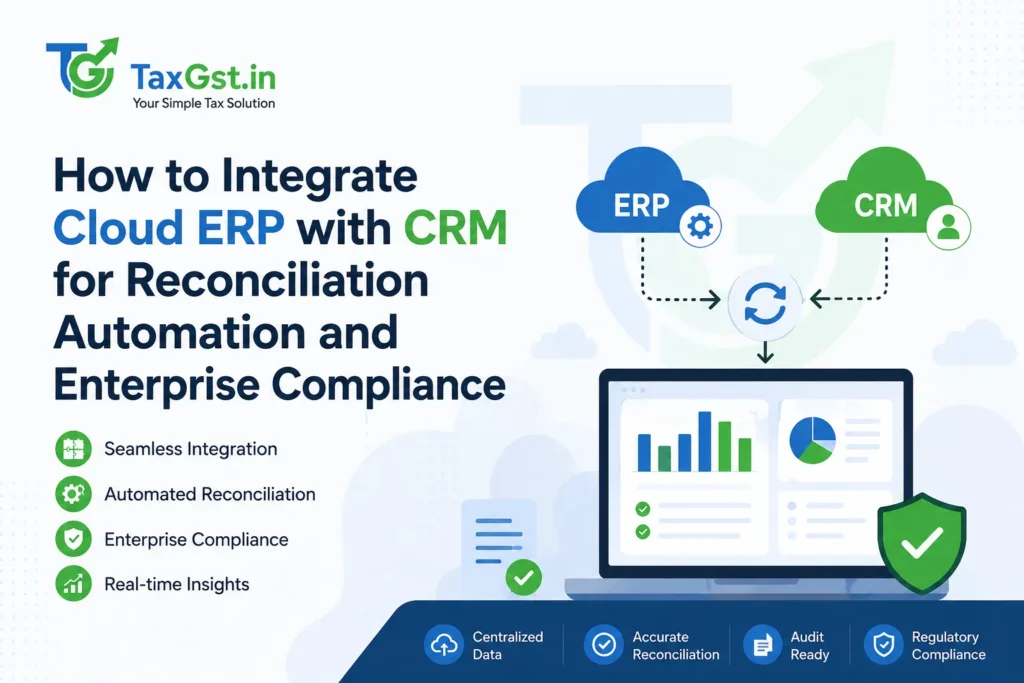
Cloud ERP-to-CRM integration for reconciliation automation connects your accounting system’s General Ledger with customer and vendor data to enable real-time matching of revenue, GST, and TDS entries. Under the current MCA compliance framework, this integration directly supports accurate half-yearly MSME Form 1 filing under Section 405 of the Companies Act, 2013, automated ITC reconciliation aligned with the Invoice Management System (IMS), and continuous 26AS reconciliation for TDS credit verification.
Quick Summary
- General Ledger integration automates data flow between sub-ledgers (sales, purchase, bank) and the master GL, eliminating manual journal entries.
- MCA’s V3 portal mandates web-based filing for 9 key compliance forms including MSME Form 1, BEN-2, and MGT-6, making ERP integration essential for accurate data extraction.
- GST ITC reconciliation is shifting to continuous monitoring under the IMS framework, requiring real-time matching between purchase registers and GSTR-2A/2B.
- 65% of enterprises struggle with real-time financial insights due to fragmented ERP environments, leading to compliance gaps and penalty exposure under Section 450 of the Companies Act, 2013.
- API-based GL integration supports five sequential steps: parameter mapping, master data definition, mapping specification, extraction-transformation-consolidation, and validation with error control.
What Is Cloud ERP to CRM Integration and Why Does It Matter for Compliance?
Cloud ERP to CRM integration is the practice of connecting your Enterprise Resource Planning system — which houses the General Ledger, sales register, purchase register, and TDS ledgers — with your Customer Relationship Management platform and, through APIs, with government compliance portals. The objective is to create a single, automated pipeline where every financial transaction flows from the sub-ledger into the General Ledger, is validated against GST and income-tax rules, and is ready for regulatory filing without manual re-entry.
This matters because the Ministry of Corporate Affairs has migrated 9 critical compliance forms to its V3 portal, all of which are now web-based and require structured data that maps directly to General Ledger accounts. As per the MCA’s 3-Forms FAQs dated 19 July 2024, forms such as MSME Form 1 (outstanding dues to Micro and Small Enterprises), BEN-2 (Significant Beneficial Ownership declaration under Section 90), and MGT-6 (declaration under Section 89) must be filed online with pre-filled data validated against uploaded Excel templates. A disconnected ERP means your team manually compiles this data, increasing the risk of misstatements that attract penalties under Section 405(4) of the Companies Act, 2013 — where the base penalty is Rs 20,000 for the company and Rs 1,000 per day of default, capped at Rs 3,00,000.
How Does General Ledger Integration Automate Reconciliation for MCA and GST Compliance?
General Ledger integration automates reconciliation through a five-step sequential process. First, parameters are mapped between the GL and respective sub-ledgers and journals. Second, master data — account codes, descriptions, and attributes — is defined for accurate extraction. Third, mapping parameters such as department code, company code, and currency code are specified for transaction-level reporting. Fourth, transaction data is extracted, transformed, and consolidated from multiple sub-ledgers into a GL-specific database. Fifth, the extracted data is validated, errors are corrected, and the data is handed off for compliance reporting.
For GST compliance, this pipeline directly supports the Invoice Management System (IMS) framework, which requires real-time matching between supplier-reported invoices in GSTR-1 and buyer-side purchase registers. A robust integration platform automatically ingests data from ERPs — whether SAP, Oracle, Tally, Zoho, or custom systems — identifies invalid GSTINs, HSN/SAC mismatches, duplicate invoices, and credit note discrepancies, and produces exception reports before the filing deadline. This is critical because, as per Rule 46 of the CGST Rules, every tax invoice must contain specific particulars including the IRN and QR code, and any invoice issued by a person covered under e-invoicing that is not an e-invoice is treated as invalid under Rule 48(5).
For direct tax compliance, GL integration enables automated 26AS reconciliation — matching TDS receivable ledgers in the ERP against Form 26AS on the income-tax portal. The reconciliation process involves fetching 26AS data, extracting the TDS receivable ledger, conducting TAN-PAN mapping, and classifying matches as matched, suggested, unmatched, or missing. Automated many-to-many matching algorithms handle the reality that vendors often merge multiple transactions into a single line item in quarterly TDS returns, making manual reconciliation impractical for enterprises with high transaction volumes.
What Are the Key Compliance Deadlines and Penalty Structures for FY 2026-27?
Understanding the compliance calendar is essential because cloud ERP-to-CRM integration is only as valuable as the timeliness of the data it produces. For MCA compliance, MSME Form 1 — filed under Section 405 of the Companies Act, 2013 — is due twice yearly: by 31st October for the April–September half-year and by 30th April for the October–March half-year. The form is filed free of cost with no prescribed ROC fees, but non-compliance attracts penalties under Section 405(4) of the Companies Act, 2013, as detailed in the table below.
| Entity | Base Penalty | Daily Default (Per Day) | Maximum Penalty |
|---|---|---|---|
| Company | Rs 20,000 | Rs 1,000 per day | Rs 3,00,000 |
| Officer in Default / Director | Rs 20,000 | Rs 1,000 per day | Rs 3,00,000 |
These figures are prescribed under Section 405(4) of the Companies Act, 2013, as confirmed in the MSME Form 1 comprehensive compliance guide. Additionally, under Section 450 of the Companies Act, 2013, the MCA has the power to impose further penalties for any default not specifically covered, making it critical that ERP-integrated systems flag overdue MSME payments before the half-year cut-off dates.
For GST compliance, the e-invoicing framework under Rule 48(5) of the CGST Rules mandates that any invoice issued by a notified person that is not an e-invoice is treated as invalid. This means the ERP must generate and authenticate invoices on the Invoice Registration Portal (IRP) before they are sent to customers. The IRN and QR code must be extracted from the signed JSON returned by the IRP and embedded in the invoice copy, as required under Rule 46 of the CGST Rules. Failure to comply blocks the recipient’s ITC claim under Section 16(2)(a) of the CGST Act, 2017, and if the supply involves movement of goods, the goods are liable for confiscation if the e-way bill is not accompanied by a valid invoice.
How Does the V3 Portal Change Data Requirements for Key MCA Forms?
The MCA’s V3 portal, effective from 15th July 2024, fundamentally changed how compliance data is captured. All 9 forms in Set 3 — including MSME Form 1, BEN-2, and MGT-6 — are now fully web-based, replacing the earlier V2 system where forms were filled offline and uploaded. In V3, users can save half-filled forms and return later, and a personalised ‘My Application’ dashboard tracks the status of every filed form (pending DSC upload, under processing, pay fees, resubmission). Login is now via email ID rather than user ID, with OTP authentication sent to both mobile and email.
For MSME Form 1 specifically, the V3 form requires expanded disclosures across four categories of MSME vendor transactions: vendors paid within 45 days, vendors paid after 45 days during the half-year, vendors with outstanding dues where 45 days have not yet elapsed, and vendors with outstanding dues where more than 45 days have elapsed. The Excel upload template supports up to 1,000 rows for TReDS and other payment modes. Critically, the MCA has expanded the reporting scope in V3 without formally amending the original 2019 Order dated 22nd January 2019, creating ambiguity that professionals are still awaiting formal clarification on.
For MGT-6 (declaration under Section 89), the V3 form now generates a BO ID similar to the SBO ID in BEN-2, requires class-wise share details for each beneficial owner, and includes new fields for registered owner and beneficial owner details. BEN-2 (Section 90 declaration) now includes two new purposes: ‘Change of existing Significant Beneficial Ownership under Section 90’ and ‘Change of the existing holding reporting company’. These structural changes mean your ERP must capture and map these additional data fields — a task that is only practical through automated GL integration rather than manual data entry.
Worked Example: How Automated Reconciliation Catches a Rs 2,40,000 TDS Mismatch
Consider a mid-size enterprise that processes 150 vendor payments monthly. In Q1 of FY 2026-27, the accounts team records TDS receivable of Rs 18,75,000 in the ERP’s TDS Receivable Ledger across all vendors. When the quarterly TDS return is filed by vendors and reflected in Form 26AS, the amount showing is Rs 16,35,000 — a shortfall of Rs 2,40,000. Without automated reconciliation, this mismatch would only surface at year-end, risking a Section 201(1A) interest liability at 1% per month on the short-deducted amount.
With an integrated GL reconciliation platform, the system performs automated TAN-PAN mapping and many-to-many matching. It identifies that Vendor X (TAN: ABCD12345F) filed their 26AS quarterly return using challan details that linked Rs 1,20,000 to the wrong assessment year — AY 2026-27 instead of AY 2027-28. A second mismatch of Rs 1,20,000 is traced to Vendor Y, where the deductor entered an incorrect PAN, causing the TDS credit to appear against a different PAN in 26AS. The platform auto-generates correction requests for both vendors, and the finance team resolves the Rs 2,40,000 gap before the advance tax computation deadline — avoiding an interest liability of Rs 14,400 (Rs 2,40,000 x 1% x 6 months) under Section 201(1A).
What Documents and Data Fields Are Required for Seamless ERP-to-CRM Integration?
Successful cloud ERP-to-CRM integration for compliance automation depends on standardising the data fields that flow between sub-ledgers, the General Ledger, and the MCA portal. The foundational document is the Chart of Accounts (CoA) — a structured list of every account code, account description, and account attribute used across the organisation. As per GL integration best practices, the CoA must be standardised across all departments, with uniform coding conventions aligned to the accounting software’s rules. Departmental representatives should be engaged in preparing the CoA to ensure every transaction maps to the correct GL account, cost centre, and tax code.
For MCA’s V3 portal filings, the following documents and data sets must be extraction-ready from the ERP at any given time:
| Compliance Area | Key Documents / Data Fields | Source Reference |
|---|---|---|
| MSME Form 1 | Vendor master with MSME classification (Micro/Small), invoice date, acceptance date, payment date, amount paid, outstanding amount, ageing bucket (within 45 days, after 45 days, outstanding < 45 days, outstanding > 45 days) | Section 405 of the Companies Act, 2013; MSME Form 1 Comprehensive Compliance Guide |
| BEN-2 | Significant Beneficial Ownership (SBO) details, BO ID, class-wise shareholding, registered owner vs beneficial owner breakdown, purpose code (including new ‘Change of existing SBO under Section 90’) | Section 90 of the Companies Act, 2013; G.S.R. 404(E) dated 15-Jul-24 |
| MGT-6 | Declaration details under Section 89, BO ID (similar to SBO ID in BEN-2), class-wise share details per BO, registered owner and beneficial owner fields | Section 89 of the Companies Act, 2013; G.S.R. 403(E) dated 15-Jul-24 |
| GST E-Invoicing | IRN, QR code, signed JSON from IRP, HSN/SAC code, GSTIN of supplier and recipient, invoice value, tax rate, e-way bill number (if applicable) | Rule 46 and Rule 48(5) of CGST Rules; Notification No. 61/2020-CT dated 30-Jul-20 |
| 26AS Reconciliation | TDS receivable ledger (TRL), TAN-PAN mapping, challan identification number, assessment year, section-wise TDS breakup, Form 16A from deductors | Section 203 of the Income-tax Act, 1961; ClearTax 26AS Reconciliation Guide |
The V3 portal’s PAS-3 (Return of Allotment) form also requires specific data restructuring. As per the high-level changes introduced in V3, the form now captures bifurcation of capital into different classes, additional valuation details, and a new declaration checkbox confirming no allotment return is pending for securities allotted prior to the date mentioned in the webform. The ‘List of allottees’ attachment must use the pre-designed Excel template available on the portal, and the fetched information is validated automatically. Attachments such as the copy of board resolution, special resolution for bonus shares, and PAS-5 records have been removed from the V3 form, reducing the document burden but increasing the accuracy requirement for data entered directly into the web form.
Key Integration Data Points for V3 Compliance:
- MSME vendor ageing data with four distinct buckets — paid within 45 days, paid after 45 days, outstanding less than 45 days, outstanding more than 45 days.
- BO ID and SBO ID generation logic for BEN-2 and MGT-6, with class-wise shareholding captured at the beneficial owner level.
- IRN and QR code extraction from IRP-signed JSON, embedded in invoices as mandated under Rule 46 of CGST Rules.
- TAN-PAN mapping table with TAN-level challan details for automated 26AS vs TRL reconciliation.
Who Is Affected — Which Company Types and Compliance Obligations Apply?
Cloud ERP-to-CRM integration for reconciliation automation is not limited to large listed companies. The MCA’s compliance framework applies across a broad spectrum of entities, and the integration requirements vary based on company type and transaction profile.
Private Limited Companies form the largest group affected by V3 portal mandates. Any private company with outstanding dues to Micro or Small Enterprises exceeding 45 days from the date of acceptance of goods or services must file MSME Form 1 half-yearly. This applies regardless of whether the company has a single MSME vendor or hundreds. If the company has procured goods or services from MSMEs and any payment remains outstanding beyond the 45-day threshold as on 31st March or 30th September, the filing obligation is triggered. The penalty for non-compliance — Rs 20,000 base plus Rs 1,000 per day up to Rs 3,00,000 under Section 405(4) of the Companies Act, 2013 — applies equally to the company and every officer in default.
Public Limited Companies, including listed entities, face the same MSME Form 1 obligations. Additionally, they are more likely to have Significant Beneficial Ownership disclosure requirements under Section 90, making BEN-2 filing a recurring compliance need. The V3 form’s new purpose codes — ‘Change of existing Significant Beneficial Ownership under Section 90’ and ‘Change of the existing holding reporting company’ — require the ERP to track SBO changes in real time and feed this data into the web-based form.
One Person Companies (OPCs) are often overlooked but are equally within the compliance net. If an OPC has outstanding dues to MSMEs beyond 45 days, it must file MSME Form 1. The V3 portal’s simplified interface — with email-based login, OTP authentication, and the ability to save half-filled forms — was designed in part to make compliance accessible for smaller entities that may not have dedicated company secretaries.
Limited Liability Partnerships (LLPs) are not directly covered by the Companies Act’s MSME Form 1 requirement, but they are affected by GST e-invoicing mandates and 26AS reconciliation needs. LLPs with aggregate turnover exceeding the e-invoicing threshold must generate IRN-authenticated invoices through the IRP, and their ERP systems must support the JSON-based integration workflow — extracting invoice data, formatting it into the IRP’s bulk offline tool format, uploading the JSON, and embedding the signed IRN and QR code back into the invoice.
Companies with multiple GST registrations — operating across states or with distinct business verticals — face the most complex integration challenge. The reconciliation platform must consolidate data across all GSTINs, handle inter-branch transactions, and produce GSTIN-level risk exposure reports. As per the 2026 Buyer’s Guide on GST ITC reconciliation automation, businesses should evaluate platforms that support multi-GSTIN visibility, vendor compliance scoring, and cross-period reconciliation for audit readiness.
How Does the V3 Portal Change Data Requirements for Key MCA Forms?
The MCA’s V3 portal, effective from 15th July 2024, fundamentally changed how compliance data is captured. All 9 forms in Set 3 — including MSME Form 1, BEN-2, and MGT-6 — are now fully web-based, replacing the earlier V2 system where forms were filled offline and uploaded. In V3, users can save half-filled forms and return later, and a personalised ‘My Application’ dashboard tracks the status of every filed form (pending DSC upload, under processing, pay fees, resubmission). Login is now via email ID rather than user ID, with OTP authentication sent to both mobile and email.
For MSME Form 1 specifically, the V3 form requires expanded disclosures across four categories of MSME vendor transactions: vendors paid within 45 days, vendors paid after 45 days during the half-year, vendors with outstanding dues where 45 days have not yet elapsed, and vendors with outstanding dues where more than 45 days have elapsed. This is a significant expansion from the V2 portal, which only required reporting on payments made after 45 days and outstanding dues beyond 45 days. The MCA has expanded the reporting scope in V3 without formally amending the underlying provisions of the Companies (Furnishing of Information about Payment to Micro and Small Enterprise Suppliers) Order, 2019 dated 22nd January 2019, creating ambiguity that professionals are awaiting official clarification on.
| Reporting Requirement | V2 Portal | V3 Portal |
|---|---|---|
| Payments made within 45 days | Not Required | Required (If Triggered by a Delay) |
| Payments made after 45 days during half-year | Required | Required |
| Outstanding < 45 days at end of half-year | Not Required | Not Required |
| Outstanding > 45 days at end of half-year | Required | Required |
For MGT-6 (return under Section 89), the V3 form now generates a BO ID similar to the SBO ID in BEN-2, captures class-wise share details for each beneficial owner, and includes new fields for registered owner and beneficial owner details. BEN-2 has added two new purposes: ‘Change of existing Significant Beneficial Ownership under Section 90’ and ‘Change of the existing holding reporting company’. These enhancements mean your ERP must store and retrieve granular ownership data — not just aggregate holding percentages — to pre-fill these forms accurately.
What Are the Most Common Pitfalls When Integrating Cloud ERP with CRM for Compliance?
The most frequent implementation failure is inconsistent chart of accounts mapping. When sub-ledgers use different account codes or naming conventions than the GL, the automated extraction in Step 4 of the integration process produces misclassified entries. For example, if the sales register records MSME vendor payments under “Trade Payables — MSME” but the GL maps all vendor payments to a single “Trade Payables” control account, the MSME Form 1 pre-fill will understate outstanding dues, leading to a filing that does not reflect the true position and exposing the company to scrutiny under Section 405(4) of the Companies Act, 2013.
The second major pitfall is irregular reconciliation between the GL and sub-ledgers. Best practices mandate regular reconciliation of general ledgers with sub-ledgers and journal entries, yet many enterprises run reconciliations only at year-end. By that point, mismatches between the purchase register and GSTR-2A, or between the sales register and GSTR-1, have compounded over 12 months and require significant effort to unwind. Under the IMS framework, where invoice-level validation happens in near real-time, a year-end reconciliation cycle is no longer viable — mismatches are flagged by the system within days of filing, and delayed correction can block ITC claims.
The third pitfall is data silos across departments. When the finance team maintains the GL in one system, the procurement team tracks vendor payments in another, and the sales team manages customer invoices in a third, the integration pipeline receives inconsistent or incomplete data. This lack of collaboration among departments is one of the seven commonly cited challenges in GL integration implementations, alongside data quality issues, data migration problems, and cost overruns.
How Should Enterprises Evaluate Automation Platforms for MCA and GST Reconciliation?
When evaluating automation platforms, businesses should focus on five capability dimensions. First, true automation capability — the platform must automatically ingest data from ERPs and accounting systems, support SAP, Oracle, Tally, Zoho, Dynamics, and custom systems, and eliminate manual data cleaning and uploads. Automation should cover the full pipeline from ingestion through validation, reconciliation, and reporting.
Second, accuracy and rule compliance. The system must identify invalid or incorrect GSTINs, HSN/SAC mismatches, duplicate invoices, credit note and amendment mismatches, and delayed or missing GSTR-1 filings. Critically, it must strictly follow GSTN rules without requiring post-processing checks by users. Third, integration and scalability — the platform should handle large invoice volumes, consolidate data across multiple GSTINs, and scale seamlessly with business growth without becoming a bottleneck.
Fourth, built-in governance and controls, including maker-checker workflows, complete audit trails, historical reconciliation records, and supplier compliance tracking. These features significantly reduce effort during departmental audits and assessments. Fifth, actionable dashboards and analytics that provide meaningful insights such as the amount of blocked ITC and reasons, vendor-wise compliance behaviour, and GSTIN-level risk exposure.
| Evaluation Dimension | What to Look For | Why It Matters for Compliance |
|---|---|---|
| True Automation | Direct ERP ingestion, multi-ERP support, no manual uploads | Eliminates data entry errors that cause MSME Form 1 and GSTR mismatches |
| Rule Compliance | GSTIN validation, HSN matching, duplicate detection | Ensures invoices meet Rule 46 CGST requirements and IRN validity |
| Multi-GSTIN Scalability | Consolidated reporting across all registrations | Critical for businesses operating across states under multiple GSTINs |
| Governance and Audit Trail | Maker-checker, version history, vendor scoring | Supports assessment defence and reduces audit effort |
| Actionable Analytics | Blocked ITC reports, vendor risk scores, exception dashboards | Enables proactive compliance rather than reactive correction |
What Should You Do Next?
- Map your chart of accounts to MCA form fields. Review every GL account that feeds into MSME Form 1, BEN-2, and MGT-6. Ensure the account structure captures MSME vendor classification, beneficial ownership details, and share class bifurcation — the three data dimensions the V3 portal now requires.
- Enable API-based GL integration between your ERP and compliance platform. API data transfer protocols support real-time or near real-time synchronisation, which is essential for IMS-aligned ITC reconciliation and continuous 26AS matching. Avoid batch-only integrations that introduce a lag of days or weeks.
- Run a parallel reconciliation for the current half-year. Before the 31st October 2026 due date for MSME Form 1 (April–September half-year), run the V3 form’s expanded four-category reporting in parallel with your existing V2-based process. Identify data gaps now rather than at the filing deadline.
- Establish monthly reconciliation cycles. Move from annual or quarterly reconciliation to monthly cycles covering GSTR-1 vs GSTR-3B, books vs GST returns, e-invoice vs ERP, IMS vs purchase register, and e-way bill vs sales register. This aligns with the continuous monitoring direction of GST 2.0 compliance.
- Conduct an ITC leakage assessment. Before selecting an automation platform, quantify the ITC currently being lost due to mismatches, missed invoices, and delayed reconciliations. This baseline will help you evaluate vendor proposals on measurable ROI rather than marketing claims.
What Should You Do Next?
- Map your current Chart of Accounts to MCA and GST reporting requirements — standardise account codes, department codes, and currency codes across all sub-ledgers before initiating integration.
- Conduct a vendor-by-vendor MSME classification exercise and tag each vendor in your ERP as Micro, Small, Medium, or Other, so that MSME Form 1 data can be auto-extracted for the April–September half-year filing due 31st October.
- Enable API-based e-invoicing integration between your ERP and the IRP — ensure the signed JSON containing IRN and QR code is automatically pulled back into the invoice record, as required under Rule 46 of the CGST Rules.
- Set up automated 26AS reconciliation cycles — pull Form 26AS data quarterly, run TAN-PAN matching against your TDS receivable ledger, and flag unmatched entries for vendor follow-up before advance tax computation deadlines.
- Configure maker-checker workflows in your reconciliation platform — every journal entry, GST return figure, and MCA form data point should have a maker and an approver before submission, creating a complete audit trail.
- Run a pre-V3-form dry test — file a dummy MSME Form 1 or MGT-6 on the V3 portal using a small data set to validate that your ERP’s web-based form output matches the portal’s expected structure before the actual due date.
- Evaluate a unified compliance platform that supports GL-stream ingestion, automated ITC reconciliation under IMS, and direct 26AS matching — request a live demo using your own ERP data rather than vendor-provided sample data.
Frequently Asked Questions
Is MSME Form 1 filing mandatory even if all MSME payments were made within 45 days?
Under the original provisions of the MCA Notification dated 22nd January 2019, filing is required only when outstanding payments to Micro or Small Enterprises exceed 45 days as on 31st March or 30th September. If all payments were made within 45 days and no dues remain outstanding at the half-year cut-off, the obligation does not arise. However, the revised V3 portal now appears to require filing even where outstanding dues are NIL at the end of the half-year, provided there were transactions with MSME vendors. The MCA has not yet issued a formal clarification on this expanded scope, and the V3 form currently overrides the original circular provisions. Practitioners should monitor the MCA portal for updated guidance and, in the interim, prepare their ERP systems to extract all four categories of MSME vendor transactions — paid within 45 days, paid after 45 days, outstanding less than 45 days, and outstanding more than 45 days — to remain compliant under either interpretation.
What is the penalty for late or non-filing of MSME Form 1 under Section 405?
Non-compliance with Section 405 of the Companies Act, 2013 is punishable under Section 405(4) of the Companies Act, 2013. The base penalty is Rs 20,000 for the company and Rs 20,000 for every officer in default, including directors. Additionally, a daily default penalty of Rs 1,000 per day applies for each day the default continues, subject to a maximum cap of Rs 3,00,000 for both the company and the officer. There are no prescribed ROC fees for filing MSME Form 1 — the form is filed free of cost even after the due date — but the statutory penalties under Section 405(4) apply regardless of whether any fee is charged. Under Section 450 of the Companies Act, 2013, the MCA also retains the power to impose further penalties for any default not specifically covered by a dedicated provision.
How does e-invoicing integration with the IRP affect ITC claims for the buyer?
Under Rule 48(5) of the CGST Rules, any invoice issued by a person covered under e-invoicing that is not an e-invoice is treated as invalid. This means the buyer cannot claim input tax credit under Section 16(2)(a) of the CGST Act, 2017, which requires a valid tax invoice. Furthermore, if the supply involves movement of goods and the e-way bill is not accompanied by a valid invoice, the goods are liable for confiscation. The ERP must therefore generate and authenticate every B2B invoice on the Invoice Registration Portal before it is shared with the customer. The signed JSON returned by the IRP — containing the unique Invoice Reference Number and QR code — must be extracted and embedded in the invoice copy, as mandated under Rule 46 of the CGST Rules. When this integration works correctly, the invoice data auto-populates in the supplier’s GSTR-1 and flows to the buyer’s GSTR-2A/2B, enabling seamless ITC matching.
Can cloud-based ERP systems integrate with the MCA V3 portal for automated form filing?
Yes. Cloud-based ERP systems can integrate with the MCA V3 portal using API data transfer protocols. The V3 portal supports web-based form filling for all 9 forms in Set 3, including MSME Form 1, BEN-2, and MGT-6. In the V2 system, forms were filled offline as Excel files and uploaded; in V3, forms are filled online with the ability to save progress and return later. A cloud ERP can extract the required data from the General Ledger and sub-ledgers, pre-populate the web-based form fields, and enable the authorised signatory to complete the filing with DSC authentication. The V3 portal uses email-based login with OTP sent to both mobile and email, and the personalised ‘My Application’ dashboard allows tracking of every filed form’s status. API integration enables the ERP to pull form status updates back into the compliance tracker, ensuring that no filing deadline is missed and that resubmission requests are actioned promptly.
What Should You Do Next?
- Map your current chart of accounts against the V3 portal’s data fields for MSME Form 1, BEN-2, and MGT-6 to identify gaps.
- Audit your ERP’s API connectivity with the IRP for e-invoicing and with the MCA21 V3 portal for web-based form filing.
- Implement monthly reconciliation cycles for 26AS vs TDS receivable ledger, GSTR-1 vs books, and IMS vs purchase register.
- Establish maker-checker workflows and complete audit trails within your compliance platform to withstand departmental scrutiny.
- Train cross-functional teams — finance, taxation, supply chain, and ERP — on GST coding accuracy and data governance standards.
Can cloud ERP to CRM integration eliminate the need for manual MSME Form 1 filing?
Integration significantly reduces manual effort but does not eliminate the need for oversight. The ERP can auto-extract the four categories of MSME vendor transactions required under the V3 portal — payments within 45 days, payments after 45 days, outstanding less than 45 days, and outstanding more than 45 days — and populate the web-based form. However, a responsible officer must still review the pre-filled data, attach the required Excel template, and certify the declaration before submission. The V3 portal’s personalised ‘My Application’ dashboard then tracks the filing status through DSC upload, processing, and approval.
How does e-invoicing integration with the IRP affect ITC claims under Section 16(2)(a)?
Under Rule 48(5) of the CGST Rules, any invoice issued by a person covered under e-invoicing that is not an e-invoice is treated as invalid. Section 16(2)(a) of the CGST Act, 2017 requires a valid tax invoice as a condition for claiming ITC. Therefore, if the ERP fails to generate and authenticate the invoice on the IRP — obtaining the IRN and QR code that must be printed on the invoice as per Rule 46 of the CGST Rules — the recipient cannot claim ITC. For supplies involving movement of goods, the e-way bill must also be accompanied by a valid e-invoice; otherwise, the goods are liable for confiscation.
What is the penalty exposure if 26AS reconciliation reveals unmatched TDS credits?
If 26AS reconciliation reveals TDS credits that do not match the ERP’s TDS receivable ledger, the taxpayer risks receiving a notice from the income-tax department for claiming excess credits. Common causes include wrong PAN entered by the deductor, non-deposit of TDS by the deductor, amount mismatches, wrong assessment year, or incorrect TAN/challan details. The resolution path is to obtain Form 16A from the deductor, identify the specific error, and request the vendor to file a correction on the TRACES portal. If the vendor does not comply, a complaint can be filed on TRACES. Regular quarterly reconciliation prevents these mismatches from accumulating and ensures accurate advance tax computations.
Is the V3 portal login different from V2, and how does DSC association work?
Yes. In the V3 portal, login is via email ID rather than the user ID used in V2. When a business user logs in, an OTP is sent to both the registered mobile number and email address to ensure authenticity. DSC (Digital Signature Certificate) association in V3 follows a streamlined process — the DSC is linked to the user profile and can be selected during form submission. The V3 portal also introduces a personalised ‘My Application’ feature that was absent in V2, allowing filers to view all forms filed to date along with their current status — pending DSC upload, under processing, pay fees, or resubmission required.
Sources
- ClearTax — General Ledger Integration: Process, Benefits, and Best Practices
- MCA — 3-Forms FAQs (V3 Portal) dated 19 July 2024
- TaxGuru — 2026 Buyer’s Guide: GST ITC Reconciliation Automation Software
- MCA — Compliance Filing FAQs
- TaxGuru — MSME Form 1 Comprehensive Compliance Guide under Section 405
- TaxGuru — GST 2.0: 10 Practical Compliance Changes for FY 2026-27
- TaxGuru — E-Invoicing under GST: Provisions and FAQs
- ClearTax — 26AS Reconciliation: Steps, Mismatches, and Fixes
Take the next step: If your organization is still relying on manual data compilation for MCA filings, GST reconciliation, or 26AS matching, now is the time to evaluate a
Article Information
Published: June 7, 2026
Last Reviewed: June 7, 2026
Category: GST
Regulatory Body: CBIC (Central Board of Indirect Taxes and Customs)
Written by C.K. Gupta, M.Com & Tax Editor at TaxGST.in — helping businesses navigate GST compliance, ITC reconciliation, and return filing across Delhi NCR since 2009.
Official Resources
- GST Portal (e-Filing)
- CBIC Portal (Circulars)
- Income Tax Portal
- GST Council Updates
- E-Way Bill Portal
- E-Invoice Portal
Disclaimer: This article is for informational purposes only. For legal advice, consult a qualified tax professional. Always refer to the original notification for authoritative information.
Discover more from TaxGst.in
Subscribe to get the latest posts sent to your email.

Never Miss a Tax Deadline Again
Due-date alerts, GST updates and tax tips — free on the app you already use.
event Next: GSTR-3B · 20 Oct