
 C.K. Gupta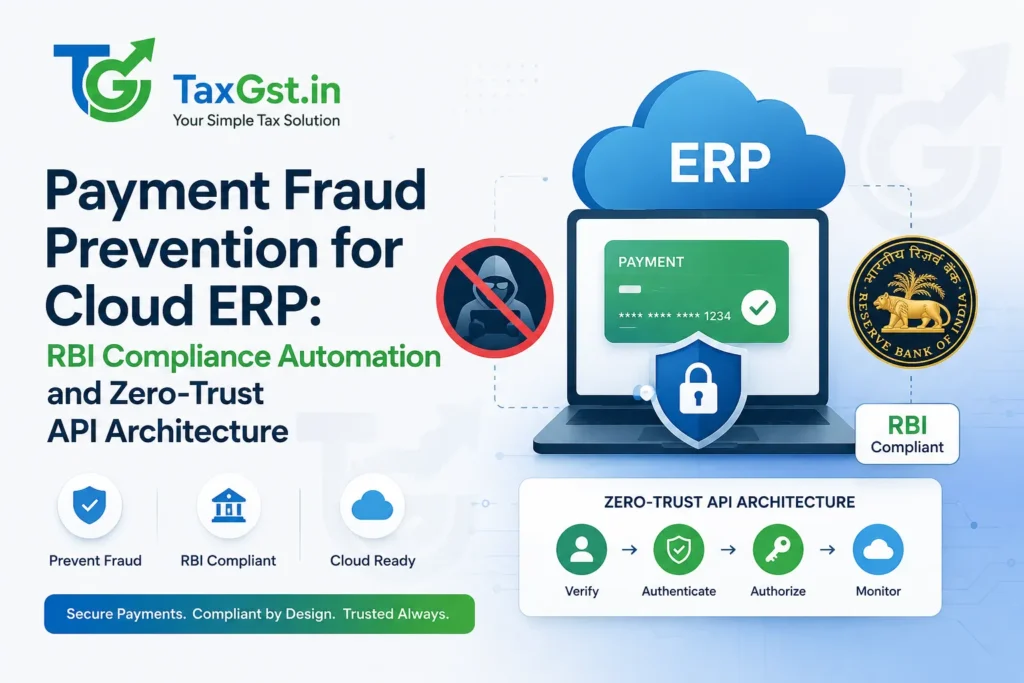
If your business runs on a cloud ERP integrated with UPI, cards, or net banking, the Reserve Bank of India’s recent Master Directions mandate real-time fraud monitoring, zero-trust API security, and automated RBI reporting within 14 days of fraud classification. Non-compliance can trigger penalties and staff accountability under the Master Direction on Fraud Risk Management in Regulated Entities (REs), 2024, and the Master Direction – Reserve Bank of India (Digital Payment Security Controls) Directions, 2024.
Quick Summary
- RBI’s Master Directions issued in 2024 and 2023 on Fraud Risk Management, Digital Payment Security Controls, and Cybersecurity apply to all commercial banks and, through them, to cloud ERP and payment ecosystem participants.
- Individual fraud cases must be reported via Fraud Monitoring Returns (FMR) within 14 days from the date of classification as fraud, with aggregate quarterly reporting for all fraud incidents, as per the Master Direction on Fraud Risk Management in Regulated Entities (REs), 2024.
- Red Flagged Accounts with aggregate exposure of ₹5 crore and above must be reported on the CRILC platform within seven days of being red flagged, as per the Master Direction on Fraud Risk Management in Regulated Entities (REs), 2024.
- E-mandate recurring transactions up to ₹15,000 per transaction are exempt from Additional Factor of Authentication (AFA); for insurance premium, mutual fund subscription, and credit card bill payments, this exemption limit is up to ₹1,00,000 per transaction, as per the Digital Payments – E-mandate Framework, 2023.
- Cloud ERP and payment gateway operators must implement zero-trust API architecture, multi-tier application segregation, real-time reconciliation within 24 hours, and continuous vulnerability assessment, as per the Master Direction – Reserve Bank of India (Digital Payment Security Controls) Directions, 2024.
What Are the New RBI Fraud and Payment Security Directions?
The Reserve Bank of India has issued a comprehensive set of three interconnected Master Directions in 2024 that together redefine how commercial banks, payment operators, and their technology partners — including cloud ERP platforms — must prevent, detect, and report fraud. These are the Master Direction on Fraud Risk Management in Regulated Entities (REs), 2024; the Master Direction – Reserve Bank of India (Digital Payment Security Controls) Directions, 2024; and the Master Direction – Reserve Bank of India (Cybersecurity, Technology:
Risk, Resilience and Assurance Framework) Directions, 2024. Collectively, these Master Directions replace earlier circulars and guidelines on the subject. They mandate a Board-approved Fraud Risk Management Policy, a dedicated Data Analytics and Market Intelligence Unit, real-time Early Warning Signal (EWS) systems, and strict timelines for reporting fraud to the RBI and Law Enforcement Agencies. The Directions also cover outsourcing of IT services, cloud governance, and API security — making them directly relevant to any business operating a cloud ERP that touches payment data.
How Do the Latest Directions Change Fraud Detection and Reporting for Banks?
The most significant shift is the move from periodic, manual fraud reporting to continuous, automated, and real-time monitoring. Under the Master Direction on Fraud Risk Management in Regulated Entities (REs), 2024, every commercial bank must now operate an EWS system that is integrated with its Core Banking Solution or operational systems. This system must capture both quantitative and qualitative indicators — transaction velocity, unusual IP origins, money mule patterns, non-KYC compliant accounts, and more — and generate alerts that are examined within a Turnaround Time prescribed by the Risk Management Committee of the Board, preferably not more than 30 days.
Once an account is red flagged — meaning suspicion of fraudulent activity is triggered by one or more EWS indicators — and the aggregate exposure is ₹5 crore or above, the bank must report it in the Red Flagged Account Return on RBI’s CRILC platform within seven days, as per the Master Direction on Fraud Risk Management in Regulated Entities (REs), 2024.
This is a tight window and demands automated data pipelines from the bank’s core systems to the regulatory reporting portal. Banks must file Fraud Monitoring Returns (FMRs) for individual fraud cases immediately, but not later than 14 days from the date of classification as fraud. Aggregate quarterly FMRs must also be submitted covering all fraud incidents, including those below ₹1 lakh. While earlier consolidated reporting mechanisms have been streamlined, Flash Reports (FR) for frauds involving ₹5 crore and above must still be submitted within one week of detection. Staff accountability for delays in identification and reporting must be examined and fixed.
The Directions also mandate that banks use the Central Fraud Registry (CFR) — RBI’s web-based searchable database — for credit risk and fraud risk management. Payment system-related disputed or suspected fraudulent transactions must be reported to the Central Payments Fraud Information Registry (CPFIR), and if subsequently concluded as fraud, must also be reported through FMR to be reflected in the CFR.
Who Is Affected — Banks, NBFCs, Cloud ERP Operators, and Payment Gateways
The recent Master Directions cast a wide net. While the primary regulated entities are commercial banks — including Regional Rural Banks and All India Financial Institutions — the obligations cascade down to every technology partner, payment system operator, and cloud ERP platform that processes, stores, or transmits payment data on behalf of a bank or its customers. Cloud ERP operators fall within the scope of the outsourcing and cloud governance provisions. If your ERP hosts customer account data, processes UPI or card transactions, or integrates with a bank’s Core Banking Solution, you are part of the regulated ecosystem.
The Master Direction – Reserve Bank of India (Cybersecurity, Technology: Risk, Resilience and Assurance Framework) Directions, 2024 (Section 11 on Outsourcing of IT Services), requires that cloud security be a shared responsibility between the regulated entity and the Cloud Service Provider. This means your ERP must implement role-based access controls, data segregation in multi-tenancy environments, encryption keys under your control, and periodic independent security audits — at least annually — with the results reviewed by the bank’s Board sub-committee responsible for IT oversight. Payment system operators — including payment gateways, payment aggregators, and payment system processors — must comply with the Master Direction on Cyber Resilience and Digital Payment Security Controls for Payment System Operators (PSOs), 2024. Medium non-bank PSOs were required to comply from April 1, 2026.
These operators must implement a real-time or near-real-time fraud monitoring solution, a 24x7x365 manned nodal officer facility, and API security measures covering authentication, authorisation, confidentiality, integrity, and availability. Even if you are not directly regulated by RBI, your bank customers will demand contractual commitments from you — covering incident response timelines, data localisation, PCI-DSS compliance, and audit rights — because the bank remains ultimately responsible for the entire chain.
What Are the Key Transaction Limits and E-Mandate Rules Under the Current Framework?
The Digital Payments – E-mandate Framework, 2026, consolidates all earlier circulars on recurring transactions into a single, unified direction. It applies to all Payment System Providers and Payment System Participants processing recurring domestic or cross-border transactions using cards, PPIs, or UPI. The framework introduces specific thresholds that determine when Additional Factor of Authentication — or AFA — is required. For general recurring transactions, all transactions up to ₹15,000 per transaction may be authorised without AFA.
This covers most subscription services, SIPs below that threshold, and small-value recurring debits. However, for three specific categories — insurance premium payments, mutual fund subscription payments, and credit card bill payments — the AFA-free threshold is significantly higher at ₹1,00,000 per transaction. Every e-mandate requires a one-time registration with AFA validation. The first transaction under the mandate also requires AFA, unless it is combined with the registration step. The issuer must send a pre-transaction notification to the customer at least 24 hours before the actual debit, containing the merchant name, amount, date and time, reference number, and reason for debit. Post-transaction notifications are mandatory as well.
Customers must be given the facility to opt out of any particular transaction or withdraw the e-mandate entirely, with AFA validation for any such action. No charges can be levied for availing the e-mandate facility. The framework also mandates a transaction velocity check mechanism, monitoring parameters such as the number of fund transfers, addition of new beneficiaries, and high-risk merchant category codes — all of which must be built into the cloud ERP or payment gateway’s rule engine.
| Parameter | General Recurring Transactions | Insurance, Mutual Fund, Credit Card Recurring |
|---|---|---|
| AFA-Free Threshold Per Transaction | Up to ₹15,000 | Up to ₹1,00,000 |
| Pre-Transaction Notification | At least 24 hours before debit | At least 24 hours before debit |
| First Transaction AFA | Required (may be combined with registration) | Required (may be combined with registration) |
| Mandate Modification or Withdrawal | Requires AFA validation | Requires AFA validation |
| Charges for E-Mandate Facility | Nil | Nil |
| Post-Transaction Notification | Mandatory (merchant, amount, date/time, reference, reason, grievance details) | Mandatory (merchant, amount, date/time, reference, reason, grievance details) |
How Does the Latest Framework Impact Cloud ERP API Architecture and Reconciliation?
The Master Direction – Reserve Bank of India (Digital Payment Security Controls) Directions, 2024, mandates that banks and payment system operators implement a multi-tier application architecture, segregating the application, database, and presentation layers. For cloud ERP platforms, this means the ERP cannot serve as a monolithic application where the database is directly accessible from the presentation layer. The API layer must sit as a distinct tier between the front end and the database, enforcing authentication, rate limiting, and input validation. The reconciliation requirement is equally demanding. A real-time or near-real-time reconciliation framework — not later than 24 hours from receipt of settlement files — must be in place for all digital payment transactions between the bank and every stakeholder, including payment gateways, payment aggregators, business correspondents, card networks, and third-party technology service providers.
If your cloud ERP handles settlement files for a bank, you must build automated reconciliation logic that matches transactions, flags exceptions, and generates alerts within this 24-hour window. Consider a practical example. A cloud ERP processes 50,000 UPI transactions daily for a partner bank, with an average transaction value of ₹2,400. The total daily throughput is ₹12 crore. Under the 2024 Framework, every one of these transactions must be reconciled with the bank’s settlement file within 24 hours. If the ERP’s reconciliation engine has a 0.3% exception rate — meaning 150 transactions per day do not auto-reconcile — those 150 exceptions must be flagged, investigated, and resolved within the same 24-hour window. At an average value of ₹2,400 per exception, this means ₹3,60,000 worth of transactions daily that require manual or automated investigation. Over a month, this accumulates to approximately ₹1.08 crore in exception-value that must be tracked and resolved.
The ERP must therefore include automated exception workflows, role-based assignment of reconciliation tasks, and audit trails that satisfy both the bank’s internal audit and the RBI’s regulatory scrutiny. The API security provisions further require that all interfaces implement authentication and authorisation to establish the identity of communicating applications, ensure message content is not tampered with, guarantee reliable transfer of resources, and maintain availability with anomalous activity detection. Cloud ERP operators must adhere to globally recognised API security frameworks and run automated vulnerability assessment scanning tools on a continuous or frequent basis across all critical, public-facing, or sensitive-data-storing systems.
What Is the Step-by-Step Compliance Process for Cloud ERP and Payment Platforms?
Implementing RBI’s recent Master Directions in a cloud ERP environment requires a structured, phased approach that covers governance, technology architecture, monitoring, and regulatory reporting. Below is a practical compliance roadmap for businesses that operate cloud ERPs integrated with banking and payment systems.
Step 1: How Can You Establish Board-Approved Information Security and Fraud Risk Policies?
The first requirement is governance. As per the Master Direction – Reserve Bank of India (Digital Payment Security Controls) Directions, 2024, the bank — and by extension its outsourced technology partners — must formulate a Board-approved policy for digital payment products and services. This policy must cover functionality, security, and performance angles, including risk management measures, compliance with regulatory instructions, and customer experience. For cloud ERP operators, this means your client bank will require documented proof that your platform’s security posture aligns with their Board-approved policy. Prepare a comprehensive information security policy that maps each RBI requirement to a specific control in your ERP. The Master Direction – Reserve Bank of India (Digital Payment Security Controls) Directions, 2024 and the RBI (Outsourcing of Information Technology Services) Directions together create a detailed security architecture mandate for any cloud ERP that participates in the payment ecosystem.
The core principle is that outsourcing IT services does not outsource responsibility — the regulated entity remains accountable for the security of the entire chain. Multi-tier application architecture is mandatory. The bank — and by extension its cloud ERP partners — must segregate the application, database, and presentation layers in digital payment products and services. This means your ERP cannot run its payment processing logic, database queries, and user interface through a single monolithic stack.
Each layer must be independently secured, monitored, and tested. API security is a specific focus area. The Directions require that all APIs implementing payment functionality must establish the identity of communicating applications, ensure message content is not tampered with, reliably transfer resources, and maintain availability with anomalous activity detection. Automated vulnerability assessment scanning tools must run on a continuous or frequent basis on all critical, public-facing, or sensitive-data-storing systems.
Source code reviews, vulnerability assessments, and penetration testing must be conducted — and where the source code is not owned by the bank, a certificate from the application developer confirming the absence of known vulnerabilities, malware, and covert channels must be obtained. Real-time or near-real-time reconciliation — not later than 24 hours from receipt of settlement files — is mandatory for all digital payment transactions between the bank and every stakeholder in the chain, including payment system operators, business correspondents, card networks, payment aggregators, and gateways. This means your ERP must have reconciliation engines that can ingest settlement files, match transactions, and flag discrepancies within a 24-hour window.
What Is the Financial and Operational Impact of Non-Compliance?
Non-compliance with the 2024 Directions carries both direct financial penalties and indirect operational consequences. The RBI has the power to impose monetary penalties under Section 47A of the Banking Regulation Act, 1949 for contravention of its directions. Beyond monetary penalties, the reputational damage of being flagged as non-compliant can trigger customer attrition, increased scrutiny from the Board, and potential restrictions on new product launches. The mandatory staff accountability provision is particularly significant. Under the 2024 Fraud Risk Management Directions, banks must examine and fix staff accountability for delays in identification of fraud cases and in reporting to RBI.
This means individual officers — not just the institution — face consequences for process failures. For cloud ERP operators, this translates into contractual liability: banks will insist on indemnification clauses, service level agreements with financial penalties, and audit rights that allow the bank to verify compliance at any time. The cost of building the required infrastructure — EWS systems, Data Analytics and MI Units, real-time reconciliation engines, zero-trust API gateways, and continuous vulnerability monitoring — is substantial. However, the cost of a single major fraud event that goes undetected or unreported can far exceed the investment in prevention infrastructure.
What Should You Do Next?
If you operate a cloud ERP platform that processes payment data, or if you are a business leader responsible for your organization’s banking integrations, immediate action is required. Begin by mapping every touchpoint where your ERP interacts with bank systems, payment gateways, or customer financial data. Each of these touchpoints must be assessed against the 2024 Directions’ requirements for API security, data segregation, access controls, and real-time monitoring. Engage with your banking partners to understand their specific compliance expectations and contractual requirements. The Directions make it clear that the bank remains responsible for the entire chain — which means your bank will demand evidence of your compliance posture.
Prepare documentation covering your cloud governance policy, identity and access management framework, encryption key management, vulnerability assessment schedules, and incident response procedures. Implement automated reconciliation with a 24-hour SLA. If your current reconciliation process runs on a weekly or monthly cycle, it must be upgraded. Deploy continuous vulnerability assessment scanning on all systems that store or transmit payment data.
Ensure that your API architecture implements authentication, authorisation, confidentiality, integrity, and availability controls as mandated by the Directions. Finally, establish a governance structure that includes Board-level oversight of information security, annual review of your Information Security Policy, and periodic independent audits of your cloud security controls. The RBI’s 2024 framework is not a one-time compliance exercise — it demands continuous vigilance, regular upgrades, and a culture of security that permeates every layer of your payment data architecture.
Common Pitfalls to Avoid
Based on our experience, here are the mistakes people often make:
- Ignoring RBI circulars – RBI circulars directly impact your banking and investment decisions. Not staying updated can result in missed opportunities or non-compliance.
- Not reading the fine print – RBI policy changes often have implementation timelines and transitional provisions that matter for your financial planning.
- Delayed action on rate changes – When RBI changes repo rate, loan EMIs and FD rates are affected. Act within the transition window to maximize benefit.
Frequently Asked Questions
What is the FMR filing deadline under the 2024 RBI Fraud Risk Management Directions?
What is the threshold for Red Flagged Account reporting on CRILC?
What are the AFA-free transaction limits under the E-mandate Framework 2026?
When did medium non-bank Payment System Operators need to comply with the Cyber Resilience Directions?
Is real-time reconciliation mandatory for digital payment transactions?
Can banks outsource fraud monitoring to third-party cloud ERP providers?
Sources
- RBI — Master Directions on Fraud Risk Management in Commercial Banks, 2024
- RBI — Master Directions on Digital Payment Security Controls, 2024
- RBI — Master Directions on Cybersecurity, Technology Risk, Resilience and Assurance, 2024
- RBI — Digital Payments – E-mandate Framework, 2026
- RBI — Cyber Resilience and Digital Payment Security Controls for PSOs Master Directions
- RBI — Outsourcing of Information Technology Services Directions
- RBI — Fraud Risk Management in Commercial Banks Directions, 2024
- RBI — Master Directions on Fraud Risk Management
Frequently Asked Questions
How does the ₹15,000 e-mandate threshold work for cloud ERP recurring billing?
Under the Digital Payments – E-mandate Framework, 2026, any recurring transaction up to ₹15,000 per transaction can be processed without Additional Factor of Authentication. This applies to general subscriptions, SIPs, and utility debits. However, if your ERP processes insurance premiums, mutual fund subscriptions, or credit card bill payments, the AFA-free threshold increases to ₹1,00,000 per transaction for those specific categories. Transactions above the applicable threshold require AFA validation for every debit. The first transaction under any new e-mandate always requires AFA regardless of amount.
What is the deadline for reporting a red flagged account to RBI’s CRILC platform?
As per the Master Direction on Fraud Risk Management in Regulated Entities (REs), 2024, an account with an aggregate exposure of ₹3 crore and above, once red flagged, must be reported in the Red Flagged Account Return on the Reserve Bank’s CRILC platform within seven days of being red flagged. This is a strict deadline — banks are required to examine and fix staff accountability for any delays in identification and reporting. For confirmed fraud cases, irrespective of the amount involved, Fraud Monitoring Returns must be filed within 14 days of classification as fraud.
Does my cloud ERP need to comply with PCI-DSS standards?
Yes, if your cloud ERP stores, processes, or transmits cardholder data — even temporarily during transaction routing — PCI-DSS compliance applies. The Master Direction – Reserve Bank of India (Digital Payment Security Controls) Directions, 2024 require banks to maintain a database of all systems and applications storing customer data in the payment ecosystem and ensure compliance with applicable PCI standards. Since the bank remains responsible for the entire chain, your ERP must either hold current PCI-DSS certification or provide a certificate from the application developer stating the application is free of known vulnerabilities, malware, and covert channels. Additionally, if your ERP uses ATM Switch Application Service Providers, those ASPs must comply with both PCI-DSS and PCI-SSF standards.
What API security measures are required under the 2024 RBI Directions?
The RBI (Cyber Resilience and Digital Payment Security Controls for PSOs) Master Directions mandate that all Payment System Operators — and by extension their cloud ERP and technology partners — implement API security covering four pillars: Authentication and Authorisation to establish the identity of communicating applications; Confidentiality to ensure message content is not tampered with; Integrity to ensure resources are reliably transferred; and Availability and Threat Protection so that APIs are available when needed and anomalous activities are identified with mitigative action. Multi-tier application architecture is mandatory — the application, database, and presentation layers must be segregated. Banks must also conduct continuous automated vulnerability assessment scanning on all critical, public-facing systems or those storing sensitive data, and penetration testing must cover OWASP compliance.
How does the 14-day FMR filing deadline impact cloud ERP data pipelines?
The Master Direction on Fraud Risk Management in Regulated Entities (REs), 2024 require banks to file Fraud Monitoring Returns within 14 days of classifying an incident as fraud. For cloud ERP platforms, this means your system must capture fraud-classification timestamps automatically and push them to the bank’s FMR portal without manual delays. If your ERP handles transaction reconciliation, ensure the fraud-flagging workflow triggers an automated alert to the bank’s compliance team within 48 hours — leaving at least 10 days for review and submission. Any lag in your data pipeline could make the bank miss the deadline, triggering staff accountability provisions under the Directions.
What API security standards must payment gateways follow under the 2026 Directions?
The RBI (Cyber Resilience and Digital Payment Security Controls for PSOs) Master Directions require payment system operators to implement API security covering four pillars — authentication and authorisation, confidentiality, integrity, and availability with threat protection. Gateways must adhere to globally recognised frameworks such as OWASP API Security Top 10 and conduct Vulnerability Assessment and Penetration Testing — including source code review — before major infrastructure changes. If your gateway is hosted on cloud infrastructure, the shared responsibility model applies: the Cloud Service Provider’s security certifications must complement your own controls, and the gateway operator must maintain a database of all systems storing customer payment data with PCI-DSS compliance in each system.
Are there penalties for delayed fraud reporting to RBI under the 2026 Directions?
Yes. The 2026 Fraud Risk Management Directions explicitly require banks to examine and fix staff accountability for delays in both identification of fraud cases and reporting to RBI. While the Directions themselves do not specify a monetary penalty figure, delayed reporting means the Central Fraud Registry is not updated in time, which can allow the same fraud to be perpetrated at other banks. RBI can take supervisory action under Section 35A of the Banking Regulation Act, 1949 — including imposing monetary penalties, restricting business operations, or issuing directions to the bank’s Board. For cloud ERP and payment partners, contractual liability to the bank may also arise if your system caused the delay.
How do the 2026 Directions affect existing outsourcing contracts for cloud ERP operators?
The RBI (Outsourcing of Information Technology Services) Directions require that all outsourcing agreements — including cloud ERP contracts — be updated to reflect the shared responsibility model for cloud security. Contracts must specify which activities are cloud-hosted, define roles and responsibilities of the regulated entity and the Cloud Service Provider, mandate data segregation in multi-tenancy environments, and require annual independent cyber security audits with results reviewed by the bank’s IT oversight committee. If your current ERP contract does not address encryption key control, disaster recovery obligations, or incident notification timelines aligned with the 2024 Directions, it should be renegotiated before the bank’s next Board review cycle. Failure to update contracts can result in the bank being found non-compliant with RBI outsourcing norms.
Article Information
Published: June 7, 2026
Last Reviewed: June 7, 2026
Category: RBI
Regulatory Body: Reserve Bank of India (RBI)
Written by C.K. Gupta, M.Com & Tax Editor at TaxGST.in — covering RBI policy changes, banking regulations, and FLA compliance for businesses since 2009.
Official Resources
Disclaimer: This article is for informational purposes only. Banking regulations and policy rates may change. Always refer to the original RBI circular for authoritative information. Contact your bank for specific queries about your accounts.
Discover more from TaxGst.in
Subscribe to get the latest posts sent to your email.



Never Miss a Tax Deadline Again
Due-date alerts, GST updates and tax tips — free on the app you already use.
event Next: GSTR-3B · 20 Oct