
 C.K. Gupta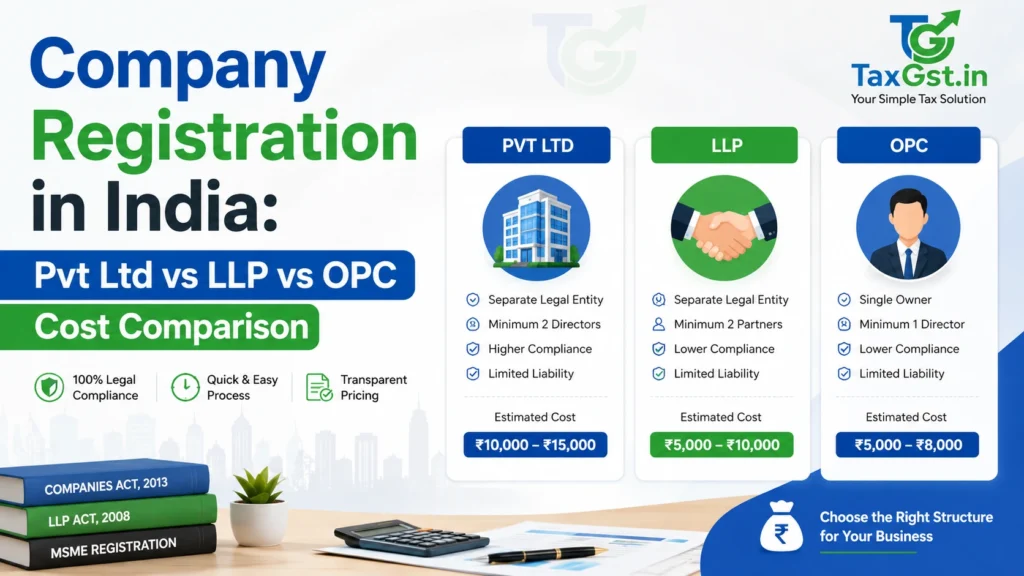
For entrepreneurs incorporating in FY 2026-27, LLP registration costs range from Rs. 9,000 to Rs. 18,000 for a standard two-partner firm, while Private Limited Company registration typically costs Rs. 8,000 to Rs. 30,000, and OPC registration falls in a similar bracket. The optimal choice depends on your fundraising plans, number of founders, and compliance capacity — LLPs offer the lowest ongoing compliance burden, Pvt Ltd companies are mandatory for VC funding, and OPCs suit solo entrepreneurs seeking limited liability.
Also Read-LEI Registration in India: RBI Applicability, Documents Required and Renewal Cycle
Quick Summary
- LLP: Lowest registration cost (Rs. 9,000-18,000), no audit requirement below Rs. 40 lakh turnover or Rs. 25 lakh capital contribution (as per LLP Act, 2008).
- Private Limited: Registration costs Rs. 8,000-30,000, mandatory statutory audit from year one, ideal for equity fundraising, governed by Companies Act, 2013.
- OPC: Single member structure under Section 2(62) of the Companies Act, 2013, no AGM requirement, limited liability protection.
What Are the Registration Costs for Pvt Ltd, LLP and OPC in FY 2026-27?
The total incorporation cost varies significantly based on professional fees, stamp duty, and government charges. For an LLP, the government fee for the FiLLiP form typically ranges from Rs. 500 to Rs. 5,000 depending on capital contribution. For example, contributions up to Rs. 1 lakh may attract a fee of Rs. 500, while higher contributions up to Rs. 10 lakh or more would incur fees of Rs. 2,000, Rs. 4,000, or Rs. 5,000 respectively. Digital Signature Certificates (DSCs) cost approximately Rs. 1,000-1,500 per partner. The LLP Agreement requires stamp paper costing Rs. 500-2,000 depending on the state, and must be filed in Form 3 within 30 days of incorporation. PAN and TAN applications cost Rs. 66 and Rs. 65 respectively.
For a Private Limited Company, the SPICe+ form fee depends on authorised share capital, with stamp duty varying by state. The government charges Rs. 1,000 for name reservation through SPICe+ Part A, plus Rs. 66 for PAN and Rs. 65 for TAN. Professional fees for incorporation services typically range from Rs. 3,000 to Rs. 20,000, depending on the complexity and the service provider.
How Do Annual Compliance Costs Compare Across Pvt Ltd, LLP and OPC?
Registration cost is a one-year decision. Compliance cost is a five-year commitment. For a bootstrapped consultancy with Rs. 8 lakh annual revenue, the structure you pick today determines whether you spend Rs. 15,000 or Rs. 1,00,000 on mandatory filings over the next three years. The audit requirement alone creates the sharpest divergence. Under the LLP Act, 2008, an LLP is exempt from statutory audit unless its annual turnover exceeds Rs. 40 lakh or its total capital contribution exceeds Rs. 25 lakh. A Private Limited Company, regardless of revenue, must appoint an auditor in the first board meeting and file audited financials every year. An OPC, despite its simplified structure, also requires a mandatory audit from year one.
| Compliance Parameter | LLP | Private Limited | OPC |
|---|---|---|---|
| Statutory Audit | Not required if turnover < Rs. 40 lakh & contribution < Rs. 25 lakh | Mandatory from year one, regardless of turnover | Mandatory from year one |
| Annual ROC Filing | Form 11 by 30 May + Form 8 by 30 October | AOC-4 within 30 days of AGM + MGT-7 within 60 days | AOC-4 within 180 days of FY close + MGT-7A |
| Annual General Meeting | Not mandatory | Mandatory under Section 96 | Not mandatory (exempted) |
| Estimated Annual Compliance Cost | Rs. 5,000 – Rs. 15,000 | Rs. 15,000 – Rs. 40,000 | Rs. 10,000 – Rs. 25,000 |
Worked Example — Three-Year Total Cost of Ownership for a Solo Consultant:
An LLP registered in Delhi with Rs. 2 lakh capital contribution pays approximately Rs. 10,000 in initial registration costs. Annual compliance runs Rs. 5,000 since no audit is triggered. Three-year total: Rs. 10,000 + (3 × Rs. 5,000) = Rs. 25,000.
The same consultant incorporating a Private Limited Company with Rs. 1 lakh authorised capital pays roughly Rs. 8,000 in registration costs. But annual compliance jumps to Rs. 18,000 once you add mandatory audit fees, AOC-4, MGT-7, DIR-3 KYC, and ADT-1 filings. Three-year total: Rs. 8,000 + (3 × Rs. 18,000) = Rs. 62,000.
The gap widens further if the business remains below audit thresholds for several years. This is why professionals and service firms with no fundraising roadmap overwhelmingly choose the LLP structure — the compliance savings compound silently but materially over a five-year horizon.
What Documents Are Required for Pvt Ltd, LLP and OPC Registration?
The document checklist diverges significantly across the three structures. For a Private Limited Company, the SPICe+ Part B webform requires the e-Memorandum of Association (Form INC-33) and e-Articles of Association (Form INC-34). Every proposed director must provide consent in Form DIR-2, and all subscribers must affirm their declaration in Form INC-9. Additionally, the company must file Form INC-20A within 180 days of incorporation declaring that every subscriber has paid the value of shares agreed to be taken — failure to file attracts a penalty of Rs. 50,000 on the company.
For LLP incorporation through the FiLLiP form, the designated partners must execute Form 9 consenting to act in that capacity. The LLP Agreement, which defines profit-sharing ratios, rights, and obligations of partners, must be executed on stamp paper and filed in Form 3 within 30 days of the Certificate of Incorporation being issued. Registered office proof — a utility bill not older than two months, rent agreement, and NOC from the owner — is required at the incorporation stage.
For an OPC, the additional critical document is Form INC-3 (nominee consent). Under Section 2(62) of the Companies Act, 2013, the sole member must nominate a natural person who will become the member in the event of the sole member’s death or incapacity. The nominee must provide written consent, and cannot be a nominee in more than one OPC simultaneously.
Who Is Eligible to Incorporate an OPC, LLP or Pvt Ltd Company?
Eligibility criteria create hard boundaries. For an OPC, only a natural person who is an Indian citizen and resident in India can act as the member and nominee. The term “resident in India” means a person who has stayed in India for not less than 120 days during the immediately preceding financial year. Minors are expressly barred from being members or nominees. An OPC cannot carry on Non-Banking Financial Company (NBFC) activities and cannot acquire securities of any body corporate.
A Private Limited Company requires a minimum of two shareholders and two directors. There is no residency requirement for all directors, but at least one director must be a resident in India (stayed for at least 182 days in the previous calendar year). Foreign nationals and NRIs can be directors and shareholders, subject to FDI sectoral caps.
An LLP requires a minimum of two partners and two designated partners, with at least one designated partner resident in India. Foreign nationals can be partners in an LLP, but only in sectors where 100% FDI is allowed under the automatic route. The LLP structure is particularly suited for professional firms (CAs, lawyers, consultants) and bootstrapped ventures that do not plan to raise equity funding. If there is any realistic possibility of equity fundraising from angel investors or VCs, the Private Limited Company structure is the only viable option.
What Are the Common Pitfalls That Lead to Name Rejection?
Proposed names resembling existing entities — even phonetically or through minor spelling variations — face rejection. No Objection Certificates from existing entities cannot validate identical or deceptively similar names. Furthermore, the Companies Rules prescribe specific cooling-off periods during which names of dissolved or struck-off entities cannot be reused.
| Scenario | Governing Rule | Cooling-Off Period |
|---|---|---|
| Company name identical to one dissolved via liquidation | Rule 8A(1)(n), Companies Rules, 2014 | 2 years from dissolution date |
| Company name identical to one struck off | Rule 8A(1)(n), Companies Rules, 2014 | 20 years from Gazette publication |
| LLP name identical to one struck off or in liquidation | Rule 18(2)(xii), LLP Rules, 2009 | 5 years |
| Company name identical to one that changed its name | Rule 8A(1)(w), Companies Rules, 2014 | 3 years from change of name date |
What Key Steps Should You Take After Deciding on a Company Structure?
- Map the fundraising timeline. If you anticipate angel or VC funding within 36 months, incorporate as a Private Limited Company from day one. Converting an LLP to a company later involves Section 366 registration, which is costly and complex.
- Verify the registered office documentation. The utility bill must be recent (not older than two months), the rent agreement valid, and the NOC from the owner must match the ownership documents. Mismatches trigger automatic resubmission.
- File Form INC-20A within 180 days (Pvt Ltd). Failure to file this declaration prohibits the company from commencing business and attracts severe penalties.
- Set calendar reminders for first-year deadlines. For LLPs, Form 3 (LLP Agreement) is due within 30 days. For Pvt Ltd Companies, the first auditor must be appointed within 30 days of incorporation under Section 139.
Frequently Asked Questions
Can an OPC be converted to a Private Limited Company later?
Yes, an OPC can be converted to a Private Limited Company by filing Webform INC-6 within 30 days of passing a special resolution. The OPC must increase its minimum members and directors to two. Voluntary conversion is common when the sole member seeks to bring in co-founders or raise equity funding.
Is statutory audit mandatory for an LLP with Rs. 15 lakh turnover and Rs. 5 lakh capital?
No. Under the LLP Act, 2008, an LLP is exempt from statutory audit unless its annual turnover exceeds Rs. 40 lakh or its total capital contribution exceeds Rs. 25 lakh. This is a massive compliance advantage over a Private Limited Company.
Can a foreign national be a partner in an LLP or a director in a Private Limited Company?
A foreign national can be a director in a Private Limited Company, provided at least one director on the board is a resident Indian. For LLPs, a foreign national can be a partner only if the LLP operates in a sector where 100% FDI is allowed under the automatic route.
Can an LLP be converted into a Private Limited Company?
Yes, but the process is complex. An LLP can be converted into a company by registering under Section 366 (Part I companies). The process involves filing Form URC-1 and providing an affidavit from all partners consenting to dissolution. It typically takes 4-6 weeks and incurs professional fees.
What are the tax implications when choosing between an LLP and a Pvt Ltd Company?
LLPs are taxed at a flat rate of 30% plus surcharge and cess. Private Limited Companies and OPCs can opt for a concessional tax rate of 22% (plus surcharge and cess) under Section 115BAA of the Income-tax Act. However, when distributing profits, dividends from companies are taxed in the hands of the shareholders, whereas profit shares from LLPs are tax-free for the partners.
Article Information
Published: August 13, 2026
Last Reviewed: August 13, 2026
Category: MCA & Corporate Compliance
Regulatory Body: Ministry of Corporate Affairs (MCA)
Written by C.K. Gupta, M.Com & Tax Editor at TaxGST.in — advising startups and enterprises on MCA compliance, corporate structuring, and annual filings since 2009.
Official Resources
Disclaimer: This article provides a comparative overview of incorporation and compliance costs based on current fee schedules and regulations for FY 2026-27. Government fees, stamp duties, and professional charges vary significantly by state and case complexity. Always consult a qualified Company Secretary (CS) or Chartered Accountant (CA) before finalizing your corporate structure.
Try the free GST calculator for instant figures.
Discover more from TaxGst.in
Subscribe to get the latest posts sent to your email.



Never Miss a Tax Deadline Again
Due-date alerts, GST updates and tax tips — free on the app you already use.
event Next: TDS Return (138 / 140) · 31 Oct