
 C.K. Gupta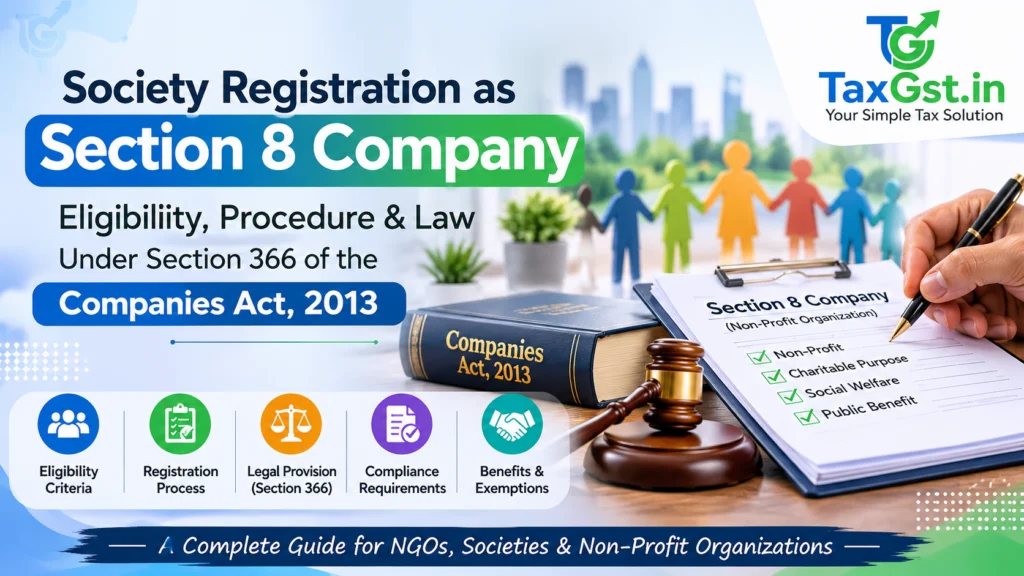
A registered society can legally convert itself into a Section 8 company by registering under Section 366 of the Companies Act, 2013 read with the Companies (Authorised to Register) Rules, 2014. The process requires a three-fourths majority member resolution, secured creditor consent, filing of Form URC-1 with the Registrar of Companies, publication of a public notice in Form URC-2, and finally obtaining a license under Section 8 from the Regional Director. Upon approval, the Registrar issues a Certificate of Incorporation under Section 367, giving the entity legal continuity as a company limited by guarantee.
Also Read – CDSCO Registration Process, Regulatory Framework & Compliance
What is the Quick Summary of Society to Section 8 Company Conversion?
- A society can register as a Section 8 company under Section 366 of the Companies Act, 2013 as a company limited by guarantee.
- The entity must have a minimum of two members; societies with fewer than seven members must register as a private company.
- A special resolution passed by at least three-fourths of members present (in person or by proxy) is mandatory under the Companies (Authorised to Register) Rules, 2014.
- Written consent from every secured creditor is required before filing the application.
- The society must be fully compliant with all annual filings under the Societies Registration Act, 1860 or applicable state legislation — defaulters are ineligible under Section 366.
- The process involves filing Form URC-1, publishing Form URC-2 in English and vernacular newspapers, and obtaining a license via Form INC-12 before incorporation through SPICe+.
How Does a Society Register Itself as a Section 8 Company?
The statutory route for a society to become a Section 8 company is provided under Section 366 of the Companies Act, 2013, read with Part I of Chapter XXI and the Companies (Authorised to Register) Rules, 2014. Although commonly called a “conversion,” the law treats it as a statutory registration of the existing society — not the creation of a new entity followed by asset transfer. This distinction matters because Section 366 itself governs the vesting of property, continuation of liabilities, and pending proceedings, ensuring legal continuity without requiring separate conveyancing.
The society must first pass a resolution at a duly convened general meeting. Where the liability of members is not already limited and the society seeks registration as a limited company, the assent must come from at least three-fourths of the members present personally or through proxy, as prescribed under the Companies (Authorised to Register) Rules, 2014. The resolution must also declare the amount each member undertakes to contribute to the company’s assets in the event of winding up — this is the “guarantee” that defines a company limited by guarantee.
Once the resolution is passed, the society files Form No. URC-1 with the Registrar of Companies, attaching the prescribed documents including the member resolution, creditor consent, latest income-tax return, and auditor-certified statement of accounts prepared not earlier than fifteen days before the filing date. Simultaneously, the society must publish an advertisement in Form No. URC-2 in one English newspaper and one vernacular newspaper circulating in the district where the society is situated, allowing twenty-one clear days for objections.
What Are the Eligibility Requirements for a Society to Qualify for Section 8 Registration?
The applicant must be a legally registered society holding a valid certificate of registration under the Societies Registration Act, 1860 or the applicable state legislation. A certified copy of this certificate must accompany the application. All amendments to the society’s memorandum, rules, or bye-laws must be properly approved and recorded with the Registrar of Societies — any mismatch between the society’s official records and the documents submitted to the Registrar of Companies can lead to resubmission or rejection.
The society must have two or more members at the time of registration, as Section 366 permits registration only for an eligible entity consisting of two or more members. Where the society has fewer than seven members, it must register as a private Section 8 company. Societies with seven or more members may opt for registration as a public Section 8 company, subject to the requirements applicable to that category.
The objects of the society must be charitable, educational, religious, scientific, cultural, social, or otherwise consistent with Section 8 of the Companies Act, 2013. Objects that permit private profit, distribution of surplus, personal benefit to members, or unrestricted commercial activities must be removed or suitably modified before the application. The society must also confirm that it intends to apply its profits — if any — solely towards promoting its objects and prohibits payment of any dividend to its members.
A critical eligibility filter is compliance history. The Companies (Authorised to Register) Rules, 2014 expressly provide that a society which has not filed its statutory annual or other returns with the Registrar of Societies is not eligible to apply under Section 366. All historical defaults must be regularised before the MCA filing is initiated. Additionally, where the society has borrowed money against security or created a charge over any asset, written consent or a no-objection certificate must be obtained from every secured creditor before the conversion application is filed.
What Changes After a Society Becomes a Section 8 Company?
Once the Certificate of Incorporation is issued under Section 367 of the Companies Act, 2013, the entity transitions from state-level regulation to central oversight by the Ministry of Corporate Affairs. The society’s objects, assets, contracts, and pending liabilities vest automatically in the company by operation of law — no separate conveyance or assignment deed is required. However, the governance framework changes significantly: the governing body becomes a board of directors, the memorandum and articles can no longer be altered without prior Central Government approval under Section 8(4)(i), and every related party transaction exceeding ₹1 lakh must be disclosed and recorded under Sections 188 and 189.
The compliance calendar also shifts. Section 8 companies enjoy certain relaxations — board meetings are required only once every six calendar months, AGM notice is reduced to 14 days, and quorum for general meetings is the lower of 8 members or 25% of total strength (subject to a minimum of 2 members). However, these exemptions are conditional: as per MCA Notification No. G.S.R. 466(E) dated June 5, 2015, they apply only when the company is not in default of filing financial statements under Section 137 or annual returns under Section 92 with the Registrar.
| Parameter | Registered Society | Section 8 Company |
|---|---|---|
| Governing Law | Societies Registration Act, 1860 or state legislation | Companies Act, 2013 |
| Regulatory Authority | State Government (Registrar of Societies) | Central Government (MCA) |
| Alteration of objects | As per society bye-laws and state rules | Previous approval of Central Government mandatory under Section 8(4)(i) |
| Related party transaction disclosure | Not statutorily mandated | Mandatory when transaction exceeds ₹1 lakh under Sections 188 and 189 |
| AGM notice period | As per bye-laws | 14 days under MCA exemption |
| Board meeting frequency | As per bye-laws | At least one meeting within every six calendar months |
What Documents Must Be Prepared and Filed for Society-to-Section-8 Conversion?
The document package for registering a society as a Section 8 company is governed by the Companies (Authorised to Register) Rules, 2014, read with the incorporation requirements under Chapter II of the Companies Act, 2013. The filing is split into two stages — the initial registration application and the subsequent incorporation — and missing even one mandatory attachment leads to resubmission or rejection by the Registrar of Companies.
For the first stage, Form No. URC-1 must be filed with the following attachments:
- A certified copy of the society’s registration certificate.
- The special resolution passed by three-fourths of members approving the registration.
- A separate resolution declaring the guarantee amount each member undertakes to contribute.
- Written consent or NOC from every secured creditor.
- The latest income-tax return filed by the society.
- A statement of accounts prepared not earlier than 15 days before the filing date and certified by the auditor.
After the Registrar approves URC-1, the society must file Form No. INC-12 with the Regional Director for issuance of a license under Section 8. This application carries its own document set: the memorandum of association in Form No. INC-13 and articles of association of the proposed company; a declaration in Form No. INC-14 by a practicing professional (CA, CS, or Advocate) confirming compliance; an estimate of future annual income and expenditure for the next three years; and a declaration in Form No. INC-15. Each director must furnish consent in Form DIR-2, and each subscriber must submit an affidavit in Form INC-9.
Once the license is issued, incorporation is completed by filing SPICe+ (Form INC-32) along with the approved MOA, AOA, and address proofs. The Registrar then issues a Certificate of Incorporation in Form INC-11 and a Certificate of Registration under Section 367. Within fifteen days of registration, the company must intimate the concerned Registrar of Societies along with necessary papers for dissolution of the original society registration.
How Should the Society Handle Secured Creditor Consent and Past Filing Defaults?
Two procedural hurdles trip up most society-to-Section-8 applications: secured creditor objections and historical non-compliance with the Societies Registration Act. Both must be resolved before the MCA accepts the filing — the Registrar of Companies does not have the authority to waive either requirement.
Under the Companies (Authorised to Register) Rules, 2014, where the society has borrowed money against security or created a charge over any asset, written consent or a no-objection certificate must be obtained from every secured creditor. This covers all secured loans, mortgages, hypothecations, and charges — the society cannot treat a loan as unsecured merely because no charge was registered with the Registrar of Societies. If a secured creditor refuses consent, the society must either repay the outstanding facility or restructure the obligation before proceeding.
The second hurdle is the statutory bar on defaulter societies. The Companies (Authorised to Register) Rules, 2014 expressly provide that a society which has not filed its annual or other returns statutorily required with the Registrar of Societies is ineligible to apply under Section 366. This means all pending annual returns, governing-body lists, and financial statements must be completed and taken on record before the MCA application is initiated. The governing body should conduct a detailed pre-filing review covering the registration certificate, memorandum, bye-laws, membership register, and audited accounts before initiating the conversion process.
What Is the Step-by-Step Procedure to Convert a Society into a Section 8 Company?
The conversion process follows a strict statutory sequence under Section 366 of the Companies Act, 2013. Missing any step or filing incomplete documents leads to resubmission and delays.
| Pitfall | Consequence | How to Avoid |
|---|---|---|
| Pending annual returns with Registrar of Societies | Application rejected under Section 366 | File all overdue returns before URC-1 submission |
| Objects permitting dividend or private profit | Section 8 licence refused by Regional Director | Amend memorandum to align with Section 8(1)(a)–(c) before filing |
| Unregistered charge treated as unsecured | Objection during URC-2 notice period | Disclose all borrowings and obtain NOC from every secured creditor |
| Statement of accounts older than 15 days | Resubmission required | Obtain fresh auditor-certified accounts immediately before filing |
| Failure to intimate Registrar of Societies post-conversion | Dual compliance liability | Send dissolution intimation within 15 days under Section 367 |
Pro Tip: The guarantee amount in a company limited by guarantee does not need to be deposited at the time of incorporation — it is a contingent commitment enforceable only upon winding up. However, the amount must be clearly stated in the member resolution and the articles of association. Most societies adopt a nominal guarantee of ₹1,000 to ₹10,000 per member to avoid ambiguity during the licence application.
What Should You Do Next?
- Verify that your society holds a valid registration certificate under the Societies Registration Act, 1860 or applicable state law.
- Audit your compliance history — confirm that all annual returns, governing-body lists, and financial statements required under society law have been filed.
- Review the society’s objects clause and remove or modify any provision that permits private profit or dividend distribution.
- Identify all secured creditors and obtain written consent or no-objection certificates from each before the general meeting is convened.
- Convene a general meeting with proper notice and pass a special resolution with at least three-fourths majority.
- Engage a practicing Chartered Accountant, Company Secretary, or Advocate to certify the statement of accounts (prepared within 15 days of filing) and to provide the declaration in Form INC-14.
- File Form URC-1 with the Registrar of Companies and simultaneously publish Form URC-2 in one English and one vernacular newspaper.
Frequently Asked Questions
Can a society with fewer than seven members register as a Section 8 company?
Yes. Section 366 of the Companies Act, 2013 permits registration by an eligible entity consisting of two or more members. However, the Companies (Authorised to Register) Rules, 2014 provide that an entity having fewer than seven members must register as a private company. Therefore, a society with two to six members may register as a private Section 8 company limited by guarantee.
Is secured creditor consent mandatory before filing the conversion application?
Yes, it is mandatory. The Companies (Authorised to Register) Rules, 2014 expressly require written consent or a no-objection certificate from every secured creditor where the society has borrowed money against security or created a charge over any of its assets. Without secured creditor consent, the application under Section 366 will not be accepted by the Registrar of Companies.
What happens to the society’s existing contracts, property, and liabilities after conversion?
Section 366 provides legal continuity. Upon registration, all property, rights, and liabilities of the society vest automatically in the Section 8 company by operation of law. Pending proceedings continue in the name of the company. No separate conveyance, assignment deed, or transfer document is required for immovable or movable property.
Can a Section 8 company alter its memorandum and articles freely after conversion?
No. Section 8(4)(i) of the Companies Act, 2013 prohibits a Section 8 company from altering the provisions of its memorandum or articles except with the previous approval of the Central Government. This restriction applies to all changes — whether to objects, liability clauses, or internal governance provisions. Any amendment filed without Central Government approval is void.
What Tax Benefits Does a Section 8 Company Enjoy After Conversion?
Upon conversion, the entity becomes eligible to apply for registration under Section 12A of the Income Tax Act, 1961, which exempts the company’s income from tax subject to compliance conditions. Additionally, the company can apply for Section 80G certification, which allows donors to claim a deduction on their donations — a significant advantage for fundraising. These registrations can be applied for provisionally within the first three years of incorporation. The company must also apply for PAN and TAN immediately after incorporation and open a dedicated bank account in the company’s name.
Can a Section 8 Company Receive Foreign Donations Under FCRA?
Yes, but only after meeting specific eligibility criteria under the Foreign Contribution (Regulation) Act. The Section 8 company must have a minimum operational history of three years and must have spent at least ₹15 lakhs on its core activities over the preceding three financial years. Capital assets like land, building, and equipment may be counted towards this threshold. The company must also possess a valid 12A certificate and must open a designated FCRA account with the State Bank of India, Main Branch, New Delhi, before receiving any foreign contribution.
What Happens If a Section 8 Company Violates Its License Conditions?
Under Section 8(11) of the Companies Act, 2013, if a company defaults in complying with the requirements of Section 8, the company is punishable with a fine of not less than ₹10 lakh but which may extend to ₹1 crore. Every director or officer in default faces imprisonment up to three years, or a fine of not less than ₹25,000 but which may extend to ₹25 lakh, or both. Furthermore, the Central Government may revoke the license under Section 8(6) and direct the company to either convert its status (adding “Limited” or “Private Limited” to its name) or be wound up in the public interest. Fraudulent conduct also attracts action under Section 447, which deals with fraud.
Can a Section 8 Company Be Converted Back to Another Structure?
Yes, but the process is restrictive. Under Section 8(4)(ii), a Section 8 company may convert itself into a company of any other kind only after complying with prescribed conditions. This requires passing a special resolution at a general meeting, obtaining approval from the Central Government, and following the procedure laid down in the rules. The Central Government may also revoke the earlier license and direct the company to change its name by adding “Limited” or “Private Limited” as applicable.
Sources
- TaxGuru — Society Registration as Section 8 Company: Eligibility, Procedure & Law
- TaxGuru — Conversion of Society into Section 8 Company
- TaxGuru — Section 8 Companies: Formation, Compliance, Features & Exemptions
- TaxGuru — Extract of Section 8 of Companies Act, 2013
Ready to begin your society’s conversion to a Section 8 company? Start by conducting a thorough compliance audit of your existing society filings and engage a qualified professional to guide you through the documentation and MCA filing process. Early preparation of member resolutions, creditor consents, and properly drafted constitutional documents will significantly reduce processing delays and objections.
Article Information
Published: July 20, 2026
Last Reviewed: July 20, 2026
Category: Company Law & Compliance
Regulatory Body: Ministry of Corporate Affairs (MCA)
Written by C.K. Gupta, M.Com & Tax Editor at TaxGST.in — helping entities navigate MCA compliance, incorporation, and structural conversions since 2009.
Official Resources
Disclaimer: This article is for informational purposes only. Corporate restructuring involves complex legal and financial liabilities. Always consult a practicing Company Secretary or Chartered Accountant before initiating conversion under Section 366.
ITR, GST returns, notices and registrations — fixed fees, human support, on-time filing.
Discover more from TaxGst.in
Subscribe to get the latest posts sent to your email.



Never Miss a Tax Deadline Again
Due-date alerts, GST updates and tax tips — free on the app you already use.
event Next: GSTR-1 · 11 Oct