
 C.K. Gupta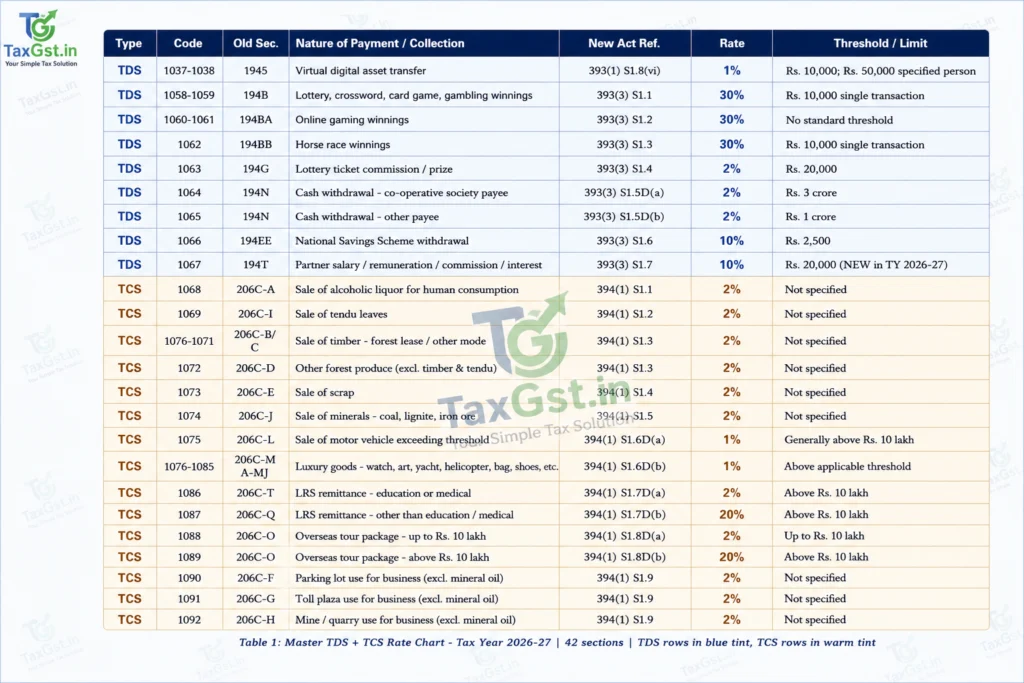
TDS Rate Chart FY 2026-27 PDF Download.
DOWNLOAD PDF HERE
The TDS and TCS Rate Chart for Tax Year/FY 2026-27 (effective 01 April 2026) operates under the newly enacted Income-tax Act, 2025, which consolidates all TDS provisions into Section 392 (salary), Section 393 (other payments), and TCS under Section 394. While most rates and thresholds remain unchanged from the earlier law, the section numbers, payment codes, and compliance references have been entirely restructured, requiring deductors to update their systems for the new tax year.
Also Read-Complete Income Tax Chart Covering Finance Act, 2026
Master TDS + TCS Rate Chart – Tax Year (FY) 2026-27
| Type | Code | Old Sec. | Nature of Payment / Collection | New Act Ref. | Rate | Threshold / Limit |
|---|---|---|---|---|---|---|
| TDS | 1001-1003 | 192 | Salary – govt / other employees | 392 | As per slab | Basic exemption / salary computation |
| TDS | 1019 | 193 | Interest on securities | 393(1) Sl.5(i) | 10% | Rs. 10,000 |
| TDS | 1020 | 194A | Interest (other than securities) – senior citizen | 393(1) Sl.5(ii).D(a) | 10% | Rs. 1,00,000 |
| TDS | 1021 | 194A | Interest (other than securities) – non-senior citizen | 393(1) Sl.5(ii).D(b) | 10% | Rs. 50,000 |
| TDS | 1022 | 194A | Other interest (other than securities) | 393(1) Sl.5(iii) | 10% | Rs. 10,000 |
| TDS | 1023-1024 | 194C | Contractor / sub-contractor / labour contract | 393(1) Sl.6(i) | 1% Ind/HUF; 2% others | Rs. 30,000 single; Rs. 1,00,000 aggregate |
| TDS | 1005 | 194D | Insurance commission | 393(1) Sl.1(i) | 2% Ind/HUF; 10% others | Rs. 20,000 |
| TDS | 1006 | 194H | Commission / brokerage (other than insurance) | 393(1) Sl.1(ii) | 2% | Rs. 20,000 (KEY UPDATE: not Rs. 15,000 / 5%) |
| TDS | 1008 | 194I(a) | Rent on plant & machinery – specified person | 393(1) Sl.2(ii).D(a) | 2% | Rs. 50,000 per month |
| TDS | 1009 | 194I(b) | Rent of land, building, furniture, fittings | 393(1) Sl.2(ii).D(b) | 10% | Rs. 50,000 per month |
| TDS | 1026 | 194J(a) | Technical services, call centre, royalty / cinema distribution | 393(1) Sl.6(iii).D(a) | 2% | Rs. 50,000 |
| TDS | 1027 | 194J(b) | Professional services and other specified sums | 393(1) Sl.6(iii).D(b) | 10% | Rs. 50,000 |
| TDS | 1028 | 194J(b) | Director fees / remuneration / commission (non-salary) | 393(1) Sl.6(iii).D(b) | 10% | No threshold |
| TDS | 1029 | 194 | Dividend incl. preference shares | 393(1) Sl.7 | 10% | Rs. 10,000 (individual) |
| TDS | 1030 | 194DA | Life insurance payout not exempt | 393(1) Sl.8(i) | 2% | Rs. 1,00,000 |
| TDS | 1031 | 194Q | Purchase of goods | 393(1) Sl.8(ii) | 0.1% | Excess over Rs. 50 lakh |
| TDS | 1033-1034 | 194R | Benefit / perquisite from business | 393(1) Sl.8(iv) | 10% | Rs. 20,000 (incl. cash / in-kind) |
| TDS | 1035 | 194O | E-commerce operator payment to participant | 393(1) Sl.8(v) | 0.1% | Rs. 5 lakh (Ind/HUF) |
| TDS | 1037-1038 | 194S | Virtual digital asset transfer | 393(1) Sl.8(vi) | 1% | Rs. 10,000; Rs. 50,000 specified person |
| TDS | 1058-1059 | 194B | Lottery, crossword, card game, gambling winnings | 393(3) Sl.1 | 30% | Rs. 10,000 single transaction |
| TDS | 1060-1061 | 194BA | Online gaming winnings | 393(3) Sl.2 | 30% | No standard threshold |
| TDS | 1062 | 194BB | Horse race winnings | 393(3) Sl.3 | 30% | Rs. 10,000 single transaction |
| TDS | 1063 | 194G | Lottery ticket commission / prize | 393(3) Sl.4 | 2% | Rs. 20,000 |
| TDS | 1064 | 194N | Cash withdrawal – co-operative society payee | 393(3) Sl.5.D(a) | 2% | Rs. 3 crore |
| TDS | 1065 | 194N | Cash withdrawal – other payee | 393(3) Sl.5.D(b) | 2% | Rs. 1 crore |
| TDS | 1066 | 194EE | National Savings Scheme withdrawal | 393(3) Sl.6 | 10% | Rs. 2,500 |
| TDS | 1067 | 194T | Partner salary / remuneration / commission / interest | 393(3) Sl.7 | 10% | Rs. 20,000 (NEW in TY 2026-27) |
| TCS | 1068 | 206C-A | Sale of alcoholic liquor for human consumption | 394(1) Sl.1 | 2% | Not specified |
| TCS | 1069 | 206C-I | Sale of tendu leaves | 394(1) Sl.2 | 2% | Not specified |
| TCS | 1070-1071 | 206C-B/ C | Sale of timber – forest lease / other mode | 394(1) Sl.3 | 2% | Not specified |
| TCS | 1072 | 206C-D | Other forest produce (excl. timber & tendu) | 394(1) Sl.3 | 2% | Not specified |
| TCS | 1073 | 206C-E | Sale of scrap | 394(1) Sl.4 | 2% | Not specified |
| TCS | 1074 | 206C-J | Sale of minerals – coal, lignite, iron ore | 394(1) Sl.5 | 2% | Not specified |
| TCS | 1075 | 206C-L | Sale of motor vehicle exceeding threshold | 394(1) Sl.6.D(a) | 1% | Generally above Rs. 10 lakh |
| TCS | 1076-1085 | 206C-M A-MJ | Luxury goods – watch, art, yacht, helicopter, bag, shoes, etc. | 394(1) Sl.6.D(b) | 1% | Above applicable threshold |
| TCS | 1086 | 206C-T | LRS remittance – education or medical | 394(1) Sl.7.D(a) | 2% | Above Rs. 10 lakh |
| TCS | 1087 | 206C-Q | LRS remittance – other than education / medical | 394(1) Sl.7.D(b) | 20% | Above Rs. 10 lakh |
| TCS | 1088 | 206C-O | Overseas tour package – up to Rs. 10 lakh | 394(1) Sl.8.D(a) | 2% | Up to Rs. 10 lakh |
| TCS | 1089 | 206C-O | Overseas tour package – above Rs. 10 lakh | 394(1) Sl.8.D(b) | 20% | Above Rs. 10 lakh |
| TCS | 1090 | 206C-F | Parking lot use for business (excl. mineral oil) | 394(1) Sl.9 | 2% | Not specified |
| TCS | 1091 | 206C-G | Toll plaza use for business (excl. mineral oil) | 394(1) Sl.9 | 2% | Not specified |
| TCS | 1092 | 206C-H | Mine / quarry use for business (excl. mineral oil) | 394(1) Sl.9 | 2% | Not specified |
Quick Summary
- New TDS sections: Section 392 (salary), Section 393 (all other payments), replacing the old Sections 192-195 series of the Income-tax Act, 1961.
- TCS now governed by Section 394 of the Income-tax Act, 2025, replacing Section 206C of the Income-tax Act, 1961.
- Effective date: 01 April 2026 for Financial Year 2026-27.
- Most TDS/TCS rates and threshold limits remain the same as under the earlier law.
- New payment codes introduced for challan filing and TDS return reporting.
- Higher TCS applies for non-PAN/Aadhaar cases: higher of twice the applicable rate, 5%, or 20%.
What Has Changed in the TDS Structure Under the Income-tax Act, 2025?
The Income-tax Act, 2025 has fundamentally restructured how TDS provisions are organized. Salary payments now fall under Section 392, replacing the old Section 192. All other TDS payments, including interest, dividends, contractor fees, rent, professional fees, and winnings, are consolidated under Section 393, replacing the scattered Sections 193 through 195 of the earlier Act.
TCS provisions have similarly been re-enacted. The old Section 206C of the Income-tax Act, 1961, which governed tax collected at source, now stands consolidated into Section 394 of the Income-tax Act, 2025. The sub-sections covering liquor, tendu leaves, timber, scrap, minerals, motor vehicles, foreign remittances, and tour packages are now restructured under Section 394 with new clause references.
A significant compliance update is the explicit inclusion of “supply of manpower” within the definition of “work” under section 402(27) of the Income-tax Act, 2025. This clarifies that TDS on manpower supply contracts is governed by the contractor payment provisions under Section 393(1), effective from 01 April 2026.
What Are the Key TDS Rates and Thresholds for FY 2026-27?
Salary TDS under Section 392 continues to apply as per applicable income tax slab rates. Premature EPF withdrawals attract 10% TDS under Section 392(7) where the accumulated balance exceeds ₹50,000 and the employee has not completed 5 years of continuous service. Interest on securities is taxed at 10% under Section 393(1) above ₹10,000 per financial year. Dividends carry 10% TDS under Section 393(1) above a threshold limit of ₹10,000.
Bank and post office interest for senior citizens attracts 10% TDS under Section 393(1) above ₹1,00,000, while for other individuals the threshold is ₹50,000. Contractor payments are taxed at 1% for individuals and HUF, and 2% for others under Section 393(1), with thresholds of ₹30,000 per contract or ₹1,00,000 aggregate per financial year. Professional fees carry 10% TDS under Section 393(1) above ₹50,000, while technical services and call center services attract 2% TDS.
Rent on plant and machinery is taxed at 2% under Section 393(1), while rent on land, building, and furniture attracts 10%, both above ₹50,000 per month. Immovable property purchases require 1% TDS under Section 393(1) on consideration exceeding ₹50 lakh. Lottery, gambling, and horse race winnings attract 30% TDS under Section 393(3) above ₹10,000, while online gaming winnings are taxed at 30% on net winnings with no threshold. Purchase of goods attracts 0.1% TDS under Section 393(1) above ₹50 lakh. E-commerce transactions are taxed at 0.1% under Section 393(1) with a ₹5 lakh threshold for individuals and HUF.
How Do TCS Provisions Compare Under the Old and New Tax Acts?
Tax Collected at Source continues to apply on the same specified goods and services, but the section references have shifted from Section 206C of the Income-tax Act, 1961 to Section 394 of the Income-tax Act, 2025. The rates and thresholds remain largely unchanged, though practitioners must cite the new clause references in challan filings and TCS returns from 01 April 2026 onwards.
Practical Worked Example: A buyer purchases goods worth ₹75,00,000 from a seller during FY 2026-27. The buyer’s turnover exceeded ₹10 crore in the preceding financial year. Under Section 393(1) [Sl. No. 8(ii)] of the Income-tax Act, 2025, TDS on purchase of goods applies at 0.1% on the amount exceeding ₹50,00,000. The TDS calculation works as follows: ₹75,00,000 minus ₹50,00,000 equals ₹25,00,000 (taxable amount), and 0.1% of ₹25,00,000 equals ₹2,500. The buyer deducts ₹2,500 and remits it to the government using the new payment code 1031 while filing the TDS statement.
For non-PAN or non-Aadhaar cases, the TCS rate escalates significantly. As per the applicable provisions under Section 394, if a buyer fails to furnish PAN or Aadhaar, the collector must charge TCS at the higher of twice the applicable rate, 5%, or 20%. This makes PAN verification a critical compliance step before executing high-value transactions under the new regime.
How to Deposit TDS and File Returns Under the Income-tax Act, 2025?
TDS deposit procedures have been updated to align with the new structural framework. When making a TDS payment through the government portal, deductors must now select the applicable law as “Income-tax Act, 2025” rather than the earlier 1961 Act. The payment flow requires navigating to the tax payment option, selecting “New Payment Option,” and choosing the relevant Tax Year (for example, 2026-27 for the current financial year).
A critical distinction is that from FY 2026-27 onwards, the assessment year concept has been replaced by the tax year for payment purposes. Financial year must always be selected for TDS/TCS deposit, which is now termed as tax year under the new regime. Deductors must click on ‘Proceed’ under the option “Pay TDS / TCS” for Sections 392, 393 and 394, and then select the status of the deductee as Resident or Non-Resident before entering the specific payment codes.
New payment codes have been introduced for challan filing and TDS return reporting. For instance, payment code 1004 applies to accumulated balance payments to employees under Section 392(7), code 1023 applies to contractor payments to individuals and HUF under Section 393(1), and code 1031 applies to purchase of goods under Section 393(1). Multiple section codes can be selected in a single challan under the new regime, simplifying the compliance process for deductors handling diverse payment types.
For verifying TDS credits, taxpayers must now use Form 149, which replaces the earlier Form 26A. This updated statement reflects deductions made under the new section codes and payment codes. Deductors should update their ERP systems, payroll software, and accounting applications to generate reports using the new section references and payment codes to avoid reconciliation mismatches during return filing.
Who is Exempt from TDS Deduction and What Are the Threshold Conditions?
Several exemptions and threshold conditions reduce the TDS compliance burden for specific categories of taxpayers. Under Section 392(7) of the Income-tax Act, 2025, no TDS applies on premature EPF withdrawals if the employee has completed 5 years of continuous service. Where this condition is not met, TDS at 10% applies only when the accumulated balance exceeds ₹50,000.
Interest income exemptions apply under Section 393(1) for government securities, LIC, GIC, and insurers. Dividend payments are similarly exempt when made to LIC, GIC, any other insurer, or a business trust. For interest other than securities, senior citizens enjoy a higher threshold of ₹1,00,000 under Section 393(1), compared to ₹50,000 for other individuals and ₹10,000 for non-bank interest payments.
Small taxpayers benefit from a significant compliance relaxation. Under the applicable provisions, individuals and HUF whose turnover or gross receipts do not exceed ₹1 crore in case of business or ₹50 lakh in case of profession in the preceding financial year need not deduct TDS under the provisions corresponding to old Sections 194C, 194J, 194H, and 194I (now consolidated under Section 393(1)). However, this exemption does not apply to rent payments exceeding ₹50,000 per month or contractor and professional payments exceeding ₹50 lakh.
PAN and Aadhaar compliance carries significant cost implications. Under Section 394, if a buyer fails to furnish a valid PAN or Aadhaar, the collector must charge TCS at the higher of twice the applicable rate, 5%, or 20%. This makes PAN verification a mandatory step before executing high-value transactions such as property purchases, motor vehicle sales, and foreign remittances. For e-commerce transactions under Section 393(1), individuals and HUF are exempt from TCS only if they have furnished their PAN or Aadhaar to the e-commerce operator.
What Are the Higher TDS and TCS Rates for Non-Filers and Non-PAN Cases?
The Income-tax Act, 2025 imposes penal TDS and TCS rates on taxpayers who fail to furnish PAN or Aadhaar, or who have not filed their income tax returns. Under Section 393(3) of the Income-tax Act, 2025, where a recipient has not filed the return of income for the preceding financial year for which the time limit to file return has expired, and the TDS/TCS amount exceeds ₹50,000 in that preceding year, the deductor must apply higher rates. The higher TDS rate applies at the higher of twice the rate prescribed in the relevant provision or 5%.
For TCS, Section 394 of the Income-tax Act, 2025 escalates the rate significantly when the buyer fails to provide PAN or Aadhaar. The collector must charge TCS at the higher of twice the applicable rate, 5%, or 20%. This makes PAN and Aadhaar verification a mandatory step before executing high-value transactions such as property purchases, motor vehicle sales, and foreign remittances under the Liberalised Remittance Scheme.
Practical Worked Example: A resident individual purchases a motor vehicle valued at ₹18,00,000 from a dealer in FY 2026-27. Under Section 394(1) [Sl. No. 6] of the Income-tax Act, 2025, TCS on sale of motor vehicle applies at 1% on value exceeding ₹10,00,000. The TCS calculation works as follows: ₹18,00,000 minus ₹10,00,000 equals ₹8,00,000 (taxable amount), and 1% of ₹8,00,000 equals ₹8,000. If the buyer fails to furnish PAN, the TCS rate escalates to the higher of twice the rate (2%), 5%, or 20% — which is 20%. The dealer collects 20% of ₹8,00,000, which equals ₹1,60,000, and remits it to the government using the applicable payment code.
How Does TDS Apply to E-Commerce, Virtual Digital Assets, and Partner Payments?
E-commerce operators face specific TDS obligations under the Income-tax Act, 2025. TDS on e-commerce transactions applies at 0.1% on the gross amount of sale of goods or services through an electronic commerce platform under Section 393(1). For individuals and Hindu undivided families, TDS applies only when the gross amount exceeds ₹5,00,000 in a financial year; for all other persons, there is no threshold, and TDS applies from the first rupee of gross transaction value.
Virtual Digital Assets, including cryptocurrency and non-fungible tokens, attract 1% TDS under Section 393(1) of the Income-tax Act, 2025. The threshold is ₹50,000 in a financial year for specified persons (individuals or HUFs whose turnover does not exceed ₹1 crore in business or ₹50 lakh in profession), and ₹10,000 for other persons. This applies to the transfer of VDA at the time of credit to the account of the transferor or at the time of payment, whichever is earlier.
A common pitfall for businesses is failing to verify the PAN and filing status of deductees before applying TDS rates. Under the Income-tax Act, 2025, the higher TDS rate for non-filers applies when the deductee is a “specified person”. A specified person is one who has not filed their income tax return for two preceding tax years, and the aggregate of TDS/TCS in each of those years was ₹50,000 or more. Deductors must check the deductee’s filing status through the TRACES portal or the compliance utility before determining the applicable rate, particularly for recurring payments such as rent, professional fees, and contractor payments where aggregate annual amounts frequently cross threshold limits.
What Should Businesses Do Next?
- Update your ERP, payroll, and accounting systems to reflect the correct section references under the Income-tax Act, 2025 (e.g., Sections 392, 393, and 394) for all TDS/TCS transactions from 01 April 2026 onwards.
- Train your finance and compliance teams on the applicable payment codes required for challan filing and TDS/TCS return reporting, verifying them on the official income tax portal.
- Review all existing contractor, professional, and rent agreements to verify that TDS deduction logic aligns with the revised thresholds and new reporting references under the Income-tax Act, 2025.
- Implement a PAN/Aadhaar verification workflow for all buyers in TCS-applicable transactions to avoid the higher collection rate under the new provisions.
- Reconcile your TDS-TCS credit statements regularly on the income tax portal to ensure that deducted and collected taxes are correctly reflected against your PAN before filing the income tax return.
- Ensure your compliance checklists correctly map the relevant provisions of the Income-tax Act, 2025 to avoid citation errors in audit proceedings and assessment scrutiny.
- Consult your tax advisor before 30 September 2026 to determine whether any structural changes impact your advance tax liability or require revision of estimated tax payments for FY 2026-27.
Frequently Asked Questions
From which date do the revised TDS and TCS provisions become applicable for FY 2026-27?
The TDS and TCS provisions under the Income-tax Act, 2025 are effective from 1 April 2026 and apply to all transactions undertaken during Financial Year 2026-27 onwards. Deductors and collectors must use the new applicable section numbers, payment codes, and challan references for all deposits and returns filed on or after this date.
What is the TDS rate on purchase of goods under the Income-tax Act, 2025?
TDS on purchase of goods is applicable at 0.1% under Section 393(1) of the Income-tax Act, 2025, where the aggregate value of goods purchased from a seller exceeds ₹50 lakh during the financial year. This provision applies only if the buyer’s turnover exceeded ₹10 crore in the immediately preceding financial year. The tax is deducted on the amount exceeding the ₹50 lakh threshold.
How does TCS apply on sale of motor vehicles?
Under Section 394(1) of the Income-tax Act, 2025, TCS on sale of motor vehicles is collected at 1% on the sale consideration exceeding ₹10 lakh per transaction. This threshold applies per transaction and not on an aggregate annual basis. The seller collects the tax at the time of sale and remits it using the applicable payment code.
What is the TCS rate when the buyer fails to furnish PAN or Aadhaar?
When a buyer fails to furnish a valid PAN or Aadhaar, the collector must charge TCS at the higher of twice the applicable rate or 5%. This punitive rate applies across all TCS provisions under Section 394 of the Income-tax Act, 2025. Verifying PAN or Aadhaar before executing the transaction is essential to avoid this higher collection burden.
What happens if a deductor cites incorrect section numbers in TDS returns for FY 2026-27?
From 01 April 2026, all TDS returns and challan payments must correctly reference the applicable section numbers under the Income-tax Act, 2025. Citing outdated sections from the 1961 Act (such as 192, 194C, or 206C) may result in processing errors, mismatches in the tax credit system, and potential compliance notices. Deductors must ensure their systems correctly use Section 392 for salary, Section 393 for other payments, and Section 394 for TCS collections.
What is the TDS rate on virtual digital assets?
Virtual digital asset transactions are covered under Section 393(1) of the Income-tax Act, 2025. The TDS rate is 1% on the transfer of crypto assets and other virtual digital assets. The threshold limit is ₹10,000 per financial year for most taxpayers, but for specified persons, the threshold is higher at ₹50,000.
Do businesses need to update their ERP systems for TDS payment codes?
Yes. Businesses must ensure their ERP systems, payroll software, and accounting applications are updated to correctly use the applicable payment codes and section references (Sections 392, 393, 394) under the Income-tax Act, 2025, for challan filing and TDS/TCS return reporting for FY 2026-27 onwards. Incorrect codes or section references can lead to compliance issues.
Sources
- TaxGuru — TDS & TCS Rate Chart FY 2026-27: Guide to New & Old Sections
- TaxGuru — TCS Rate Chart for Tax Year 2026-27 under Income-tax Act, 2025
- TaxGuru — Guide to TDS/TCS Restructuring for FY 2026-27 under Income Tax Act, 2025
- TaxGuru — TDS Rates & Thresholds for FY 2026-27 (w.e.f. 01.04.2026)
- TaxGuru — Income-tax Act, 2025: TDS Rates, Thresholds & Compliance Changes for TY 2026-27
- ClearTax — TDS Rate Chart
- TaxGuru — TDS Payment Under New Income Tax Act 2025
Next step: Verify the latest rates and thresholds on the official Income Tax India portal before filing your first TDS return for FY 2026-27. Update your payment systems with the correct section codes and ensure proper financial year selection to avoid compliance mismatches from 01 April 2026 onwards.
Article Information
Published: July 19, 2026
Last Reviewed: July 19, 2026
Category: Income Tax
Regulatory Body: CBDT (Central Board of Direct Taxes)
Written by C.K. Gupta, M.Com & Tax Editor at TaxGST.in — helping 500+ clients navigate IT notices, GST audits, and ITR filings across Delhi NCR since 2009.
Official Resources
- Income Tax Portal (e-Filing)
- TRACES (TDS/TCS)
- AIS/TIS Portal
- CBDT Circulars
- ITR e-Filing AY 2027-28
- Source Document (PDF)
Disclaimer: This article is for informational purposes only. For legal advice, consult a qualified tax professional. Always refer to the official gazette for authoritative text on the Income-tax Act, 2025.
ITR, GST returns, notices and registrations — fixed fees, human support, on-time filing.
Discover more from TaxGst.in
Subscribe to get the latest posts sent to your email.

Never Miss a Tax Deadline Again
Due-date alerts, GST updates and tax tips — free on the app you already use.
event Next: GSTR-1 · 11 Oct