
 C.K. Gupta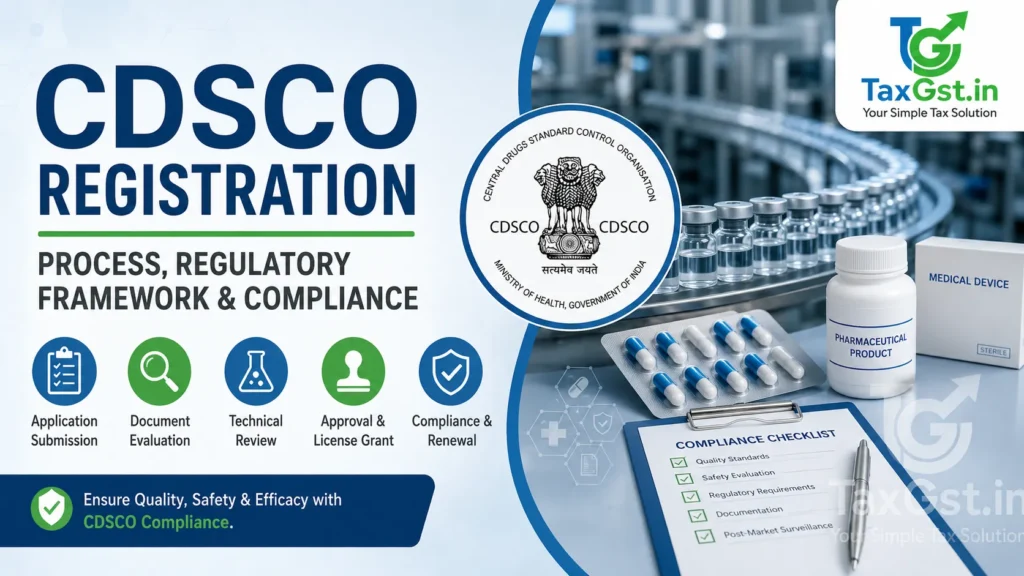
CDSCO registration is the mandatory regulatory approval required for importing, manufacturing, or distributing drugs, medical devices, cosmetics, and clinical trial products in India. The Central Drugs Standard Control Organisation operates under the Ministry of Health and Family Welfare and grants approvals under the Drugs and Cosmetics Act, 1940, the Medical Devices Rules, 2017, the New Drugs and Clinical Trials Rules, 2019, and the Cosmetics Rules, 2020. There is no single universal certificate — the exact licence or registration depends on the product category, risk classification, and whether the activity involves import, manufacture, or clinical research.
Also read-Why Can’t I Claim GST ITC on Cars, Staff Lunches & Office Renovation?
What are the Key Points of CDSCO Registration?
- CDSCO is India’s national regulatory authority for drugs, medical devices, cosmetics, and clinical trials, functioning under the Directorate General of Health Services, Ministry of Health and Family Welfare.
- The regulatory framework is built on multiple laws — the Drugs and Cosmetics Act, 1940, Drugs Rules, 1945, Medical Devices Rules, 2017, New Drugs and Clinical Trials Rules, 2019, and Cosmetics Rules, 2020.
- Medical devices are classified into Class A (low risk), Class B (low-moderate risk), Class C (moderate-high risk), and Class D (high risk) under the Medical Devices Rules, 2017, with the licensing authority shifting from State to Central as risk increases.
- For medical device imports, applications are filed in Form MD-14 and the licence is issued in Form MD-15 (as per Medical Devices Rules, 2017). For cosmetics, Form COS-1 is used for application and Form COS-2 is issued as the registration certificate through the SUGAM portal (as per Cosmetics Rules, 2020).
- Foreign manufacturers must appoint an Indian authorised agent through a Power of Attorney to file applications, respond to queries, and maintain regulatory communication with CDSCO.
What Exactly Is CDSCO Registration and Why Does It Matter?
CDSCO registration is not a single certificate. It is an umbrella term covering the licences, registrations, permissions, and approvals granted under India’s drug, medical device, cosmetic, and clinical research laws. The Central Drugs Standard Control Organisation functions as the gatekeeper of India’s healthcare sector — it determines whether a regulated product or activity can legally enter, operate, and continue in the Indian market.
The organisation works under the Directorate General of Health Services, Ministry of Health and Family Welfare. Its responsibilities include approval of new drugs, permission for clinical trials, regulation of imported drugs and medical devices, laying down drug standards, and coordinating the activities of State Drug Control Authorities. Without the correct CDSCO approval, a business cannot legally manufacture, import, test, or distribute regulated healthcare products in India.
Which Laws and Rules Govern CDSCO Compliance?
CDSCO compliance is built on a multi-layered legal structure. The Drugs and Cosmetics Act, 1940 is the parent legislation. Under it, the Drugs Rules, 1945 prescribe detailed requirements for the import, manufacture, sale, distribution, testing, and labelling of pharmaceutical drugs. These rules specify different application forms, licences, manufacturing conditions, and quality-control requirements.
Medical devices are regulated separately under the Medical Devices Rules, 2017. These rules provide a dedicated framework for classification, import, manufacture, sale, distribution, clinical investigation, labelling, and quality management of medical devices. The New Drugs and Clinical Trials Rules, 2019 regulate new drugs, investigational new drugs, clinical trials, bioavailability studies, bioequivalence studies, and ethics committees. Cosmetics are governed by the Cosmetics Rules, 2020, which cover import, manufacture, registration, labelling, testing, safety, and quality requirements for cosmetic products in India.
Who Needs CDSCO Registration and Approval?
CDSCO approval is required by pharmaceutical manufacturers, drug importers, medical device manufacturers, medical device importers, cosmetic importers, cosmetic manufacturers, diagnostic kit manufacturers, clinical trial sponsors, clinical research organisations, testing laboratories, Indian authorised agents of foreign manufacturers, wholesalers, distributors, and healthcare startups launching regulated products. The need for registration depends on the nature of the product and the business activity — whether it involves import, manufacture, sale, distribution, testing, or clinical research.
An overseas pharmaceutical manufacturer intending to sell products in India must register its manufacturing premises and products with CDSCO. The Indian importer or authorised agent must also possess the licences and infrastructure required to import, store, and distribute pharmaceutical products. Possession of an Importer Exporter Code alone does not authorise the import of pharmaceutical drugs — the importer must separately comply with the Drugs and Cosmetics Act, 1940, the Drugs Rules, 1945, and CDSCO requirements.
| Product Category | Activity | Approval Type | Application Form / Route | Issuing Authority |
|---|---|---|---|---|
| Medical Device (Class A & B) | Import | Import Licence | Form MD-14 (application) → Form MD-15 (licence) under Medical Devices Rules, 2017 | State Licensing Authority / Central Licensing Authority |
| Medical Device (Class C & D) | Import | Import Licence | Form MD-14 → Form MD-15 under Medical Devices Rules, 2017 | Central Licensing Authority (CDSCO) |
| Cosmetics | Import | Import Registration Certificate | Form COS-1 (application) → Form COS-2 (registration) through SUGAM portal under Cosmetics Rules, 2020 | CDSCO |
| Drugs (Existing) | Import | Import Licence and Registration | Application in Form 8 (non-Schedule X) or Form 8A (Schedule X); Licence in Form 10 (non-Schedule X) or Form 10A (Schedule X) after obtaining Registration Certificate in Form 41 (as per Drugs Rules, 1945) | CDSCO / State Licensing Authority |
| New Drugs | Market Approval | New Drug Permission | As per New Drugs and Clinical Trials Rules, 2019 — may involve Subject Expert Committee evaluation | CDSCO (DCGI) |
| Clinical Trials | Research / BA-BE Studies | Clinical Trial Permission | As per New Drugs and Clinical Trials Rules, 2019 — ethics committee approval also required | CDSCO (DCGI) |
A foreign medical device manufacturer based in Germany wants to import a Class C cardiac monitoring device into India. The manufacturer appoints an Indian authorised agent through a Power of Attorney. The agent files Form MD-14 on the medical device online portal under the Medical Devices Rules, 2017, uploads the technical file, ISO 13485 certificate, Free Sale Certificate from Germany, Plant Master File, Device Master File, risk analysis documents, clinical evaluation reports, and labelling details. The prescribed government fee for the Class C device import licence is $3,000 for the manufacturing site and $1,500 for each distinct medical device (as per Medical Devices Rules, 2017, Second Schedule). This fee is paid online. After review and query resolution, CDSCO issues Form MD-15, allowing the importer to legally import the device from the approved German manufacturing site. The total compliance cost — including government fees, documentation, legalisation of the Power of Attorney, and authorised agent charges — can vary significantly depending on device complexity and professional assistance engaged. Businesses should verify current fees on the official portal. This illustrates why correct product classification and document preparation are critical before filing any CDSCO application.
What Is the Step-by-Step Process for CDSCO Registration?
The CDSCO registration process follows a structured sequence that varies by product category, but the core workflow remains consistent across drugs, medical devices, cosmetics, and clinical trials. Understanding each stage helps businesses plan timelines, allocate resources, and avoid common pitfalls that cause delays or rejection.
Step 1 — Product Identification and Classification: The first step is to identify the product correctly. The applicant must understand whether the product is a drug, cosmetic, medical device, IVD, biological product, or general healthcare product. For medical devices, risk classification is critical. Under the Medical Devices Rules, 2017, devices are classified as Class A (low risk), Class B (low-moderate risk), Class C (moderate-high risk), and Class D (high risk). The classification determines whether the State Licensing Authority or the Central Licensing Authority (CDSCO) processes the application. Wrong classification can lead to rejection, delay, or future regulatory issues.
Step 2 — Decide the Type of Approval: The applicant must determine whether the business needs an import licence, manufacturing licence, registration certificate, test licence, clinical trial approval, or market authorisation. For example, a foreign manufacturer selling medical devices in India through an Indian importer may need an import licence. An Indian company manufacturing the same device may need a manufacturing licence.
Step 3 — Appoint Indian Authorised Agent: If the applicant is a foreign manufacturer, an Indian authorised agent must be appointed. The authorisation should be properly documented through a Power of Attorney or authorisation letter. The agent should be capable of handling regulatory communication and compliance responsibility in India. The Power of Attorney should generally mention the name and address of the foreign manufacturer, Indian authorised agent, product details, authority to file application, authority to communicate with CDSCO, and responsibility for regulatory matters. The document may also need notarisation, apostille, or embassy attestation depending on requirements.
Step 4 — Prepare Technical File and Document Checklist: The technical file is one of the most important parts of CDSCO registration. It explains the product in detail and may include product description, intended use, design details, composition, manufacturing process, safety data, performance data, risk analysis, testing reports, stability data, and labelling. A weak technical file may result in repeated queries. The checklist should cover business documents, authorisation documents, product documents, quality certificates, technical files, labels, testing reports, and declarations.
Step 5 — Create Online Account and File Application: Most CDSCO applications are filed through online portals such as SUGAM or the medical device online system. The applicant or authorised agent must create an account, select the correct application form, fill in details such as product name, manufacturer name, site address, product category, model number, intended use, shelf life, storage condition, and authorised agent details. Accuracy is critical — wrong details in the application may create mismatch with documents.
Step 6 — Upload Documents and Pay Government Fee: All required documents should be uploaded in the prescribed format. The documents should be readable, complete, properly signed, and arranged correctly. The prescribed government fee must be paid as per product category and application type. Payment proof should be submitted with the application. Incorrect fee payment may delay processing.
Step 7 — Application Review and Query Response: After submission, the authority reviews the application and documents. The review may include administrative scrutiny and technical evaluation. If deficiencies are found, the applicant receives a query or clarification request. The applicant must respond with proper explanation and supporting documents. Query response should be clear, professional, and complete. Incomplete query replies can further delay approval.
Step 8 — Approval and Post-Approval Compliance: If the authority is satisfied, the registration, licence, permission, or approval is granted. The approval will mention the approved product, manufacturer, site, importer, conditions, and validity wherever applicable. After approval, the business must follow all conditions. Products should be imported, manufactured, labelled, stored, and sold as per approved details. Any major change may require approval or intimation.
What Documents Are Required for CDSCO Registration?
The document checklist for CDSCO registration varies depending on the product category, application type, and whether the applicant is a domestic manufacturer or foreign entity. However, certain documents are commonly required across most applications. Preparing these documents carefully before filing reduces the likelihood of queries and accelerates the approval timeline.
Business and Legal Documents: The Indian importer or authorised agent must provide incorporation certificate, partnership deed, or proprietorship proof, PAN, GST certificate, address proof, drug licence or wholesale licence if applicable, authorised signatory details, and board resolution or authorisation letter. These documents establish the legal existence of the Indian applicant and its authority to apply on behalf of the business.
Power of Attorney: For foreign manufacturers, the Power of Attorney is one of the most important documents. It authorises the Indian agent to act on behalf of the foreign manufacturer. The Power of Attorney should be properly signed by the foreign manufacturer and Indian agent. It should clearly mention the product category and authority granted. If the document is executed outside India, it must be notarised and either apostilled or attested by the Indian embassy in the country of origin.
Despite following the prescribed steps, many applications face delays or rejection due to avoidable errors. The most frequent pitfall is document mismatch — the name of the manufacturer, product name, or site address differs between the Power of Attorney, manufacturing licence, Free Sale Certificate, and the application form. CDSCO cross-verifies every detail across documents, and even a minor spelling variation can trigger a query that adds weeks to the timeline.
Another critical error is incorrect product classification under the Medical Devices Rules, 2017. A device classified as Class B when it actually falls under Class C leads to the application being routed to the wrong licensing authority — State instead of Central — resulting in rejection and the need to restart the process. Similarly, cosmetic products with prohibited ingredients or therapeutic claims that drag them into the drug category under the Drugs and Cosmetics Act, 1940 face immediate objection. Labels that miss mandatory declarations — such as the name and address of the manufacturer, batch number, manufacturing date, expiry date, and importer details — are among the most common grounds for query under both the Cosmetics Rules, 2020 and the Medical Devices Rules, 2017.
How Do Medical Device, Drug, and Cosmetic Approvals Differ?
While all three categories fall under CDSCO’s umbrella, the regulatory intensity, documentation burden, and approval timelines vary significantly. Medical devices require the most rigorous technical documentation — including Device Master File, Plant Master File, risk analysis, clinical evaluation reports, and ISO 13485 quality management certification — particularly for Class C and Class D devices licensed by the Central Licensing Authority under the Medical Devices Rules, 2017. The scrutiny level increases with device risk, and implantable or life-supporting devices may additionally require clinical investigation data.
Drug approvals, governed by the Drugs and Cosmetics Act, 1940 and the Drugs Rules, 1945, demand comprehensive pharmaceutical data — composition, manufacturing process, stability studies, labelling, and evidence of approval in the country of origin. New drugs and those regulated under the New Drugs and Clinical Trials Rules, 2019 may require Subject Expert Committee evaluation, extending timelines considerably. Cosmetic imports, regulated under the Cosmetics Rules, 2020 through Form COS-1 and Form COS-2 on the SUGAM portal, involve comparatively lighter technical scrutiny but still require ingredient compliance, Free Sale Certificate, authorised agent appointment, and label adherence. The table below summarises the key differences.
| Parameter | Medical Device (Class C/D Import) | Drug (Existing/Import) | Cosmetic (Import) |
|---|---|---|---|
| Governing Law | Medical Devices Rules, 2017 | Drugs and Cosmetics Act, 1940; Drugs Rules, 1945 | Cosmetics Rules, 2020 |
| Application Form | Form MD-14 | Form 8 or Form 8A (for registration) and Form 10 (for import license) | Form COS-1 |
| Approval Issued In | Form MD-15 | Form 9 (Registration Certificate) and Form 10 (Import Licence) | Form COS-2 |
| Licensing Authority | Central Licensing Authority (CDSCO) | CDSCO / State Licensing Authority | CDSCO |
| Key Technical Documents | Device Master File, Plant Master File, ISO 13485, risk analysis, clinical evaluation, Free Sale Certificate | Manufacturing licence, product composition, stability data, GMP certificate, Free Sale Certificate | Ingredient list, Free Sale Certificate, manufacturing quality documents, label compliance |
| Quality Certification | ISO 13485 (medical device QMS) | GMP certificate as applicable | Manufacturing quality documents |
| Typical Timeline Range | Several months (varies with query resolution and technical complexity) | Several months (longer for new drugs requiring SEC evaluation) | Generally shorter than devices and drugs, subject to document completeness |
| Portal | Medical device online portal | CDSCO / SUGAM portal | SUGAM portal |
A South Korean skincare brand wants to import a range of anti-ageing creams into India. The brand appoints an Indian authorised agent through a notarised and apostilled Power of Attorney. The agent files Form COS-1 on the SUGAM portal under the Cosmetics Rules, 2020, submitting the product ingredient list, Free Sale Certificate from South Korea, manufacturing licence, product labels with mandatory declarations, and the prescribed government fee. As per Rule 24(1) of the Cosmetics Rules, 2020, the government fee for import registration is ₹5,000 for each manufacturing site and ₹2,000 for each category of cosmetic. The total compliance cost — including government fees, Power of Attorney legalisation, authorised agent charges, and documentation — may range from approximately ₹50,000 to ₹1,20,000 per product variant depending on pack sizes and professional assistance. After review and label verification, CDSCO issues Form COS-2, the Import Registration Certificate, allowing the importer to legally import and sell the cosmetics in India. This example illustrates that while cosmetic approvals are less technically intensive than medical devices, label compliance and ingredient scrutiny remain critical — claims like “skin whitening” or “therapeutic” can shift the product into the drug category under the Drugs and Cosmetics Act, 1940, requiring an entirely different approval route.
What are the essential next steps for CDSCO compliance?
- Identify your product category correctly — determine whether your product is a drug, medical device, cosmetic, IVD, or biological product, as each follows a different regulatory route under CDSCO.
- For medical devices, verify the risk classification (Class A, B, C, or D) under the Medical Devices Rules, 2017, because the classification determines whether the State Licensing Authority or the Central Licensing Authority processes your application.
- If you are a foreign manufacturer, appoint an Indian authorised agent through a properly executed Power of Attorney, and ensure the document is notarised and apostilled as required for Indian regulatory submissions.
- Prepare a product-specific document checklist covering the technical file, manufacturing licence, Free Sale Certificate, ISO 13485 or GMP certificate, Plant Master File, Device Master File, clinical evaluation reports, and compliant labelling.
- Create an online account on the relevant CDSCO portal — SUGAM for cosmetics and the medical device online system for device imports — using details that exactly match your business incorporation documents.
- File the correct application form with all supporting documents and pay the prescribed government fee. For medical device imports, use Form MD-14. For cosmetics, use Form COS-1.
- After submission, track the application status regularly and respond to any query raised by CDSCO within the stipulated time to avoid delays or rejection.
Frequently Asked Questions
What is the validity of CDSCO registration and import licence?
The validity of CDSCO registration depends on the type of licence or registration granted. An Import Registration Certificate for cosmetics issued under the Cosmetics Rules, 2020 is valid for a period of five years from the date of issue, subject to compliance with applicable conditions. Medical device import licences granted under the Medical Devices Rules, 2017 remain valid perpetually, subject to payment of a retention fee as specified in the Second Schedule, on or before the due date. The licence holder must track the due date for retention fees or expiry date and ensure compliance to avoid suspension or cancellation of the approval.
Can a foreign manufacturer directly apply for CDSCO registration without an Indian agent?
No. A foreign manufacturer cannot directly file an application with CDSCO for import registration or import licence. The regulatory framework requires the appointment of an Indian authorised agent who is resident in India and possesses the necessary infrastructure to handle regulatory communication, submit documents, respond to queries, and maintain post-market compliance. The authorised agent acts through a Power of Attorney executed by the foreign manufacturer. This Power of Attorney must clearly specify the product category, the authority granted to the agent, and the responsibility for regulatory matters. The document typically requires notarisation and apostille or embassy attestation depending on the country of origin.
What is the difference between Form MD-14 and Form MD-15 under the Medical Devices Rules, 2017?
Form MD-14 is the application form used to apply for an import licence for medical devices under the Medical Devices Rules, 2017. The Indian authorised agent or importer files Form MD-14 through the medical device online portal, along with the required technical documents, quality certificates, and labelling details. Form MD-15 is the actual import licence granted by the licensing authority after reviewing the application and satisfying itself that the device meets safety, quality, and performance requirements. In simple terms, MD-14 is the request you submit, and MD-15 is the approval you receive. The licence specifies the approved product, manufacturer, site address, Indian agent details, and validity period.
Is CDSCO approval required for all medical devices sold in India?
Not all medical devices require a separate CDSCO import or manufacturing licence at present. The Medical Devices Rules, 2017 apply to notified device categories. The government has been progressively bringing medical devices under regulation. Currently, certain high-risk devices and specified categories require mandatory registration or licensing. However, even for devices not yet notified under mandatory registration, manufacturers and importers must ensure compliance with quality and safety standards. It is essential to check the latest list of notified devices on the CDSCO portal before importing or manufacturing any medical product, as the regulatory scope continues to expand. Selling an unapproved notified device can lead to product detention, penalties, and legal action.
Can a single CDSCO import licence cover multiple products or manufacturing sites?
No. A CDSCO import licence is typically granted for a specific product or product range from a specific approved manufacturing site. If a business wants to import the same product from a second manufacturing site, or a different product from the same site, a separate application is generally required. Each combination of product, manufacturer, and site must be individually approved. Attempting to import unapproved variants, pack sizes, or brands under an existing licence can lead to detention of goods at customs and regulatory action.
What happens if a CDSCO licence expires and the business continues operations?
Operating without a valid CDSCO licence is a violation of the Drugs and Cosmetics Act, 1940, and the Medical Devices Rules, 2017, as applicable. Consequences can include suspension or cancellation of the licence, seizure of stock, prohibition on further import or manufacture, and potential prosecution. The business must track the licence validity and initiate the renewal process well before the expiry date. Late renewal may attract additional fees or require fresh application depending on the gap and the specific rules applicable to that licence category.
Is CDSCO approval required for in-vitro diagnostic devices and kits?
Yes. In-vitro diagnostic devices and diagnostic kits are regulated as medical devices under the Medical Devices Rules, 2017. They are classified into Class A, B, C, or D based on risk. Depending on the classification, the importer or manufacturer must obtain the appropriate import licence or manufacturing licence from the Central or State Licensing Authority. The application requires technical documentation, performance evaluation data, quality certificates, and labelling compliance, similar to other medical devices.
Article Information
Published: July 14, 2026
Last Reviewed: July 14, 2026
Category: Medical & Healthcare Compliance
Regulatory Body: Central Drugs Standard Control Organisation (CDSCO)
Written by C.K. Gupta, M.Com & Tax Editor at TaxGST.in — helping businesses navigate corporate law, import licensing, and regulatory compliance since 2009.
Official Resources
Disclaimer: This article is for informational purposes only. Regulatory requirements for medical devices and drugs change frequently. Always refer to the CDSCO portal and consult a qualified regulatory affairs consultant for authoritative advice.
Try the free NPS calculator for instant figures.
ITR, GST returns, notices and registrations — fixed fees, human support, on-time filing.
Discover more from TaxGst.in
Subscribe to get the latest posts sent to your email.

Never Miss a Tax Deadline Again
Due-date alerts, GST updates and tax tips — free on the app you already use.
event Next: GSTR-1 · 11 Oct