
 C.K. Gupta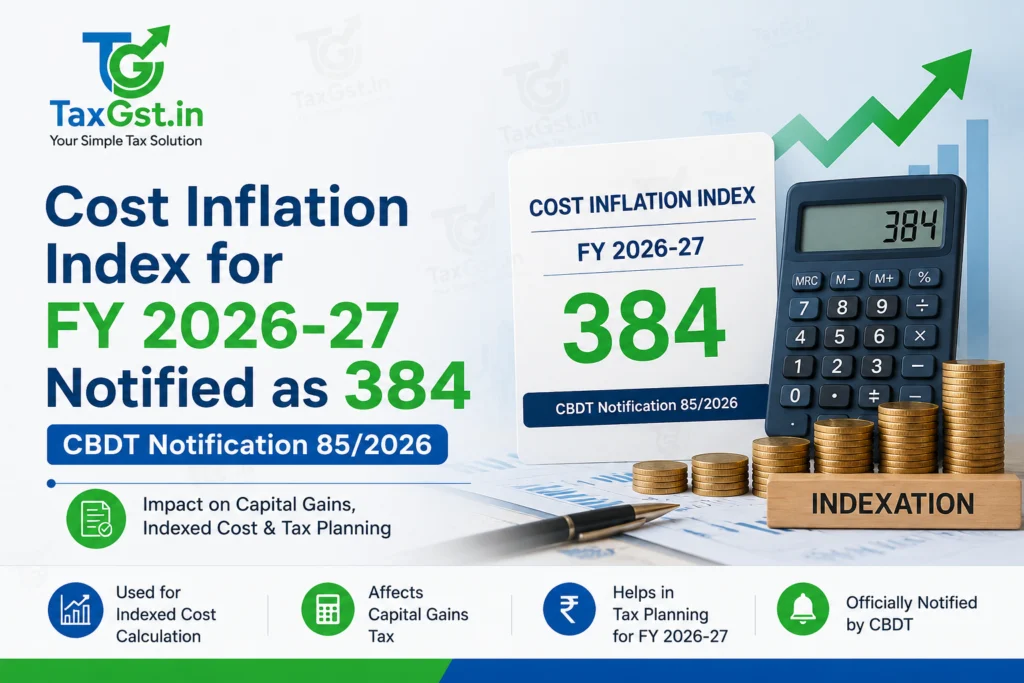
The Cost Inflation Index (CII) for Financial Year 2026-27 has been notified as 384 by the Central Board of Direct Taxes (CBDT) through Notification No. 85/2026-Income Tax dated 15th July, 2026. Issued under Section 72(8)(a) of the Income-tax Act, 2025, this index applies to Tax Year 2026-27 (from 1st April, 2026) and will be used for computing indexed cost of acquisition wherever indexation benefits are available under the law.
Also Read-CDSCO Registration Process, Regulatory Framework & Compliance
What are the Key Highlights of the CII for FY 2026-27?
- CII for Financial Year 2026-27 stands at 384, an increase from 376 in Financial Year 2025-26, as per Notification No. 85/2026-Income Tax dated 15th July, 2026.
- The notification is issued under Section 72(8)(a) of the Income-tax Act, 2025, and applies to Tax Year 2026-27 onwards.
- Indexation benefit for land or building acquired before 23rd July 2024: Resident individuals and Hindu Undivided Families (HUFs) can choose between a 12.5% tax rate without indexation or a 20% tax rate with indexation, whichever is more beneficial.
- For land or building purchased on or after 23rd July 2024, the applicable rate is 12.5% without any indexation benefit.
- The base year remains 2001-02 with a CII of 100, as established by the principal notification S.O. 1790(E) dated 5th June, 2017.
What Exactly is the Cost Inflation Index and Why Does It Matter?
Have you ever noticed that the rupee your grandfather spent on buying a house in 1990 could buy far more than the same rupee can today? This steady erosion of purchasing power is inflation, and the Cost Inflation Index (CII) is the government’s official yardstick to measure it for tax purposes.
The Cost Inflation Index, or CII, is a number notified annually by the Central Board of Direct Taxes (CBDT) that helps taxpayers adjust the purchase price of an asset for inflation when calculating capital gains tax. Think of it as a correction factor: without it, you would pay tax on the entire sale price minus the original cost, even though part of that gain is purely due to inflation and not real wealth creation. The CII is computed as 75% of the average rise in the Consumer Price Index (urban) for the immediately preceding Financial Year.
The index was first introduced with base year 1981-82 (CII = 100), but was revised to base year 2001-02 (CII = 100) vide the Finance Act, 2017. This means that for any asset acquired before 1st April 2001, the cost of acquisition is taken as the fair market value as on that date, and only improvements incurred after that date are indexed. The principal notification S.O. 1790(E) dated 5th June, 2017, as amended from time to time, contains the complete table of CII from 2001-02 onwards.
How Has the CII Evolved from Previous Years to FY 2026-27?
The CII has shown a consistent upward trajectory, reflecting decades of cumulative inflation. For Financial Year 2024-25, the CII was notified as 363 through Notification No. 44/2024-Income-Tax dated 24th May, 2024. The following year, Financial Year 2025-26, saw an increase to 376 as per Notification No. 70/2025 dated 1st July, 2025. Now, for Financial Year 2026-27, the index has climbed further to 384.
This jump from 376 to 384 represents an increase of approximately 2.13% over the previous year. While this may seem modest, the compounding effect over long holding periods is substantial. For instance, a property purchased in Financial Year 2005-06 (CII = 117) and sold in Financial Year 2026-27 (CII = 384) would see its cost base multiplied by a factor of 3.28, dramatically reducing the taxable capital gain. The complete table of CII from 2001-02 to 2026-27 is maintained on the Income Tax India portal and is essential reference material for any taxpayer computing long-term capital gains.
It is worth noting that the legal framework for notifying CII has transitioned. While earlier notifications were issued under clause (v) of the Explanation to Section 48 of the Income-tax Act, 1961, the current Notification No. 85/2026 is issued under Section 72(8)(a) of the Income-tax Act, 2025. This reflects the ongoing codification and restructuring of direct tax law, though the fundamental purpose and computation methodology remain unchanged.
How Do You Calculate the Indexed Cost of Acquisition for FY 2026-27?
The indexed cost of acquisition adjusts your original purchase price upward using the CII ratio, ensuring you pay tax only on real gains rather than inflationary gains. The formula, as prescribed under the capital gains computation provisions, is straightforward: Indexed Cost = Actual Purchase Price × (CII of the year of transfer ÷ CII of the year of purchase). This indexed figure is then subtracted from the sale consideration to arrive at the taxable long-term capital gain.
For land or building acquired before 23rd July 2024, resident individuals and HUFs now face a choice between two regimes: pay tax at 20% with indexation benefit, or pay tax at 12.5% without indexation. The CII of 384 for Financial Year 2026-27 becomes relevant only if you opt for the indexation route. For assets purchased on or after 23rd July 2024, indexation is not available, and the flat 12.5% rate applies regardless of the CII.
| Financial Year | Cost Inflation Index (CII) | Source Notification |
|---|---|---|
| 2020-21 | 301 | As per Notification No. 70/2025 |
| 2021-22 | 317 | As per Notification No. 70/2025 |
| 2022-23 | 331 | As per Notification No. 70/2025 |
| 2023-24 | 348 | As per Notification No. 70/2025 |
| 2024-25 | 363 | As per Notification No. 44/2024-Income-Tax |
| 2025-26 | 376 | As per Notification No. 70/2025 |
| 2026-27 | 384 | As per Notification No. 85/2026-Income Tax |
Worked Example: Mr. Mehta purchased a residential flat in January 2016 for ₹55,00,000 and sold it in September 2026 for ₹1,40,00,000. Since the property was acquired before 23rd July 2024, he can choose between the two tax options. Using CII of 264 for Financial Year 2016-17 (as per Notification No. 70/2025) and CII of 384 for Financial Year 2026-27 (as per Notification No. 85/2026), the indexed cost works out to ₹55,00,000 × (384 ÷ 264) = ₹79,99,999 (approximately ₹80,00,000).
The long-term capital gain with indexation is ₹1,40,00,000 − ₹80,00,000 = ₹60,00,000, attracting tax of ₹12,00,000 at 20%. Without indexation, the gain is ₹1,40,00,000 − ₹55,00,000 = ₹85,00,000, attracting tax of ₹10,62,500 at 12.5%. In this scenario, the 12.5% rate without indexation yields a lower tax outgo by ₹1,37,500, making it the more beneficial option.
Who Can Claim Indexation Benefits on Capital Gains in FY 2026-27?
The eligibility for indexation benefits has undergone significant changes, and understanding who can claim the CII of 384 is critical before filing your return. For resident individuals and HUFs, for land or building acquired before 23rd July 2024 and transferred on or after that date, there is an option to pay tax at either 12.5% without indexation benefits or 20% with indexation benefits. This dual regime means the CII of 384 for Financial Year 2026-27 becomes relevant only if you choose the indexation route for qualifying property.
For land or building purchased on or after 23rd July 2024, the tax rate is fixed at 12.5% without any indexation benefit, regardless of the holding period. This means the CII of 384 will not apply to such transactions at all. Additionally, starting 1st April 2023, indexation benefit is not available for Debt Funds (mutual funds investing less than 35% in domestic equity shares) purchased on or after this date, as per amendments introduced in the Finance Act, 2023. Indexation is also generally not allowed in the case of bonds or debentures, except for capital indexation bonds or Sovereign Gold Bonds (SGBs) issued by RBI, which continue to enjoy the benefit on transfer.
For inherited property, the CII to be used is for the year in which the property was originally purchased by the previous owner, not the year of inheritance. If you received a property through a will, you must trace back the cost and holding period to the original acquisition date. Furthermore, any improvement cost incurred before 1st April 2001 must be ignored for indexation purposes, as the base year for computation was reset to 2001-02 with CII of 100, as established by the principal notification S.O. 1790(E) dated 5th June, 2017.
What Documents Do You Need to Claim Indexed Cost of Acquisition?
Claiming indexed cost of acquisition requires maintaining a clear paper trail from purchase to sale. The primary document is the original purchase deed or agreement, which establishes the acquisition date and cost. For assets acquired before 1st April 2001, you need the fair market value as on that date, supported by a registered valuer’s report if the assessing officer demands it. The sale deed or transfer agreement for the current transaction is equally essential, as it determines the year of transfer and the applicable CII of 384 for Financial Year 2026-27.
If you have incurred any capital improvements on the asset, retain all receipts, invoices, and contractor bills. These improvement costs are also indexed separately using the CII of the year of improvement. For inherited or gifted property, you need the original purchase documents of the previous owner, along with the gift deed, will, or succession certificate that establishes your ownership. In the case of property received through a will, the CII of the year in which the property was purchased by the previous owner must be used, as per the capital gains computation provisions.
Taxpayers opting for the 20% rate with indexation on land or building acquired before 23rd July 2024 should maintain a comparative calculation showing both tax outcomes. This documentation becomes crucial during assessment proceedings, as the choice between 12.5% without indexation and 20% with indexation is irrevocable once the return is filed. Ensure your Form 26AS and capital gains schedule in the ITR reflect the indexed cost correctly, and keep all supporting documents for at least six years from the end of the relevant Assessment Year.
When Should You Choose 12.5% Without Indexation Over 20% With Indexation?
The choice between the two tax regimes for land or building acquired before 23rd July 2024 depends entirely on the gap between your purchase price and sale price, and critically, on which Financial Year you bought the asset. The CII of 384 for Financial Year 2026-27, as notified under Section 72(8)(a) of the Income-tax Act, 2025 through Notification No. 85/2026-Income Tax dated 15th July, 2026, becomes more powerful as the purchase year’s CII gets smaller. Assets bought in earlier years with low CII values see a larger inflation adjustment, making the 20% with indexation route more attractive.
Worked Example — When Indexation Wins: Mrs. Kapoor inherited a commercial property in Financial Year 2005-06 (CII = 117, as per Notification No. 70/2025) with a documented purchase cost of ₹30,00,000. She sells it in Financial Year 2026-27 for ₹1,20,00,000. With indexation, the adjusted cost is ₹30,00,000 × (384 ÷ 117) = ₹98,46,154. The taxable long-term capital gain is ₹1,20,00,000 − ₹98,46,154 = ₹21,53,846, and tax at 20% works out to ₹4,30,769. Without indexation, the gain is ₹1,20,00,000 − ₹30,00,000 = ₹90,00,000, attracting tax of ₹11,25,000 at 12.5%. Here, the indexation route saves her ₹6,94,231 — a substantial difference driven by the 267-point CII gap between the purchase year and sale year.
| Scenario | Purchase CII | Indexed Cost | Tax at 20% with Indexation | Tax at 12.5% without Indexation | Better Option |
|---|---|---|---|---|---|
| Bought FY 2005-06, sold FY 2026-27 (₹30L → ₹1.2 Cr) | 117 | ₹98,46,154 | ₹4,30,769 | ₹11,25,000 | Indexation saves ₹6,94,231 |
| Bought FY 2016-17, sold FY 2026-27 (₹55L → ₹1.4 Cr) | 264 | ₹80,00,000 | ₹12,00,000 | ₹10,62,500 | 12.5% rate saves ₹1,37,500 |
| Bought FY 2010-11, sold FY 2026-27 (₹25L → ₹90L) | 167 | ₹57,48,503 | ₹6,50,299 | ₹8,12,500 | Indexation saves ₹1,62,201 |
The break-even point shifts based on your specific numbers. As a practical rule, if your asset was purchased before Financial Year 2010-11 (CII below 167), indexation almost always yields lower tax for high-value properties. For assets purchased after Financial Year 2015-16 (CII above 254), the 12.5% rate without indexation tends to be more beneficial. Always compute both scenarios before filing, as the optimal choice varies case by case.
What Are the Common Pitfalls When Applying CII to Capital Gains?
Even experienced taxpayers make errors when applying the CII of 384 for FY 2026-27. One frequent mistake involves inherited property. When you receive an asset through a will or inheritance, the CII to be used is not the year you received it — it is the year in which the previous owner originally purchased the asset. For example, if your father bought a house in FY 2008-09 (CII = 137) and you inherited it in 2020 and sell it in FY 2026-27, you must use CII of 137, not 301. This rule, embedded in the capital gains computation framework, ensures the indexation benefit reflects the entire holding period across generations.
Another pitfall concerns improvement costs. Many taxpayers index the entire cost including pre-2001 improvements. As per Section 55 of the Income-tax Act, 1961, cost of improvement includes only capital expenses incurred on or after 1st April 2001. Any renovation, extension, or structural modification done before that date is ignored entirely for indexation purposes. If you spent ₹5,00,000 on improvements in FY 2003-04 and another ₹8,00,000 in FY 2018-19, only the latter amount gets indexed using the CII ratio. The pre-2001 expenditure is simply excluded from the computation.
Taxpayers also frequently overlook that indexation benefit is not available for all asset classes. Starting 1st April 2023, indexation benefit is not available for Debt Funds, as per the amendments introduced in the Finance Act, 2023. Similarly, indexation benefit is not allowed in the case of bonds or debentures, except for capital indexation bonds or sovereign gold bonds issued by RBI. For land or building purchased on or after 23rd July 2024, the tax rate is fixed at 12.5% without any indexation benefit, as per the amendments effective from that date under the Finance (No. 2) Act, 2024. Applying the CII of 384 to such transactions would be incorrect and could trigger scrutiny. Always verify the acquisition date of your asset against these cut-off dates before computing indexed cost.
What Steps Should Taxpayers Take Regarding CII for FY 2026-27?
- Identify whether your land or building was acquired before or after 23rd July 2024, as this determines whether indexation is available at all.
- If your property was acquired before 23rd July 2024, and you are a resident individual or a Hindu Undivided Family (HUF), compute your tax liability under both options — 20% with indexation using CII 384, and 12.5% without indexation — and choose the lower outgo.
- For property acquired before 1st April 2001, obtain the fair market value as on that date from a registered valuer, as this becomes your deemed cost of acquisition for indexation purposes, as per Section 55 of the Income-tax Act, 1961.
- Maintain documentary evidence of the purchase date, sale consideration, and improvement costs, since the CII of the year of purchase directly impacts your indexed cost calculation.
- If you hold Debt Mutual Funds acquired after 1st April 2023, note that indexation benefit is not available regardless of the CII notified for FY 2026-27.
- Cross-verify the CII figures from Notification No. 85/2026 (for FY 2026-27) and the historical table in Notification No. 70/2025 (for previous years up to FY 2025-26) before filing your ITR for Assessment Year 2027-28.
- Consult a tax practitioner if your holding period spans multiple base years or if you have claimed improvement costs across different financial years.
Frequently Asked Questions
Can I use CII 384 for a property I bought in FY 2025-26 and sold in FY 2026-27?
No. Since the property was purchased in FY 2025-26, which is after 23rd July 2024, indexation benefit is not available. The applicable tax rate is 12.5% on the unindexed capital gain, and the CII of 384 for FY 2026-27 does not apply to this transaction, as per the Finance (No. 2) Act, 2024.
How do I calculate indexed cost if my property was inherited in 2010?
For property received by inheritance or will, the CII of the year in which the previous owner first held the asset is used, not the year you received it. If the previous owner purchased it in FY 2010-11, you would use CII 167 (as per the table in CBDT Notification No. 70/2025) as the denominator, and CII 384 (as per CBDT Notification No. 85/2026) as the numerator for a transfer in FY 2026-27.
Is indexation available for bonds and debentures sold in FY 2026-27?
Indexation benefit is not available for bonds or debentures, except for capital indexation bonds and sovereign gold bonds issued by RBI. For all other debt instruments, including corporate bonds and government securities, the CII of 384 does not apply, and gains are taxed at the applicable rates without indexation.
What happens if I sell a property acquired before 23rd July 2024 but forget to choose between the two tax options?
If you are a resident individual or HUF, you must make the choice explicitly in your income tax return for Assessment Year 2027-28. If you do not exercise the option, the default treatment may not be in your favour. Compute both scenarios — 20% with indexation using CII 384, and 12.5% without indexation — and declare the option that results in lower tax liability. This choice is final once the return is filed.
Can I claim indexation separately on renovation or improvement costs incurred after purchase?
Yes, improvement costs are indexed independently using the CII of the year in which the expense was incurred, not the year of purchase. The formula is: Indexed Cost of Improvement = Actual Improvement Cost × (CII of year of transfer ÷ CII of year of improvement). For example, if you spent ₹10,00,000 on renovation in FY 2018-19 (CII = 280) and sell the property in FY 2026-27 (CII = 384), the indexed improvement cost becomes ₹10,00,000 × (384 ÷ 280) = ₹13,71,429. This indexed improvement cost is added to the indexed cost of acquisition to arrive at the total indexed cost, which is then deducted from the sale consideration. Only improvements incurred on or after 1st April 2001 are eligible for indexation, as per Section 55 of the Income-tax Act, 1961.
Does the CII of 384 apply to slump sale or business restructuring transactions?
No, the Cost Inflation Index is not applicable to slump sale transactions. Under Section 50B of the Income-tax Act, 1961, capital gains from slump sale are computed as the difference between the sale consideration and the net worth of the undertaking, without applying indexation. The net worth is calculated based on book values as reflected in the balance sheet, not indexed costs. However, for item-wise sale of capital assets during restructuring, each asset’s indexation eligibility is determined individually based on its nature and holding period. The CII of 384 for FY 2026-27 would apply only to qualifying long-term capital assets sold individually, not to the slump sale as a whole.
How is CII applied when an asset was acquired before the base year 2001-02?
For assets acquired before 1st April 2001, the cost of acquisition is taken as the fair market value as on that date, as per Section 55 of the Income-tax Act, 1961. The CII of 100 for FY 2001-02 (the base year) is then used as the denominator in the indexation formula. For instance, if a property was purchased in 1995 for ₹15,00,000 and its fair market value as on 1st April 2001 was ₹40,00,000, the indexed cost for a sale in FY 2026-27 would be ₹40,00,000 × (384 ÷ 100) = ₹1,53,60,000. Only improvement costs incurred on or after 1st April 2001 are eligible for separate indexation. This provision ensures that pre-2001 appreciation is not taxed, while post-2001 inflation is fully accounted for.
Where Can I Find Official Information on CII and Capital Gains?
- Income Tax Department – Cost Inflation Index Table
- CBDT Notification No. 85/2026 for FY 2026-27 (verify on the official portal)
- CBDT Notification No. 70/2025 for FY 2025-26 (verify on the official portal)
- Income Tax Department – Historical CII Data
- Income Tax Department – All Finance Acts
Next Step: If you are a resident individual or HUF planning to sell land or building acquired before 23rd July 2024, compute your tax liability under both the 12.5% without indexation and 20% with indexation options using the CII of 384 for FY 2026-27. Consult a tax practitioner to determine which regime minimizes your outgo, factoring in your total income slab and other deductions available under the Income-tax Act, 2025.
Article Information
Published: July 16, 2026
Last Reviewed: July 16, 2026
Category: Income Tax
Regulatory Body: CBDT (Central Board of Direct Taxes)
Written by C.K. Gupta, M.Com & Tax Editor at TaxGST.in — helping 500+ clients navigate IT notices, GST audits, and ITR filings across Delhi NCR since 2009.
Official Resources
Disclaimer: This article is for informational purposes only. For legal advice, consult a qualified tax professional. Always refer to the original source document for authoritative information.
Related Reading
- TDS on Sale of Property under Section 393: New 1% Rules, Form 141 Process & Compliance Guidelines
- Switched to New Tax Regime? Deductions and Exemptions You Can No Longer Claim
- Stand Up India Scheme – Loans for SC/ST and Women Entrepreneurs: A Complete 2026 Guide
Try the free income tax calculator for instant figures.
ITR, GST returns, notices and registrations — fixed fees, human support, on-time filing.
Discover more from TaxGst.in
Subscribe to get the latest posts sent to your email.


Never Miss a Tax Deadline Again
Due-date alerts, GST updates and tax tips — free on the app you already use.
event Next: GSTR-1 (IFF) · 13 Oct