
 C.K. Gupta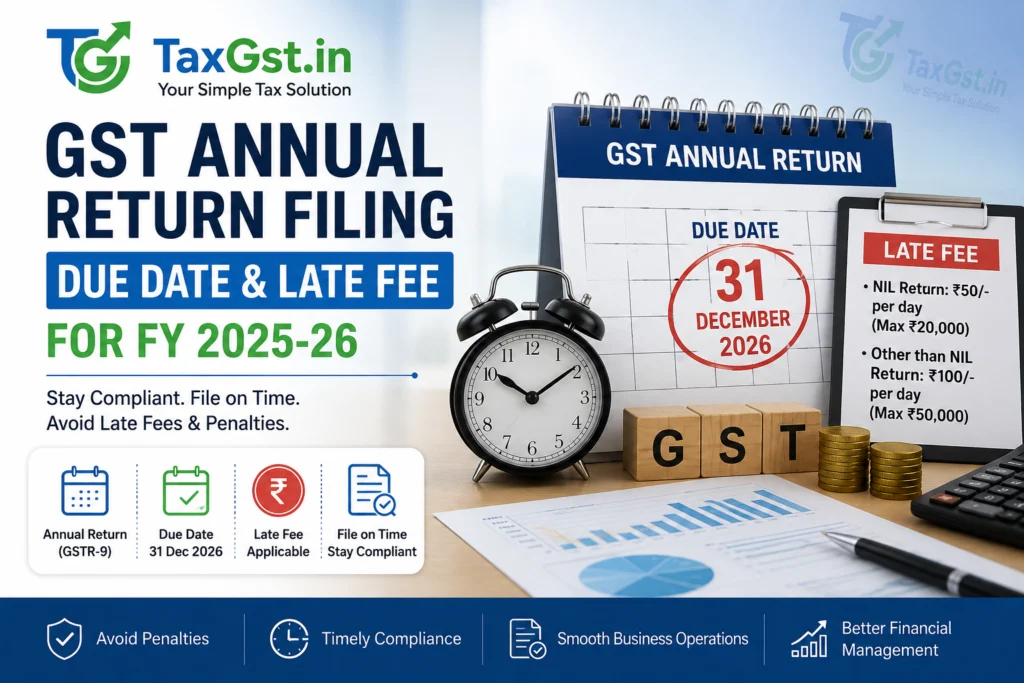
The due date for filing the GSTR-9 annual return for FY 2025-26 is 31st December 2026. Delay in filing attracts a late fee of ₹200 per day (₹100 CGST + ₹100 SGST), capped at 0.25% of turnover in the relevant state or union territory under each Act (i.e., 0.50% combined). As per Notification No. 15/2025-Central Tax, taxpayers with an aggregate turnover exceeding ₹2 crore are mandatorily required to file GSTR-9, while a self-certified GSTR-9C is required if turnover exceeds ₹5 crore under Rule 80(3) of the CGST Rules, 2017. Need GSTR-9/9C filing assistance from experienced CAs?
Also Read-Why Can’t I Claim GST ITC on Cars, Staff Lunches & Office Renovation?
What is a Quick Summary of GSTR-9 Annual Return Filing?
- GSTR-9 due date for FY 2025-26 is 31st December 2026, as per Rule 80(1) of CGST Rules, 2017.
- Mandatory filing required if aggregate turnover exceeds ₹2 crore, per Notification No. 15/2025-Central Tax.
- Late fee is ₹100 per day per Act (CGST + SGST), totaling ₹200 daily, with a cap of 0.25% of turnover per Act (0.50% combined) under Section 47(2) of CGST Act.
- GSTR-9C self-certified reconciliation statement is required for taxpayers with aggregate turnover exceeding ₹5 crore, filed alongside GSTR-9.
- Recent amendments via Notification No. 13/2025-Central Tax and Notification No. 16/2025-Central Tax have introduced new ITC reporting fields and IMS-based auto-population in GSTR-9.
What Is the Due Date for Filing GSTR-9 Annual Return for FY 2025-26?
The statutory deadline for furnishing the annual return in FORM GSTR-9 for any financial year is the thirty-first day of December following the end of such financial year. For FY 2025-26, this translates to 31st December 2026. This due date is prescribed under Rule 80(1) of the Central Goods and Services Tax Rules, 2017, which mandates every registered person — other than Input Service Distributors, persons paying tax under section 51 or section 52, casual taxable persons, and non-resident taxable persons — to file the annual return electronically through the common portal by this date.
The government retains the power to extend this due date through notification, as has been done in previous years. Taxpayers should monitor the GST portal and CBIC notifications for any extensions applicable to FY 2025-26. It is critical to note that the due date applies to the complete annual return, which includes both GSTR-9 and GSTR-9C where the latter is applicable.
Who Must File GSTR-9 and What Are the Turnover Thresholds?
As per Notification No. 15/2025-Central Tax, every registered person whose aggregate turnover during a financial year exceeds ₹2 crore is mandatorily required to file FORM GSTR-9. This threshold has been consistently maintained since FY 2017-18, with taxpayers having turnover up to ₹2 crore exempted from filing the annual return. The aggregate turnover is computed on an all-India basis and includes the value of all taxable supplies, exempt supplies, exports, and inter-state supplies of persons having the same Permanent Account Number.
For taxpayers whose aggregate turnover exceeds ₹5 crore during the financial year, an additional requirement applies. Under Rule 80(3) of the CGST Rules, 2017, as substituted by Notification No. 30/2021-CT, such persons must also furnish a self-certified reconciliation statement in FORM GSTR-9C along with the annual return. This statement reconciles the value of supplies declared in the annual return with the audited financial statements and details of input tax credit availed and utilised. The GSTR-9C is self-certified by the taxpayer and is filed on or before the same due date of 31st December.
How Is Late Fee Calculated for Delayed Filing of GSTR-9 and GSTR-9C?
The late fee for delayed filing of the annual return is governed by Section 47(2) of the Central Goods and Services Tax Act, 2017, which prescribes a fee of ₹100 per day for each day of delay. Since an equivalent provision exists under the respective State Goods and Services Tax Acts, the effective late fee amounts to ₹200 per day — comprising ₹100 under CGST and ₹100 under SGST. This daily accrual continues until the date of furnishing the complete annual return, subject to a maximum cap.
The cap on late fee is linked to the taxpayer’s aggregate turnover in the relevant state or union territory. As per Section 47(2) of the CGST Act, the maximum late fee cannot exceed 0.25% of the turnover per Act, which translates to an overall ceiling of 0.50% of turnover when both CGST and SGST components are combined. However, the government has introduced concessional late fee structures for smaller taxpayers through specific notifications, reducing the effective burden for businesses with turnover up to ₹20 crore.
What is the Late Fee Structure Based on Turnover Categories?
| Aggregate Turnover in Relevant FY | Daily Late Fee (CGST + SGST) | Maximum Cap (Combined) | Legal Reference |
|---|---|---|---|
| Up to ₹5 crore | ₹50 per day (₹25 + ₹25) | 0.04% of turnover (0.02% per Act) | Notification under Section 47(2) of CGST Act |
| More than ₹5 crore and up to ₹20 crore | ₹100 per day (₹50 + ₹50) | 0.04% of turnover (0.02% per Act) | Notification under Section 47(2) of CGST Act |
| Above ₹20 crore | ₹200 per day (₹100 + ₹100) | 0.50% of turnover (0.25% per Act) | Section 47(2) of CGST Act |
| GSTR-9C filed after GSTR-9 due date | Late fee accrues from original due date till GSTR-9C filing date | Same as applicable GSTR-9 category | Circular No. 246/03/2025-GST |
Circular No. 246/03/2025-GST dated 2025 issued by the CBIC clarifies a critical aspect of late fee computation. Where GSTR-9C is required to be furnished along with GSTR-9, the annual return under Section 44 of the CGST Act is deemed complete only when both forms are filed. If a taxpayer files GSTR-9 on time but furnishes GSTR-9C subsequently beyond the due date, late fee accrues for the entire period from the original due date until the date of furnishing GSTR-9C.
Practical Worked Example: Late Fee Calculation
Consider a registered person in Maharashtra with an aggregate turnover of ₹8 crore for FY 2025-26. The due date for filing GSTR-9 is 31st December 2026. Suppose the taxpayer files the annual return on 15th February 2027, resulting in a delay of 46 days. For a turnover between ₹5 crore and ₹20 crore, the daily late fee is ₹100 (₹50 CGST + ₹50 SGST). The late fee calculation would proceed as follows: ₹100 per day, amounting to ₹4,600 for 46 days. The maximum cap for this category is 0.04% of turnover (0.02% per Act). For a turnover of ₹8 crore, this cap is ₹32,000. Since ₹4,600 is less than ₹32,000, the taxpayer pays ₹4,600 as late fee through the electronic cash ledger before filing the return.
If the same taxpayer had a turnover of ₹25 crore, the full statutory rate of ₹200 per day would apply, amounting to ₹9,200 for 46 days. The maximum cap would be 0.50% of turnover (0.25% per Act) — for ₹25 crore, this is ₹12,50,000. Since the accrued fee is well below the cap, the taxpayer would pay the full ₹9,200. This example illustrates how turnover classification directly impacts the late fee liability.
What Documents and Data Must Be Reconciled Before Filing GSTR-9?
Filing GSTR-9 is not merely a data entry exercise — it is the culmination of an entire year’s reconciliation between your books of accounts, monthly returns, and input tax credit records. The form is divided into six parts and nineteen sections, each demanding specific information that must align with your previously filed GSTR-1, GSTR-2B, and GSTR-3B returns.
On the outward supply side, you must reconcile the taxable value and tax liability declared in your monthly or quarterly GSTR-1 with the summary figures in GSTR-3B. Any discrepancies between these returns — such as invoices recorded in GSTR-1 but omitted from GSTR-3B, or vice versa — must be identified and corrected.
On the inward supply and ITC side, the reconciliation is equally rigorous. You must match the input tax credit availed in GSTR-3B with the auto-drafted ITC statement in GSTR-2B for the entire financial year. As per Notification No. 13/2025-Central Tax, new ITC reporting fields have been introduced in GSTR-9, requiring granular disclosure of credit availed, reversed, and ineligible. Furthermore, Notification No. 16/2025-Central Tax has updated the GSTR-9 format to enable IMS-based ITC auto-population, which pulls data from the Invoice Management System.
Essential Documents Checklist for GSTR-9 Preparation
| Document / Data Source | Purpose in GSTR-9 | Reconciliation Required |
|---|---|---|
| GSTR-1 (monthly/quarterly) | Outward supply details, tax liability | Match taxable value and tax with GSTR-3B |
| GSTR-3B (monthly/quarterly) | Summary of supplies, ITC availed, tax paid | Reconcile ITC and tax with GSTR-1 and GSTR-2B |
| GSTR-2B (auto-drafted) | Eligible and ineligible ITC statement | Match ITC availed with eligible credit per 2B |
| Audited Financial Statements | Turnover computation, GSTR-9C reconciliation | Reconcile audited turnover with GST returns |
| E-invoice Portal Data | B2B invoice-level reporting | Cross-check invoice values with GSTR-1 |
| Books of Accounts (Sales & Purchase Registers) | Source data for all disclosures | Reconcile with all GST returns filed during FY |
For taxpayers required to file GSTR-9C — those with aggregate turnover exceeding ₹5 crore as per Rule 80(3) of the CGST Rules, 2017 — the reconciliation extends to the audited financial statements. Any additional liability arising from non-reconciliation of turnover or input tax credit must be disclosed in Part V of GSTR-9C and discharged before filing.
How to Navigate the GST Portal to File GSTR-9 and Pay Late Fees?
To begin, log on to the GST portal at www.gst.gov.in and navigate to the Returns Dashboard. Select the financial year for which you are filing — in this case, FY 2025-26 — and locate the GSTR-9 tile. Click the PREPARE ONLINE button to access the annual return form.
Step-by-Step Portal Navigation for GSTR-9 Filing
| Step | Action on GST Portal | Key Detail to Enter |
|---|---|---|
| 1 | Returns Dashboard → Select FY 2025-26 | Choose GSTR-9 tile and click PREPARE ONLINE |
| 2 | Fill Part II: Outward and inward supplies | Taxable value, exempt supplies, reverse charge inward supplies |
| 3 | Fill Part III: ITC availed and reversed | Inputs, input services, capital goods, ITC reversal details |
| 4 | Fill Part IV: Tax paid as declared in returns | Integrated Tax, Central Tax, State/UT Tax, Cess paid through cash and ITC |
The requirement to file the reconciliation statement in FORM GSTR-9C has undergone significant threshold revisions since the inception of GST. The most consequential amendment came via Notification No. 30/2021-CT, which raised the GSTR-9C filing threshold from ₹2 crore to ₹5 crore of aggregate turnover. This means taxpayers with turnover between ₹2 crore and ₹5 crore are relieved from the compliance burden of obtaining a self-certified reconciliation statement, though they must still file GSTR-9.
| Financial Year | GSTR-9C Threshold (Turnover) | Legal Reference | Practical Impact |
|---|---|---|---|
| FY 2020-21 onwards | ₹5 crore | Notification No. 30/2021-CT | Taxpayers with ₹2-5 crore turnover exempt from GSTR-9C |
| FY 2024-25 and FY 2025-26 | ₹5 crore (unchanged) | Rule 80(3) of CGST Rules, 2017 | Current applicable threshold for mandatory self-certified GSTR-9C |
What are the common pitfalls in GSTR-9 late fee computation?
One of the most frequent errors practitioners encounter is the misapplication of concessional late fee caps. The government has waived late fees in excess of reduced daily rates for taxpayers with turnover up to ₹20 crore. Taxpayers often mistakenly apply the full ₹200 per day rate without accounting for these waivers, resulting in over-provision of late fee liability in their books.
Another critical pitfall arises when GSTR-9C is furnished after GSTR-9 but beyond the due date. As clarified in Circular No. 246/03/2025-GST, the annual return is considered complete only when both GSTR-9 and GSTR-9C are furnished. If a taxpayer files GSTR-9 on 20th December (before the deadline) but files GSTR-9C on 15th January, late fees accrue from 1st January until 15th January. The late fee is computed from the original due date of the complete annual return, not from the date of the first form filed.
What are the key steps for timely GST annual return compliance?
- Reconcile your GSTR-1, GSTR-2B, and GSTR-3B data for FY 2025-26 immediately.
- Compute your aggregate turnover to determine whether GSTR-9C filing is mandatory (threshold: ₹5 crore) and which late fee structure applies.
- Prepare your GSTR-9C reconciliation statement early — it must be filed alongside GSTR-9 by 31st December 2026.
- Review the updated GSTR-9 format to understand the new IMS-based ITC auto-population features applicable from FY 2024-25 onwards.
- If you have already filed GSTR-9 but GSTR-9C is pending, prioritise furnishing GSTR-9C immediately to stop the accrual of late fees.
Frequently Asked Questions
Can I file GSTR-9 if I have not filed all my GSTR-3B returns for the financial year?
No. GSTR-9 consolidates data from all monthly or quarterly GSTR-3B returns and GSTR-1 statements filed during the financial year. If any GSTR-3B or GSTR-1 return remains unfiled for any tax period within that financial year, the annual return cannot be filed on the portal.
Is there any late fee waiver available for small taxpayers filing GSTR-9 after the due date?
Yes. For registered persons with aggregate turnover up to ₹5 crore, late fee in excess of ₹25 per day has been waived, subject to a maximum of 0.04% of turnover in the state. For those with turnover between ₹5 crore and ₹20 crore, late fee in excess of ₹50 per day has been waived, also capped at 0.04% of turnover.
What happens if there is a mismatch between figures reported in GSTR-9 and GSTR-9C?
GSTR-9C bridges the gap between the audited financial statements and the annual return filed in GSTR-9. Any discrepancy must be reported in Part V of GSTR-9C as additional liability, which the taxpayer must discharge. Persistent mismatches may trigger scrutiny or audit by the GST department.
Can I revise GSTR-9 after it has been filed?
No, the CGST Act and Rules do not provide a mechanism to revise GSTR-9 once it has been filed on the GST portal. If you discover an error after filing, the only remedy is to approach the jurisdictional tax officer and seek corrective action, which underscores the importance of thorough review before submission.
What is the difference between GSTR-9 and GSTR-4 for composition scheme taxpayers?
Composition scheme taxpayers (under Section 10 of the CGST Act) are required to file GSTR-4 (Annual Return) instead of GSTR-9. GSTR-4 is a simplified annual return that consolidates the quarterly statements filed in FORM CMP-08, with a due date of 30th April following the end of the financial year.
Article Information
Published: July 29, 2026
Last Reviewed: July 29, 2026
Category: GST Compliance & Returns
Regulatory Body: CBIC (Central Board of Indirect Taxes and Customs)
Written by C.K. Gupta, M.Com & Tax Editor at TaxGST.in — helping businesses navigate GST compliance, ITC reconciliation, and return filing across Delhi NCR since 2009.
Official Resources
Disclaimer: This article is for informational purposes only. GST late fees and due dates may be extended by official notifications. Always refer to the original CBIC circular for authoritative information.
Try the free GST calculator for instant figures.
ITR, GST returns, notices and registrations — fixed fees, human support, on-time filing.
Discover more from TaxGst.in
Subscribe to get the latest posts sent to your email.


Never Miss a Tax Deadline Again
Due-date alerts, GST updates and tax tips — free on the app you already use.
event Next: GSTR-1 · 11 Oct