
 C.K. Gupta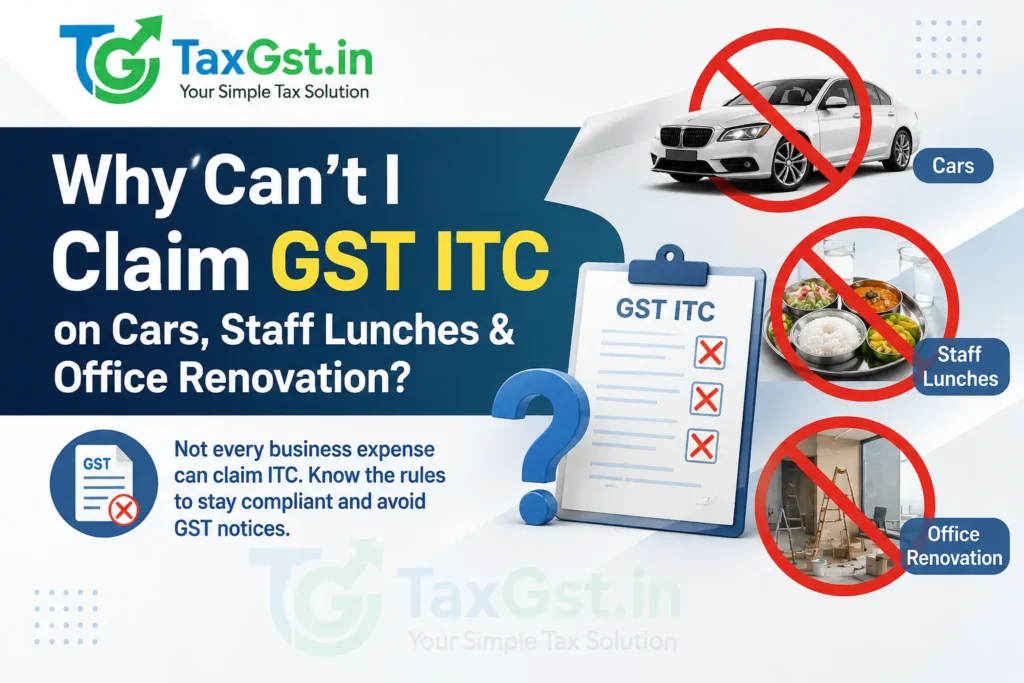
GST Input Tax Credit is denied on cars, staff meals and office renovation because Section 17(5) of the CGST Act, 2017 explicitly blocks credit on these categories regardless of whether they are used for business. Motor vehicles with seating up to 13 persons, food and beverages, outdoor catering, and construction of immovable property (other than plant and machinery) are listed as blocked credits, meaning the GST you pay on them becomes a cost to your business rather than a credit you can set off against your output tax liability.
Also Read-GST Return Troubleshooting: Fixing ITC Mismatch, E-invoice Errors, and Late Fee Penalties
Quick Summary
- Section 17(5) of the CGST Act, 2017 overrides Section 16(1) and Section 18(1) to block ITC on specific goods and services even when used for business purposes.
- ITC on motor vehicles for transportation of persons with approved seating capacity up to 13 persons is blocked unless used for resale, passenger transport or driving training, as per Section 17(5)(a) of the CGST Act.
- Food, beverages and outdoor catering services are blocked under Section 17(5)(b), with a narrow exception where providing such facilities is mandatory under any law for employees.
- Works contract services and construction of immovable property (excluding plant and machinery) are blocked under clauses (c) and (d) of Section 17(5).
- The Karnataka AAR in Aditya Auto Products & Engineering India Pvt. Ltd. [KAR. ADRG 25/2026 dated May 19, 2026] recently held that ITC on factory canteen services is admissible only to the extent of catering expenses actually borne by the employer for regular employees.
What Exactly Are Blocked Credits Under GST?
Think of blocked credits as a wall that sits in front of your ITC claim. Even if you satisfy every condition under Section 16 of the CGST Act — you hold a valid tax invoice, goods or services have been received, your supplier has filed returns, and you have filed your own return — Section 17(5) steps in and says “no credit for this particular expense.” This is a critical distinction that many taxpayers miss.
Section 16(1) gives you the right to claim input tax credit on goods or services used in the course or furtherance of business. Section 18(1) covers special circumstances like change in constitution or registration. But Section 17(5) of the CGST Act overrides both these provisions and creates a specific list of goods and services where credit is simply not available.
The policy rationale is straightforward. The legislature intends to block credit on items that are prone to personal consumption or where the value chain ends with the final user. By blocking credit on these items, GST ensures that the tax paid on them remains embedded in the cost structure rather than being passed forward as a credit. Blocked credits, specifically those that are non-reclaimable under Section 17(5), must be reflected in Table 4(B)(1) of Form GSTR-3B, as clarified by Notification No. 14/2022-Central Tax dated 5th July 2022 and Circular No. 170/02/2022-GST dated 6th July 2022. Importantly, these details must not be reported in Table 4(D)(1) of the same form, which is used for ITC reclaimed in the current tax period.
Why Is ITC Blocked on Motor Vehicles, Food and Construction?
The three categories that generate the most confusion — and the most audit disputes — are motor vehicles, food and catering services, and construction of immovable property. Each has its own clause under Section 17(5) with specific exceptions that you must understand before claiming any credit.
Motor Vehicles — Section 17(5)(a): ITC is blocked on motor vehicles for transportation of persons with approved seating capacity of not more than 13 persons including the driver. However, credit is available when the vehicle is used for further supply of such vehicles (car dealers), transportation of passengers (taxi operators), or imparting training on driving such vehicles (driving schools). Notably, electric vehicles are equally covered under this restriction since they remain classified as motor vehicles for transportation of persons. As per Notification No. 12/2019-Central Tax (Rate) dated 31st July 2019, the GST rate on electric vehicles was reduced from 12% to 5% effective 1st August 2019, but the ITC block remains intact.
Food and Catering — Section 17(5)(b): ITC on food and beverages, outdoor catering, beauty treatment, health services, cosmetic and plastic surgery, and membership of clubs or fitness centres is blocked. The proviso inserted by the CGST (Amendment) Act, 2018 with effect from 1st February 2019 allows credit only where it is obligatory for an employer to provide such facilities to employees under any law. This is why the Karnataka AAR’s recent ruling matters — it clarified that the statutory obligation under Section 46 of the Factories Act, 1948 applies only to regular employees and only to the portion of cost actually borne by the employer.
Construction of Immovable Property — Section 17(5)(c) and (d): Works contract services when supplied for construction of an immovable property (other than plant and machinery) are blocked, except where it is an input service for further supply of works contract services. Similarly, goods or services or both received by a taxable person for construction of an immovable property (other than plant and machinery) on his own account are also blocked, even if used in the course or furtherance of business. The term “construction” includes reconstruction, renovation, additions, alterations and repairs to the extent of capitalization.
How Should You Report Blocked Credits in Your GST Returns?
The compliance mechanism for blocked credits is built directly into your monthly return. As per Notification No. 14/2022-Central Tax dated 5th July 2022 and Circular No. 170/02/2022-GST dated 6th July 2022, details of ineligible ITC under Section 17(5) must be reflected in Table 4(B)(1) of Form GSTR-3B. Critically, these details must not be reported in Table 4(D)(1), which covers ITC reclaimed in the current tax period, nor in Table 4(D)(2), which covers ineligible ITC under Section 16(4) and due to Place of Supply provisions.
This means every tax period, you must identify expenses that fall under Section 17(5) and reverse the corresponding credit. The reversal is not optional — it is a statutory compliance requirement. If you fail to reverse blocked ITC and the department detects it during audit, you will face demand for the wrongly availed credit with interest under Section 50 of the CGST Act and potential penalty under Section 73 or 74. The table below summarizes the key blocked credit categories, their legal basis, and the compliance action required.
| Category | Legal Basis | ITC Status | Compliance Action |
|---|---|---|---|
| Motor vehicles (≤13 persons) | Section 17(5)(a) of the CGST Act | Blocked (except for resale, passenger transport, driving training) | Reverse full GST paid in Table 4(B)(1) of GSTR-3B |
| Food, beverages, outdoor catering | Section 17(5)(b) of the CGST Act | Blocked (except where mandatory under law for employees) | Reverse in Table 4(B)(1); claim only employer-borne portion where exception applies |
| Works contract for immovable property | Section 17(5)(c) of the CGST Act | Blocked (except for further works contract supply) | Reverse full GST paid in Table 4(B)(1) of GSTR-3B |
| Construction on own account | Section 17(5)(d) of the CGST Act | Blocked (including renovation, alterations, repairs if capitalized) | Reverse full GST paid in Table 4(B)(1) of GSTR-3B |
| Insurance/repairs of motor vehicles | Section 17(5)(ab) of the CGST Act | Blocked when underlying vehicle ITC is blocked | Reverse in Table 4(B)(1) along with vehicle ITC |
Consider a practical example. A manufacturing company purchases a car for its Managing Director at ₹15,00,000 with GST of ₹2,70,000 at 18%. The company also spends ₹5,00,000 on office renovation with GST of ₹90,000 at 18%. Additionally, it pays ₹3,00,000 for factory canteen services with GST of ₹15,000 at 5%, of which 40% is recovered from employees.
Total GST paid on these three expenses = ₹2,70,000 + ₹90,000 + ₹15,000 = ₹3,75,000. ITC blocked on car under Section 17(5)(a) = ₹2,70,000. ITC blocked on office renovation under Section 17(5)(d) = ₹90,000. ITC on canteen services = ₹15,000, but only the employer-borne portion (60% of ₹15,000 = ₹9,000) is admissible under the proviso to Section 17(5)(b). The remaining ₹6,000 attributable to employee recovery must be reversed. Net ITC to be reversed in Table 4(B)(1) of GSTR-3B = ₹2,70,000 + ₹90,000 + ₹6,000 = ₹3,66,000. The company can claim only ₹9,000 as admissible ITC from the canteen expense. The rest becomes a cost to the business.
This example illustrates why procurement-stage identification of blocked credits matters. If your accounts team flags these items at the time of purchase rather than at the time of filing, you avoid the risk of wrongly availing credit and facing demand notices later.
How Do You Calculate and Reverse Blocked ITC Correctly?
For expenses falling under Section 17(5) of the CGST Act, the entire GST paid on such inward supplies, where no exception applies, must be reversed. For instance, if a car is purchased for the personal use of a director, the full GST paid is blocked under Section 17(5)(a). Similarly, for office renovation that is capitalized, the entire GST paid is blocked under Section 17(5)(d). In cases like canteen services, where a statutory obligation exists, ITC is admissible only on the portion of the cost actually borne by the employer for regular employees, with the remaining portion being reversed under Section 17(5)(b).
The total amount of such ineligible ITC must be reported as a non-reclaimable reversal in Table 4(B)(1) of Form GSTR-3B for the relevant tax period. For businesses making both taxable and exempt supplies, the apportionment exercise becomes more complex. Rule 42 of the CGST Rules, 2017 prescribes the formula for reversing ITC on inputs and input services used partly for exempt supplies or personal use. Rule 43 covers capital goods. The key principle is that ITC must be attributed to the taxable use portion only, and the remainder must be reversed.
Banking companies and NBFCs have a specific option under the proviso to Section 17(4) of the CGST Act — they can claim a flat 50% of eligible ITC monthly on inputs, capital goods and services, with the remainder lapsing. This option, once exercised, cannot be changed during the remaining part of the financial year and does not apply to inter-branch transfers with the same Permanent Account Number.
What Documents Must You Maintain to Support ITC Claims and Reversals?
Even when ITC is blocked, your documentation must be audit-ready. The GST department routinely demands proof during scrutiny and audit, and missing documents can lead to demands even for credit you have not claimed. The following documents must be maintained for every ITC transaction, whether claimed or reversed:
- Valid Tax Invoice: Issued by a registered supplier containing all mandatory fields as per Rule 46 of the CGST Rules, 2017, including GSTIN, HSN/SAC code, taxable value, and tax amount.
- Proof of Receipt of Goods or Services: Delivery challan, acknowledgment of service completion, or email confirmation establishing that goods or services have been received.
- GSTR-2B Reconciliation: Monthly reconciliation of purchase register with GSTR-2B to identify invoices where the supplier has not filed GSTR-1. As per Section 16(2)(aa) of the CGST Act, ITC is available only to the extent it appears in GSTR-2B.
- Payment Records: Bank statements and payment vouchers proving that payment to the supplier (including the GST component) has been made within 180 days of the invoice date, as required under Section 16(2) of the CGST Act. If payment is not made within 180 days, the ITC claimed must be reversed under Rule 37 of the CGST Rules, 2017.
- Blocked Credit Working Sheet: A month-wise working sheet identifying each expense falling under Section 17(5), the GST amount, the clause under which it is blocked, and the reversal entry passed in GSTR-3B.
- Canteen Cost Bifurcation (where applicable): For factory canteen expenses, maintain a clear split between the employer-borne portion and the employee-recovered portion, along with salary deduction records or recovery receipts, in line with rulings like the Karnataka AAR in Aditya Auto Products & Engineering India Pvt. Ltd.
What Are the Critical Deadlines You Cannot Miss for ITC Claims?
Missing the ITC deadline is one of the most painful errors in GST compliance because the credit lapses permanently. Under Section 16(4) of the CGST Act, input tax credit on any invoice or debit note must be claimed by the earlier of two dates: 30th November of the financial year following the year of the invoice, or the date of furnishing the annual return (GSTR-9) for that financial year. For example, for an invoice dated 15th March 2026 (FY 2025-26), the last date to claim ITC is 30th November 2026, assuming the annual return for FY 2025-26 is filed after that date. If the annual return is filed earlier, that filing date becomes the deadline.
There is no provision for condoning this delay through the GST portal. Courts have consistently upheld this time limit, and the only narrow exception exists where a return was not filed due to a technical glitch on the portal — and even that typically requires litigation or GST Council intervention. The 180-day payment rule under Section 16(2) operates on a different timeline. If you have claimed ITC on an invoice but have not paid the supplier the value of the supply along with the tax payable thereon within 180 days from the date of issue of the invoice, the ITC claimed must be reversed. However, Rule 37(4) of the CGST Rules, 2017 clarifies that the time limit specified in Section 16(4) does not apply to a claim for re-availment of any credit that had been reversed earlier due to non-payment.
Many real-world expenses do not fall neatly into “fully eligible” or “fully blocked.” The most frequent mixed-use scenario involves canteen services, where the employer bears part of the cost and recovers the balance from employees. The Karnataka AAR ruling in Aditya Auto Products & Engineering India Pvt. Ltd. [KAR. ADRG 25/2026 dated May 19, 2026] established a clear principle: ITC on statutory canteen services is admissible only to the extent of catering expenses actually borne by the employer for regular employees. The portion recovered from employees is not eligible because the employer has not “borne” that cost. Additionally, ITC attributable to contractual workers was denied because Section 46 of the Factories Act, 1948 does not cast a statutory obligation on the principal employer for contract labour. This means businesses must implement a bifurcation mechanism in their books and in reconciliations with the canteen service provider. The invoice must be split into the employer-borne component (ITC admissible under the first proviso to Section 17(5)(b) of the CGST Act) and the employee-recovered component (ITC blocked).
Consider this worked example. A company purchases a sedan for its Chief Financial Officer at ₹22,00,000 with GST of ₹3,96,000 at 18%. The company also pays annual insurance of ₹45,000 with GST of ₹8,100 at 18%, and servicing costs of ₹15,000 with GST of ₹2,700 at 18%. None of these expenses qualify for ITC because the car is not used for resale, passenger transport, or driving training. Total GST paid = ₹3,96,000 + ₹8,100 + ₹2,700 = ₹4,06,800. This entire amount is blocked under Section 17(5)(a) and Section 17(5)(ab) of the CGST Act. The company must reverse ₹4,06,800 in Table 4(B) of GSTR-3B. There is no partial eligibility — the insurance and servicing credits are blocked because the underlying vehicle itself is blocked. Now contrast this with a car dealer who purchases the same vehicle at ₹22,00,000 as stock-in-trade. The GST of ₹3,96,000 is fully eligible as ITC because the vehicle is held for further supply, falling squarely within the exception under Section 17(5)(a) of the CGST Act. This distinction — the same vehicle, different ITC outcomes based on the nature of the business — is what makes blocked credit analysis fact-specific.
| Scenario | GST Paid | ITC Available | Amount to Reverse in Table 4(B) | Legal Basis |
|---|---|---|---|---|
| Car purchased by CFO for office use | ₹3,96,000 | Nil | ₹3,96,000 | Section 17(5)(a) — blocked |
| Same car purchased by car dealer as stock-in-trade | ₹3,96,000 | ₹3,96,000 | Nil | Section 17(5)(a) exception — further supply |
| Canteen services — employer bears 60%, recovers 40% from employees | ₹15,000 | ₹9,000 (60% of ₹15,000) | ₹6,000 (40% of ₹15,000) | First proviso to Section 17(5)(b) read with KAR. ADRG 25/2026 |
| Office renovation — repairs capitalized in books | ₹90,000 | Nil | ₹90,000 | Section 17(5)(d) — construction on own account |
The canteen example above reflects the principle laid down in the Karnataka AAR ruling. The employer can claim ITC only on the ₹9,000 GST component of the portion it actually bears. The ₹6,000 GST on the employee-recovered portion must be reversed. This bifurcation must be documented in the books and supported by a reconciliation statement linking the canteen service provider’s invoice to the salary deduction records.
What Are the Most Common Mistakes Taxpayers Make With Blocked Credits?
The single most frequent error is claiming full ITC on canteen services without excluding the employee-recovered portion. Many businesses treat the entire canteen GST as eligible because the facility is mandatory under Section 46 of the Factories Act, 1948. The Karnataka AAR ruling makes it clear that the exception applies only to the employer-borne cost, not to amounts recovered from employees through salary deductions or direct payments.
The second common mistake involves repairs and renovation. Businesses often claim ITC on office repairs, treating them as revenue expenditure. However, if the repairs are capitalized in the books of accounts — meaning they are treated as improvements to the immovable property rather than routine maintenance — the ITC is blocked under Section 17(5)(d) of the CGST Act. The determining factor is not the nature of the expense but whether it is capitalized.
The third mistake is overlooking the 180-day payment rule under Section 16(2) of the CGST Act. Even where ITC is legitimately available — such as the employer-borne canteen portion — if the supplier is not paid within 180 days of the invoice date, the credit must be reversed. Once payment is made, the credit can be re-availed, but the reversal entry in the interim period is mandatory.
Taxpayers should also note that the GST rate on electric vehicles remains at 5% as per Notification No. 12/2019-Central Tax (Rate) dated 31st July 2019. However, the ITC block under Section 17(5)(a) of the CGST Act applies equally to EVs. The lower rate reduces the upfront cost burden, but it does not change the credit eligibility position. A business purchasing an electric sedan for its director’s office use cannot claim ITC on the 5% GST paid, just as it could not on an internal combustion engine car at 18%.
How Much ITC Can You Actually Block in This Example?
Continuing the example from above, let us compute the exact ITC impact. The car purchase attracts GST of ₹3,96,000 at 18%, office renovation attracts ₹90,000 at 18%, and canteen services attract GST of ₹15,000. Total GST paid on these three expenses equals ₹5,01,000.
Now apply the Section 17(5) restrictions. The car is for the Managing Director’s office use — not for resale, passenger transport, or driving training. Hence, the entire ₹3,96,000 is blocked under Section 17(5)(a) of the CGST Act. The office renovation is construction of immovable property on own account — the entire ₹90,000 is blocked under Section 17(5)(d) of the CGST Act. The canteen services qualify for the proviso under Section 17(5)(b) of the CGST Act because Section 46 of the Factories Act, 1948 mandates the facility.
However, as per the Karnataka AAR ruling in Aditya Auto Products & Engineering India Pvt. Ltd. [KAR. ADRG 25/2026 dated May 19, 2026], ITC is restricted to the employer-borne portion only. Since 40% is recovered from employees, only 60% of ₹15,000 — which is ₹9,000 — is admissible. The remaining ₹6,000 is blocked. Total blocked ITC = ₹3,96,000 (car) + ₹90,000 (renovation) + ₹6,000 (canteen) = ₹4,92,000. Total admissible ITC = ₹9,000. This means approximately 98.2% of the GST paid on these three expenses becomes a cost to the business. The blocked amount of ₹4,92,000 must be reversed in Table 4(B) of Form GSTR-3B for the relevant tax period.
What Should You Do Next?
Taking corrective action now prevents demand notices and interest liability later. Here is what you should implement immediately.
- Review all expenses incurred in the current financial year and identify items falling under Section 17(5) of the CGST Act — specifically motor vehicles, food and catering, works contract for immovable property, and construction on own account.
- Reverse blocked ITC in Table 4(B) of Form GSTR-3B for every tax period. Do not wait until the annual return — monthly reversal is the compliance requirement, as reinforced by Notification No. 14/2022-Central Tax dated 5th July 2022.
- For factory canteen expenses, maintain a clear bifurcation in your books between the employer-borne portion and the employee-recovered portion. ITC cannot exceed the actual expenditure incurred by you, as clarified by the Karnataka AAR in its May 2026 ruling.
- Separate regular employees from contractual workers in your canteen cost allocation. The proviso to Section 17(5)(b) of the CGST Act applies only where a statutory obligation exists under any law — and Section 46 of the Factories Act, 1948 casts that obligation only in respect of workers directly employed.
- Train your procurement and accounts teams to flag blocked credit items at the invoice stage itself. If your team knows that a car purchase or office renovation will attract blocked ITC, they can factor that into the total cost of acquisition rather than discovering it post-filing.
- Maintain documentary evidence of statutory applicability — factory licence, employee head count registers, HR records showing regular vs contractual workforce, and canteen service provider invoices with clear cost bifurcation.
- Reconcile your GSTR-2B with your purchase register every month to ensure that ITC claimed matches what appears in your auto-drafted statement. Any credit not appearing in GSTR-2B is at risk of mismatch notice, as ITC is available only to the extent it appears in GSTR-2B as per Section 16(2)(aa) of the CGST Act.
Frequently Asked Questions
Can I claim ITC if my supplier has not filed their GST return?
ITC must appear in your GSTR-2B for a clean claim. If a supplier has not filed GSTR-1, their invoices will not reflect in your GSTR-2B. You can technically claim credit on the basis of a valid invoice, but this risks a mismatch notice. The safest approach is to follow up with the supplier for immediate GSTR-1 filing or defer the credit until it appears in GSTR-2B. Post-2022 amendments through Section 16(2)(aa) of the CGST Act have reinforced that ITC is available only to the extent it appears in GSTR-2B.
Can I claim ITC on electric vehicles used for office purposes?
No. Electric vehicles are classified as motor vehicles for transportation of persons under GST law. Section 17(5)(a) of the CGST Act blocks ITC on motor vehicles with seating capacity up to 13 persons unless used for resale, passenger transport, or driving training. Even though the GST rate on electric vehicles was reduced from 12% to 5% via Notification No. 12/2019-Central Tax (Rate) dated 31st July 2019, the ITC block remains intact. The lower rate only reduces your upfront cost — it does not make credit available.
Is ITC available on insurance, repairs and maintenance of a car?
ITC on general insurance, servicing, repairs and maintenance of motor vehicles is blocked under Section 17(5)(ab) of the CGST Act. The block applies whenever the underlying vehicle itself does not qualify for ITC. So if you cannot claim ITC on the car purchase, you also cannot claim ITC on its insurance, servicing or repairs. The only exception is when the vehicle is used for purposes that qualify under Section 17(5)(a) of the CGST Act — such as a car dealer claiming ITC on demonstration vehicles or a taxi operator claiming ITC on fleet maintenance.
Can I claim full ITC on factory canteen services?
No. The Karnataka AAR in Aditya Auto Products & Engineering India Pvt. Ltd. [KAR. ADRG 25/2026 dated May 19, 2026] held that ITC on canteen services is admissible only to the extent of catering expenses actually borne by the employer for regular employees. You cannot claim ITC on the portion recovered from employees through salary deductions. Additionally, the proviso to Section 17(5)(b) of the CGST Act applies only where a statutory obligation exists — Section 46 of the Factories Act, 1948 mandates canteens for factories employing more than 250 workers, but this obligation extends only to directly employed workers, not contractual labour.
Can I claim ITC on Corporate Social Responsibility (CSR) expenses?
No. ITC on goods or services used for CSR activities is generally considered blocked under Section 17(5) of the CGST Act. Even though Section 135 of the Companies Act, 2013 mandates certain companies to spend on CSR, the GST law does not treat such expenditure as being in the course or furtherance of business for ITC purposes. The rationale is that CSR is essentially philanthropic, and allowing credit would indirectly subsidize such activities through the tax chain. You must reverse any GST paid on CSR-related procurement in Table 4(B) of GSTR-3B.
What are the consequences if I mistakenly claim blocked ITC?
If you wrongly avail or utilize ITC blocked under Section 17(5) of the CGST Act, the department can demand recovery along with interest under Section 50 of the CGST Act. Where the error is genuine and not fraudulent, penalty under Section 73 applies. If suppression or willful misstatement is alleged, penalty under Section 74 — at 100% of the tax evaded — may be imposed. The safest course is to voluntarily reverse the credit in Table 4(B) of GSTR-3B.
Article Information
Published: July 12, 2026
Last Reviewed: July 12, 2026
Category: GST
Regulatory Body: CBIC (Central Board of Indirect Taxes and Customs)
Written by C.K. Gupta, M.Com & Tax Editor at TaxGST.in — helping businesses navigate GST compliance, ITC reconciliation, and return filing across Delhi NCR since 2009.
Official Resources
- GST Portal (e-Filing)
- CBIC Portal (Circulars)
- Income Tax Portal
- GST Council Updates
- E-Way Bill Portal
- E-Invoice Portal
Disclaimer: This article is for informational purposes only. For legal advice, consult a qualified tax professional. Always refer to the original notification for authoritative information.
Try the free GST calculator for instant figures.
ITR, GST returns, notices and registrations — fixed fees, human support, on-time filing.
Discover more from TaxGst.in
Subscribe to get the latest posts sent to your email.
Never Miss a Tax Deadline Again
Due-date alerts, GST updates and tax tips — free on the app you already use.
event Next: GSTR-1 (IFF) · 13 Oct