
 C.K. Gupta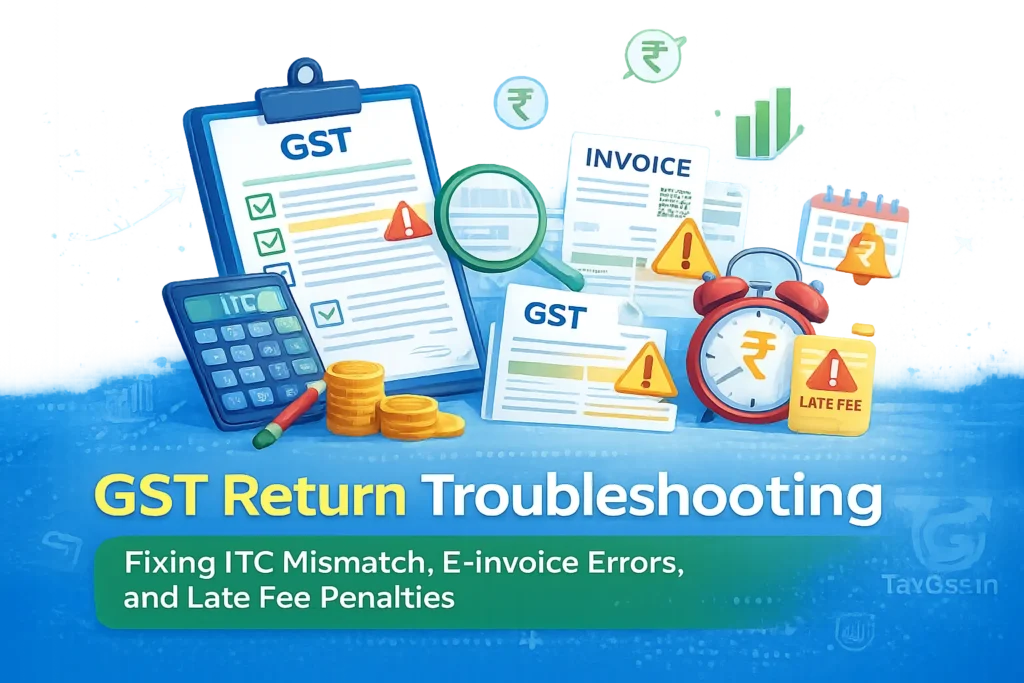
GST return troubleshooting in FY 2026-27 revolves around three critical areas: ITC mismatches between GSTR-2B and GSTR-3B that trigger automatic notices under Rule 88D of CGST Rules, e-invoice errors that render invoices invalid and deny buyers their ITC, and late fee penalties that accumulate daily under Section 47 of the CGST Act. With the e-invoicing framework now linking ITC directly to vendor behaviour, businesses must reconcile monthly rather than annually to avoid blocked returns, interest demands, and departmental scrutiny.
Quick Summary
- ITC claimed in GSTR-3B exceeding GSTR-2B by a prescribed percentage or amount triggers auto-generated intimation in Form DRC-01C under Rule 88D of CGST Rules.
- E-invoicing is mandatory from 1 April 2026 for businesses with Aggregate Annual Turnover (AATO) above ₹5 crore (as per Notification No. 10/2023-Central Tax dated 10.05.2023).
- Late fee for GSTR-3B with tax liability is ₹50 per day (₹25 CGST + ₹25 SGST), capped at ₹10,000 per return, as per Section 47 of the CGST Act.
- Interest at 18% per annum applies separately on unpaid tax under Section 50 of the CGST Act and is not capped. For excess ITC claimed or utilised, interest is 24% per annum.
- Fresh invoice series must start from 1 April 2026 for all GST registrants to avoid reconciliation mismatches.
- Electronic Credit Reversal and Reclaimed Statement (ECRS) negative balances may trigger warnings and departmental scrutiny, and future enhancements might systemically block business compliance registrations entirely.
Why Are ITC Mismatches Triggering GST Notices in 2026?
The single most common reason for GST notices in 2026 is ITC claimed in GSTR-3B that exceeds the auto-populated GSTR-2B statement. When this difference crosses a prescribed percentage or amount, the system automatically generates an intimation in Form DRC-01C under Rule 88D of CGST Rules (as per Notification No. 38/2023-Central Tax dated 04.08.2023). You get only 7 days to respond. Non-response blocks GSTR-1 filing and allows tax recovery without a Show Cause Notice under Sections 73 or 74 of the CGST Act.
Under the e-invoicing framework now active for FY 2026-27, ITC is directly linked to vendor behaviour. If your supplier fails to file GSTR-1 or deposit tax, the invoice will not reflect in your GSTR-2B, and your ITC claim becomes invalid as per Section 16(2)(aa) of the CGST Act. The defaulting party in the eyes of the law is not the vendor — it is you, the buyer who claimed the credit.
Structural mismatches also cause notices even when claims are valid. IGST on imports may not appear in GSTR-2B. Prior period ITC claims and transitional credits create reconciliation gaps. These require documented explanation rather than reversal. Common e-invoice errors compound the problem. Missing IRN, incorrect recipient GSTIN, HSN code mismatches, and failure to generate e-invoices for credit or debit notes all render invoices invalid.
How Does GST Late Fee Calculation Work and What Are the Current Caps?
GST late fee operates under Section 47 of the CGST Act as a fixed daily penalty, completely separate from interest under Section 50. For GSTR-3B and GSTR-1 with tax tax liability and interest calculations, the rate is ₹50 per day (₹25 CGST plus ₹25 SGST). For nil returns, it drops to ₹20 per day (₹10 CGST plus ₹10 SGST). The maximum cap for GSTR-3B and GSTR-1 with tax liability is ₹10,000 per return (₹5,000 each under CGST and SGST). For nil GSTR-3B returns specifically, the cap is ₹500 per return (₹250 each under CGST and SGST).
Interest under Section 50 of the CGST Act runs at 18% per annum on unpaid output tax from the day after the due date. For excess ITC claimed or utilised, interest is 24% per annum. Unlike the late fee, interest has no ceiling and keeps accumulating until the liability is discharged.
A practical error taxpayers make is paying the interest but not the late fee, or vice versa. Both appear on the challan under different heads — late fee under ‘Fee’ and interest under ‘Interest’. If either is left unpaid, the return stays unprocessed. The portal auto-calculates both amounts, but for long-overdue returns, the raw daily calculation may exceed the legal cap of ₹10,000. Manually verify: days late multiplied by ₹50. If that exceeds ₹10,000, you should only pay the capped amount.
If the portal shows more, raise a grievance on the GST portal or consult a professional before proceeding. No fresh blanket waiver is currently active for pending returns. Some taxpayers delay filing waiting for an amnesty announcement. That is a costly bet — interest runs regardless of whether a waiver is ever notified. The practical approach is to file the oldest overdue return first, verify the late fee against the statutory cap, pay both fee and interest under correct challan heads, and close the liability.
What Steps Should You Take to Reconcile ITC Before Filing GSTR-3B?
Monthly reconciliation is no longer optional. Under the e-invoicing framework active for FY 2026-27, ITC claims are validated against supplier filings in near real-time. Follow this sequence before submitting every GSTR-3B.
- Download GSTR-2B for the period from the GST portal. This auto-populated statement reflects invoices where your supplier has both filed GSTR-1 and deposited tax. Under Section 16(2)(aa) of the CGST Act, ITC is available only if the invoice appears in GSTR-2B.
- Compare GSTR-2B against your purchase register. Identify invoices present in your books but missing from GSTR-2B. These represent vendor non-compliance. Follow up immediately and do not claim ITC on missing invoices until they appear.
- Verify ITC claimed in previous periods against the 180-day vendor payment reconciliation tracking rule under the second proviso to Section 16(2) of the CGST Act. If you have not paid the supplier within 180 days of the invoice date, reverse the ITC in Table 4(B)(2) of GSTR-3B. Reclaim once payment is made.
- Check compliance with Section 16(2)(aa). ITC claimed in GSTR-3B Table 4(A) cannot exceed the amount appearing in GSTR-2B. Excess claims trigger auto-notices under Rule 88D of CGST Rules.
- Reconcile credit notes with vendor communications. A credit note rejected in the GST system by your customer creates additional GSTR-3B liability for them. Similarly, rejected vendor credit notes reduce your eligible ITC. Resolve rejections before filing.
- Discharge differential liability. If GSTR-1 shows higher tax than GSTR-3B, pay the difference plus interest under Section 50 of the CGST Act in the next return. If GSTR-3B shows higher tax, claim refund under Section 54 or adjust in subsequent periods.
Common Reconciliation Errors and Corrective Actions
| Error Type | Source Mismatch | Legal Reference | Corrective Action |
|---|---|---|---|
| ITC claimed in GSTR-3B but missing from GSTR-2B | GSTR-3B > GSTR-2B | Section 16(2)(aa) CGST Act | Reverse excess ITC in Table 4(B)(1); claim only when reflected in GSTR-2B |
| Tax paid in GSTR-3B but invoice not in GSTR-1 | GSTR-3B > GSTR-1 | Section 37(3) CGST Act; Section 50 CGST Act | Supplier to amend registration particulars or modify return values GSTR-1; pay interest under Section 50 if delayed |
| ITC claimed without 180-day vendor payment | GSTR-3B vs Books | Second proviso to Section 16(2) CGST Act | Reverse in Table 4(B)(2); re-avail after payment within time limit under Section 16(4) |
| Wrong tax head — IGST vs CGST/SGST | GSTR-3B vs GSTR-1 | Sections 77 CGST / 19 IGST | Pay correct head; seek refund of amount paid under wrong head |
| Credit note omitted or reported in wrong table | GSTR-3B Table 4(B) | Section 34 CGST Act | Report in Table 4(B)(1) for permanent reversal; adjust ECRS for temporary reversals |
| Prior period ITC claimed after deadline | GSTR-3B vs GSTR-2B | Section 16(4) CGST Act | ITC claim permitted up to 30 November of following FY or annual return date, whichever is earlier |
What Documents Must You Maintain to Respond to a DRC-01C Notice?
When ITC claimed in GSTR-3B exceeds GSTR-2B by a prescribed percentage or amount, the system auto-generates an intimation in Form GST DRC-01C under Rule 88D of CGST Rules (as per Notification No. 38/2023-Central Tax dated 04.08.2023). You have exactly 7 days to respond. The documentation you maintain determines whether you can defend the ITC claim or must reverse it. Ensure your archive holds:
- Tax invoices from suppliers — original invoices that meet all the statutory parameters under Section 16(2) of the CGST Act.
- Bank clearance proofs and payment logs — solid ledger verification showing full settlement of value plus taxes within the 180-day window.
- Interactive Invoice Management System (IMS) trail records — logs showcasing the real-time acceptance or systemic pendency allocations.
- ICEGATE import entries — corresponding bills of entry and automated port clearing challans for missing overseas IGST data strings.
Under the IMS framework active for FY 2026-27, credit note reporting has become a two-way dependency. When you issue a credit note and report it in GSTR-1, your recipient must accept it in IMS. If they reject it, the credit note does not reduce their GSTR-2B liability, which means they continue showing the original ITC claim while you have already reduced your output tax. This creates a cross-mismatch that triggers advisories for both parties.
On the inbound side, if your vendor issues a credit note and you reject it in IMS, your ITC gets reduced without corresponding adjustment in your books. This leads to an ITC balance in your ledger that no longer exists in GSTR-2B. Under the compliance framework, this discrepancy surfaces as an excess ITC claim in GSTR-3B. The practical approach is to treat credit note reconciliation as a weekly activity. Before filing GSTR-3B, check all credit notes issued and received during the period. Verify IMS acceptance status. For rejected outbound notes, follow up with customers immediately. For rejected vendor notes, resolve the dispute before the return filing deadline.
What Happens If You File GSTR-3B With an ITC Mismatch and How Do You Fix It?
If you file GSTR-3B with ITC exceeding GSTR-2B by more than 5% of available ITC or ₹25,000, whichever is lower, the system generates an intimation in Form GST DRC-01C under Rule 88D of CGST Rules. This is an auto-generated notice, not a scrutiny assessment. You have 7 days to respond with an explanation or reversal. If you do not respond within 7 days, the system blocks your GSTR-1 filing for the subsequent period, and the department may initiate recovery under Sections 73 or 74 of the CGST Act without issuing a Show Cause Notice.
The fix depends on the nature of the mismatch. If the excess ITC is due to a supplier not filing GSTR-1, reverse the ITC in Table 4(B)(1) of the next GSTR-3B and reclaim it once the supplier files and the invoice appears in GSTR-2B. The time limit for reclaiming is the earlier of 30th November of the following financial year or the date of filing the annual return, as per Section 16(4) of the CGST Act as amended by the Finance Act 2022.
If the mismatch is due to an error in your own reporting — such as claiming ITC on invoices not eligible under Section 17(5) — reverse the amount permanently in Table 4(B)(1). Pay interest at 24% per annum under Section 50 of the CGST Act from the date of wrongful claim to the date of reversal. If the excess ITC was utilised against output liability, the interest runs from the date of utilisation. For structural mismatches such as IGST on imports not reflecting in GSTR-2B, maintain supporting documents including the Bill of Entry, proof of IGST payment, and shipping bills.
Worked Example: Late Fee and Interest Calculation for a 45-Day Late Filing
A manufacturing unit in Pune files GSTR-3B for May 2026 on 3 July 2026, which is 13 days after the 20 June due date. The return shows a tax liability of ₹78,000. Late fee calculation: 13 days multiplied by ₹50 equals ₹650. Since this is below the maximum cap of ₹10,000 (for AATO > ₹5 crore) or ₹5,000 (for AATO up to ₹5 crore), the full ₹650 is payable. Interest under Section 50 of the CGST Act at 18% per annum on ₹78,000 for 13 days equals approximately ₹78,000 × 18% / 365 × 13, which is about ₹499. Total amount due: ₹650 late fee plus ₹499 interest equals ₹1,149 over and above the tax liability.
Now consider a nil return filed 40 days late. Late fee: 40 days multiplied by ₹20 equals ₹800, but the cap for nil GSTR-3B is ₹500. The taxpayer pays only ₹500. No interest applies because there is no tax outstanding. This distinction matters — many taxpayers overpay on nil returns by not applying the cap.
What Are the Key GST Compliance Actions for FY 2026-27 That Affect Return Filing?
Several structural changes from 1 April 2026 directly impact how returns are filed and reconciled for the current financial year. First, every GST registrant must start a fresh invoice numbering series from 1 April 2026. Continuing the previous year’s series creates reconciliation problems in GSTR-1 and invites departmental scrutiny. Invoice numbers must be unique within each financial year for each GSTIN.
Second, e-invoicing becomes mandatory from 1 April 2026 for any GSTIN whose aggregate annual turnover exceeded ₹1 crore in FY 2025-26 (based on Notification No. 01/2024-Central Tax dated 05.01.2024). For taxpayers with AATO exceeding ₹100 crore, a 30-day time limit applies for reporting e-invoices on the IRP portal (as per Notification No. 53/2023-Central Tax dated 27.12.2023). Invoices reported after 30 days are invalid, and buyers lose ITC. Register on the IRP before raising your first invoice under the new threshold.
Third, exporters and SEZ suppliers must file a new Letter of Undertaking in Form RFD-11 for FY 2026-27 before raising any export invoice. The LUT filed for FY 2025-26 expired on 31 March 2026. Miss this, and you must pay IGST on exports and claim refund later, which delays cash flow and adds compliance work.
Fourth, the condition that refund applications below ₹1,000 would not be processed has been removed from 05.07.2022 (as per Notification No. 14/2022-Central Tax dated 05.07.2022). Every valid export refund claim, regardless of amount, will now be processed. Small claims that were earlier ignored can now be filed and recovered.
Fifth, the Electronic Credit Reversal and Reclaimed Statement (ECRS) on the GST portal tracks ITC reversals and subsequent reclaims. A negative closing balance currently triggers a warning and may block GST return filing entirely. Update the ECRS with accurate document-level data now rather than waiting for it to become a filing block.
Sixth, taxpayers with AATO exceeding ₹50 lakh must comply with Rule 86B of CGST Rules, which requires paying at least 1% of output tax liability in cash each month. Non-compliance may block GSTR-3B submission. Verify your turnover for FY 2025-26 to determine applicability from April 2026.
Finally, HSN code reporting accuracy remains critical. The number of digits required depends on your annual turnover and whether the supply is B2B or B2C. For taxpayers with AATO up to ₹5 crore, 4-digit HSN is mandatory for B2B supplies. For those with AATO above ₹5 crore, 6-digit HSN is mandatory for both B2B and B2C supplies. Incorrect or missing HSN codes trigger departmental notices and distort GSTR-1 data. Cross-check your HSN mapping before issuing the first invoice of the financial year.
What Should You Do Next?
- Download and review GSTR-2B for April 2026 immediately. Compare it line-by-line with your purchase register to identify invoices where your supplier has filed but not deposited tax, or where invoices are missing entirely.
- Calculate your late fee exposure for any pending returns from FY 2025-26 or earlier. Multiply days overdue by ₹50 (or ₹20 for nil returns) and verify the amount does not exceed the statutory cap of ₹10,000 (for AATO > ₹5 crore) or ₹5,000 (for AATO up to ₹5 crore) (₹500 for nil GSTR-3B) under Section 47 of the CGST Act.
- File Form RFD-11 (LUT) on the GST portal if you have any zero-rated supplies, exports, or SEZ deliveries planned for FY 2026-27. The LUT filed for FY 2025-26 expired on 31 March 2026 and cannot be used for invoices raised from 1 April 2026.
- Reset your invoice numbering series to start fresh from 1 April 2026. Continuing the previous year’s series creates reconciliation mismatches in GSTR-1 and can trigger departmental scrutiny during assessments.
- Verify your e-invoicing obligations based on your FY 2025-26 AATO. If it exceeded ₹1 crore, e-invoicing is mandatory from 1 April 2026. If your AATO exceeded ₹100 crore, ensure all invoices are reported to IRP within 30 days to remain valid for ITC.
- Update the Electronic Credit Reversal and Reclaimed Statement (ECRS) with accurate document-level data. A negative closing balance may currently trigger a warning but can block GST return filing entirely in the near future.
- Set up a monthly vendor compliance calendar. Track filing status of your key suppliers before claiming ITC. Under the IMS framework, vendor non-compliance directly blocks your credit and creates reconciliation disputes.
Frequently Asked Questions
How much late fee do I owe if I file GSTR-3B 45 days late with a tax liability?
The late fee is ₹50 per day (₹25 CGST plus ₹25 SGST) for returns with tax liability, as per Section 47 of the CGST Act. For 45 days, the calculation is ₹50 multiplied by 45, which equals ₹2,250. This is well below the maximum cap of ₹10,000 per return (₹5,000 CGST plus ₹5,000 SGST) for taxpayers with AATO exceeding ₹5 crore, or ₹5,000 (₹2,500 CGST plus ₹2,500 SGST) for taxpayers with AATO up to ₹5 crore, so you pay the full calculated amount. Remember, interest at 18% per annum under Section 50 of the CGST Act applies separately on the unpaid tax from the day after the due date and is not capped.
Can I claim ITC if the invoice is in my purchase register but missing from GSTR-2B?
No. Under Section 16(2)(aa) of the CGST Act, ITC is available only if the invoice appears in GSTR-2B. If the supplier has failed to file GSTR-1 or deposit tax, the invoice will not reflect in your auto-populated statement. Claiming ITC on such invoices triggers an auto-generated intimation in Form DRC-01C under Rule 88D of CGST Rules if the difference exceeds 5% of available ITC or ₹25,000, whichever is lower. Follow up with the supplier immediately and claim credit only once the invoice appears in GSTR-2B.
What happens if I do not pay my vendor within 180 days of the invoice date?
Under the second proviso to Section 16(2) of the CGST Act, you must reverse the ITC claimed on that invoice in Table 4(B)(2) of GSTR-3B. The reversal can be reclaimed once you pay the supplier (value plus tax) within the time limit prescribed under Section 16(4) of the CGST Act — which is the earlier of 30th November of the following financial year or the date of filing the annual return. Failure to reverse within 180 days attracts interest at 24% per annum on the excess ITC claimed under Section 50 of the CGST Act.
Is there any late fee waiver available for pending GST returns in FY 2026-27?
No fresh blanket waiver is active for returns pending from April 2025 onward. The CBIC has issued amnesty schemes in the past, including one covering returns up to March 2023, but no equivalent scheme is active in 2026 for newer pending returns. Waiting for a waiver announcement is a costly strategy — interest at 18% per annum under Section 50 of the CGST Act continues to run on unpaid tax regardless of whether a waiver is notified. The practical approach is to file the oldest overdue return first, verify the late fee against the statutory cap of ₹10,000 (or ₹5,000 depending on turnover), and discharge both fee and interest under the correct challan heads.
How Do You Handle ECRS Negative Balances Before They Block Your GST Return?
The Electronic Credit Reversal and Reclaimed Statement (ECRS) on the GST portal tracks temporary ITC reversals reported under Table 4(B)(2) of GSTR-3B and subsequent reclaims. A negative closing balance in ECRS currently triggers a system warning. Going forward, it may block GST return filing entirely, similar to how the RCM ITC statement issue blocks filings today. Update the ECRS with accurate document-level data immediately. Identify tax periods where permanent reversals were wrongly reported under Table 4(B)(2) instead of Table 4(B)(1). Make an offsetting adjustment in Table 4(B)(2) in the current tax period to neutralize the misreported amounts and bring the ledger balance to its correct position. Do not wait for the negative balance to become a filing block — resolve it proactively each month.
What Happens If You Continue the Previous Year’s Invoice Series After 31 March 2026?
Every GST-registered business must reset and start a new invoice numbering series from 1 April 2026. According to GST advisory guidelines, invoice numbers must be unique within a financial year for each GSTIN. Continuing the previous year’s series creates reconciliation problems in GSTR-1, can cause e-way bill generation failures, and invites departmental scrutiny during audits. A consistent, sequential series simplifies GSTR-1 filing, e-invoice generation on the IRP portal, and e-way bill issuance. Before raising your first invoice of FY 2026-27, verify that your ERP or billing system has been reset to the new series and that the series is unique.
Sources
- CBIC Portal (Circulars and Central Tax Notifications Archive)
- GST Portal (e-Filing and Rule 88D Advisories)
- GST Council Recommendations Dashboard
Disclaimer: This article is for informational purposes only. For legal advice, consult a qualified tax professional. Always refer to original notifications and gazetted updates from the CBIC for authoritative information.
Related Reading
- New E-Way Bill Rules 2026: Mandatory Ship-To GSTIN & Closure Facility
- Simplified GST Registration Under Rule 14A: Step By Step Detailed Guide
- How to Handle GST ASMT-10 Notice for Mismatch in GSTR-1 and GSTR-3B
Try the free GST calculator for instant figures.
ITR, GST returns, notices and registrations — fixed fees, human support, on-time filing.
Discover more from TaxGst.in
Subscribe to get the latest posts sent to your email.


Never Miss a Tax Deadline Again
Due-date alerts, GST updates and tax tips — free on the app you already use.
event Next: GSTR-1 (IFF) · 13 Oct