
 C.K. Gupta
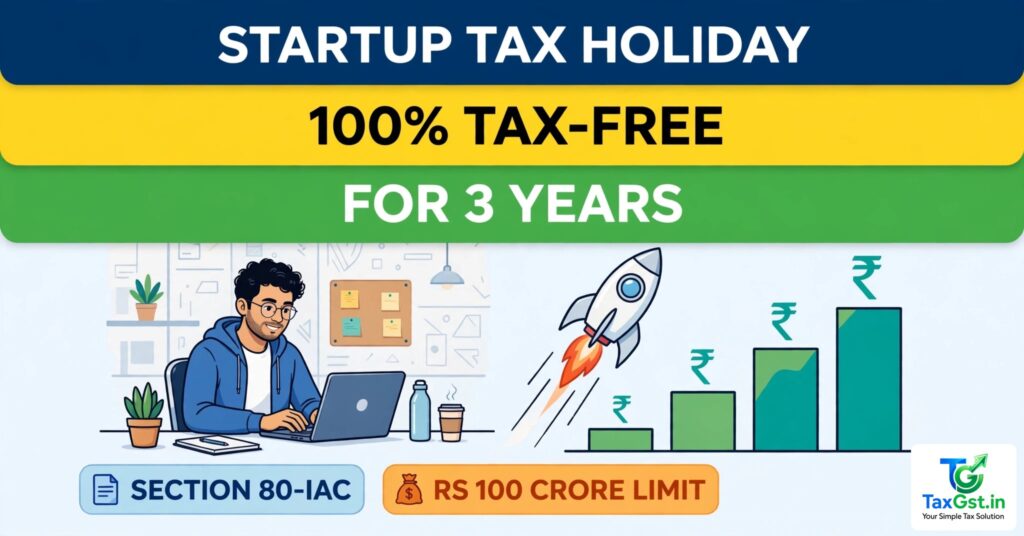
An eligible startup pays zero income tax on its profits for any three consecutive years out of its first ten, under Section 80-IAC of the Income-tax Act, 1961 (Section 140 of the Income-tax Act, 2025). The Finance Act, 2025 extended the window to startups incorporated up to 31 March 2030. You need DPIIT recognition and a separate Inter-Ministerial Board certificate, turnover of no more than ₹100 crore, and you must be a company or LLP. DPIIT recognition alone does not give the holiday. Verified November 2026 · TaxGST.in
A founder in Pune incorporated her SaaS company in 2023. In Tax Year 2026-27 it turns its first real profit — ₹40 lakh. Her CA tells her the tax on that profit would be about ₹10 lakh. Then he adds: she may not have to pay a rupee of it, for three years, if she claims the startup tax holiday. She has never heard of it. She is not alone — most eligible startups never apply, because the holiday needs two separate approvals and nobody tells founders the second one exists. This is the complete guide: who qualifies, what it is worth, and the exact route to claiming it.
If you are still choosing your business structure, start with the presumptive tax guide for freelancers and professionals — it works through how small businesses are taxed before the startup rules enter the picture. The deductions side of the story lives in the deductions hub, which collects every major saving route in one place.
What the holiday actually is
Section 80-IAC of the Income-tax Act, 1961 — carried into the new law as Section 140 of the Income-tax Act, 2025 — gives an eligible startup a 100% deduction on the profits and gains of its eligible business. In plain terms: for any three consecutive years you choose within your first ten years from incorporation, your eligible profits are fully deductible, so no income tax is payable on them. The holiday was introduced with the Startup India initiative on 1 April 2017, and the Finance Act, 2025 extended the incorporation window by five years: startups incorporated on or after 1 April 2016 and on or before 31 March 2030 can qualify.
The worked example makes the value concrete. Our Pune founder’s ₹40 lakh profit, at the 25.17% effective rate for a company under the 22% regime (22% plus 10% surcharge plus 4% cess), would cost about ₹10.07 lakh in tax. Claimed under Section 80-IAC, that tax is zero for the year — and across three profitable years at the same level, the saving is roughly ₹30 lakh. That is a hire, a marketing budget, or six months of runway. The catch is that you choose the three years: claim them too early, while profits are small, and you waste the holiday on years when the tax would have been trivial. The smart move is to wait for the profitable years — but not too long, because the three years must fall within the first ten from incorporation.
Who qualifies: the five tests
| Test | Requirement |
|---|---|
| Entity type | Private limited company or LLP only — partnership firms and others cannot claim it |
| Incorporation window | On or after 1 April 2016 and on or before 31 March 2030 |
| Turnover | Not exceeding ₹100 crore in the financial year for which the deduction is claimed |
| DPIIT recognition | Recognised as a startup by the Department for Promotion of Industry and Internal Trade |
| IMB certificate | Certificate of eligible business from the Inter-Ministerial Board |
Two points trip people up. First, the business must be an eligible business — one involved in innovation, development or improvement of products, processes or services, with a scalable model and high potential for employment generation or wealth creation. A business formed by splitting up or reconstructing an existing business does not qualify. Second, the turnover test applies to the year of claim: exceed ₹100 crore in a year and the deduction is lost for that year. Note the difference from DPIIT recognition itself — under the DPIIT notification of 4 February 2026, an entity can be recognised as a startup for up to 10 years from incorporation with turnover up to ₹200 crore in any financial year (up to 20 years and ₹300 crore for deep-tech startups). That wider recognition does not extend the tax holiday: the Section 140 deduction still needs turnover of no more than ₹100 crore and three consecutive years within the first ten.
The two-step application route
Step one is DPIIT recognition. Apply on the Startup India portal (startupindia.gov.in) as a startup under Notification G.S.R. 127(E) dated 19 February 2019. Recognition is a self-certified online process, free of charge, and it confirms you meet the government’s definition of a startup. It brings other benefits too — self-certification for labour and environmental laws, faster patent examination, easier public procurement — but on its own it gives you no tax holiday. That is the step most founders stop at, and it is why the holiday goes unclaimed.
Step two is the Inter-Ministerial Board certificate. After DPIIT recognition, apply through the Startup India portal for a certificate of eligible business from the IMB, which examines whether your business is genuinely innovative and eligible for the deduction. The DPIIT has granted this approval to a limited number of startups — 187 in one recent count — which tells you the Board applies the innovation test seriously. Your application needs a real case: what is innovative, what is scalable, and how the business creates employment or wealth. A generic business plan will not pass. Once the certificate is issued, claim the deduction in the return for the chosen years, and keep the certificate with your records.
The traps: what founders get wrong
- Assuming recognition equals the holiday: DPIIT recognition is the door; the IMB certificate is the room. Without the certificate, there is no deduction.
- Claiming the wrong three years: the holiday covers three consecutive years of your choice within the first ten. Picking years one to three, when the startup is loss-making, wastes it entirely.
- Forgetting the ₹100 crore test: the recognition limit is ₹200 crore, but the tax holiday limit is ₹100 crore. Growing past ₹100 crore ends the deduction even while recognition continues.
- Ignoring MAT: the holiday cuts your normal tax, but a company under the old corporate regime can still face minimum alternate tax on book profits — one more reason many startups opt for the 22% regime, where MAT does not apply. Check with your CA before choosing.
- Missing the window: incorporation after 31 March 2030 does not qualify. If you are incorporating now, the window is open — but it is not open forever.
One related change founders should know: the angel tax — Section 56(2)(viib) — was abolished from 1 April 2025, applying from Assessment Year 2025-26. Raising money above fair market value no longer triggers a tax charge on the company, which removes one of the old deterrents to early funding rounds. For the wider year-end picture, the mid-year tax moves checklist covers the deductions still open before March 2027, and if your startup also pays salaries, the salary TDS guide explains how to keep employee withholding correct from the first payslip.
FAQs
How many years of tax holiday does a startup get under 80-IAC?
Three consecutive years, of the startup’s choice, within the first ten years from incorporation. The deduction is 100% of the profits of the eligible business.
Is DPIIT recognition enough to claim the tax holiday?
No. You also need a certificate of eligible business from the Inter-Ministerial Board, applied for separately through the Startup India portal.
What is the last date to incorporate and still qualify?
31 March 2030, as extended by the Finance Act, 2025. The startup must be incorporated on or after 1 April 2016.
Does the holiday apply to partnership firms?
No. Only companies and LLPs can claim the Section 80-IAC (now Section 140) deduction, even though partnership firms can be DPIIT-recognised.
What is the turnover limit for the startup tax holiday?
₹100 crore in the financial year for which the deduction is claimed. The DPIIT recognition limit of ₹200 crore (₹300 crore for deep-tech) is separate and does not raise the holiday limit.
Sources
Section 80-IAC, Income-tax Act, 1961 (Section 140, Income-tax Act, 2025) — 100% deduction for three consecutive years out of the first ten. Finance Act, 2025 — incorporation window extended to 31 March 2030. DPIIT Notification G.S.R. 127(E), dated 19 February 2019 (startup definition; recognition via Startup India portal). DPIIT notification of 4 February 2026 (recognition up to 10 years / ₹200 crore turnover; deep-tech up to 20 years / ₹300 crore). Finance Act, 2025 — abolition of angel tax (Section 56(2)(viib)) from 1 April 2025.
Discover more from TaxGst.in
Subscribe to get the latest posts sent to your email.