
 C.K. Gupta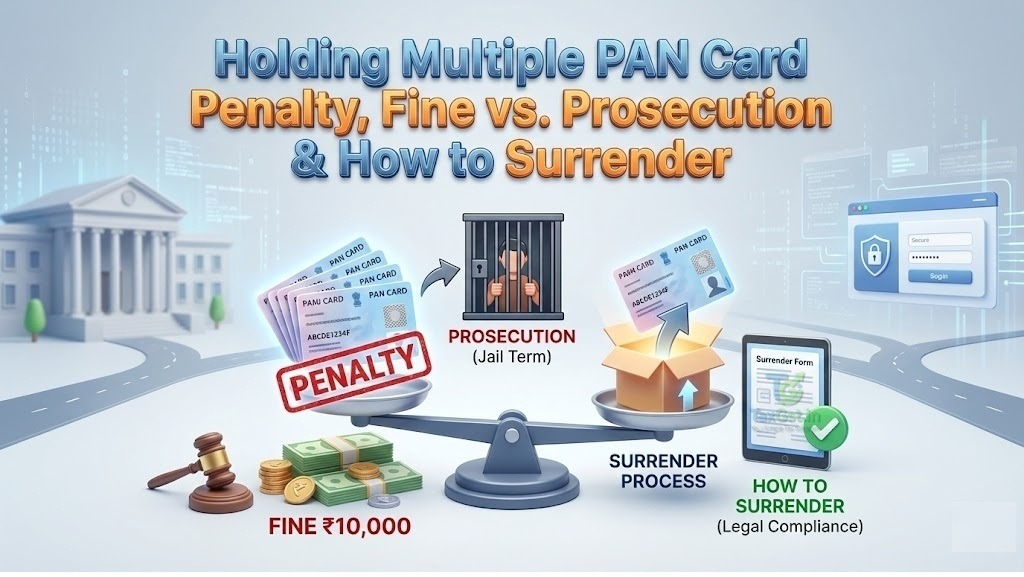
The Permanent Account Number (PAN) is the backbone of India’s financial infrastructure. Issued by the Income Tax Department (ITD) under the supervision of the Central Board of Direct Taxes (CBDT), this 10-digit alphanumeric identifier is not merely a card—it is the digital DNA of a taxpayer.
However, a significant number of individuals and entities in India inadvertently or intentionally possess more than one PAN. While some view this as a harmless clerical error or a “backup” identity, the Indian legal system views it through a much harsher lens.
Also Read-Govt Introduces New Labour Law Codes Reforms 2025: What Every Indian Worker Must Know
Contrary to popular belief, holding multiple PANs is not just a minor compliance issue. While accidental duplication attracts a civil fine of ₹10,000, the intentional use of multiple PANs for financial gain constitutes fraud. Recent judicial precedents (including the 2025 convictions of prominent political figures) have established that this can lead to rigorous imprisonment of up to 7 years under the Indian Penal Code.
The Legal Mandate: Why “One Person, One PAN”?
The foundation of PAN laws lies in the Income Tax Act, 1961. The government enforces a strict “One Person, One Number” policy to maintain the integrity of the tax base.
Section 139A(7): The Prohibition.
The law is explicit. Section 139A(7) states: “No person who has already been allotted a permanent account number under the new series shall apply, obtain or possess another permanent account number.”
This section makes the mere possession of a second PAN a statutory violation, regardless of whether it is used. The rationale behind this strict prohibition is threefold:
- Prevention of Tax Splitting: Taxpayers with multiple PANs could theoretically split their income across two identities to remain in lower tax slabs (e.g., claiming the ₹7 Lakh rebate twice).
- Loan & Credit Fraud: Individuals with poor credit scores (CIBIL defaults) often attempt to generate a “clean” PAN to secure fresh loans from unsuspecting banks.
- Benami Transactions: Multiple PANs are the primary tool used in money laundering to hide the true beneficial owner of assets.
Penalties for Holding Multiple PAN: From Fines to Prison.
The consequences of holding multiple PANs fall into two distinct buckets: Civil Penalties (for errors) and Criminal Prosecution (for fraud). It is vital to understand the difference.
Tier 1: The Civil Penalty (Section 272B).
Scenario: You lost your wallet in 2010 and applied for a new PAN instead of a reprint. You now physically hold two cards but use only one.
The Law: Under Section 272B of the Income Tax Act, the Assessing Officer (AO) has the discretion to impose a penalty of ₹10,000. This is a compounding offense, meaning once the fine is paid and the extra PAN surrender is processed, the matter is closed. There is no jail time, and it does not result in a criminal record.
Tier 2: Criminal Prosecution (IPC & Tax Evasion).
Scenario: An individual deliberately obtains a second PAN with a slightly manipulated date of birth to open a new bank account and hide income from the authorities.
The Law: This moves beyond the Income Tax Act and triggers the Indian Penal Code (IPC). The relevant sections include:
- Section 420 (Cheating): Cheating and dishonestly inducing delivery of property (e.g., getting a loan using a fake PAN). Penalty: Up to 7 Years Jail.
- Section 467 (Forgery): Forgery of valuable security (the PAN card itself). Penalty: Up to Life Imprisonment (in extreme cases) or 10 Years.
- Section 468 (Forgery for Cheating): committing forgery for the purpose of cheating. Penalty: Up to 7 Years Jail.
- Section 277 (Income Tax Act): Making a false statement in verification. Penalty: Up to 7 Years Jail.
The “7-Year Jail” Reality: Analyzing Real Cases.
The threat of jail time is not theoretical. While the original article cited a “Rajesh Mehta” case (which is not a standard precedent), we can look at the very real and high-profile conviction of Azam Khan and Abdullah Azam (November 2025 / Late 2024 Context).
The Abdullah Azam Case Study.
The Offense: The accused was found to be in possession of two PAN cards.
- PAN 1: Reflected a specific Date of Birth used for educational records.
- PAN 2: Reflected a different Date of Birth used to qualify for elections (minimum age requirement).
The Verdict: The Special Court did not treat this as a simple tax violation. Because the second PAN was used to deceive authorities (Election Commission and Banks), the court convicted the accused under IPC Sections 420 (Cheating), 467, 468, and 471. The sentence handed down was 7 years of imprisonment.
Key Lesson for the Common Man.
You might argue, “I am not a politician.” However, if you use a second PAN to:
- Get a credit card after defaulting on a previous one;
- Hide a property purchase;
- Create a fake supplier for GST invoices;
…you are committing the exact same offense of Cheating and Forgery. The IT Department’s “Project Insight” now shares data with the Ministry of Corporate Affairs and Banks to catch these discrepancies automatically.
Collateral Damage: Non-Legal Consequences.
Even if you avoid prison, holding duplicate PANs can destroy your financial life in other ways.
A. The “Benami” Property Risk.
Under the Benami Transactions (Prohibition) Amendment Act, 2016, properties purchased under a PAN that is not your legally valid primary PAN can be classified as “Benami.”
Consequence: The government can confiscate 100% of the property value, and you may face rigorous imprisonment up to 7 years solely under the Benami Act.
B. Banking and Credit Freeze.
With the integration of the Account Aggregator Framework, banks now deduplicate customers. If a bank detects two PANs linked to the same biometric (Aadhaar) identity:
- Your bank accounts may be frozen “Debit Freeze” immediately.
- Your KYC status will be flagged as “High Risk.”
- Your CIBIL score may be fragmented, or worse, “Red Flagged” for fraud, making it impossible to get loans for the next decade.
C. Demat and Investment Locks.
SEBI (Securities and Exchange Board of India) mandates strict KYC. If your Demat account is linked to a PAN that gets deactivated by the ITD during a de-duplication drive, your shares and mutual funds will be frozen. You will be unable to sell or transfer them until the issue is rectified, which can take months.
How to Check & Surrender a Duplicate PAN.
If you suspect you have multiple PANs, do not wait for a notice. Voluntary surrender is viewed leniently by the law.
Phase 1: Verification (Do you actually have two?).
Before surrendering, verify which PAN is active and linked to your ecosystem.
- Step 1: Log in to the Income Tax e-Filing Portal (incometax.gov.in).
- Step 2: Go to “My Profile” to see your primary linked PAN.
- Step 3: Use the “Know Your PAN” tool (if available) or check your CIBIL report. Often, the CIBIL report lists all PANs reported by lenders.
Phase 2: Determining the “Primary” PAN.
You must decide which PAN to keep. Ideally, keep the PAN that is:
- Linked to your Aadhaar.
- Used for filing ITRs in the last 3 years.
- Linked to your main bank account and Demat account.
The other PAN (the “Secondary” one) must be surrendered.
Phase 3: The Surrender Process (Online/Offline Hybrid).
Option A: NSDL/UTIITSL Online Request.
- Visit the NSDL (Protean) portal for “Changes/Correction in PAN”.
- Fill out the form using your Primary PAN (the one you want to keep).
- In Item No. 11 of the form, there is a specific checkbox for “Mention other Permanent Account Numbers (PANs) if any, inadvertently allotted to you.”
- Enter the Duplicate PAN number(s) here.
- Submit the form and pay the processing fee.
- Crucial: This notifies the NSDL, but legal surrender requires informing the Assessing Officer (AO).
Option B: The Letter to the AO (Highly Recommended).
To ensure you have legal proof of surrender (in case of future scrutiny), follow this manual step:
Drafting the Affidavit/Letter:Write a letter to your Jurisdictional Assessing Officer (you can find your AO code on the e-filing portal under “Know Your AO”).
Subject: Voluntary Surrender of Duplicate PAN [Number] allotted inadvertently.
Content: State clearly that you possess PAN A (Primary) and PAN B (Duplicate). Explain that PAN B was obtained due to error/ignorance and has/has not been used. Request its cancellation under Section 139A.
Attachments: Copy of PAN A, Copy of PAN B, Copy of Aadhaar.
Procedure: Submit this physically at the Aaykar Bhavan (Income Tax Office) of your ward and get a stamped acknowledgement on a photocopy. This stamped copy is your shield against penalties.
Exceptions: When are Multiple Numbers Allowed?
Is there ever a scenario where two numbers are legal? The strict answer is NO for the same entity. However, there are nuances:
| Scenario | Legality | Explanation |
|---|---|---|
| Individual + Sole Proprietorship | ❌ Illegal | A Sole Proprietorship and the Individual are the same tax entity. You must use your personal PAN for your business. |
| Individual + Partnership Firm | ✅ Legal (Distinct) | The Firm gets a separate PAN (starts with ‘F’) and the Partner has a personal PAN (starts with ‘P’). This is not a duplicate; it is a separate entity. |
| Individual + HUF (Hindu Undivided Family) | ✅ Legal (Distinct) | An individual can be the Karta of a HUF. The HUF gets its own PAN (starts with ‘H’) distinct from the Karta’s personal PAN. |
| NRI with Foreign Tax ID + Indian PAN | ✅ Legal | An NRI can hold an Indian PAN and a US SSN/UK NIN. These are jurisdiction-specific and allowed. |
Future Outlook: The End of the Duplicate PAN.
If you are holding a duplicate PAN hoping “no one will notice,” be aware that the window is closing. The government’s technology stack has evolved dramatically.
Project Insight & AIS.
The Income Tax Department’s Annual Information Statement (AIS) aggregates data from 40+ sources (Banks, Registrars, Mutual Funds, Foreign Remittances). Even if you use PAN A for Bank 1 and PAN B for Bank 2, the system matches them using:
- Fuzzy Logic Name Matching: Detecting “Ramesh Kumar” and “Ramesh K.” as the same person.
- Address Clustering: Linking accounts with identical addresses.
- Biometric De-duplication: Since PAN must be linked to Aadhaar, the Aadhaar database acts as the master key. Two PANs linked to one Aadhaar trigger an immediate alert.
The “Inoperative” PAN Rule.
As of recent finance acts, any PAN not linked to Aadhaar has become “Inoperative.” If you have a duplicate PAN that you haven’t dared to link to Aadhaar, it is likely already inoperative. However, simply letting it go inoperative is not enough; you must legally surrender it to avoid the Section 272B penalty
Frequently Asked Questions (FAQs) on Multiple PAN Cards
What is the penalty for holding two PAN cards?
Can I go to jail for having multiple PAN cards?
How do I surrender a duplicate PAN card?
I have two PAN cards with the same number. Is that illegal?
Can I have a separate PAN for my business?
Disclaimer: The information provided in this article is for educational purposes and based on the Income Tax Act, 1961, and Indian Penal Code provisions active as of 2025. Tax laws are subject to change. Readers are strongly advised to consult a qualified Chartered Accountant (CA) or Tax Practitioner before taking action regarding duplicate PANs.
Related Reading
- Old Income Tax Act 1961 vs New Income Tax Bill 2025: An Overview
- How to Calculate Advance Tax , Online Payments & Due Dates for FY 2024-25
- Section 54F: Invest Capital Gains Multiple Times to Buy Your Dream Home
Try the free income tax calculator for instant figures.
Discover more from TaxGst.in
Subscribe to get the latest posts sent to your email.



Never Miss a Tax Deadline Again
Due-date alerts, GST updates and tax tips — free on the app you already use.
event Next: TDS Return (138 / 140) · 31 Oct