
 C.K. Gupta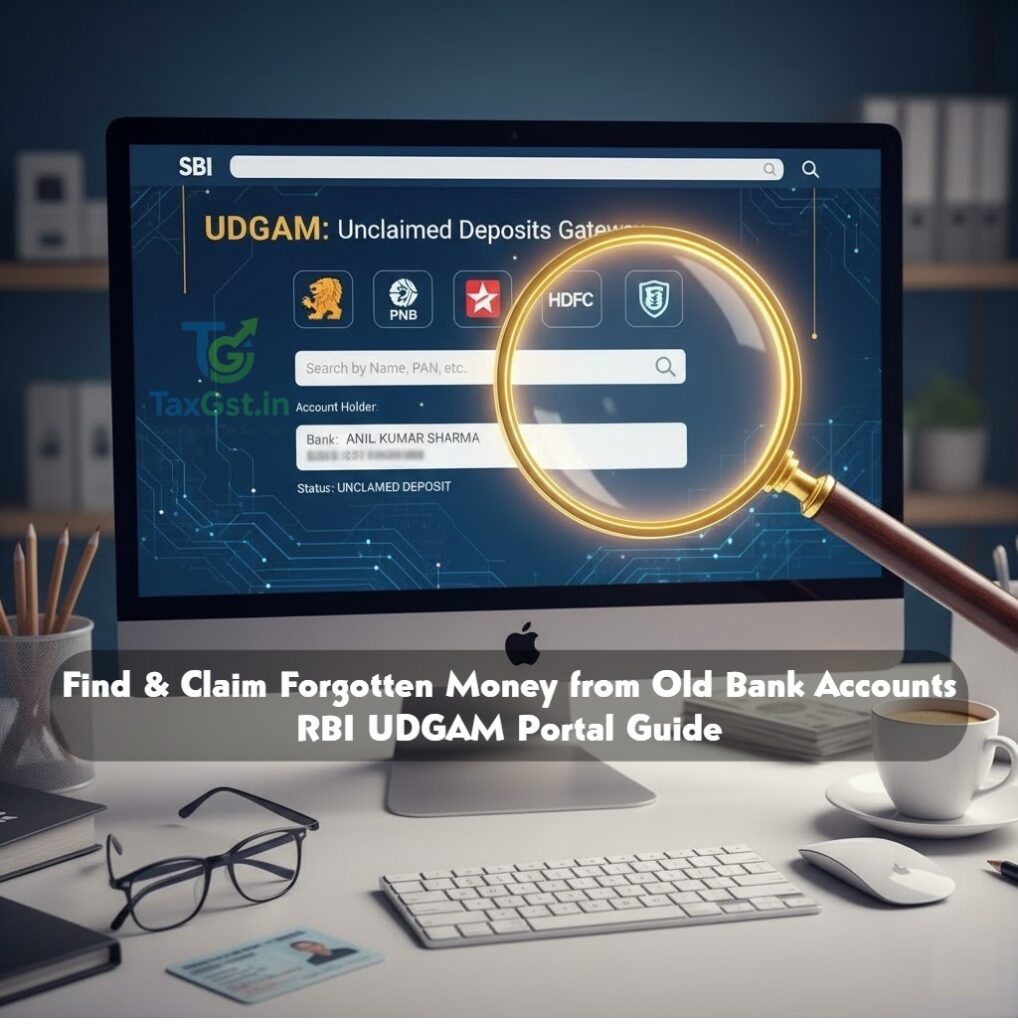
Do you remember that first salary account you opened? Or perhaps an old savings account your parents opened for you? What about a Fixed Deposit (FD) that matured years ago, and you forgot to collect the money?
In India, lakhs of people have bank accounts that they have simply forgotten about. These accounts, lying untouched for years, add up to thousands of crores of rupees. It’s our own hard-earned money, just sitting there, with no one to claim it.
For a long time, finding this money was a difficult job. You would have to visit every old bank branch, show old passbooks (if you could find them!), and go through a lot of paperwork.
But now, there is good news. The Reserve Bank of India (RBI) has stepped in to make this entire process simple for the common person. If you think you or your family members might have “forgotten money” in an old account, the RBI has created a new, simple way to help you find and recover it.
Also Read-RBI’s Same-Day Cheque Clearing is Now Live: What You Need to Know
First, What is “Forgotten Money” or “Unclaimed Deposit”?
In banking language, this is called an “Unclaimed Deposit.”
The RBI has a very clear rule:
- If a Savings or Current Account has not been operated for 10 years (meaning no deposits, no withdrawals by you), it is declared “inoperative” and the money is classified as an “unclaimed deposit.”
- If a Fixed Deposit (FD) or Term Deposit is not claimed for 10 years after its maturity date, that money also becomes an “unclaimed deposit.
Important: This does not mean the bank keeps your money. The money is still yours.
Where Does This Money Go? The RBI’s DEAF Fund.
Banks cannot just keep this unclaimed money. As per RBI rules, they must transfer this entire amount to a special fund managed by the RBI.
This fund is called the Depositor Education and Awareness (DEAF) Fund.
But please note: Even after your money is transferred to the DEAF Fund, it still belongs to you. You (or your legal heirs) have the right to claim this money at any time in the future. The bank is legally responsible for paying you back. They will pay you first and then claim a refund from the RBI’s DEAF Fund.
The RBI’s Big Solution: The UDGAM Portal.
To make it easy for people to search for their lost money, the RBI launched a new, centralized web portal in 2023.
It is called UDGAM (Unclaimed Deposits – Gateway to Access inforMation).
Think of UDGAM as a central search engine for lost bank accounts. Instead of you going to 10 different bank websites, you can now go to this one single portal to search for unclaimed money across many banks at once.
Key things to know about UDGAM:
- It is 100% free to use. The RBI or banks will never charge you a fee to search for your own money.
- It is a search portal only. It helps you find the money. It does not handle the final payment or claim. The claim must still be made at the bank.
- Right now, 30 major banks are part of the UDGAM portal (including SBI, PNB, HDFC Bank, ICICI Bank, Canara Bank, etc.). This covers over 90% of the total unclaimed money. More banks are being added all the time.
Step-by-Step Guide: How to Find Your Money.
You have two main ways to check for unclaimed deposits. The UDGAM portal is the easiest and best place to start.
Method 1: Using the RBI UDGAM Portal (The Best Way).
Follow these simple steps.

- Registration.
Go to the official UDGAM portal:https://udgam.rbi.org.in
Click on the “Register” button.
Enter your Mobile Number, your Name, and set a Password.
You will receive an OTP (One Time Password) on your mobile. Enter the OTP to complete your registration. - Login.
Go back to the UDGAM homepage and log in using your registered Mobile Number and the Password you set.
You will again receive an OTP to log in safely. - Search for Unclaimed Deposits.
Once you are logged in, you will see a search page.
Enter the Name of the Account Holder. (This could be your name, or the name of a family member you are searching for).
Select the Bank Name(s) you want to search. You can select one bank, multiple banks, or just select “All” to search all available banks at once.
You must enter at least one of the following details for the search:- PAN Card Number
- Voter ID Card Number
- Passport Number
- Driving License Number
- Date of Birth
- See the Results.
Click the “Search” button.
The portal will search the databases of all the banks you selected.
If any unclaimed deposit matches the details you entered, it will be displayed on the screen. It will show you the name of the bank and the account details.
Method 2: Checking Individual Bank Websites.
What if the old bank is a small co-operative bank that is not yet on the UDGAM portal? You can still check.
- Go to the official website of that specific bank.
- Look for a link in the website’s footer (at the very bottom of the page) or in the “Customer Service” section. The link will say something like “Unclaimed Deposits” or “Inoperative Accounts.”
- Each bank has its own search tool. You can usually search by entering your name and/or address to see if you are on their list.
“I Found My Money!” – Now, How to Claim It?
This is the most important part. Finding the deposit is just the first step. To get the money, you must contact the bank directly.
The UDGAM portal will not pay you the money. The RBI will not pay you the money. Only the bank where the account was held will pay you.
Here is the process:
- Visit the Bank Branch:
Go to the nearest branch of the bank where the deposit was found.
Good News (Recent RBI Rule): You no longer need to visit the exact “home branch” where the account was opened. As per new RBI guidelines, you can submit your KYC and reactivation documents at any branch of that bank. - Fill the Claim Form:
Ask the bank staff for the “Unclaimed Deposit Claim Form” (or DEAF Fund Claim Form).
Fill out the form with all your details and the account details you found on the UDGAM portal. - Submit Your KYC Documents:
You will need to prove your identity and address. You must submit self-attested copies of:- Identity Proof: PAN Card (mandatory), Aadhaar Card, Passport, or Voter ID.
- Address Proof: Aadhaar Card, latest electricity/phone bill, etc.
- Proof of Deposit: If you have the old passbook, FD receipt, or account number, bring it. If not, the printout from the UDGAM search result is also very helpful.
- A recent photograph.
- If You Are Claiming for a Deceased Person (as a Legal Heir):
This process is slightly more complex, but it is your right.
You will need all the documents mentioned in Step 3.
Additionally, you must provide:- The Death Certificate of the original account holder.
- Your own KYC documents.
- Proof of your relationship to the deceased.
- Depending on the amount, the bank may ask for legal documents like a Will, a Succession Certificate, or a Letter of Administration. For smaller amounts, banks sometimes accept a simple Indemnity Bond signed by all legal heirs.
- Verification and Payment:
The bank will verify all your documents.
Once they are satisfied that you are the genuine claimant, they will activate the account and transfer the money (including any interest that was due) to your current active savings account.
Final, Important Things Every Indian User Must Know.
- BEWARE OF SCAMS: The RBI or any bank will never call you, send you an SMS, or email you asking for your OTP, PIN, or bank details to “release your unclaimed money.” This is a 100% scam. The official process always requires you to go to the bank branch with your documents.
- NO FEE: This entire service is free. Do not pay any “agent” or “consultant” a commission or fee to find your money.
- HOW TO PREVENT THIS:
- Do one transaction: To keep an account “active,” just do one small transaction (deposit or withdrawal) at least once every 2 years.
- Update your Nominee: This is the most important thing. Make sure every bank account and FD has a nominee listed. A nominee makes it 100 times easier for your family to claim funds.
- Update Mobile/Address: If you move or change your phone number, inform your bank.
Your money is your money. Thanks to the RBI’s new efforts, it is now easier than ever to find and claim what is rightfully yours.
Disclaimer:
The information provided in this article is for general informational and educational purposes only. All information is provided in good faith, however, we make no representation or warranty of any kind, express or implied, regarding the accuracy, adequacy, validity, reliability, availability, or completeness of any information. Banking rules and RBI guidelines are subject to change. Please always verify the latest information and procedures directly with the Reserve Bank of India (RBI) or your respective bank before taking any action. This article does not constitute financial or legal advice.
Related Reading
- RBI Circular Dec 11, 2025: Borrowers with Loans Under ₹10 Cr Can Now Open Current Accounts with Any Bank
- SEBI Revises Nomination Rules for Demat Accounts and Mutual Funds
- RBI Mandates Weekly Credit CIBIL Reporting Mandatory from July 1, 2026
Discover more from TaxGst.in
Subscribe to get the latest posts sent to your email.


Never Miss a Tax Deadline Again
Due-date alerts, GST updates and tax tips — free on the app you already use.
event Next: TDS Return (138 / 140) · 31 Oct