
 C.K. Gupta
CBDT NOTIFICATION NO. 22/2026 / G.S.R. 198(E)
On March 20, 2026, the Central Board of Direct Taxes notified the Income-tax Rules, 2026 through G.S.R. 198(E), issued as Notification No. 22/2026. The official notification page confirms that these rules are linked to the new framework under the Income-tax Act, 2025 and took effect from April 1, 2026.
That makes this one of the most important practical tax updates of the year. For professionals and ordinary taxpayers alike, the Rules define how compliance actually happens—forms, filing references, statements, certificates, timelines, digital communication, and procedural discipline.
If the Act is the law’s blueprint, the Rules are the instruction manual. This article expands the practical side of the notification with clearer examples, comparison tables, workflow visuals, callout quotes, and a stronger action plan for taxpayers, employers, businesses, and advisors.
Quick Summary of Key Changes Under G.S.R. 198(E)
Effective date
April 1, 2026 is the key date for applying the new procedural framework.
Core shift
The system moves toward a digital-first, Tax Year-based compliance structure.
What to watch
New form numbers, updated filing references, and tighter e-compliance workflows.
| Feature | Old Rule (Pre-2026) | New Rule (From Apr 1, 2026) |
|---|---|---|
| Zero-tax limit (New Regime) | ₹7 lakh | ₹12 lakh |
| Section 87A rebate | ₹25,000 | ₹60,000 |
| Standard deduction (New Regime) | ₹50,000 | ₹75,000 |
| Tax slabs (New Regime) | ₹3 lakh intervals | ₹4 lakh intervals |
| Marginal relief threshold | ₹7 lakh | ₹12 lakh |
| Form 26AS | Available via TRACES | Replaced by Form 168 (Financial Diary) |
| Form 15G/15H | Separate declarations | Unified into Form 121 |
| Assessment Year | Used in filings | Replaced by Tax Year |
| ITR-1/ITR-2 deadline | July 31 | July 31, 2026 (unchanged) |
| ITR-3/ITR-4 deadline | July 31 | Extended to August 31, 2026 |
Income Tax 2026 Migration Cheat Sheet: Old vs. New Forms
| Category | Purpose of the Form | New Form (2026 Rules) | Earlier Form (1962 Rules) | Impact / Why It Matters |
| Certificates | Salary TDS Certificate | Form 130 | Form 16 | The most vital document for every salaried individual in India. |
| Non-Salary TDS Certificate | Form 131 | Form 16A | Critical for freelancers, consultants, and anyone earning FD interest. | |
| Lower/Nil TDS Certificate | Form 128 | Form 13 | A “must-have” for cash flow management in large professional contracts. | |
| Declarations | Unified Non-Deduction | Form 121 | Form 15G / 15H | Unified! Senior citizens and low-income earners now use a single form. |
| Investment Declaration | Form 124 | Form 12BB | Employees must submit this to HR by Feb to avoid heavy March TDS. | |
| Previous Employer Income | Form 122 | Form 12B | Merged form for individuals who switched jobs mid-Tax Year. | |
| Statements | Annual Information Statement | Form 168 | Form 26AS / AIS | The “Financial Diary”—the anchor for pre-filled return reconciliation. |
| Returns | Salary TDS Return | Form 138 | Form 24Q | Mandatory quarterly filing for all employers/payroll departments. |
| Non-Salary TDS Return | Form 140 | Form 26Q | Required for domestic payments like Rent, Fees, and Commissions. | |
| TCS Return | Form 143 | Form 27EQ | Relevant for sellers of motor vehicles, scrap, or LRS remittances. | |
| Non-Resident TDS Return | Form 144 | Form 27Q | Critical for anyone dealing with payments to NRIs or foreign firms. | |
| Audits | Consolidated Tax Audit | Form 26 | Form 3CA/CB/CD | Merged! A single, streamlined report for business tax audits. |
Why This Notification Matters
The Income-tax Rules are not just legal fine print. They convert statutory language into real compliance steps: which form to use, what deadline applies, how tax is deducted or deposited, how notices are served, and what records are needed when disputes arise.
Because the Rules now sit under the Income-tax Act, 2025, they represent a break from the legacy rules long associated with the older 1961/1962 framework. That is why the notification is receiving so much professional attention—routine compliance habits built over decades now need remapping.
Practical takeaway: The biggest challenge is not learning a new law in the abstract. It is updating daily compliance behavior—software, checklists, terminology, return formats, statement mapping, and response workflows.
The Big Picture Behind the 2026 Rules
Several current guidance and practitioner summaries point in the same direction: the new Rules are designed to create a cleaner procedural structure, reduce unnecessary overlap, standardize forms, and make digital compliance the default mode rather than an optional convenience.
In simple terms, the tax system is being re-expressed in a more structured language. That means clearer form design, more standardized reporting, stronger use of machine-readable formats, and a bigger role for pre-filled and statement-driven filings.
| Policy direction | What it means in practice | Why it matters |
|---|---|---|
| Simplification | Cleaner forms, simpler references, reduced fragmentation | Helps both taxpayers and compliance teams work faster |
| Digitization | E-filing, e-notices, machine-readable formats, portal-based workflows | Reduces paper dependency and increases automation |
| Data-led compliance | Statement matching, pre-filled data, structured reporting | Makes reconciliation more important than before |
| Transition discipline | Old and new references may coexist during the handover period | Mistakes are likely if teams do not map old forms to new forms |
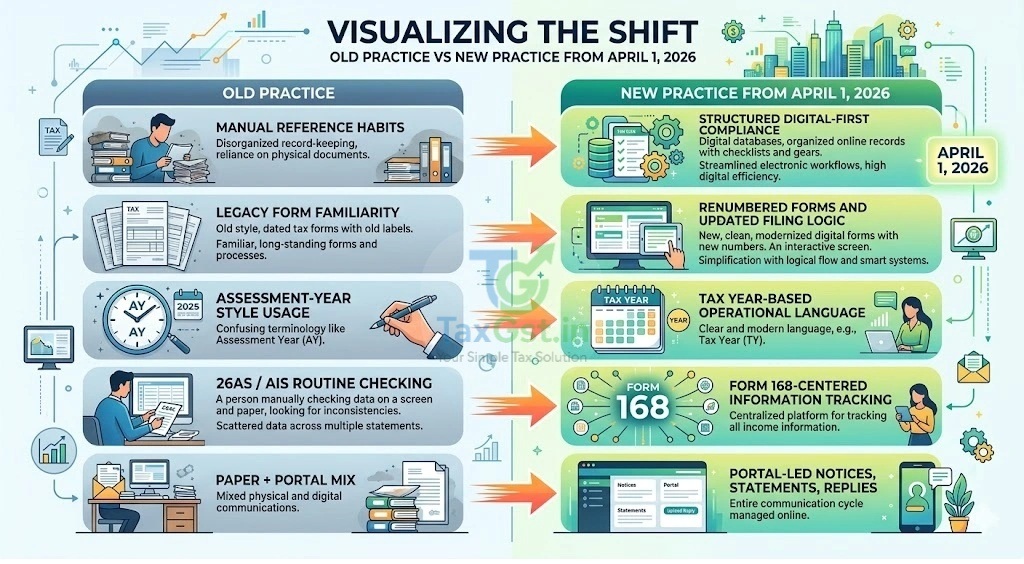
Visualizing the Shift
What Changes First From April 1, 2026
- New procedural rules start applying under the Income-tax Act, 2025 framework.
- Tax Year terminology becomes central in practical filing references and new-form discussions.
- Form numbers change, which means familiar names may still be used informally by professionals, but official references will increasingly use the new numbering.
- Digital-only submissions and portal communication matter more, especially for time-sensitive notices and responses.
- TDS/TCS workflows need updating, including return references and statement mapping.
Two High-Authority Technical Shifts
1) Tax Year Becomes a Working Reference
Current coverage of the 2026 transition highlights the move toward the Tax Year concept for the new framework. For professionals, this matters because it affects how due dates, filing references, software labels, and internal client communication are framed from the new cycle onward.
For example, instead of thinking only in the older language of FY and AY when discussing new utilities, teams should now prepare for Tax Year 2026-27 as a more operational reference in many practical situations.
2) Form 168 Becomes the New Information Anchor
One of the most searched practical changes is the renumbering of Form 26AS into Form 168. Multiple current explainers point to Form 168 as a key annual tax information reference that taxpayers and professionals will need to review before filing.
Why this matters: When forms change, confusion rises. Search behavior shows that many taxpayers are not asking whether compliance changed in theory—they are asking, “Which form do I now check?” and “What is the new name of the statement I already know?”
Old vs New Framework
| Area | Earlier familiar approach | 2026 framework direction |
|---|---|---|
| Core law | Income-tax Act, 1961 with older Rules | Income-tax Act, 2025 with Income-tax Rules, 2026 |
| Effective procedural shift | Legacy practice continued by habit | April 1, 2026 becomes the transition line |
| Compliance language | AY/FY-heavy references | Greater emphasis on Tax Year |
| Tax information statement | Form 26AS / AIS familiarity | Form 168 becomes a major reference point |
| Notice handling | Mixed physical and digital dependence | Digital service and portal discipline become central |
Who Is Most Affected
Salaried individuals
The return journey may become more pre-filled and streamlined, but readers will need to adapt to new form references such as Form 130 and Form 168.
Small businesses
Threshold changes and simplified workflows may help some taxpayers, but bookkeeping and statement reconciliation remain essential.
Professionals and freelancers
TDS certificates, statement matching, and correct digital records become even more important when compliance is data-led.
Companies, banks, fintechs
Reporting systems and internal tax ops must align with new forms, new file references, and stricter electronic consistency.
Quick Summary: The “2026 Tax Migration” Cheat Sheet
| Feature | Old Rule (Pre-2026) | New Rule (From Apr 1, 2026) |
| Zero-tax Limit (New Regime) | ₹7 Lakh | ₹12 Lakh |
| Section 87A Rebate | ₹25,000 | ₹60,000 |
| Standard Deduction (New) | ₹50,000 | ₹75,000 |
| Tax Slabs (New Regime) | ₹3 Lakh intervals | ₹4 Lakh intervals |
| Annual Tax Statement | Form 26AS / AIS | Form 168 (Financial Diary) |
| TDS Declarations (15G/H) | Separate Forms | Form 121 (Unified Declaration) |
| TDS Certificate (Salary) | Form 16 | Form 130 |
| ITR-3/ITR-4 Deadline | July 31 | August 31, 2026 (Extended) |
Practical Implications: Real-World Scenarios
Understanding the new math is critical. The Section 87A rebate is now a “cliff”—once you cross ₹12 Lakh, the ₹60,000 benefit disappears, and Marginal Relief takes over to protect you.
Example 1: Salaried Employee Earning ₹13,25,000
- Gross Salary: ₹13,25,000
- Standard Deduction (New Regime): ₹75,000
- Taxable Income: $₹13,25,000 – ₹75,000 = ₹12,50,000
Tax Calculation as per 2026 Slabs:
- 0–4,00,000: Nil
- 4,00,001–8,00,000 (5%): ₹20,000
- 8,00,001–12,00,000 (10%): ₹40,000
- 12,00,001–12,50,000 (15%): ₹7,500
- Total Slab Tax: $₹20,000 + ₹40,000 + ₹7,500 = ₹67,500
The Marginal Relief Logic:
Since the income exceeds ₹12 Lakh, the ₹60,000 rebate is lost. However, the law states your tax cannot exceed the amount by which your income exceeds the threshold.
- Excess over ₹12 Lakh: ₹12,50,000 – ₹12,00,000 = ₹25,000.
- Final Tax Payable: Since ₹25,000 is lower than the slab tax (₹67,500), your tax is capped at ₹25,000 (plus 4% cess).
Example 2: Freelancer with ₹11,50,000 Income
- Total Taxable Income: ₹11,50,000 (No standard deduction for non-salaried)
- Tax as per Slabs: $₹20,000 (4L-8L) + ₹35,000 (8L-11.5L @ 10%) = ₹55,000$.
- Rebate (Sec 87A): Since income is $le ₹12 text{ Lakh}$, the full rebate of up to ₹60,000 applies.
- Net Tax Payable: ₹0.
🔍 The “Financial Diary” (Form 168)
The transition to Form 168 is perhaps the most significant procedural change. Unlike the old Form 26AS, Form 168 is a real-time ledger. It doesn’t just show TDS; it tracks:
- SFT Reporting: High-value credit card spends and property transactions.
- GST Integration: Real-time matching of your GSTR-1 turnover with your ITR-3/4.
- VDA Tracking: Direct reporting from crypto exchanges under Section 194S.
Practitioner Tip: Before filing your return this July, ensure every entry in your Form 168 matches your bank statements. Discrepancies now trigger automated “limited scrutiny” notices within 24 hours of filing.
🗓 Key Dates for Tax Year 2026
- April 1, 2026: Income-tax Rules, 2026 officially come into force.
- June 15, 2026: Deadline for employers to issue Form 130 (formerly Form 16).
- July 31, 2026: Deadline for ITR-1 and ITR-2 (Salaried & Capital Gains).
- August 31, 2026: New extended deadline for ITR-3 and ITR-4 (Non-audit business/profession).
Practical Impact on Daily Compliance
- Software updates are no longer optional. Payroll, tax filing, ERP, and compliance tools must reflect the new form numbers and filing logic.
- Portal access becomes mission-critical. A missed email, inactive login, or expired DSC can now create a real procedural problem.
- Statement matching matters more than memory. In a digital-first system, what your records say must align with what the reporting systems show.
- Terminology discipline is necessary. Teams that continue using only old references internally may create avoidable mistakes in filings, documentation, and client advice.
Transition Rules: Where Mistakes Are Most Likely
The risky period is not when everything is old or everything is new. The risky period is the overlap—when businesses, advisors, software teams, and taxpayers are still mentally using the old labels while the legal framework and filing systems have already shifted.
| Situation | Common risk | Better approach |
|---|---|---|
| Payroll teams issuing tax documents | Using old form names in employee communication | Mention both old and new names for one transition cycle |
| Accountants preparing TDS returns | Selecting the wrong return due to old habit | Maintain a mapped internal form sheet |
| Taxpayers checking statements before ITR filing | Looking only for Form 26AS references | Educate users that Form 168 is now the key reference |
| Notice management | Missing response deadlines after e-service | Create a digital notice-tracking workflow with alerts |
Reader Checklist: What to Do This Week
- Check whether your tax software, payroll software, or filing utility is updated for the 2026 framework.
- Make a one-page internal old-form vs new-form mapping sheet.
- Verify access to registered email, portal login, OTP-linked mobile, and DSC if applicable.
- Review your annual tax statement under the new naming logic, especially Form 168.
- Train your accounting or HR team on the new references before the first live deadline arrives.
- Keep a transition glossary in client mails and SOPs so teams do not mix up old and new names.
Expert-Style Callouts You Can Keep in the Article
“The transition is not difficult because the system is more digital. It becomes difficult only when old internal habits continue after the form logic and filing references have already changed.”
“For most taxpayers, the right approach is simple: update your software, verify your statements, and stop assuming that the old form names will continue to guide the filing process.”
Frequently Asked Questions
Do the Income-tax Rules, 2026 change tax slabs?
No. Tax rates and slabs come from the Act, not the procedural Rules. But the Rules can still affect practical tax outcomes because they define how reporting, statements, rebates, certificates, and filing mechanics work.
Is AY 2026-27 now the same as Tax Year 2026-27?
The new framework puts more practical emphasis on Tax Year terminology in forms and filing discussions. Taxpayers should be ready to see new-cycle compliance framed in that language from April 1, 2026 onward.
What is Form 168?
Form 168 is the new annual information statement-style reference that taxpayers are expected to consult in the 2026 system, replacing the old familiarity around Form 26AS.
Will old records still matter?
Yes. Older returns, certificates, and supporting records remain relevant for legacy periods, scrutiny matters, and transition questions.
What is the biggest practical risk in the transition?
The biggest risk is procedural confusion—using outdated form references, relying on old internal checklists, and missing digital notices because teams assume old workflows still apply.
Official and Practical References
Closing Note
The real story behind the Income-tax Rules, 2026 is not just renumbering. It is the arrival of a more structured compliance system built around digital workflows, cleaner filing references, statement-led reporting, and stronger procedural discipline.
For readers, the most useful mindset is simple: don’t just learn the new names—update the way you work. That is what will make the transition smoother, faster, and less error-prone.
Disclaimer:
This article is intended solely for general information and education on the CBDT notification and the Income-tax Rules, 2026. It does not constitute tax advice, legal advice, or a professional opinion, and should not be relied upon as a substitute for detailed research or consultation with a qualified tax or legal adviser. While reasonable care has been taken to keep the information conceptually aligned with current rules and publicly available guidance, laws and interpretations may change and the specifics of your situation may differ. Before acting on any information contained in this article, you should obtain advice tailored to your particular facts and circumstances.
Related Reading
- CBDT’s Income-Tax (Fifth Amendment) Rules 2025: Changes to Rule 12CA, 12CC & New Forms
- New Income Tax Return Filing Portal Features for AY 2026-27
- 10 Changes in the 2025 Income Tax Bill Every Taxpayer Must Know
Try the free income tax calculator for instant figures.
Discover more from TaxGst.in
Subscribe to get the latest posts sent to your email.



Never Miss a Tax Deadline Again
Due-date alerts, GST updates and tax tips — free on the app you already use.
event Next: TDS Return (138 / 140) · 31 Oct