
 C.K. Gupta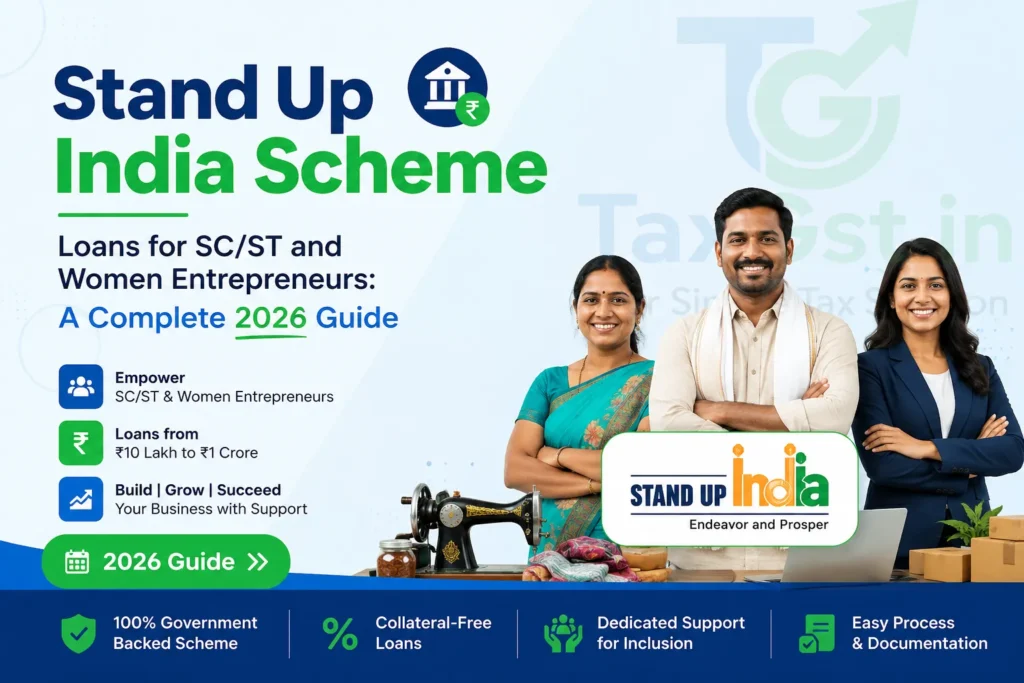
As of May 2026, it continues to offer collateral-free bank loans ranging from ₹10 lakh to ₹1 crore—specifically designed to help you launch greenfield enterprises in manufacturing, services, or trading sectors. In this comprehensive guide, we’ll walk you through everything you need to know—from eligibility and benefits to application steps, common pitfalls, and expert tips that can make or break your loan approval. Whether you’re applying online or visiting your nearest bank branch, this is your go-to resource.
Also Read-New vs Old Tax Regime FY 2025-26: Which Saves You More?
Quick Summary
- What you need to know – Key points from the source
- Who this affects – Applicability details
- Action required – What you should do
- Deadline – Important timelines if any
What Is the Stand Up India Scheme? – Complete Overview
The Stand Up India Scheme was launched by the Government of India to foster job creation and economic inclusion by enabling bank loans for entrepreneurship among women and SC/ST communities. The scheme is implemented through all scheduled commercial banks across the country.
As per the official notification dated May 5, 2026, the scheme continues to provide bank loans between ₹10 lakh and ₹1 crore for setting up new enterprises. These must be greenfield projects—meaning no prior business activity should have been conducted in that name.
This isn’t just about money—it’s about empowerment. The scheme ensures that at least one woman and one SC/ST entrepreneur benefit per bank branch. With over 1.2 lakh bank branches nationwide, that translates into massive outreach potential.
The scheme covers:
- Women entrepreneurs (any age, any sector)
- SC/ST entrepreneurs (any gender, any sector)
And crucially—only one loan per household is permitted under this scheme. So if your spouse or sibling has already availed it, you may not qualify unless you’re establishing a completely separate enterprise with no financial overlap.
Key Benefits and Financial Assistance
The Stand Up India Scheme isn’t just another loan program—it’s structured to reduce risk for both you and the lender. Here’s what you get:
| Benefit | Details |
|---|---|
| Loan Amount | ₹10 lakh to ₹1 crore (For the working capital portion (up to ₹10 lakh), the bank provides a RuPay Debit Card for easy withdrawal and management of day-to-day business) |
| Collateral Requirement | None (up to ₹1 crore) |
| Interest Rate | As per RBI guidelines; typically 2–3% below market rate for priority sector lending |
| Repayment Tenure | Up to 7 years + 18-month moratorium (as per project need) |
| Credit Guarantee | Covered under CGTMSE (Credit Guarantee Fund Trust for Micro and Small Enterprises) |
| Sector Coverage | Manufacturing, Services, Trading (excluding retail, education, and agriculture) |
One often-overlooked advantage: the loan can cover up to 90% of project cost for SC/ST and women entrepreneurs, compared to 75% for others. This means you need less upfront capital to get started. Also, since the loan is backed by CGTMSE, banks are more willing to lend—even if your credit score isn’t perfect. However, don’t assume bad credit won’t matter. Banks still assess repayment capacity rigorously.
Eligibility Criteria – Who Can Apply?
Not everyone qualifies—and that’s by design. The scheme targets those who’ve historically faced barriers to formal credit. Here’s the full checklist:
✅ Who Is Eligible?
- Women entrepreneurs (Indian citizen, aged 18+)
- Individuals belonging to SC/ST categories (Indian citizen, aged 18+)
- Must be setting up a greenfield enterprise (first-time venture in that name)
- Enterprise must fall under manufacturing, services, or trading
- Not applicable: Retail shops, educational institutions, agricultural activities, self-help groups (SHGs), or franchises without innovation
- While traditional crop-farming is excluded, the scheme explicitly supports activities allied to agriculture. This includes pisciculture (fish farming), poultry, dairy, beekeeping, agro-processing, and agri-business centers
❌ Who Is NOT Eligible?
- Existing businesses (even if expanding)
- Non-individual entities (companies, LLPs, partnerships unless promoted by eligible individual)
- Borrowers with willful default history
- Applicants whose spouse/sibling has an active Stand Up India loan
Note: If you’re a woman from an SC/ST background, you can apply—but only once per household.
Required Documents Checklist
Missing a single document is the #1 reason for rejection. Based on our experience handling hundreds of MSME loan applications, here’s your foolproof checklist:
| Document | Format/Specification |
|---|---|
| Aadhaar Card | Self-attested copy |
| PAN Card | Mandatory for loan > ₹50 lakh |
| Caste Certificate (for SC/ST) | Issued by competent authority (Tehsildar/District Magistrate) |
| Proof of Identity & Address | Voter ID, Driving License, or Passport |
| Business Plan | Detailed project report including cost breakup, revenue projections, break-even analysis |
| Bank Statement | Last 6 months (personal/savings account) |
| CGTMSE Application Form | Available on bank portal or CGTMSE website |
| Photographs | 2 passport-size |
| Rent Agreement/Ownership Proof | For business premises (if applicable) |
💡 Pro Insight: Your business plan doesn’t need to be 50 pages long—but it must show realistic assumptions. Banks reject vague plans like “I’ll sell clothes online” without supplier details, target market, or logistics.
All documents must be self-attested. Photocopies without signature = automatic rejection.
How to Apply – Step by Step (Online & Offline)
You have two options: online via the Stand Up India portal or offline at your nearest bank branch. We recommend starting online—it’s faster and gives you a digital trail.
If you are struggling with your business plan or documentation, the portal connects you with Handholding Agencies. You can also reach out to your Lead District Manager (LDM) or District Development Manager (DDM) at the local administrative office for personal guidance on bank coordination.
🔹 Option 1: Online Application (Recommended)
1. Visit the official portal: [https://www.standupmitra.in](https://www.standupmitra.in) 2. Register using your mobile number and Aadhaar (OTP-based verification)
3. Fill the application form (keep your business plan ready)
4. Upload scanned copies of required documents
5. Select your preferred bank branch
6. Submit and note your application reference number Within 7–10 working days, a bank representative will contact you for verification.
🔹 Option 2: Offline Application
1. Visit any scheduled commercial bank branch (SBI, PNB, HDFC, ICICI, etc.)
2. Ask for the Stand Up India Loan Application Form
3. Submit filled form + documents
4. Get an acknowledgment receipt with tracking ID
⚠️ Warning: Avoid agents promising “guaranteed approval.” Legitimate banks never charge upfront fees. If someone asks for cash, walk away.
Application Status and Tracking
Once submitted, track your application in real time:
- Online: Log in to [standupmitra.in](https://www.standupmitra.in) → “Track Application”
- Offline: Call the bank’s toll-free number or visit the branch with your acknowledgment number
Most banks resolve applications within 14–21 days. If delayed beyond 30 days, escalate to the Branch Manager or file a grievance on the CGTMSE portal: [https://cgtmse.in](https://cgtmse.in)
If your application remains pending beyond 21 days without a valid reason, call the national helpline at 1800-180-1333 (9 AM to 6 PM) or escalate the matter to the bank’s Regional Office
Common Reasons for Rejection (And How to Avoid Them)
In our practice, we’ve seen these mistakes repeat like clockwork:
| Mistake | Why It Happens | How to Fix |
|---|---|---|
| Incomplete business plan | Applicants copy-paste generic templates | Hire a CA or use MSME Samadhan’s free template |
| Mismatched signatures | Signed form ≠ signature on Aadhaar | Use consistent signature across all docs |
| Applying for excluded sector | Thinking “kirana store” qualifies | Stick to manufacturing/services only |
| Multiple applications | Applying in spouse’s name too | Remember: one loan per household |
| Poor credit history | Past defaults not disclosed | Clear dues before applying; explain in writing if resolved |
Comparison With Similar Schemes
How does Stand Up India stack up against other popular schemes?
| Scheme | Target Group | Loan Range | Collateral | Key Difference |
|---|---|---|---|---|
| Stand Up India | Women + SC/ST | ₹10L – ₹1Cr | No | Greenfield only; per-branch mandate |
| PM Mudra Yojana | All entrepreneurs | ₹10K – ₹10L | No | Includes small traders; no caste/gender focus |
| CGTMSE (General) | MSMEs | Up to ₹2Cr | No | Not restricted to women/SC/ST |
| Atal Pension Yojana | Unorganized sector | Pension-based | N/A | Retirement-focused, not entrepreneurial |
📌 Bottom line: If you’re a woman or SC/ST entrepreneur seeking ₹10L+, Stand Up India is your best bet. For smaller amounts (<₹10L), consider Mudra.
Important Deadlines and Dates
- No fixed deadline: The scheme runs year-round
- Processing time: 14–21 days (aim to apply by May 31 to avoid FY-end rush)
- Loan disbursement: Within 7 days of sanction (if all docs in order)
📅 Mark your calendar: While there’s no expiry, budget allocations are reviewed annually. Apply early in the financial year (April–June) for smoother processing.
Pro Tips for Successful Application
1. Start with a lean business model: You don’t need a ₹1Cr factory to qualify. A ₹12L packaging unit or ₹15L digital marketing agency works.
2. Get your CGTMSE pre-approval: Some banks fast-track if you apply for guarantee cover first.
3. Use Udyam Registration: Though not mandatory, it strengthens your MSME credibility. [Register here](https://udyamregistration.gov.in)
4. Avoid joint applications: Unless co-applicant is also eligible (e.g., woman + SC partner), keep it individual.
5. Follow up weekly: Don’t wait passively. A polite call every 5 days keeps your file active.
FAQs – Quick Answers to Common Questions
Can I apply for Stand Up India if I already have a Mudra loan?
Yes, as long as the Mudra loan is for a different business and you meet all other eligibility criteria. However, total exposure across schemes should not exceed your repayment capacity.
Is the loan taxable under Income-tax Act, 2025?
No. Loan amounts are not income—they’re liabilities. However, profits from the business are taxable in the relevant Tax Year (e.g., Tax Year 2026-27).
Can I repay the loan early without penalty?
Yes. Most banks allow prepayment after 6 months with minimal or no charges. Check your sanction letter for exact terms.
What if my business fails? Do I still owe the money?
Yes, the loan remains your personal liability. However, CGTMSE may cover up to 85% of the loss to the bank. You’re still responsible for the remainder unless settled via restructuring.
Final Word: Your Entrepreneurial Journey Starts Now
The Stand Up India Scheme isn’t just a loan—it’s a lifeline for millions who’ve been excluded from formal finance. With zero collateral, government backing, and a clear path to approval, there’s never been a better time to turn your idea into reality. But remember: eligibility ≠ approval. Your business plan, documentation, and follow-up matter as much as your category. So gather your documents, draft that project report, and hit “submit” today. The next success story could be yours.
Last Updated: May 13, 2026
Sources: PIB Notification (May 5, 2026), CGTMSE Guidelines, RBI Master Directions on Priority Sector Lending
Disclaimer: This article is for informational purposes only and does not constitute legal or financial advice. Consult a qualified CA or bank officer before applying. Scheme terms are subject to change by the Government of India.
Related Articles:
Article Information
Published: May 13, 2026
Category: Govt Scheme
Official Resources
Disclaimer: This article is for informational purposes only. Scheme benefits, eligibility criteria, and application processes may change. Always verify current details on the official government portal before applying. For assistance, visit your nearest Common Service Centre (CSC).
ITR, GST returns, notices and registrations — fixed fees, human support, on-time filing.
Discover more from TaxGst.in
Subscribe to get the latest posts sent to your email.

Never Miss a Tax Deadline Again
Due-date alerts, GST updates and tax tips — free on the app you already use.
event Next: GSTR-1 · 11 Oct