
 C.K. Gupta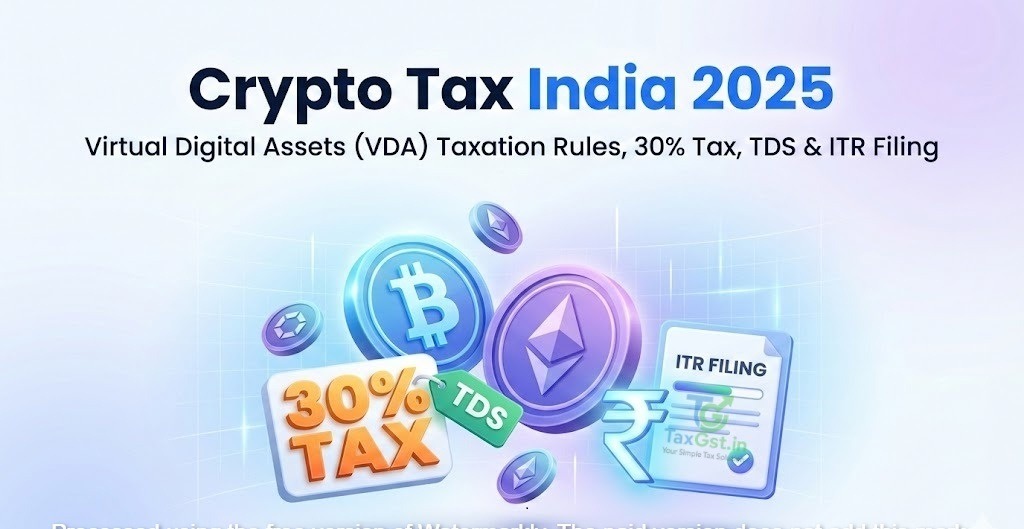
Remember Diwali back in 2021? It seemed like everyone and their cousin was making lakhs on Shiba Inu or Dogecoin overnight. But then came Budget 2022, and suddenly, friends like “Rahul from Mumbai” were losing sleep, worried about tax notices instead of celebrating profits.
The Indian crypto market has grown massively, now estimated to be worth over ₹10 lakh crore. However, the government made one thing crystal clear: if you earn from crypto, you have to pay tax. In true desi style, the government wants its share!
Also Read-MAHA Prof Tax (PT) Payment Online – Step By Step Guide for New Maharashtra GST (MahaGST) Portal
Before 2022, it was the Wild West. But the introduction of Section 115BBH and Section 194S in the Income Tax Act brought definitive—if somewhat harsh—VDA taxation rules to India. While the high tax rate was a bitter pill to swallow, it at least brought much-needed clarity to investors and traders.
Worried about that 30% crypto tax in India eating your profits? Confused by the 1% TDS on crypto? You are not alone. Navigating crypto taxes can feel harder than understanding blockchain itself. But don’t worry, grab a cup of chai, and let’s break down crypto tax India 2026 rules step-by-step, just like your trusted CA uncle would.
What Are Virtual Digital Assets (VDAs)?
Before we talk about tax, we need to know what is being taxed. The government doesn’t just say “crypto”; they use a broader term: Virtual Digital Assets (VDAs).
Introduced in the Finance Act 2022, Section 2(47A) defines a VDA. In simple terms, a VDA is any information, code, number, or token (not being Indian currency or foreign currency) generated through cryptographic means or otherwise, providing a digital representation of value.
This definition is intentionally broad to catch everything in the Web3 net. It includes:
- Cryptocurrencies: Like Bitcoin (BTC), Ethereum (ETH), Solana (SOL).
- Stablecoins: Like USDT or USDC.
- Non-Fungible Tokens (NFTs): Digital art, collectibles, or gaming items.
- Other crypto tokens and assets.
It’s crucial to understand that VDAs are not treated like stocks or mutual funds in India. The tax rules are entirely different and, frankly, much stricter. You cannot apply the logic of long-term capital gains from the share market to your crypto portfolio.
Crypto Tax Rates in India 2026
If you are looking for crypto tax India 2026 updates, the reality is that the rules established in 2022 remain largely unchanged. The government has maintained a strict stance. There are two main pillars to the current taxation structure: a flat tax on profits and a Tax Deducted at Source (TDS) on transactions.
The Flat 30% Tax on Gains (Section 115BBH)
Here is the headline rule: Any income from the transfer of a VDA is taxed at a flat rate of 30%.
Whether you are in the highest income tax bracket of 30% or you earn zero other income, your crypto profits are taxed at 30%. There are no slab benefits here.
- Plus Cess and Surcharge: It’s not just 30%. You also have to pay a 4% Health and Education Cess on top of the tax. If your total income is very high (above ₹50 lakh), applicable surcharges also kick in. So, the effective tax rate is minimum 31.2%.
- No Deductions Allowed: This is the biggest pain point for traders. When calculating your profit, the only deduction allowed is the “cost of acquisition” (the price you bought it for). You cannot deduct trading fees, exchange charges, internet costs, or the cost of that expensive hardware wallet.
- No Indexation Benefit: Unlike real estate or debt funds held long-term, there is no indexation benefit to account for inflation, even if you hold Bitcoin for five years.
The No-Set-Off Rule (The Sting in the Tail)
Perhaps the harshest rule is regarding losses. If you make a loss on Bitcoin, you cannot set it off against profits from Ethereum.
Every VDA is treated independently. A loss in one asset is a dead loss; it cannot reduce your taxable profit in another asset, nor can it be set off against other income sources like salary or business income. Furthermore, you cannot carry forward crypto losses to future years.
1% TDS on Crypto Transactions (Section 194S)
To track transactions, the government introduced 1% TDS on crypto. This applies when you sell or swap a crypto asset for more than certain thresholds in a financial year.
- Thresholds: The TDS applies if transaction values exceed ₹50,000 for “specified persons” (usually individual investors/HUF with business turnover below certain limits) or ₹10,000 for others during the financial year.
- Who Deducts It? If you are trading on compliant Indian exchanges like CoinDCX, WazirX, or CoinSwitch, they automatically deduct this 1% and deposit it with the government against your PAN.
Here is a quick comparison to understand how different crypto taxation is from stocks:
| Feature | Crypto VDAs | Stocks/Equity |
|---|---|---|
| Tax Rate on Gains | 30% flat (irrespective of holding period) | 15% (Short Term) / 10% (Long Term over ₹1.25L) |
| Loss Set-off | No. Cannot set off losses between assets or other income. | Yes. Can set off STCL against STCG/LTCG. |
| Carry Forward Losses | No. | Yes, up to 8 assessment years. |
| TDS | 1% on sell/swap transactions (u/s 194S) | None on standard buy/sell. |
| Deductions Allowed | Cost of acquisition only. | Brokerage, STT, and other transfer expenses. |
How to Calculate Crypto Gains Tax in India
Learning how to calculate crypto gains tax in India is essential to avoid surprises during ITR filing. The formula seems simple, but the application requires meticulous record-keeping.
The Formula:
Taxable Gain = Sale Price (Transfer Value) – Cost of Acquisition (Buy Price)
Remember, no other expenses are deductible.
Example: The Bitcoin Trade
Imagine you bought 1 Bitcoin (BTC) in April 2024 for ₹30,00,000.
In January 2025, the price surges, and you sell it for ₹50,00,000.
- Sale Value: ₹50,00,000
- Less: Cost of Acquisition: ₹30,00,000
- Net Profit (Gain): ₹20,00,000
Now, calculate the tax:
- Base Tax (30% of ₹20 Lakh): ₹6,00,000
- Add: 4% Health & Education Cess: ₹24,000
- Total Tax Payable: ₹6,24,000
(Note: If your total income exceeds ₹50 lakh, add applicable surcharge).
Trading vs. Investment Income
Many users ask if high-frequency crypto trading is treated as “business income” instead of capital gains. In the context of Section 115BBH, it currently doesn’t matter much. The section states income from transfer of VDA is taxed at 30%, regardless of whether you call it business income or capital gains. The rate remains the same flat 30%.
P2P Crypto Tax India
What about Peer-to-Peer (P2P) transactions? This is tricky territory. If you are selling USDT for INR directly to another person via Binance P2P, you (the seller) are technically responsible for ensuring the 1% TDS is deducted if the buyer hasn’t done it.
Furthermore, the profit you make on the P2P sale (if selling above your buying cost) is subject to the same 30% tax. P2P is often under the taxman’s scanner, so ensure you maintain proofs of all bank transfers and corresponding crypto releases.
Other Crypto Incomes: Staking, Airdrops, Mining
Not all crypto income comes from buying low and selling high. What about passive income? The tax treatment for these is slightly different and often involves a two-step process.
Crypto Airdrops and Mining Tax India
When you receive crypto for free (Airdrops) or through mining, you haven’t “bought” it. So, what is your cost of acquisition?
- At the time of Receipt (Stage 1): The Fair Market Value (FMV) of the tokens on the day you receive them is treated as your income. This is usually categorized as “Income from Other Sources” and taxed according to your regular income tax slab rates.
- At the time of Sale (Stage 2): When you eventually sell these tokens, the FMV you already paid tax on becomes your “cost of acquisition.” Any profit above that FMV is taxed at the flat 30% VDA rate.
Staking Rewards
Staking is similar to earning interest in a savings account.
- Receipt: The value of the staking rewards at the time of receipt is taxed at your slab rate as “Income from Other Sources.”
- Sale: When you sell those reward tokens later, any appreciation in value is taxed at 30%.
Here is a summary table for these special income types:
| Income Type | Tax on Receipt (Stage 1) | Tax on Sale/Transfer (Stage 2) |
|---|---|---|
| Airdrops/Gifts | Taxed at Slab Rates (as Income from Other Sources based on FMV) | 30% on gains (Sale Price – FMV at receipt) |
| Mining rewards | Taxed at Slab Rates (as Income from Other Sources based on FMV) | 30% on gains (Sale Price – FMV at receipt) |
| Staking rewards | Taxed at Slab Rates (as Income from Other Sources based on FMV) | 30% on gains (Sale Price – FMV at receipt) |
TDS on Crypto Transactions: All You Need to Know
The 1% TDS on crypto (Section 194S) was introduced primarily to create a transaction trail for the government. It is not the final tax; it’s just tax deducted in advance.
- The Mechanism: When you sell crypto for ₹100 on an Indian exchange, you only receive ₹99. The exchange keeps ₹1 and deposits it with the government against your PAN.
- Crypto-to-Crypto Trades: TDS applies here too. If you swap BTC for ETH, 1% TDS is applicable on the transaction value. Indian exchanges handle this seamlessly. On international exchanges, compliance becomes complex.
- The P2P Challenge: As mentioned earlier, in P2P trades, the responsibility technically falls on the buyer to deduct TDS when paying the seller if the amount crosses thresholds. In reality, this rarely happens, leaving many traders non-compliant. “Exchanges auto-deduct, but in P2P? You’re the boss, and you carry the risk!” says CA Ravi Sharma (name changed), a Mumbai-based crypto tax expert.
- Claiming it Back: The good news is that this 1% TDS is adjustable. You will see these deductions in your Form 26AS or AIS (Annual Information Statement). When filing your ITR, you can claim this amount as tax credit against your final tax liability. If your total tax liability is zero, you can even claim a refund of this TDS.
Filing Crypto Taxes: Schedule VDA in ITR
Come tax season (usually July 31st), you must report your crypto activity. You cannot just mention a lump sum profit figure. The Income Tax Department requires detailed reporting.
You must file ITR-2 (if you have capital gains) or ITR-3 (if you treat it as business income). You cannot use the simpler ITR-1 or ITR-4 if you have VDA income.
Introducing Schedule VDA
The ITR forms now contain a specific section called “Schedule VDA”. This is mandatory for Schedule VDA ITR filing. You need to report every single taxable transaction line by line.
Information required in Schedule VDA:
- Date of Acquisition
- Date of Transfer (Sale)
- Head under which income is taxed (Capital Gains or Business)
- Cost of Acquisition (Buy Price)
- Consideration Received (Sell Price)
- Income/Gain derived (Profit)
The Practical Steps:
- Download Reports: Go to every exchange you used (WazirX, CoinDCX, Binance, etc.) and download your complete transaction history (CSV files) for the Financial Year (April 1 to March 31).
- Calculate: Use Excel or specialized crypto tax software to calculate the gain on each sell transaction. Remember, you cannot net off losses.
- Populate ITR: Enter these details into Schedule VDA.
- Verify TDS: Check your Form 26AS/AIS to ensure the TDS deducted by exchanges matches your records and claim the credit in the ITR.
This process can be tedious if you are an active trader with thousands of transactions. Using reputable crypto tax software that integrates with Indian exchanges can save you days of work.
Common Mistakes & Penalties
The taxman is increasingly using technology to track crypto evaders. Avoiding mistakes is crucial.
- Ignoring AIS/TIS: Your Annual Information Statement (AIS) now reflects high-value crypto transactions that the government already knows about. Ignoring this while filing ITR is a recipe for a scrutiny notice.
- Trying to Set Off Losses: A very common error. You calculated a total profit of ₹5L and a total loss of ₹3L, and only paid tax on ₹2L. This is incorrect. You must pay 30% tax on the ₹5L profit. The ₹3L loss is ignored.
- Not Reporting International Exchanges: Just because Binance or KuCoin are foreign doesn’t mean you are exempt. As an Indian resident, your global income is taxable. The government can track these through wallet transfers from Indian exchanges.
- Penalties: Under-reporting income can lead to penalties ranging from 50% to 200% of the tax evaded, plus interest under sections 234A/B/C. It’s not worth the risk.
Crypto Tax Saving Tips (Legal!)
Is there any way to lower the 30% crypto tax in India? In short: not really. The rules are designed to be rigid.
- Does HODLing help? No. Unlike stocks, holding crypto for more than a year does not lower the tax rate. It remains 30%.
- Can I use other losses? No. You cannot use a loss in the stock market to offset crypto gains.
The only real “tips” are compliance-based:
- Accurate Cost Tracking: Ensure you have proof of your buying price to ensure you don’t overpay tax on the entire sale amount.
- Claim TDS Refunds: Ensure you file your ITR to claim the 1% TDS back if your overall income is below the taxable limit.
- Don’t Hide: The cost of penalties far outweighs the cost of the tax.
Future of Crypto Taxation in India
What does the future hold beyond crypto tax India 2026?
The industry continues to lobby for reasonable rules, specifically asking for the allowance of loss set-offs and a tiered tax structure similar to equities. There are hopes that future budgets might address these harsh aspects once the regulatory framework is more settled.
Globally, India is signing up for frameworks like the OECD’s Crypto-Asset Reporting Framework (CARF), which will enable automatic sharing of crypto transaction information between countries. This means the taxman’s visibility over your international trades will only get sharper.
Conclusion
Navigating the VDA taxation rules in India requires diligence. The rules are tough: a flat 30% tax, no loss set-offs, and a 1% TDS trail on almost everything.
As Nirmala Sitharaman stated during the introduction of these rules, the aim was to tax a hitherto unregulated asset class. While the 30% bite hurts, the clarity allows serious investors to plan better.
The golden rule? Document everything. Download your trade history regularly, compute your gains accurately, and file your Schedule VDA on time. Don’t let the fear of the taxman ruin your crypto journey. Trade smart, but stay compliant!
Frequently Asked Questions (FAQs) on Crypto Tax India 2026.
What is the crypto tax rate in India for 2026?
Can I set off crypto losses against other profits?
How do I file crypto taxes in India for AY 2025-26?
Is 1% TDS applicable on P2P crypto transactions?
Are crypto airdrops and gifts taxable in India?
What is the penalty for not reporting crypto in ITR?
Can I claim a refund on the 1% TDS deducted?
Is crypto legal in India in 2026?
Related Reading
- How to File Income Tax Returns (ITR) Online in India?
- Income Tax Exemptions and Deductions in India: What You Need to Know
- Tax Benefits of Tuition Fees & Education Allowances 2022-23
Discover more from TaxGst.in
Subscribe to get the latest posts sent to your email.



Never Miss a Tax Deadline Again
Due-date alerts, GST updates and tax tips — free on the app you already use.
event Next: TDS Return (138 / 140) · 31 Oct