 C.K. Gupta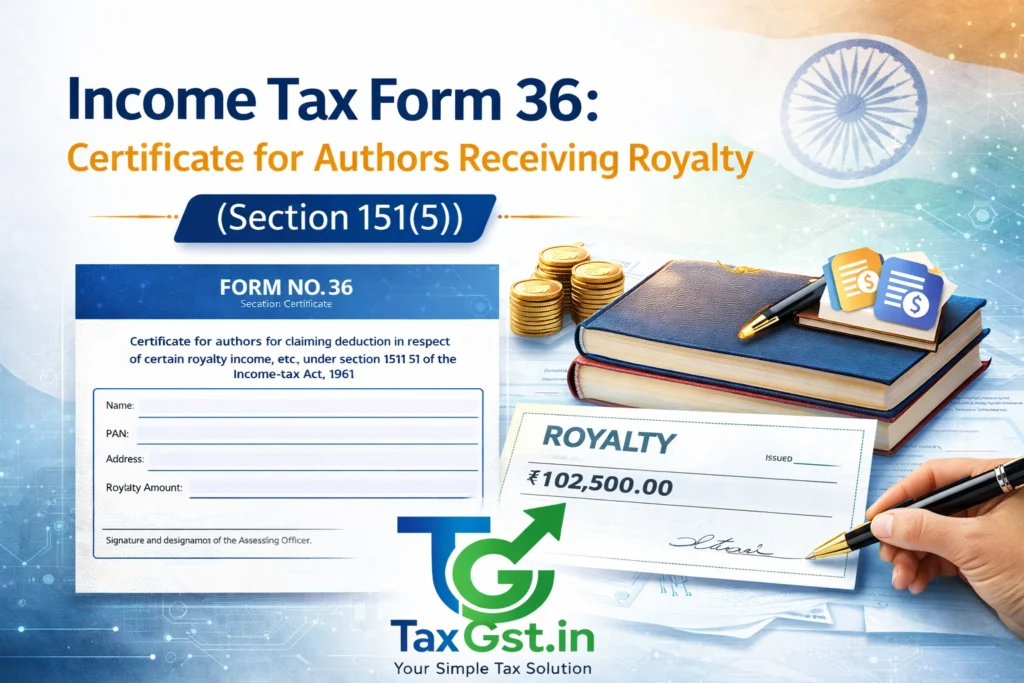
For authors earning income from books, literary works, or artistic creations, understanding and utilizing Form 36 can lead to significant tax savings. However, the process of obtaining this certificate is often misunderstood or overlooked due to lack of awareness. This article provides a comprehensive guide to Income Tax Form 36, its legal basis, eligibility criteria, application process, and implications under the current tax regime.
Key Takeaways:
-
- Form 36 is a certificate issued under Section 151(5) of the Income Tax Act, 1961, allowing authors to receive royalty income at a concessional tax rate.
- Only authors of books (excluding textbooks for schools/colleges) are eligible to apply for this certificate.
- The application must be submitted to the jurisdictional Assessing Officer via the Income Tax Portal.
- Tax is deducted at source (TDS) at a lower rate (typically 10%) once the certificate is issued, instead of the standard TDS rate.
- The certificate is valid for a specific financial year and must be renewed annually.
Legal Framework: Section 151(5) of the Income Tax Act
The foundation of Form 36 lies in Section 151(5) of the Income Tax Act, 1961. This provision empowers the Assessing Officer to issue a certificate to an author, permitting the payer (such as a publisher) to deduct tax at a rate lower than the standard TDS rate applicable under Section 194J or other relevant sections.
According to the provision, the concessional rate applies only to royalty income received by an author in respect of a book. Importantly, the term “book” is defined narrowly under the Act. It excludes textbooks meant for schools, colleges, or universities, as well as directories, guides, journals, dictionaries, and encyclopedias. This means that authors of fiction, non-fiction, poetry, biographies, and other literary works may qualify, while academic textbook writers generally do not.
The rationale behind this provision is to encourage literary creativity and support individual authors who may not have substantial income streams. By reducing the tax burden at the source, the government ensures that authors retain a larger portion of their earnings, thereby promoting cultural and intellectual development.
It is important to note that the benefit under Section 151(5) is available only if the author applies for and obtains the certificate in Form 36 from the Assessing Officer. Without this certificate, the payer is required to deduct tax at the applicable TDS rate, which could be as high as 10% under Section 194J for professional services, or even higher if the payee does not furnish a PAN.
Eligibility Criteria for Form 36
Not all authors automatically qualify for the concessional tax treatment under Section 151(5). The eligibility is strictly defined and includes the following conditions:
-
- The applicant must be an individual (not a company, firm, or HUF) who is the author of a book.
- The book must be a literary work and not fall under the excluded categories such as textbooks, directories, or reference materials.
- The royalty income must be received in respect of the copyright of the book, not for any other service such as editing, translation, or adaptation.
- The author must have a valid Permanent Account Number (PAN) and be a resident of India for tax purposes.
- The application must be made before the royalty payment is due, to allow time for processing and issuance of the certificate.
Authors who are co-authors of a book may also apply jointly, provided all co-authors meet the eligibility criteria. In such cases, the certificate will be issued in the names of all co-authors, and the royalty income will be apportioned accordingly.
Application Process for Form 36
The process of obtaining Form 36 has been streamlined with the digitization of tax services through the Income Tax Portal. The application is now filed online, reducing paperwork and processing time. Here is a step-by-step guide to applying for Form 36:
-
- Login to the Income Tax e-Filing Portal: Visit incometax.gov.in and log in using your PAN and password. Ensure that your profile is complete and up to date.
- Navigate to ‘e-File’ > ‘Income Tax Forms’ > ‘File Income Tax Forms’: Select the relevant form category. Look for “Form 36 – Application for Certificate under Section 151(5)”.
- Fill in the Required Details: Provide personal information, PAN, address, and details of the book (title, ISBN, publisher, expected royalty income, etc.).
- Upload Supporting Documents: Attach scanned copies of:
-
- Proof of authorship (e.g., publishing agreement, copyright registration, or publisher’s letter).
- Copy of PAN card.
- Bank account details (for refund purposes, if applicable).
- Any other document as specified by the AO.
- Submit the Application: Review all details and submit the form electronically. A confirmation number will be generated.
- Track Application Status: Use the acknowledgment number to track the status of your application under ‘e-File’ > ‘View Filed Applications’.
- Respond to Queries (if any): The Assessing Officer may seek additional information or clarification. Respond promptly through the portal.
- Receive the Certificate: Once approved, the certificate in Form 36 will be issued electronically and can be downloaded from the portal.
-
The entire process typically takes 15 to 30 days, depending on the workload of the jurisdictional AO and the completeness of the application. It is advisable to apply well in advance of any expected royalty payments to avoid delays.
Impact on TDS and Royalty Payments
Once the Assessing Officer issues Form 36, the author can provide this certificate to the publisher or any other entity making royalty payments. The payer is then legally obligated to deduct tax at the rate specified in the certificate, which is usually 10% or lower, instead of the standard TDS rate under Section 194J (which is also 10% for royalty payments, but may be higher without PAN).
For example, if an author is due to receive ₹1,00,000 as royalty and holds a valid Form 36, the publisher will deduct ₹10,000 as TDS (at 10%) and pay ₹90,000 to the author. Without the certificate, the same payment would still attract 10% TDS under Section 194J, but the key benefit of Form 36 is the assurance of concessional treatment and the avoidance of higher rates in case of non-compliance.
Moreover, the certificate ensures that the tax is deducted only on the royalty component and not on any other payments such as advances, editing fees, or translation charges, which may be taxed differently. This distinction is crucial for authors who receive multiple types of income from their literary work.
It is also important to note that the certificate is valid only for the financial year specified in the form. Authors must reapply each year if they continue to receive royalty income. Failure to renew the certificate may result in higher TDS deductions in subsequent years.
Reporting and Compliance
Authors who receive royalty income and hold a Form 36 certificate must still report the income in their annual Income Tax Return (ITR). The TDS deducted by the publisher will be reflected in Form 26AS and the Annual Information Statement (AIS), which can be accessed via the Income Tax Portal.
The appropriate ITR form for authors is typically ITR-2 or ITR-3, depending on whether they have other sources of income such as capital gains or business income. Royalty income is reported under the head “Income from Other Sources” and the TDS credit is claimed to reduce the final tax liability.
Authors should also maintain proper records of all royalty agreements, payment receipts, and TDS certificates (Form 16A) issued by publishers. These documents may be required during tax assessments or audits.
Common Challenges and Misconceptions
Despite its benefits, many authors face challenges in obtaining and utilizing Form 36. Some common issues include:
-
- Delayed Applications: Authors often apply only after receiving royalty payments, leading to higher TDS deductions. It is essential to apply before the payment is due.
- Incorrect Book Classification: Applying for a textbook or academic guide may result in rejection. Only literary books qualify.
- Lack of Awareness: Many publishers are unaware of Form 36 and may refuse to accept it, insisting on standard TDS rates. Authors should educate their publishers about the provision.
- Technical Glitches: The online application process, while efficient, may sometimes face technical issues. It is advisable to apply during non-peak hours and keep backups of all submissions.
Another common misconception is that Form 36 exempts royalty income from tax altogether. This is incorrect. The certificate only allows for lower TDS deduction at source. The final tax liability is determined based on the author’s total income and applicable tax slabs. If the author falls in a lower tax bracket, they may even claim a refund of excess TDS.
Recent Updates and Digital Integration
The Central Board of Direct Taxes (CBDT) has been actively promoting digital tax processes, and the application for Form 36 is now fully integrated into the e-filing system. This has reduced processing time and improved transparency. Additionally, the introduction of the Annual Information Statement (AIS) allows authors to view all financial transactions, including TDS credits, in one place, making compliance easier.
Authors can also use the e-verify feature to authenticate their ITR using Aadhaar OTP, net banking, or other methods, ensuring faster processing and refunds. The government has also extended the timeline for filing revised and belated returns, providing relief to taxpayers who may have missed earlier deadlines.
For those facing issues with portal login problems or form submission errors, the Income Tax Department offers helpdesk support and online chat assistance through the portal.
Income Tax Form 36 is a powerful tool for authors seeking to minimize their tax burden on royalty income. By leveraging Section 151(5) of the Income Tax Act, eligible authors can ensure that tax is deducted at a concessional rate, thereby retaining more of their hard-earned income. The process, though requiring timely action and accurate documentation, is straightforward and fully supported by the digital infrastructure of the Income Tax Portal.
Authors are encouraged to apply for Form 36 at the earliest, maintain proper records, and stay informed about changes in tax laws. With the right approach, this provision can significantly enhance financial sustainability for writers and contribute to the growth of India’s literary landscape.
For more information on related tax procedures, including revised ITR timelines and TDS guidelines, visit our dedicated sections on TaxGST.in.
Article Information
Published: March 24, 2026
Author Royalty: FAQ
1. What is Income Tax Form 36 for authors?
Form 36 is the official certificate under Section 151(5) of the Income Tax Act (effective from 2025-26). It allows authors to receive royalty income at a concessional TDS rate, typically 10%, by providing formal authorization to publishers to deduct tax at a lower rate.
2. Who can apply for royalty tax benefits under Section 151(5)?
Individual authors who are residents of India and have authored literary, artistic, or scientific books are eligible. This excludes authors of school/college textbooks, guides, directories, and dictionaries.
3. How long is the Form 36 certificate valid?
A Form 36 certificate is valid only for the financial year in which it is issued. Authors must file a new application annually on the Income Tax Portal to continue receiving benefits in subsequent years.
4. Does Form 36 make my royalty income tax-free?
No. Form 36 only reduces the TDS (Tax Deducted at Source) rate. Your total royalty income must still be reported in your ITR, and any remaining tax liability will be calculated based on your applicable tax slab.
Category: Income Tax
Official Resources
Disclaimer: For informational purposes only. Consult a tax professional for advice.
Related Reading
Discover more from TaxGst.in
Subscribe to get the latest posts sent to your email.

Never Miss a Tax Deadline Again
Due-date alerts, GST updates and tax tips — free on the app you already use.
event Next: TDS Return (138 / 140) · 31 Oct