
 C.K. Gupta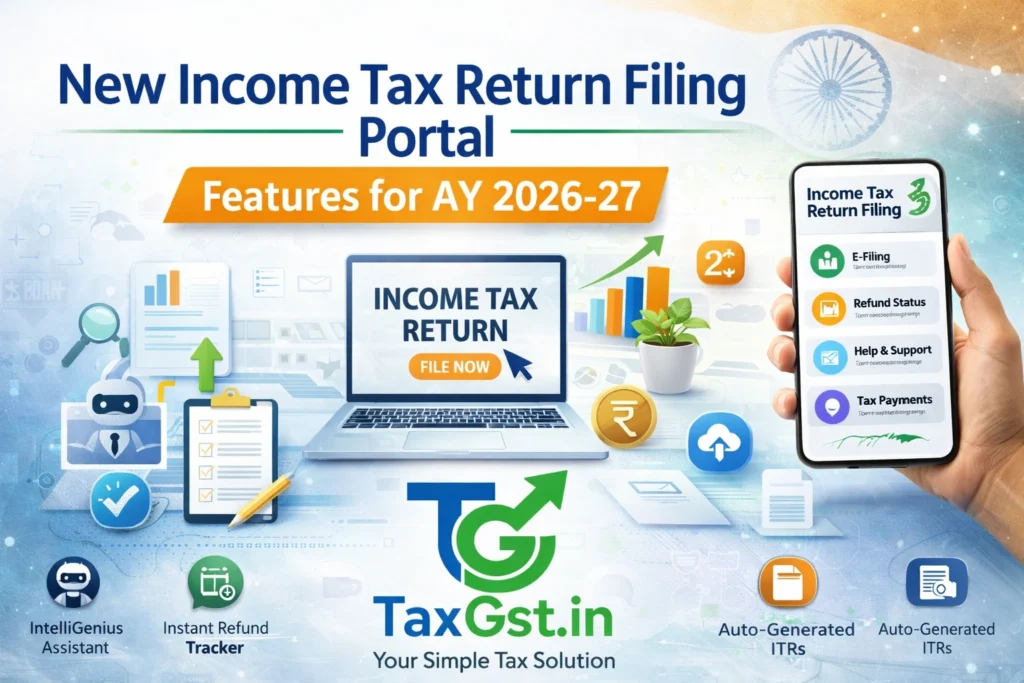
The Income Tax Department has introduced a series of transformative enhancements to the e-Filing portal for Assessment Year (AY) 2026–27, aimed at streamlining compliance, improving user experience, and promoting transparency in tax administration. Announced officially on March 23, 2026, these updates reflect the government’s ongoing commitment to digitization and taxpayer-centric reforms under the broader framework of the Central Board of Indirect Taxes and Customs (CBIC) and the Goods and Services Tax (GST) network. With the financial year 2025–26 drawing to a close, taxpayers—ranging from salaried individuals to businesses and professionals—must familiarize themselves with these new features to ensure accurate, timely, and hassle-free ITR filing.
From pre-filled forms enriched with GST and bank data to real-time validation and AI-driven assistance, the revamped portal leverages integrated data ecosystems to reduce manual errors and accelerate processing. This article provides a comprehensive overview of the key changes, step-by-step guidance on navigating the updated system, and expert insights into how these features align with India’s evolving tax landscape.
Key Takeaways
- Pre-filled ITR forms now include data from GST returns, bank statements, and Form 26AS for AY 2026–27.
- Real-time TDS and advance tax validation reduces discrepancies during filing.
- Enhanced Form 26AS and AIS integration provides a unified view of income and tax credits.
- New AI-powered chatbot offers contextual help for ITR-1 to ITR-7 filers.
- Mandatory digital signature or Aadhaar OTP for all ITR submissions, reinforcing security.
Seamless Data Integration: The Backbone of the New Portal
One of the most significant upgrades for AY 2026–27 is the deep integration of financial data across multiple government platforms. The e-Filing portal now automatically populates taxpayer information using data from Form 26AS, the Annual Information Statement (AIS), GST returns filed on the GST portal, and bank transaction records shared via the Account Aggregator (AA) framework.
This means that salaried individuals using ITR-1 (Sahaj) or ITR-2 will see their salary income, house property income, and interest from fixed deposits pre-filled based on TDS certificates (Form 16/16A) and bank feeds. Similarly, businesses filing ITR-3, ITR-4 (Sugam), or ITR-5 can expect their turnover, GST liabilities, and input tax credits to be auto-populated from GSTN data, reducing the risk of mismatches between ITR and GSTR-3B filings.
For instance, under Section 44AD of the Income Tax Act, presumptive income taxpayers using ITR-4 will benefit from automated calculation of deemed profits based on GST-reported turnover, ensuring compliance with both direct and indirect tax norms. This cross-verification mechanism not only simplifies filing but also strengthens audit trails, making it harder to conceal income or claim ineligible deductions.
Real-Time Validation and Error Prevention
To minimize processing delays and rectification requests, the updated portal introduces real-time validation checks at every stage of ITR preparation. As taxpayers enter data—whether it’s capital gains under Section 54, home loan interest under Section 24(b), or deductions under Section 80C—the system cross-checks entries against available records and flags inconsistencies immediately.
For example, if a taxpayer claims a deduction of ₹1.5 lakh under Section 80C but the AIS shows only ₹1.2 lakh in eligible investments (such as PPF, ELSS, or life insurance premiums), the portal will prompt a correction before submission. Similarly, advance tax payments made during FY 2025–26 are now auto-verified against challan data, ensuring that taxpayers receive full credit for prepaid taxes without manual intervention.
This feature is particularly beneficial for non-audit cases (due by July 31) and audit cases (due by October 31), as it reduces the likelihood of notices under Section 143(1) for arithmetical errors or mismatched data. The system also validates TDS claims by matching them with Form 26AS entries, preventing over-claiming or duplication.
Enhanced Form 26AS and AIS: Your Financial Mirror
The Form 26AS has long served as a consolidated tax statement, but for AY 2026–27, it has been upgraded into a dynamic financial dashboard. Now integrated with the Annual Information Statement (AIS), it provides a granular view of all financial transactions reported to the Income Tax Department by banks, mutual funds, employers, and other institutions.
Taxpayers can access detailed breakdowns of:
- Salary and pension income
- Interest from savings accounts, FDs, and bonds
- Dividends and capital gains
- GST turnover and tax payments
- Foreign remittances and overseas assets (for applicable filers)
The AIS also includes “feedback” functionality, allowing taxpayers to contest or clarify any reported transaction directly through the portal. Once resolved, the updated data flows into the ITR form, ensuring accuracy. This transparency empowers taxpayers to detect and correct errors early, avoiding potential scrutiny or penalties under Section 271(1)(c) for concealment of income.
AI-Powered Assistance and User Experience Upgrades
Recognizing the complexity of tax laws, the Income Tax Department has deployed an AI-powered virtual assistant on the e-Filing portal. Available 24/7, this chatbot understands natural language queries and provides contextual guidance based on the user’s profile and selected ITR form.
Whether a user is confused about reporting rental income under ITR-2 or needs help calculating depreciation for ITR-3, the assistant offers step-by-step explanations, relevant sections of the Income Tax Act, and links to official help documents. It also supports multilingual queries, making the portal more accessible to non-English speakers.
Additionally, the user interface (UI) has been redesigned for better navigation. Key features include:
- A personalized dashboard showing pending actions, refund status, and compliance calendar
- One-click access to previous year’s ITRs and acknowledgment receipts
- Mobile-responsive design for seamless filing on smartphones and tablets
- Progress tracker for ITR preparation, highlighting incomplete sections
These improvements are part of a broader effort to make tax compliance intuitive, especially for first-time filers and senior citizens who may find traditional forms daunting.
Mandatory Digital Authentication: Strengthening Security
In a move to enhance data security and prevent fraud, the Income Tax Department has made digital signature (DSC) or Aadhaar-based e-Verification mandatory for all ITR filings starting AY 2026–27. This applies to all seven ITR forms—from ITR-1 for salaried individuals to ITR-7 for trusts and political parties.
Taxpayers can choose between:
- Aadhaar OTP: A one-time password sent to the mobile number linked with Aadhaar, used to authenticate the return electronically.
- Digital Signature Certificate (DSC): Required for companies, LLPs, and individuals mandated to get their accounts audited under Section 44AB.
This eliminates the need for physical ITR-V submission and speeds up processing. The system also logs authentication details, creating an immutable audit trail that deters tampering and identity theft.
Step-by-Step Guide to Filing ITR on the Updated Portal
Here’s how taxpayers can navigate the new features when filing their return for AY 2026–27:
- Log in to the e-Filing Portal: Visit https://www.incometax.gov.in/iec/foportal and sign in using your PAN and password.
- Access the Dashboard: Review the personalized dashboard for any pending actions or alerts related to Form 26AS or AIS discrepancies.
- Select the Correct ITR Form: Based on your income sources, choose from ITR-1 to ITR-7. The portal now recommends the appropriate form using AI analysis of your financial data.
- Enable Pre-Fill: Click “Pre-fill” to auto-populate data from Form 26AS, AIS, GST, and bank records. Review and edit if necessary.
- Enter Additional Details: Manually input any income or deduction not covered by pre-fill, such as capital gains from unlisted shares or foreign income.
- Validate in Real-Time: The system will highlight errors or mismatches. Correct them before proceeding.
- Calculate Tax and Verify: Review the tax computation summary. Ensure advance tax and TDS credits are accurately reflected.
- Choose Verification Method: Select Aadhaar OTP or DSC for e-Verification.
- Submit and Confirm: Once verified, the ITR is successfully filed. Download the acknowledgment (ITR-V) for your records.
For audit cases, ensure that the audit report (in Form 3CA/3CB and 3CD) is uploaded before submission. The portal now supports direct integration with CA portals for seamless report sharing.
Pro Tip
Always cross-check your AIS before filing. If you notice any unreported income—such as interest from a forgotten FD or dividend from an old mutual fund investment—include it in your ITR to avoid future notices. Use the “Feedback” option in AIS to dispute incorrect entries and get them corrected before filing.
Alignment with Broader Tax Reforms
These portal enhancements are not isolated upgrades but part of a cohesive strategy to integrate India’s direct and indirect tax systems. By linking ITR data with GST returns and CBIC-managed customs and excise records, the government aims to create a single source of truth for taxpayer financial behavior.
For example, a business reporting high turnover in GSTR-3B but low income in ITR-3 will trigger automated alerts for scrutiny. Similarly, individuals receiving large foreign remittances must now disclose them in both ITR and AIS, ensuring compliance with FEMA and tax laws.
Moreover, the push toward pre-filled forms and real-time validation supports the vision of a “privacy-preserving, data-driven tax administration,” as outlined in recent policy discussions by the Ministry of Finance. It also reduces the compliance burden on honest taxpayers while increasing the cost of evasion.
The new features on the Income Tax e-Filing portal for AY 2026–27 mark a significant leap toward a smarter, faster, and more secure tax compliance ecosystem. By harnessing data integration, AI, and real-time validation, the Department is not only simplifying the filing process but also building a foundation for proactive tax governance.
Taxpayers are encouraged to leverage these tools to file accurate returns, claim eligible deductions under sections like 80C, 80D, and 24(b), and avoid unnecessary scrutiny. As India moves closer to a fully digital tax regime, staying informed and proactive will be key to seamless compliance.
For the latest updates, always refer to the official Income Tax Portal and subscribe to email alerts for deadline reminders and policy changes.
Sources & References
- Income Tax e-Filing Portal
- Form 26AS – Income Tax Department
- Annual Information Statement (AIS) – Income Tax Department
- Goods and Services Tax Portal
- Central Board of Indirect Taxes and Customs (CBIC)
Note: All features and processes described are based on the official notification dated March 23, 2026, and verified sources from the Income Tax Department and allied portals.
Related Reading
- Income Tax Refund Stuck on ‘Processing’? Here are 5 Reasons and What You Can Do
- Income Tax Notice Alert: CBDT’s New AI Scrutiny Framework for AY 2025-26 Goes Live
- Extension of ITR Filing Deadline? 11 Glitches on E-Filing ITR Portal
Try the free income tax calculator for instant figures.
Discover more from TaxGst.in
Subscribe to get the latest posts sent to your email.



Never Miss a Tax Deadline Again
Due-date alerts, GST updates and tax tips — free on the app you already use.
event Next: TDS Return (138 / 140) · 31 Oct