 C.K. Gupta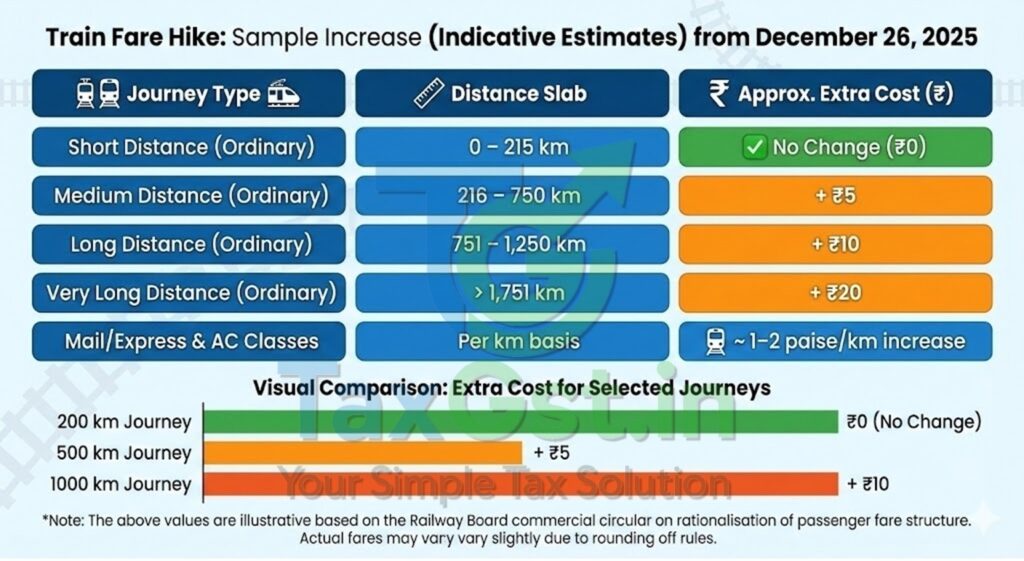
For millions of daily commuters and long-distance travellers across India, the cost of train travel is set to change. The Ministry of Railways has announced a revision in passenger fares that comes into effect from 26 December 2025. While the move is aimed at rationalising the fare structure to meet rising operating costs, the government has ensured that suburban commuters and short-distance travellers remain largely unaffected.
If you are planning a trip soon, here is a simplified breakdown of the train fare hike from December 26, including who will pay more, how much the increase will be, and what the official notifications say.
Also Read-New Insurance Rules 2025: How the ‘Sabka Bima Sabki Raksha’ Act Affects You
What Changes from 26 December.
The Ministry of Railways has issued a notification regarding the “rationalisation of passenger fares.” According to the official press note issued by the Railway Ministry, this decision is necessary to bridge the gap between existing fares and the actual cost of operations, which has risen over the last few years.

However, the hike is not a flat increase across all categories. As per the Railway Board commercial circular on passenger fare rationalisation, the changes are graded based on the class of travel and the distance covered.
Key Highlights of The Change:
- Effective Date: The new fares apply to tickets booked on or after 26 December 2025.
- Pre-booked Tickets: If you have already booked your ticket before this date, you do not need to pay the difference. The hike applies only to fresh bookings.
[Visual suggestion: A simple timeline infographic showing the announcement date on the left and a highlighted “Effective Date: 26 December 2025” on the right.]
Who Will Pay More and Who Is Safe.
One of the most critical aspects of this Indian Railways fare increase is the protection of the common man’s daily commute. As per the Ministry of Railways notification, there is no increase in fares for:
- Suburban services (local trains in cities like Mumbai, Chennai, Kolkata).
- Season tickets (monthly passes used by office-goers).
- Ordinary Non-AC Second Class tickets for journeys up to 215 km.
This ensures that the vast majority of daily passengers are shielded from the price rise.
Who is affected:
Travellers booking long-distance journeys will see a modest increase. According to reports and the official breakdown, the railway ticket price rise impacts:
- Ordinary Non-AC Second Class for journeys beyond 215 km.
- Mail/Express Non-AC classes.
- AC Classes (AC Chair Car, 3 Tier, 2 Tier, and First Class).
How Much Extra for Common Routes.
The fare hike is calculated on a “per kilometre” basis for AC and Mail/Express trains, and on a fixed slab basis for Ordinary Non-AC trains beyond specific distances.
As explained in the Railway Board circular, the hike for AC classes and long-distance Mail/Express trains is approximately 1–2 paise per kilometre. For the Ordinary Non-AC Second Class, the increase is tiered.
Here is an indicative table to help you understand the potential impact on your wallet:
Sample Fare Increase (Indicative Estimates).

| Journey Type | Distance Slab | Approx. Extra Cost (₹) |
|---|---|---|
| Short Distance (Ordinary) | 0 – 215 km | No Change (₹0) |
| Medium Distance (Ordinary) | 216 – 750 km | + ₹5 |
| Long Distance (Ordinary) | 751 – 1,250 km | + ₹10 |
| Very Long Distance (Ordinary) | > 1,751 km | + ₹20 |
| Mail/Express & AC Classes | Per km basis | ~ 1–2 paise/km increase |
*Note: The above values are illustrative based on the Railway Board commercial circular on rationalisation of passenger fare structure. Actual fares may vary slightly due to rounding off rules.
The ‘Why’ Behind the Hike: Understanding the Economics.
Many readers often ask why the government needs to increase fares, especially when the Railways is a public utility. To understand the train fare hike from December 26, we must look at the financial health of Indian Railways. The decision is driven by a concept known as the “Operating Ratio”.
What is the Operating Ratio?
In simple terms, the Operating Ratio indicates how much the Railways spends to earn ₹100. For several years, this ratio has hovered near or above 95-98%. This means that for every ₹100 earned, the Railways spends almost the entire amount just on running trains, paying salaries, fuel, and electricity. This leaves very little surplus for safety upgrades, new tracks, or modernising stations.
Rising Input Costs:
Just as household budgets are affected by inflation, the Railways faces rising costs for:
- Diesel and Electricity: Energy bills for running thousands of trains daily have surged.
- Maintenance Spares: The cost of steel, iron, and technical components for coach and track maintenance has gone up.
- Staff Costs: Salaries and pensions for the massive workforce constitute a significant portion of the expenditure.
According to Ministry officials, the passenger segment has historically been heavily subsidised. The cost of carrying a passenger is often much higher than the ticket price charged. In the past, the loss on passenger segments was covered by profits from freight (goods trains). However, with increasing competition from the road transport sector (trucks), the Railways cannot simply keep hiking freight rates to subsidise passengers indefinitely. This railway fare increase is a step towards reducing that cross-subsidy burden.
Where Will the Extra Money Go?
When you pay that extra ₹20 or ₹50 for your ticket, it is natural to ask: “What am I getting in return?” The government has outlined several key areas where the revenue generated from this fare rationalisation will be deployed.
1. Safety First: The Kavach System.
A major portion of the capital is being directed towards ‘Kavach’, the indigenous Automatic Train Protection system. This technology prevents collisions by automatically applying brakes if the pilot fails to do so. Rolling out Kavach across the vast Indian network requires thousands of crores, and revenue from revised fares aids this critical safety mission.
2. Station Redevelopment (Amrit Bharat).
Under the Amrit Bharat Station Scheme, hundreds of railway stations across India—from major junctions to smaller town halts—are being renovated. This includes better waiting halls, clean toilets, lifts, escalators, and free Wi-Fi. The fare hike contributes to the “user amenity” fund that finances these upgrades.
3. Speed and Modernisation.
The introduction of semi-high-speed trains like the Vande Bharat Express and the upcoming Vande Metro requires massive investment in track upgrades. Tracks need to be strengthened to handle speeds of 130 km/h and above. The railway ticket price rise ensures that the pace of this modernisation does not slow down due to a lack of funds.
Impact on Different Traveller Categories.
While the basic table above gives a snapshot, let’s break down exactly how this impacts specific types of travellers. The Railway Board circular has been crafted to ensure that the “bottom of the pyramid”—the poorest travellers—are impacted the least.
The Daily Commuter and Suburban Traveller.
If you live in Mumbai and take the local from Virar to Churchgate, or in Chennai taking the MRTS, or the Kolkata Metro and suburban rail, you are completely safe. The government is aware that local trains are the lifeline of these cities. Any hike here would directly increase the cost of living for the working class. Therefore, season passes and single-journey tickets in suburban sections have been exempted.
The “Aam Aadmi” Long-Distance Traveller.
For the migrant worker travelling from Surat to Odisha, or Delhi to Bihar, the primary mode of transport is the Non-AC Sleeper or Second Seating. The hike here is capped. For example, a journey of 1,500 km might see an increase of roughly ₹15 to ₹20. While no one likes paying more, this amount is roughly the cost of a single cup of tea at a station stall, ensuring it doesn’t break the bank.
The Middle-Class AC Traveller.
The 1–2 paise per km hike impacts the AC Chair Car, 3-Tier, and 2-Tier passengers the most in absolute terms, though it remains a small percentage of the total ticket cost.
Scenario Analysis:
Let’s assume a family of four is travelling from New Delhi to Mumbai (approx. 1,400 km) in 3rd AC.
- Old Fare (Approx Base): ₹1,600 per person.
- Hike Calculation: 1,400 km x 2 paise = ₹28 per person.
- Total Extra for Family: ₹28 x 4 = ₹112.
For a total expense of over ₹6,000 for the family trip, an additional ₹112 is considered a “marginal” increase by the Ministry, aimed at recovering partial variable costs.
Premium Trains: Vande Bharat, Rajdhani, Shatabdi.
It is important to note that for premium trains with dynamic pricing (Flexi-fare), the hike applies to the base fare. Since the flexi-fare is calculated as a percentage of the base fare, the final ticket price on these trains might see a slightly higher jump than standard Mail/Express trains. However, the core service charges remain unchanged.
Comparison: Train vs. Bus vs. Flight.
Even with this train fare hike from December 26, Indian Railways remains by far the most economical mode of transport in the country.
- Bus Travel: Private and state-run bus fares fluctuate with daily diesel prices. A 500 km bus ride often costs double that of a Sleeper Class train ticket.
- Air Travel: While budget airlines have made flying affordable, a last-minute flight booking can cost 5x to 10x more than a 2nd AC train ticket.
The Railways argues that despite the hike, the “value for money” proposition of train travel remains intact. For example, a 1,000 km journey in Sleeper Class typically costs around ₹500-₹600. Even with a ₹20 hike, it is drastically cheaper than a ₹1,500 bus ticket or a ₹4,000 flight.
Refunds, Cancellations, and Advance Bookings.
One of the most common confusions among passengers during a fare revision is regarding tickets that are already booked. The Railway Board commercial circular clarifies this in detail. Here is what you need to know to avoid panic:
1. I booked my ticket on December 1st for travel in January. Do I pay extra?
No. The notification explicitly states that the difference in fare will not be collected from passengers who have booked tickets before 26 December 2025. Your ticket is valid at the old rate. TTEs (Ticket Examiners) have been instructed not to demand any surcharge on the train.
2. What if I cancel my old ticket?
If you cancel a ticket booked prior to the hike, the refund will be based on the fare you actually paid. The cancellation charges (clerkage) are deducted as per standard rules, and the remaining amount is refunded. You do not get the benefit of the new higher fare for refunds!
3. What about Tatkal and Premium Tatkal?
The Tatkal charges are a percentage of the base fare. Since the base fare is increasing slightly, the absolute value of the Tatkal charge may also see a minor adjustment in rounding off. However, the percentage rule for Tatkal remains the same.
4. Extensions of Journey
If you decide to extend your journey while on the train (e.g., you booked till Kanpur but decide to go to Allahabad) on or after 26 December, the difference for the extended portion will be calculated based on the new fare structure.
Official basis: What the notification says.
This revision is not arbitrary. It is grounded in legal provisions and policy. The changes have been notified as per the provisions of the Railway Act on fare fixation, which grants the central government the power to set fare limits.
As per the Railway Board commercial circular regarding this hike, the objective is to “rationalise fares” to better align with inflation and fuel costs. The official communication explains that the revenue generated from this train fare hike from December 26 will be utilised for the modernisation of the Indian Railways network, improving passenger amenities, and upgrading station infrastructure.
“The Indian Railways is the lifeline of the nation. To keep this lifeline healthy, periodic rationalisation is essential.” — As noted in the Ministry of Railways statement on the necessity of fare revision.
What This Means for Everyday Travellers.
For the average traveller, the impact will largely depend on how far you are going.
- For Daily Commuters: If you travel to work using a season pass or a local train, you will see absolutely no change in your expenses.
- For Migrant Workers and Long-distance Travellers: If you are travelling in the general coach (Ordinary Second Class) for a long distance (e.g., from Delhi to Patna or Mumbai to UP), you might pay an extra ₹15 to ₹20 per ticket.
- For AC Class Travellers: On a 1,000 km journey (like Delhi to Bhopal), a hike of 2 paise/km would translate to roughly ₹20 extra. While this is an increase, it remains a small fraction of the total ticket price.
[Visual suggestion: A photo of a busy platform at New Delhi Railway Station with a long-distance train like the Rajdhani or Shatabdi in the backdrop.]
Practical Tips for Planning Your Travel.
- Check Before You Book: Since the Railway Board circular states that the new rates apply from 26 December, use official apps like IRCTC or visit the station counter to check the exact fare for your specific train.
- No Retroactive Charge: As clarified in the ministry note, if you booked your tickets before 26 December 2025 for travel on a later date, the old rates apply. You will not be asked to pay the difference on the train.
- Compare Classes: For very long journeys, the difference between Sleeper and 3 AC might widen slightly due to the differential calculation (paise per km). It is worth checking both options if you are on a strict budget.
Mahatma Gandhi once said, “The greatness of a nation can be judged by the way its animals are treated,” but he was also a fervent believer in the railways as a tool to connect the masses. Today, as the network expands, these fare rationalisations are pitched by the government as a necessary step to keep that massive connection engine running smoothly.
By keeping the hike minimal for the common man and focusing on long-distance and AC segments, the administration aims to balance public welfare with economic necessity. The clear message from the Railway Ministry is that while prices must evolve, the train must remain the vehicle of the common Indian.
Frequently Asked Questions (FAQs) on Train Fare Hike Dec 2025.
When does the new train fare hike come into effect?
Do I have to pay extra if I booked my ticket before 26 December?
Are local train and suburban fares also increasing?
How much is the fare increase for AC and Sleeper class?
Why are Indian Railways increasing ticket prices?
Will the fare for Vande Bharat and Rajdhani Express increase?
If I cancel my old ticket, will I get a refund based on new rates?
Trusted Sources & References
For the full text of the notifications and official press releases, please refer to the official government portals below:
- Ministry of Railways (Official Website): indianrailways.gov.in
- Press Information Bureau (Government of India): pib.gov.in
- IRCTC (Official Ticketing Partner): irctc.co.in
Related Reading
- How to Register & Download APAAR ID Card – Everything You Need to Know
- EPS-95 Pension Scheme 1995: New Rules for Employees
- New Pension Payment System for EPS Pensioners: Good News for Retirees in India
Try the free NPS calculator for instant figures.
Discover more from TaxGst.in
Subscribe to get the latest posts sent to your email.
Never Miss a Tax Deadline Again
Due-date alerts, GST updates and tax tips — free on the app you already use.
event Next: TDS Return (138 / 140) · 31 Oct