
 C.K. Gupta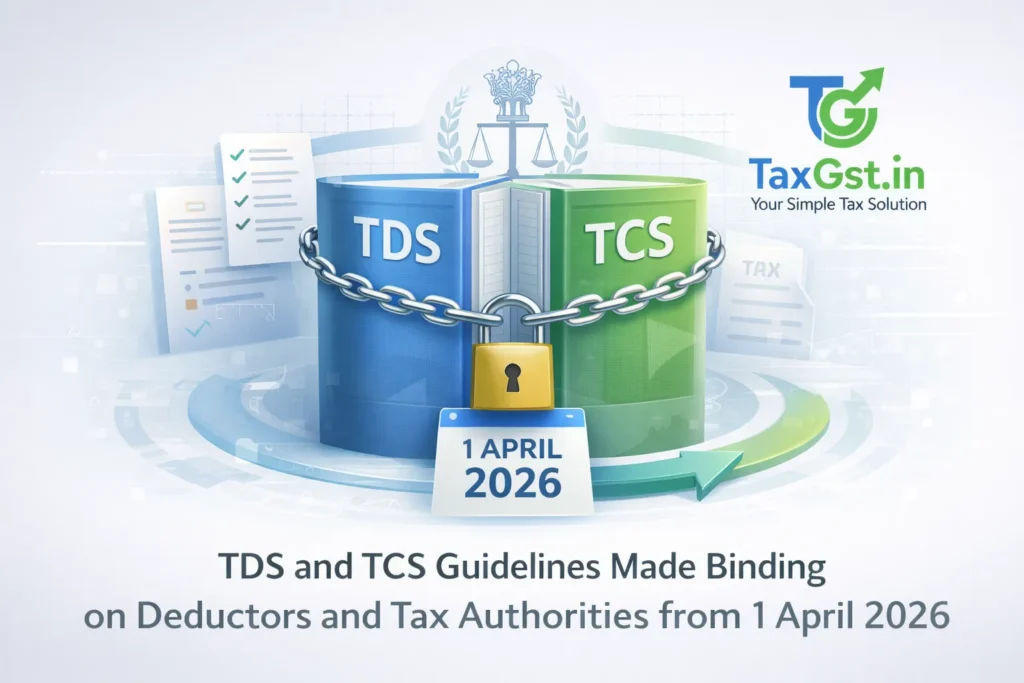
In a significant move to streamline tax administration and curb the persistent headache of litigation, the Finance Bill, 2026 has proposed a crucial amendment to the Income-tax Act, 2025. Starting 1 April 2026, all guidelines issued by the Central Board of Direct Taxes (CBDT) for removing difficulties in TDS and TCS provisions will be legally binding on both tax authorities and deductors. This change effectively restores a vital compliance anchor that was standard under the old 1961 regime but was initially absent in the draft of the new Act.
The amendment to Section 400(2) of the Income-tax Act, 2025 is designed to ensure that when the CBDT issues a clarification to solve a practical problem—whether it is regarding TDS on property or TCS on foreign remittances—every stakeholder, from the Assessing Officer (AO) to the corporate finance team, must follow it to the letter. As noted in the official Budget 2026 FAQs hosted on the Income Tax Department portal, this shift aligns with the broader goal of making the transition to the Income-tax Act 2025 TDS TCS regime seamless and predictable for the Indian industry.
The Legal Restoration: Amending Section 400(2) of the Income-tax Act, 2025
For decades, the Indian tax landscape relied on the “Removal of Difficulties” clauses to navigate the murky waters of new tax provisions. Under the Income-tax Act, 1961, several sections (such as Section 194-O, 194Q, and 206C(1G)) gave the CBDT the power to issue guidelines with the prior approval of the Central Government. Critically, the 1961 Act explicitly stated that these guidelines were binding on both the tax department and the deductors (for example, guidelines issued under earlier provisions of the 1961 Act for TDS/TCS compliance).
However, when the Income-tax Act, 2025 was first conceptualised to replace the aging 1961 law, the initial phrasing of Section 400(2) lacked this “binding” language. It empowered the Board to issue guidelines but stopped short of giving them the force of law over the person responsible for deducting or collecting tax.
The Finance Bill, 2026 Memorandum clarifies that this was an omission that needed rectification. The proposed amendment substitutes the existing sub-section (2) of Section 400 to specifically provide that:
“The guidelines issued shall be binding on the income-tax authorities and on the person liable to deduct or collect income-tax.”
By doing so, the government is ensuring that the new tax code does not inadvertently open the floodgates for litigation simply because a taxpayer and a tax officer interpreted a “guideline” differently.
“Certainty is the mother of quietness and repose, and uncertainty the cause of variance and contentions.” – Sir Edward Coke. This amendment is the legislative bridge to that certainty.
Why This Amendment? Restoring Certainty and Reducing Disputes
The government has brought this amendment now to ensure uniform interpretation and reduce the litigation burden on businesses. Tax research platforms such as Taxmann, CAclubIndia, and A2ZTaxCorp have explained that this change is meant to remove ambiguity in the Income-tax Act, 2025 and ensure uniform interpretation of CBDT TDS guidelines, as highlighted in their Budget 2026 analysis pieces.
In the complex world of Indian TDS (Tax Deducted at Source) and TCS (Tax Collected at Source), “variance and contentions” are far too common. For instance, when Section 194Q (TDS on purchase of goods) was introduced a few years ago, thousands of businesses struggled to decide if the tax applied to GST components or how to handle purchase returns. It was only the CBDT guidelines that provided a standard operating procedure.
Without the “binding” tag in the new Act, a tax auditor or an AO could potentially argue that a CBDT guideline is merely “advisory” and not a strict legal mandate. This could lead to situations where a deductor follows a CBDT circular in good faith, only to have their deduction challenged during an assessment.
Leading tax research platform Taxmann has highlighted that this amendment is a proactive step to prevent such jurisdictional inconsistencies. By making the guidelines binding, the government is providing a “safe harbor” to deductors. If you follow the CBDT’s published path, the tax department cannot penalise you for it later.
💡 Did You Know? Interesting Facts
- Binding Force: The guidelines are now legally binding on Income-tax authorities handling assessments and persons responsible for deducting or collecting tax alike.
- Reduced Litigation: Expert comments in Budget 2026 coverage by leading financial media platforms suggest this will drastically lower the number of TDS surveys and disputes.
- Global Standard: This aligns India with international best practices where tax authorities must strictly follow their own published interpretative guidelines.
How It Works: The Binding Nature in Practice
From 1 April 2026, the operational reality for finance departments will change. Currently, many companies view CBDT circulars as “strong suggestions.” Under the amended Section 400(2), these guidelines will carry the same weight as the Act itself for the purposes of compliance.
Comparison: Regime Shift for TDS/TCS Guidelines
| Feature | Position Under Income-tax Act, 1961 | Position Under Income-tax Act, 2025 (Pre-Amendment) | Position from 1 April 2026 (Post-Amendment) |
| Status of CBDT Guidelines | Legally Binding | Clarificatory / Advisory | Legally Binding |
| Binding on Tax Officers? | Yes | Yes (General administrative power) | Yes (Specific Statutory Mandate) |
| Binding on Deductors? | Yes | Ambiguous / Not explicitly stated | Yes (Statutory Mandate) |
| Legal Protection | High (Adherence protected from penalty) | Moderate (Subject to interpretation) | High (Statutory Shield) |
As noted in various analyses by CAclubIndia, this change is particularly relevant because the Income-tax Act, 2025 involves a massive re-numbering and restructuring of sections. During such a transition, the potential for “difficulties” is high. Section 400(2) acts as the “emergency valve” that allows the CBDT to fix issues without waiting for the next year’s Finance Bill.
📊 Infographic Idea: The Binding Force Timeline
[Vertical Timeline: Old Law (1961) Binding → ITA 2025 Gap → Finance Bill 2026 Amendment → Effective from 1 April 2026]
Impact on Key TDS/TCS Scenarios: Property, 194Q, and Beyond
The practical impact of making TDS and TCS guidelines binding from 1 April 2026 will be felt most in “grey area” transactions. Let’s look at how this affects specific, high-volume compliance areas:
1. TDS on Immovable Property
Property transactions are often fraught with confusion regarding the timing of deduction (at the time of agreement vs. payment) and the treatment of club membership fees or car parking charges. Guidelines issued under the new Act will now be the final word for both the buyer (deductor) and the Sub-Registrar’s office.
2. E-commerce and Section 194-O (Corresponding Sections in 2025 Act)
E-commerce operators often face dilemmas regarding “gross amount” of sales when discounts or cashbacks are involved. A2ZTaxCorp has pointed out in its budget commentary that binding guidelines will prevent AOs from taking an aggressive stand that differs from the Board’s stated policy, providing much-needed relief to the digital economy.
3. TCS on LRS and Overseas Tour Packages
With the Finance Bill 2026 proposing shifts in TCS rates (such as the uniform 2% for certain remittances), the role of the “authorized dealer” (bank) becomes critical. Banks require absolute legal certainty that their collection logic won’t be questioned later. The binding nature of Section 400(2) guidelines provides this exact “compliance insurance.”
4. Supply of Manpower and Contractor TDS
As highlighted by Taxmann’s analysis, the clarification that manpower supply falls under the definition of “work” (similar to the old Section 194C) is a prime example of where binding guidelines prevent local-level disputes. When the Board says a specific rate applies, no local officer can demand a higher rate under “fees for professional services.”
Way Forward: Action Points for Finance Teams and Deductors
As we approach the 1 April 2026 effective date, Indian businesses and tax practitioners must pivot their compliance strategies. The transition to the Income-tax Act 2025 TDS TCS regime is not just a change of section numbers; it is a shift in the legal hierarchy of guidelines.
Benjamin Franklin famously said, “By failing to prepare, you are preparing to fail.” To ensure a smooth transition, consider the following steps:
- Update Internal SOPs: Review your company’s Standard Operating Procedures for TDS/TCS. Ensure that the “Source of Truth” for your tax team includes the latest CBDT guidelines issued under the 2025 Act, as these now hold statutory binding force.
- Bridge the Knowledge Gap: Finance teams should subscribe to reliable tax portals like Taxgst.in or Taxmann to receive real-time alerts on new Section 400(2) guidelines. Given their binding nature, missing a guideline could mean being in direct violation of the law.
- Audit Your Positions: For complex transactions (like international remittances or complex contracts), check if there is an existing CBDT “Removal of Difficulties” guideline. If you are following it, you now have a solid legal shield against any future “Demand Notices” from the department.
- Documentation: When filing TDS returns or responding to notices, explicitly cite the relevant CBDT guideline issued under Section 400(2). This forces the tax authority to adhere to the Board’s position, as they are now legally barred from taking a contrary view.
The amendment to Section 400(2) is a welcome “re-run” of a successful policy from the 1961 Act. By giving the CBDT the power to issue binding roadmaps, the government is essentially promising taxpayers that if they follow the map, they won’t be penalized for the journey. For an Indian business landscape that has often felt “lost in translation” between the law and its implementation, this move toward certainty is a breath of fresh air.
“The power to tax involves the power to destroy.” – John Marshall.
Binding guidelines ensure this power is governed by clarity, protecting businesses from the destruction of uncertainty.
Frequently Asked Questions (FAQs) on TDS and TCS Guidelines 2026
Are CBDT guidelines for TDS/TCS legally binding now?
What is the effective date of the Section 400(2) amendment?
Does this change affect my current 1961 Act compliance?
Will these binding guidelines help in reducing tax litigation?
How do binding guidelines impact Section 194Q (Purchase of Goods)?
Do these rules apply to e-commerce and LRS/Foreign remittances?
Disclaimer: This article and FAQ are for informational purposes only and do not constitute professional legal or tax advice. Readers are advised to consult with a qualified tax professional or Chartered Accountant before making any decisions based on the Finance Bill, 2026 proposals.
📚 Trusted Authorities & Reference Links
- ✅ Ministry of Finance: Finance Bill 2026 & Memorandum
- ✅ Income Tax Department: Official Budget 2026 FAQs & Explanatory Notes
- ✅ Taxmann Research: Budget 2026 Analysis on Income-tax Act 2025
- ✅ CAclubIndia: Section 400(2) Impact Explainer
Related Reading
- TDS Chart as Per New Section Old vs New April 2026: Full List of New TDS & TCS Sections
- TDS Rate Chart (FY) Tax Year 2026-27 (AY 2027-28): New Income Tax Act 2025 Rules
- The 30% Crypto Tax in 2026 Explained: Keep Your Profits, Avoid Penalties
Discover more from TaxGst.in
Subscribe to get the latest posts sent to your email.



Never Miss a Tax Deadline Again
Due-date alerts, GST updates and tax tips — free on the app you already use.
event Next: TDS Return (138 / 140) · 31 Oct