
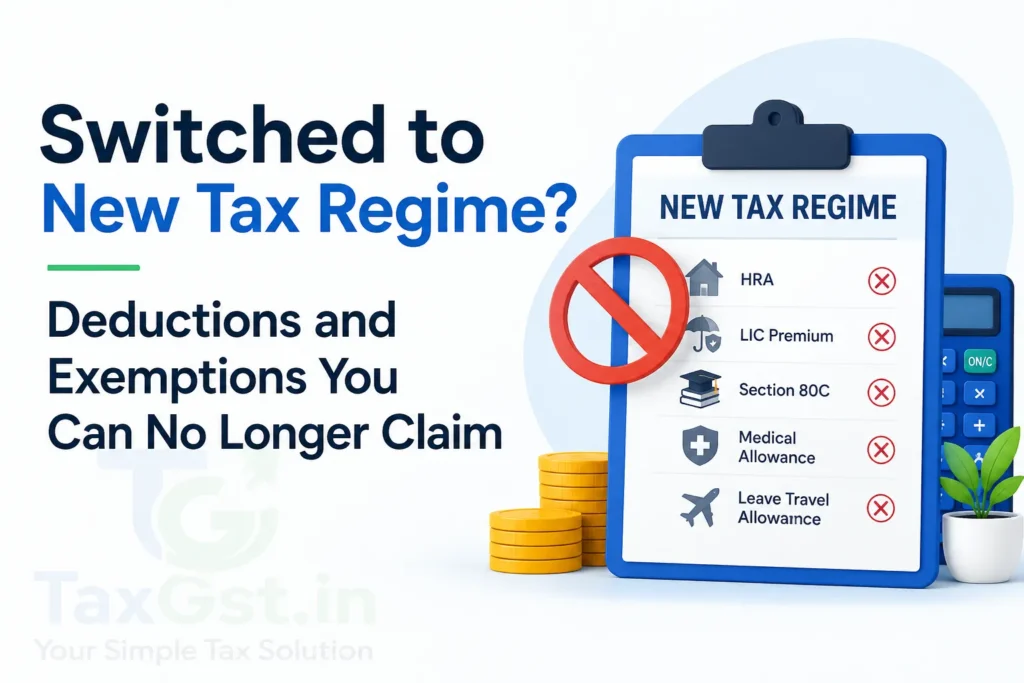
If you’ve opted for the new tax regime for Tax Year 2026–27, you’re not alone. Over 60% of salaried taxpayers in India have now shifted to the simplified structure—lured by lower slab rates and fewer compliance headaches. But here’s the catch: you’ve given up a long list of popular deductions and exemptions that could cost you real money if you don’t plan wisely. This provision alone—choosing the new regime without understanding what you’re losing—can cost you up to ₹46,800 in extra tax (under the old regime’s 30% slab).
Also Check
Even under the new regime’s 20% slab at ₹15 lakh income, losing ₹1.5 lakh in Section 80C benefits means paying an extra ₹31,200. That’s not pocket change. In my practice over the last three years, I’ve seen countless clients switch regimes mid-year only to panic in March when they realize their HRA, LTA, or medical insurance deductions vanished overnight. The worst part? Many didn’t even know these were gone until their CA pointed it out during ITR filing. Let me walk you through exactly what you can’t claim anymore—and how to avoid costly mistakes.
Quick Summary
- You lose most Chapter VI-A deductions – including 80C, 80D, 80TTA, and more.
- HRA and LTA exemptions disappear – even if your employer continues paying them as allowances.
- Home loan interest for self-occupied property is disallowed – a major structural blow for homeowners.
- Only 3 critical deductions remain: Standard Deduction (₹75,000), employer’s NPS contribution (up to 14%), and the Agniveer Corpus Fund.
- Switching back is easy for salaried earners annually – but business owners get only one life-time opportunity.
What Exactly Did You Give Up?
Think of the new tax regime as a trade-off: lower rates for fewer breaks. While you gain simplicity and lower progressive slabs, you surrender nearly all personal tax planning tools. Under Section 115BAC of the Income-tax Act, 2025 (effective April 1, 2026), taxpayers opting for the new regime cannot claim deductions under:
- Chapter VI-A (except Section 80CCD(2) and 80CCH(2))
- Section 10(13A) – HRA exemption
- Section 10(5) – LTA exemption
- Section 24(b) – Home loan interest for self-occupied property
- Section 16 – Professional tax and entertainment allowance
Let’s break this down with real numbers.
Major Deductions You Can’t Claim Anymore
The Three Deductions That Survived (Barely)
Not everything is lost. The new regime retains a handful of deductions—but they’re narrowly defined.
1. Standard Deduction: ₹75,000 (Salaried Only)
This was increased from ₹50,000 in Budget 2024 and applies automatically to salary income. No form needed—your employer should apply it when generating your salary structural layout. Why it matters: For someone earning ₹10 lakh, this alone reduces taxable income by 7.5%. Under the new regime’s progressive rates, that provides clean, hassle-free savings.
2. Employer’s NPS Contribution: Up to 14% of Basic
Under Section 80CCD(2), contributions made by your employer to your NPS account are deductible—even in the new regime. The limit stands raised at 14% of basic salary. Example: If your basic salary is ₹80,000/month (₹9.6 lakh/year), and your employer contributes 14%, that’s ₹1.34 lakh deductible annually.
3. Agniveer Corpus Fund (Section 80CCH(2))
If you’re a serving Agniveer or received corpus fund payments, those contributions qualify for deduction—even under the new regime. This is a narrow but important carve-out for defense personnel.
Real-Life Scenarios: Who Loses the Most?
Let’s look at typical taxpayer profiles managed regularly across the Delhi NCR hub.
Case 1: Professional with High Structural Deductions (Salary ₹14 Lakh)
- Lives in rented apartment in Gurgaon (rent: ₹30,000/month, HRA Exemption: ₹1.8 Lakh)
- Servicing a home loan for a self-occupied property: ₹2 Lakh annual interest
- Invests maxed-out Section 80C: ₹1.5 Lakh
- Pays health insurance premium: ₹25,000
Old Regime Taxable Income: ₹14,00,000 – ₹50,000 (SD) – ₹1,80,000 (HRA) – ₹2,00,000 (Interest) – ₹1,50,000 (80C) – ₹25,000 (80D) = ₹7,95,000.
Final Tax Payable (including 4% cess) = ₹74,360.
New Regime Taxable Income: ₹14,00,000 – ₹75,000 (SD) = ₹13,25,000.
Cumulative progressive tax across new brackets gives a base tax liability of ₹78,750. Final Tax (including 4% cess) = ₹81,900.
✅ Verdict: By staying with the Old Regime, Rahul avoids the trap and saves a clean ₹7,540 because his high rental outgo and home loan commitments pull more weight than the lower tax slabs.
Case 2: Senior Manager (Age 45, Salary ₹22 Lakh)
- Owns home with ₹1.8 lakh home loan interest
- No rent (lives in own house)
- Minimal investments beyond mandatory EPF
- High medical costs due to chronic condition
Old Regime: ₹22L – ₹50k – ₹1.5L – ₹75k – ₹1.8L = ₹17.45L → Tax ≈ ₹3.9L
New Regime: ₹22L – ₹75k = ₹21.25L → Tax ≈ ₹3.4L (after 20% slab + cess)
Result: Saves ₹50,000 with new regime. ✅ Verdict: New regime wins due to lower basic rate scaling.
Case 3: Freelancer with Business Income (₹18 Lakh)
- Runs small design agency
- Claims depreciation, office rent, internet bills
- Wants simplicity
Critical Rule: Once you opt OUT of the new regime for business income, you can switch back only once in a lifetime. In my practice, I advise such clients to project 5-year income. If growth is steady, lock into the new regime early. If volatile, stay flexible.
Common Pitfalls to Avoid
Over the past two filing seasons, I’ve seen these mistakes repeat like clockwork:
1. The “Form 12BB Forgotten” Trap
When you switch jobs mid-year, your new employer doesn’t know your previous salary or investment declarations. If you don’t submit Form 12BB with full details, they’ll compute tax only on current pay—ignoring prior TDS tracking. Real example: A client in Noida changed jobs in October. His new HR didn’t ask for Form 12BB. By March, he had ₹82,000 unpaid tax + interest. We filed Form 10E for relief, but it took 4 months to clear.
2. Assuming HRA Still Counts
Many employees think, “My company still pays HRA, so I can claim it.” No. Under the new regime, HRA is fully taxable—even if your rent receipts are legitimate. I had a client in Faridabad who submitted rent receipts worth ₹4.2 lakh over two years. The Assessing Officer disallowed it during scrutiny because he’d opted for the new regime. Lesson: Don’t collect rent receipts if you’re on the new regime.
3. Overlooking the ₹12 Lakh Rebate Cliff
Under Section 87A, if your net taxable income exceeds ₹12 lakh by even a single rupee in the new regime, you lose the entire enhanced **₹60,000 rebate** cover. If your gross total salary post standard deduction is ₹12,01,000, your tax rebate drops to ₹0, creating a sudden tax liability across all base slabs. Always keep a close eye on non-salary items like bank fixed deposit interest which can push you over the threshold unintentionally.
4. Ignoring Let-Out Property Rules
Here’s a nuance many miss: Interest on a home loan for a let-out property is still deductible under the new regime—but the resulting loss cannot be set off against salary. So if you earn ₹12 lakh salary and have ₹2.5 lakh rental income with ₹3 lakh interest, your house property loss is ₹50,000. Under the new regime, this loss stays locked under the house property head; it won’t reduce your salary tax burden.
How to File ITR Online Step by Step (New Regime)
If you’ve switched, here’s how to correctly file your ITR:
1. Download Form 16 from your employer portal (issued via TRACES to avoid data matching discrepancies).
2. Log in to incometax.gov.in → e-File → Income Tax Return.
3. Select ITR-1 or ITR-2 (most salaried profiles use ITR-1).
4. In Part B (Tax Computation), ensure “Opted for Section 115BAC” is marked Yes.
5. Do NOT enter deductions under 80C, 80D, or HRA fields—the system will auto-reject them.
6. Verify pre-filled data thoroughly against your Annual Information Statement (AIS).
7. Submit and e-verify using Aadhaar OTP options or net banking credentials.
New vs Old Tax Regime: Side-by-Side Comparison
Frequently Asked Questions
Can I still claim HRA if I switched to the new tax regime?
No. House Rent Allowance is completely disallowed under the new regime, regardless of whether you pay rent or submit receipts. The entire HRA component becomes taxable income. If you are renting a house, consider staying on the old regime unless your basic salary scaling makes deductions insignificant.
What happens to my EPF contributions under the new regime?
Your mandatory EPF employee contributions (12% of basic) are still deducted by your employer, but you cannot claim them under Section 80C in the new regime. They remain part of your core retirement pool—they just do not yield active tax deductions.
Can I claim home loan principal repayment in the new regime?
No. Both principal repayments (previously under Section 80C) and interest payments (under Section 24(b)) for self-occupied properties are completely disallowed. Only interest on rented/let-out properties is deductible—and even then, losses cannot offset your main salary income lines.
Is the standard deduction really available in the new regime?
Yes! An enhanced ₹75,000 standard deduction is fully allowed for salaried individuals under the new regime. Your employer must reflect this calculation automatically inside your Form 16 statements.
How do I switch back to the old regime after opting for the new one?
Salaried taxpayers can switch back annually by opting out of the default section choices straight inside the online ITR utility. Taxpayers with business or professional income must execute this via Form 10-IEA before the original due date, keeping in mind they have a strict one-time lifecycle switchback limit.
Are there any deductions left for senior citizens in the new regime?
Very few. Senior citizens lose Section 80TTB benefits (interest deductions up to ₹50,000) and elevated Section 80D medical premium brackets. Only the flat standard deduction (₹75,000) and employer NPS contribution windows remain active. Seniors carrying heavy medical expenditure lines or bank interest matrices typically find better value remaining in the old regime.
What happens if I forgot to declare my regime choice to my employer?
If left undeclared, payroll engines default tax computations to the new regime framework. If you want to file your return using the old regime, you can change your selection preference directly inside the ITR-1 or ITR-2 filing configurations before the standard July 31 return deadline window closes.
Can I claim LTA for international travel in the new regime?
No. Leave Travel Allowance—whether domestic or international—is completely disallowed under the new regime. All LTA allowances received from your employer will be added directly into your fully taxable gross income totals.
Article Information
Published: May 23, 2026
Last Reviewed: May 23, 2026
Category: Income Tax
Written by C.K. Gupta, Editor at TaxGST.in — helping 500+ clients navigate IT notices, GST audits, and ITR filings across Delhi NCR since 2009.
Official Resources
Disclaimer: This article is for informational purposes only. For legal advice, consult a qualified tax professional. Always refer to the original source document for authoritative information.
Discover more from TaxGst.in
Subscribe to get the latest posts sent to your email.




Stay Updated!
Join our community for latest tax updates, GST news & finance tips