C.K. Gupta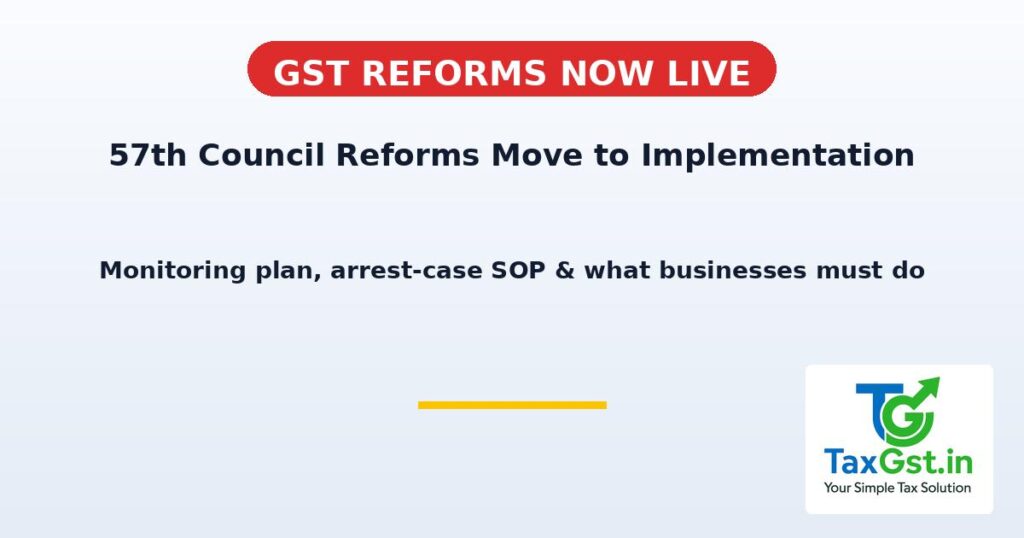
From Recommendations to Reality
On 8 October 2026, the 57th GST Council recommended the biggest reset of GST compliance rules in recent memory: scrapping the power of arrest, raising the prosecution threshold, cutting the general penalty, and speeding up refunds. But Council recommendations do not change the law by themselves — they need circulars, notifications, and in some cases amendments by Parliament and the state assemblies.
This week, the implementation machinery started moving. Between 13 and 16 October, three developments signalled that the Council’s intent is turning into action: a monitoring mechanism for how states implement the reforms, a standard operating procedure (SOP) for existing arrest cases, and a public outreach push by the CBIC chairman to traders. Here is what is happening — and what it means for your business.
The Centre Will Monitor How States Implement the Reforms
On 16 October, government sources told The New Indian Express that the Centre will put in place a monitoring mechanism to ensure the process reforms flow uniformly into every state. The focus will be on the decriminalisation measures — the removal of arrest powers and the higher prosecution threshold — where implementation across central and state tax administrations matters most.
An official told TNIE: “Once a change is made in the CGST Act, states will have to do it. And there will be a mechanism to monitor how the states are implementing the process reforms.” The official added that historically, states — ruling and opposition alike — have not been an implementation problem.
The context: some opposition-ruled states had initial reservations about removing arrest powers, though the Council eventually reached a unanimous decision. The Centre will also run training programmes for central and state tax officials — including at its Palasamudra facility — and review every data point, with “special focus on the duration of refund.”
A Standard Operating Procedure for Existing Arrest Cases
The trickiest implementation question is what happens to cases already in the pipeline. On 13 October, a senior official said the Centre will work with states to frame an SOP for existing arrest cases, bringing uniformity to how the Centre and states treat them “in alignment with the proposed decriminalisation measures.”
The official was candid that the SOP still needs more discussion — but the intent is continuity: taxpayers should not face different treatment for the same facts depending on whether the Centre or the state is handling the case. Separately, the government will conduct a quarterly review of the risk-assessment process for GST refunds with states, targeting faster, fairer refund processing.
What the Council Actually Recommended — a Quick Recap
Since the reforms are now moving toward law, it is worth fixing the headline changes in mind:
| Change | From | To |
|---|---|---|
| Power of arrest (Section 69, CGST Act) | Officers could arrest in specified cases | Proposed to be omitted |
| Prosecution threshold | ₹1 crore | ₹5 crore |
| Maximum general penalty | ₹25,000 | ₹10,000 |
| Show-cause notice floor | No floor | No notices below ₹10,000; pending ones withdrawn |
| Provisional refunds (zero-rated / inverted duty) | Discretionary | 90% released automatically |
| Refund acknowledgement / deficiency memo | 15 days | 10 days |
| ITC refund — input services | Not allowed | From 1 Nov 2026 |
| ITC refund — capital goods | Not allowed | From 1 Apr 2027 |
Also in the package: simplified GST registration for small e-commerce sellers, an alternative method for amending liabilities and input tax credits in returns from April 2027, and intelligence-based (not random) interception of goods in transit. Treat everything as recommendations until notified — the Finance Ministry has said that only the circulars, notifications and law amendments “alone shall have the force of law.”
The CBIC Chairman’s Message to Traders
Implementation is not just paperwork — it is also about how field officers behave. CBIC chairman Vivek Chaturvedi briefed traders and officers in Chennai on 13 October and addressed a taxpayers’ meet in Hyderabad on 16 October attended by around 250 stakeholders — MSMEs, manufacturers, exporters, start-ups and e-commerce operators.
His message to officers: trade facilitation must not come at the cost of government revenue, but routine errors and payment delays should face proportionate penalties — recovery, interest and fines — not criminal proceedings. Industry bodies welcomed the reforms but said they will watch whether the intent translates into “measurable ease at the transactional level.”
The Long Clock: Invoice Matching Goes Fully Digital from April 2027
One structural change flew slightly under the radar: the government plans to make the Invoice Management System (IMS) mandatory from 1 April 2027, and the CBIC is upgrading its systems to make invoice matching completely digital, leaving “minimum scope for human error.”
The reason for the April 2027 date is the legislative load: about a dozen amendments to rules and laws are needed, and some require Parliament’s approval. Rule-level changes may roll out sooner. For businesses, this is a clear signal — the era of manual invoice reconciliation is ending. If your GSTR-2B reconciliation is still spreadsheet-driven, now is the time to fix it. See our ITC reconciliation guide (GSTR-2B & IMS) and the ITC conditions and blocked credits under Section 17(5).
What Your Business Should Do Right Now
- Reconcile ITC monthly, not yearly. With digital invoice matching becoming mandatory, late or wrong ITC claims will be flagged automatically. Reconcile GSTR-2B against purchase registers every month.
- Review pending refund claims. With 90% provisional refunds and a 10-day acknowledgement clock coming, make sure your documentation is ready so you benefit from day one. For refund timelines, check our GST return due dates and compliance guide.
- Do not panic over small demands. Demands below ₹10,000 will no longer trigger show-cause notices, and pending low-value notices are to be withdrawn — but keep paying legitimate dues on time; interest still runs.
- Audit your e-commerce registrations. Small sellers on online platforms should prepare for the simplified registration route.
- Watch the notifications, not just the headlines. Until the circulars and amendments are issued, the old law applies. Bookmark the GST Hub and our 57th GST Council recommendations explainer for updates as each reform is notified.
Frequently Asked Questions
When will the 57th GST Council recommendations become law?
There is no single date. Rule-level changes (like refund timelines) can roll out sooner through notifications; provisions needing amendments to the CGST Act — such as removing arrest powers — require Parliament’s approval, targeting 1 April 2027 for the full package.
What happens to existing arrest cases under GST?
The Centre and states are drafting a standard operating procedure (SOP) to handle ongoing cases uniformly, in line with the decriminalisation measures. Details are still under discussion.
Will GST refunds really get faster?
That is the stated target: 90% provisional refunds for zero-rated supplies and inverted duty structures, a 10-day acknowledgement window, and quarterly reviews of the refund risk-assessment process with states — with refund duration under special watch.
Do states have to follow the Centre’s reforms?
Once the CGST Act is amended, states must align their SGST laws — and the Centre says a monitoring mechanism will track exactly that. The Council’s decision on decriminalisation was unanimous.
Should I change anything in my invoicing right away?
Not overnight — but start treating invoice accuracy as a hard requirement. With fully digital invoice matching from April 2027, every vendor invoice you claim ITC on must match on the portal. Monthly GSTR-2B reconciliation is the cheapest insurance.
Disclaimer: Council recommendations are not law until notified. Verify the current legal position in official CBIC notifications before acting.
Discover more from TaxGst.in
Subscribe to get the latest posts sent to your email.