
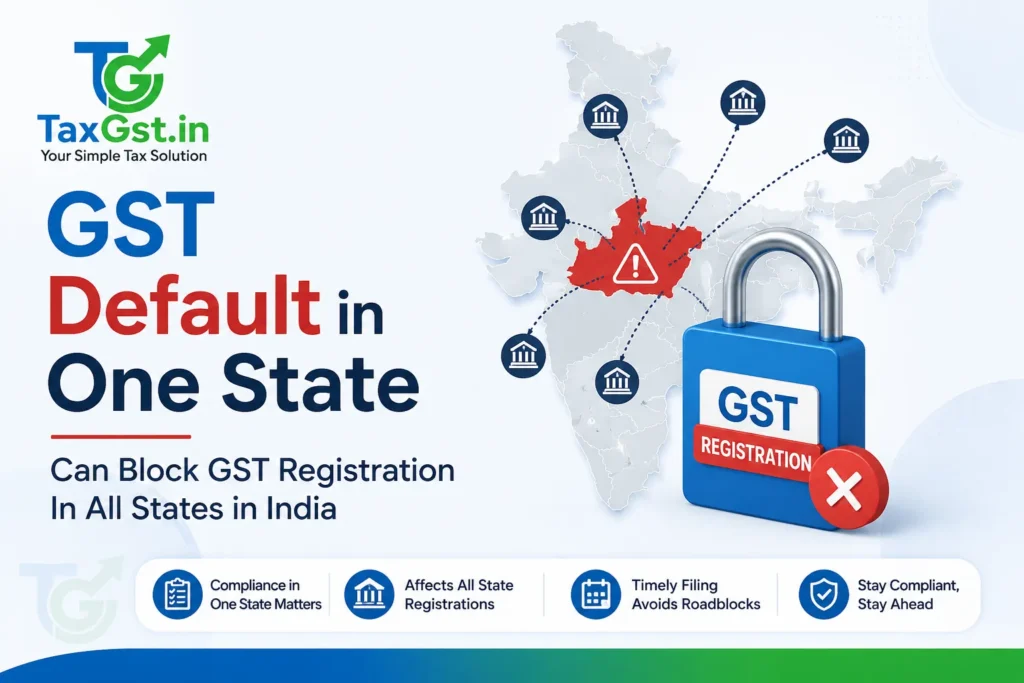
What are the Key Takeaways from the Recent Ruling on Cross-State GST Defaults?
- GST registration can be denied in any State if the taxpayer has outstanding defaults in another State.
- The Rajasthan High Court dismissed the writ petition, holding that a defaulter in one State cannot seek fresh registration in another without first complying with the law.
- Non-filing of returns under Section 39 of the CGST Act, 2017 amounts to a breach with pan-India consequences for registration purposes.
- The GSTN portal is integrated to flag such defaults across all States linked to the same PAN.
- Writ jurisdiction under Article 226 will not be exercised to facilitate circumvention of statutory compliance.
Can GST Registration Be Denied in One State for Defaults in Another State?
Yes, and the Rajasthan High Court has now confirmed this beyond doubt. In Leighton India Contractors Private Limited Vs Union of India (D.B. Civil Writ Petition No. 4042/2026), the Jaipur Bench dismissed the petitioner’s challenge against the denial of GST registration in Rajasthan, where the company had failed to file GST returns in Tamil Nadu. The petitioner, Leighton India Contractors Private Limited, having its registered office at Udaipur, Rajasthan, had argued that non-filing of returns in Tamil Nadu could not operate as a fetter on what it claimed was a statutory right to obtain registration in Rajasthan.
The petitioner’s counsel contended that each State is a separate taxable territory for GST purposes, and a default in one State cannot create an embargo in another. The Court rejected this contention outright. The Division Bench comprising Hon’ble Mr. Justice Sanjeev Prakash Sharma, Acting Chief Justice and Hon’ble Mrs. Justice Shubha Mehta, held that the CGST Act, 2017 operates parallel to the respective State GST Acts, and the statutory framework is designed to ensure uniform compliance across States. A taxpayer who fails to discharge statutory obligations in one State cannot circumvent the law by seeking fresh registration in another State.
What Legal Provisions Support Cross-State GST Registration Denial?
The Court’s reasoning rests on several interconnected provisions of the CGST Act, 2017 and the CGST Rules, 2017. Understanding these provisions is essential for every taxpayer and compliance professional.
Section 25 of the CGST Act, 2017 governs the procedure for registration.
Sub-section (1) requires every person liable to be registered to apply in every State or Union territory where they are liable, within thirty days of becoming liable.
Sub-section (2) provides that a person shall be granted a single registration in a State or Union territory, though separate registrations may be granted for multiple places of business within the same State.
Crucially, sub-section (4) states that a person obtaining more than one registration, whether in one State or multiple States, shall be treated as distinct persons for each registration. However, the Court emphasized that this distinct-person treatment does not mean compliance obligations are compartmentalized. The framework is both State-centric and Central-centric simultaneously.
Rule 8 of the CGST Rules, 2017 requires every applicant to declare their PAN, mobile number, email address, and State in Part A of FORM GST REG-01 on the common portal. This single PAN-based architecture means the GSTN system maintains a unified view of all registrations linked to one PAN.
The Court specifically noted that non-filing of returns amounts to a breach of Section 39 of the CGST Act, 2017 read with Rule 59 of the CGST Rules, 2017, and such breach has pan-India consequences for the purposes of registration.
Section 39 mandates that every registered person shall furnish a return for each tax period, and failure to do so triggers cancellation proceedings under Section 29. The doctrine of clean hands was also invoked. The Bench held that a registered person who fails to discharge statutory obligations in one State, leading to cancellation or abeyance of registration, cannot be permitted to seek fresh registration in another State. To hold otherwise would render the provisions of the Act otiose and encourage forum shopping.
How Does the GSTN Portal Flag Cross-State Defaults for Registration Applicants?
The GSTN common portal operates on a PAN-linked architecture, which means every registration application filed under FORM GST REG-01 is automatically checked against the compliance history of all existing GSTINs linked to that PAN. When an applicant applies for registration in a new State, the system verifies whether any GSTIN under the same PAN has outstanding return filing defaults, pending cancellation proceedings, or unpaid tax liabilities. This is not merely an administrative practice.
The legal basis flows from Section 25(4) of the CGST Act, 2017, which treats each registration as a distinct person, but the PAN-based integration ensures that the defaulter character follows the entity across States. Rule 8(1) of the CGST Rules, 2017 mandates that the applicant declare their PAN on the common portal, enabling this cross-referencing. The portal’s automated validation under Rule 9 then flags any non-compliance before the proper officer even examines the application on merits. The table below summarizes how different categories of GST registrants are affected by this cross-State default rule.
| Taxpayer Category | Impact of Default in Another State | Remedy Available | Key Legal Provision |
|---|---|---|---|
| New applicant with existing GSTIN in another State where returns are pending | Registration application in the new State can be denied until the default is cured | File all pending returns, pay tax and interest, then apply for revocation of cancellation under Section 30 of the CGST Act, 2017. | Section 25 read with Section 29, CGST Act, 2017 |
| Taxpayer whose GSTIN in another State has been cancelled for non-filing | Fresh registration in any other State will be blocked; the GSTN portal will flag the cancelled status | Apply for revocation of cancellation under Section 30 of the CGST Act, 2017 in the State where cancellation occurred, or file an appeal under Section 107. | Section 30 and Section 107, CGST Act, 2017 |
| Taxpayer with multiple active GSTINs filing returns regularly in all States | No impact; registration in additional States will proceed normally | Continue compliance; no action required | Rule 8, CGST Rules, 2017 |
| Taxpayer who has applied for cancellation of registration in one State but has pending liabilities | The application for cancellation itself may be denied under Rule 20(1) of the CGST Rules, 2017 if liabilities remain unpaid; this can also affect new registration elsewhere | Clear all arrears including tax, interest, and penalty under Section 29(5) of the CGST Act, 2017 before applying. | Rule 20 and Rule 22, CGST Rules, 2017 |
What Are the Practical Consequences for Businesses Operating in Multiple States?
Consider a practical example. A construction company, ABC Infra Private Limited, holds GSTINs in Maharashtra, Karnataka, and Tamil Nadu. During FY 2025-26, the company failed to file GSTR-3B returns for four consecutive tax periods in Tamil Nadu, accumulating an outstanding tax liability of ₹18,00,000 including interest. The Tamil Nadu GST authority issued a show cause notice in FORM GST REG-17 under Rule 22(1) of the CGST Rules, 2017, and subsequently cancelled the registration. Now, in FY 2026-27, ABC Infra applies for fresh GST registration in Gujarat for a new project. The GSTN portal flags the Tamil Nadu default during the validation stage.
The proper officer in Gujarat denies the application, citing the non-compliance in Tamil Nadu. The company’s argument that Gujarat is a separate taxable territory fails, as the Rajasthan High Court confirmed in Leighton India Contractors Private Limited Vs Union of India (D.B. Civil Writ Petition No. 4042/2026). The company must now file all four pending GSTR-3B returns in Tamil Nadu, pay the outstanding ₹18,00,000 along with applicable interest under Section 50 of the CGST Act, 2017, and then apply for revocation of cancellation under Section 30.
Only after the Tamil Nadu GSTIN is restored can the Gujarat registration proceed. This process could take 60 to 90 days, causing significant project delays. The Leighton India judgment is a stern reminder that the GST regime is a single, integrated tax structure despite its dual nature. The principle that he who seeks equity must do equity squarely applies. Taxpayers and professionals must ensure that all GSTINs are compliant, for a default under one will haunt all others.
What Is the Step-by-Step Process to Cure a Cross-State GST Default Before Applying for Fresh Registration?
The Leighton India Contractors Private Limited Vs Union of India judgment makes one thing abundantly clear: there is no shortcut. A taxpayer with outstanding defaults in one State must first purge that default before seeking registration in any other State. The process is governed by specific provisions of the CGST Act, 2017 and the CGST Rules, 2017, and skipping any step will result in continued blockage on the GSTN portal.
The first step is to identify the exact status of the defaulting GSTIN.
Log in to the GST common portal at www.gst.gov.in and navigate to the ‘Services’ tab, then ‘Registration,‘ and select ‘Track Application Status.’ If the GSTIN has been cancelled, the portal will display the cancellation order reference number and the effective date of cancellation. If the registration is merely suspended or in abeyance due to non-filing, the portal will show pending return periods under the ‘Returns’ dashboard. The second step is to file all pending returns.
Under Section 39 of the CGST Act, 2017, every registered person must furnish a return for each tax period. Rule 59 of the CGST Rules, 2017 prescribes the form and manner of filing. For each pending GSTR-3B, the taxpayer must self-assess the tax liability, pay the tax along with interest under Section 50 of the CGST Act, 2017, and file the return. Late fees under Section 47 of the CGST Act, 2017 will also apply.
There is no provision to skip filing old returns and start fresh. The third step is to apply for revocation of cancellation under Section 30 of the CGST Act, 2017, if the registration has already been cancelled. This application must be filed in FORM GST REG-21 on the common portal within thirty days from the date of the cancellation order, though the Commissioner may extend this period for sufficient cause.
The proper officer will verify compliance and, if satisfied, pass an order in FORM GST REG-22 revoking the cancellation. Only after the default is fully cured, all returns are filed, all taxes and interest are paid, and the GSTIN status is restored to ‘Active’ should the taxpayer apply for fresh registration in the new State through FORM GST REG-01 under Rule 8 of the CGST Rules, 2017.
What Documents and Compliance Records Should You Prepare Before Applying for GST Registration in a New State?
Given the Rajasthan High Court’s ruling and the GSTN portal’s PAN-linked verification, preparation is critical. The proper officer examining a registration application under Rule 9 of the CGST Rules, 2017 will not only check the documents submitted in FORM GST REG-01 but will also verify the compliance history of all existing GSTINs under the same PAN. The following documents and records should be organized before filing the application.
First, a compliance certificate or self-declaration confirming that all GSTINs linked to the PAN are filing returns regularly. This is not a statutory form, but maintaining an internal compliance tracker helps respond quickly if the department raises queries.
Second, copies of the latest filed GSTR-3B and GSTR-1 for every active GSTIN, demonstrating that the taxpayer is current on filings.
Third, proof of tax payment for all pending periods in the defaulting State, including challan copies showing payment under Section 50 of the CGST Act, 2017 for both tax and interest.
Fourth, if the earlier GSTIN was cancelled, a copy of the revocation order in FORM GST REG-22 restoring the registration to active status.
Additionally, the standard registration documents remain mandatory under Rule 8 of the CGST Rules, 2017. These include proof of principal place of business such as a rent agreement or property tax receipt, the PAN card of the business entity, Aadhaar and photographs of the authorized signatory, and the constitutional document such as the Certificate of Incorporation for a company or Partnership Deed for a firm.
The table below provides a practical checklist of documents and compliance actions to complete before submitting a fresh registration application.
| Document / Compliance Action | Purpose | Legal Reference | Status Before Filing |
|---|---|---|---|
| Filed GSTR-3B for all pending periods in defaulting State | Cures the default that triggered the block | Section 39, CGST Act, 2017 | Must be completed |
| Tax and interest payment challans for defaulting periods | Proof of discharge of tax liability and interest | Section 50, CGST Act, 2017 | Must be completed |
The table below outlines a practical compliance framework for businesses operating across multiple States, keeping in mind the Leighton India ruling and the GST 2.0 environment.
| Compliance Area | Recommended Action | Frequency | Consequence of Non-Compliance |
|---|---|---|---|
| Return filing across all GSTINs | File GSTR-1 and GSTR-3B for every active GSTIN in every State without exception, even if there is no turnover in a particular State | Monthly, by the due date under Section 39 of the CGST Act, 2017 | Default in one State blocks new registration in any other State; cancellation proceedings under Section 29 initiated |
| Vendor compliance monitoring | Verify filing status, registration validity, and e-invoice applicability of all vendors linked to ITC claims | Monthly, before claiming ITC under Section 16 of the CGST Act, 2017 | ITC reversal under Section 17(5) read with Rule 36(4) of the CGST Rules, 2017 if vendor defaults |
| ITC reconciliation | Reconcile GSTR-2B with purchase register and books of account for every GSTIN | Monthly, before filing GSTR-3B | Excess ITC claimed attracts demand and interest under Section 73 or Section 74 of the CGST Act, 2017 |
| Registration status monitoring | Track active, suspended, and cancelled status of every GSTIN linked to the PAN | Weekly, through the GSTN portal | Undetected cancellation in one State can cascade into blocking of registration in another State |
| Centralized notice response | Maintain a centralized tracker for all GST notices, show cause notices, and assessment orders across States | As received, with response within the time specified in the notice | Non-response to FORM GST REG-17 leads to cancellation; non-response to DRC-01 leads to ex parte assessment |
What Is the Interplay Between Section 29 Cancellation and Section 30 Revocation in a Multi-State Context?
A critical edge case arises when a taxpayer has GSTINs in three States, one of which has been cancelled for non-filing, while the other two remain active and compliant. The question is whether the cancellation in one State automatically triggers cancellation proceedings in the other two States. The answer, based on the legal framework and the Leighton India judgment, is nuanced. Section 29(1) of the CGST Act, 2017 empowers the proper officer to cancel registration when the person has not furnished returns for a continuous period as prescribed.
Under Rule 21A of the CGST Rules, 2017, where a registered person has applied for cancellation or where the proper officer believes cancellation is warranted, the registration can be suspended pending proceedings. However, Section 25(4) treats each registration as a distinct person, meaning cancellation in one State does not automatically cancel registrations in other States. That said, the Leighton India principle means that the cancelled status in one State will be visible on the GSTN portal to officers in all other States.
If the taxpayer applies for any new registration or even for amendment of existing registrations, the proper officer in the other States may issue inquiries about the cancellation. The taxpayer must proactively resolve the cancellation under Section 30 of the CGST Act, 2017 in the defaulting State before any inter-State compliance issues can be fully resolved.
Which Sectors Face the Highest Risk Under This Cross-State Default Framework?
Certain sectors are disproportionately affected by the Leighton India ruling due to their inherent multi-State operations. Construction companies executing projects in multiple States, as was the case in Leighton India itself, face the highest risk because project sites are temporary and compliance oversight is often decentralized. E-commerce sellers using fulfillment centers or warehouses across States, logistics and transport companies operating inter-State, and service providers with branches in multiple cities all face similar exposure.
For these sectors, the key risk is not deliberate non-compliance but administrative failure. A project site in a remote location may not have dedicated accounting staff, and returns may go unfiled without the head office’s knowledge. The GSTN portal’s automated flagging under the GST 2.0 framework means such lapses are detected quickly, and the consequences now extend beyond the defaulting State to block registrations in all other States. The practical takeaway is clear.
Every business with multi-State GST registrations must treat compliance in each GSTIN as equally critical. A default in Tamil Nadu will block registration in Rajasthan. A cancellation in Karnataka will raise flags in Maharashtra. The GST architecture is integrated, the law demands uniform compliance, and the courts will not permit forum shopping. The only sustainable approach is to build a compliance system that treats every GSTIN as a non-negotiable obligation, filed on time, every month, without exception.
What Should You Do Next?
The Leighton India judgment makes it clear that GST compliance is no longer a State-isolated exercise. Here is what every taxpayer and professional should act on immediately.
- Audit all existing GSTINs under your PAN: Log in to the common portal at gst.gov.in and verify the filing status of every GSTIN linked to your PAN across all States. Identify any GSTR-3B or GSTR-1 returns pending for more than two tax periods.
- File all pending returns before applying for new registration: If you are planning to obtain GST registration in a new State, ensure all returns are current in every other State. Even one non-filing GSTIN can block the new application.
- Clear unpaid tax, interest, and penalty dues: Outstanding liabilities under any GSTIN will be visible on the portal. Pay all dues and download the challan reconciliation before submitting FORM GST REG-01 for a new State.
- Apply for revocation of cancellation where applicable: If any GSTIN has been cancelled under Section 29 of the CGST Act, 2017, file an application for revocation under Section 30 read with Rule 23 of the CGST Rules, 2017 in that State before seeking registration elsewhere.
- Set up a monthly multi-State compliance calendar: Assign a dedicated compliance officer or use an ERP-based tracker to monitor return filing deadlines for every GSTIN. The due date for GSTR-3B is the 20th of the following month, and missing it triggers automatic default flags on the GSTN portal.
- Review vendor and client GSTIN compliance: Under the GST 2.0 compliance framework for FY 2026-27, vendor compliance monitoring is critical. A non-compliant vendor can disrupt your Input Tax Claim chain and invite scrutiny across all your active registrations.
- Consult a GST practitioner if you have more than three active GSTINs: Multi-State compliance requires professional oversight. A qualified practitioner can conduct a quarterly reconciliation under Rule 36(4) of the CGST Rules, 2017 and ensure that cross-State default risks are flagged early.
Common Pitfalls to Avoid
Based on our experience, here are the mistakes taxpayers often make:
- The “Closed Branch” Oversight – Businesses often stop filing returns for a branch they intend to close before the formal cancellation order is passed. This “lame duck” period of non-filing creates a default record that can block urgent registrations for new projects in other states.
- Missing the deadline – Always file or respond before the due date. Late submissions often have limited recourse.
- Incomplete documentation – Ensure you have all required documents ready before filing or responding to notices.
Frequently Asked Questions
Can I apply for GST registration in a new State if my GSTIN in another State is already cancelled for non-filing?
No. The GSTN portal will flag the cancelled status linked to your PAN, and the proper officer in the new State will deny the application. You must first apply for revocation of cancellation under Section 30 of the CGST Act, 2017 in the State where the cancellation occurred, or file an appeal under Section 107, and obtain an order restoring the registration before applying in any other State.
Does the Leighton India judgment apply only to companies or also to proprietorships and LLPs?
The judgment applies to all registered persons irrespective of their constitution. The Court’s reasoning is based on the PAN-linked architecture of the GSTN portal. Whether you are a proprietorship, partnership firm, LLP, or company, if your PAN has a defaulting GSTIN in any State, the system will flag it when you apply for registration in another State. The legal principle is entity-agnostic.
What happens if I file all pending returns after my registration application is denied in another State?
Filing pending returns after denial does not automatically entitle you to fresh registration. You must first cure the default completely, including payment of tax, interest under Section 50 of the CGST Act, 2017, and any late fee. Then you may either reapply for registration under Rule 8 of the CGST Rules, 2017 or seek revocation of the cancellation order under Section 30, depending on whether the original GSTIN was cancelled or merely suspended.
Can a writ petition under Article 226 override the cross-State default block on GST registration?
The Rajasthan High Court in Leighton India Contractors Private Limited Vs Union of India (D.B. Civil Writ Petition No. 4042/2026) categorically held that writ jurisdiction will not be exercised to facilitate circumvention of statutory compliance. The Bench observed that the petitioner must first purge the default and that the doctrine of clean hands applies. High Courts are loath to intervene in such matters, and taxpayers should treat this as a settled legal position for FY 2026-27.
What Should You Do If Your GST Registration Is Denied Due to a Default in Another State?
If your application for GST registration in a new State has been denied because of non-compliance in another State, the first step is to stop treating this as a fresh-start opportunity. The proper remedy is to go back to the State where the default occurred and cure it. File all pending GSTR-3B and GSTR-1 returns, pay the tax due along with applicable interest under Section 50 of the CGST Act, 2017, and clear any late fees. Once the default is cured, you may apply for revocation of cancellation under Section 30 of the CGST Act, 2017 in that State, or file an appeal under Section 107 if the cancellation order has already been passed. Only after the GSTIN in the defaulting State is fully compliant should you reapply for registration in the new State.
How Does This Judgment Affect Professionals Advising Multi-State Clients?
For chartered accountants, tax advocates, and GST practitioners, this judgment demands a fundamental shift in advisory approach. Before filing any new GST registration application for a client, practitioners must now verify the compliance status of every existing GSTIN linked to the client’s PAN across all States. This means checking return filing history, cancellation status, and outstanding demands for each GSTIN before preparing FORM GST REG-01. A failure to conduct this due diligence can result in the application being summarily denied, wasting the client’s time and damaging the practitioner’s credibility with the department. The judgment also reinforces the importance of centralized compliance monitoring for multi-state businesses. Firms should maintain a compliance calendar that tracks return filing deadlines for every GSTIN, not just the ones in the head office’s State. The cost of non-compliance in one State now extends far beyond that State’s borders.
Can You Challenge a Cross-State Registration Denial in Court?
The Rajasthan High Court’s ruling makes it clear that writ jurisdiction under Article 226 of the Constitution will not be exercised to facilitate circumvention of statutory compliance. The Court in Leighton India Contractors Private Limited dismissed the writ petition in limine, meaning it was rejected at the admission stage itself without even issuing notice to the department. This sends a strong signal to other High Courts that taxpayers who approach the court with unclean hands, seeking to bypass compliance obligations in one State by registering in another, are unlikely to receive judicial sympathy. The practical implication is that litigation is not a viable remedy for cross-state registration denial. The proper course is administrative compliance, not legal challenge. Taxpayers should invest their resources in filing pending returns and clearing dues rather than filing writ petitions.
Article Information
Published: June 10, 2026
Last Reviewed: June 10, 2026
Category: GST
Regulatory Body: CBIC (Central Board of Indirect Taxes and Customs)
Written by C.K. Gupta, M.Com & Tax Editor at TaxGST.in — helping businesses navigate GST compliance, ITC reconciliation, and return filing across Delhi NCR since 2009.
Official Resources
- GST Portal (e-Filing)
- CBIC Portal (Circulars)
- Income Tax Portal
- GST Council Updates
- E-Way Bill Portal
- E-Invoice Portal
Disclaimer: This article is for informational purposes only. For legal advice, consult a qualified tax professional. Always refer to the original notification for authoritative information.
Discover more from TaxGst.in
Subscribe to get the latest posts sent to your email.





Stay Updated!
Join our community for latest tax updates, GST news & finance tips