
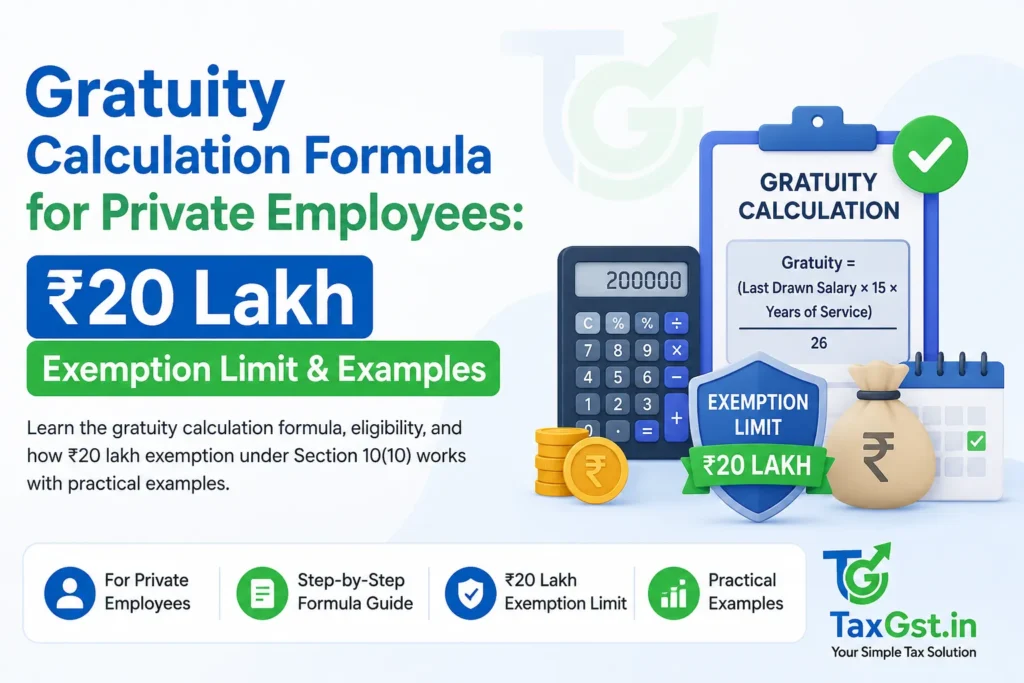
You’ve worked hard for years at your private company, and now you’re wondering—how much gratuity will I actually get? And more importantly, how much of it will be tax-free? As of April 2026, the good news is that the gratuity exemption limit has been raised to ₹20 lakh under the Payment of Gratuity Act, 1972, as amended by the latest Finance Act. This means if you’re a private-sector employee who has completed at least five years of continuous service, you can now receive up to ₹20 lakh as gratuity without paying a single rupee in income tax—provided your employer is covered under the Act. Anything above this threshold is taxable in your hands under “Salaries” in your Form 130 (the new Form 16) unless you qualify for other exemptions.
Also Check – Calculators & Tools
Quick Summary
- Exemption limit raised to ₹20 lakh for private employees covered under the Payment of Gratuity Act, effective April 1, 2026
- Eligibility requires 5+ years of continuous service with the same employer
- Gratuity is calculated as (15/26) × last drawn salary × number of completed years of service
- Tax treatment depends on employer coverage: exempt up to ₹20 lakh if covered under the Act; otherwise, different rules apply
Understanding the Gratuity Calculation Formula for Tax Year 2026-27
The core formula used to calculate gratuity for private employees remains unchanged, but the tax implications have evolved significantly with the ₹20 lakh exemption cap. The statutory formula under Section 4(2) of the Payment of Gratuity Act, 1972 is:
Gratuity = (15/26) × Last Drawn Salary × Number of Completed Years of Service
Here, “Last Drawn Salary” includes basic salary plus dearness allowance (if it forms part of retirement benefits). It excludes bonuses, commissions, HRA, overtime, and other allowances unless specifically included in the employment contract as part of retirement benefits. The factor “15/26” comes from 15 days’ wages based on a 26-day working month—a standard assumption in Indian labor law.
For example, if your last drawn basic + DA is ₹1,00,000 per month and you’ve completed 20 years of service, your gratuity would be: (15/26) × ₹1,00,000 × 20 = ₹11,53,846. Since this is below ₹20 lakh, the entire amount is tax-free if your employer is covered under the Act.
Who Is Eligible for Gratuity?
Not every private employee automatically qualifies. To be eligible:
- You must have completed at least five consecutive years of service with the same employer (this includes temporary, contractual, or probationary periods if they’re continuous)
- Your employer must be covered under the Payment of Gratuity Act, 1972—which applies to establishments with 10 or more employees
- Gratuity becomes payable upon superannuation, resignation, retirement, death, or disablement
If your company has fewer than 10 employees, it may still choose to pay gratuity voluntarily—but in such cases, the ₹20 lakh exemption does not automatically apply. Instead, the exemption is the least of three amounts: actual gratuity received, ₹20 lakh, or half a month’s average salary for each completed year of service (capped at 20 years). This distinction is critical and often misunderstood.
Calculate Your Exact Gratuity Instantly!
Don’t get tangled in manual math. Use our free, updated 2026 Gratuity Calculator to estimate your precise payout and verify your tax-free eligibility in under 30 seconds.
Tax Treatment: Old vs New Rules (Effective April 1, 2026)
This doubling of the exemption limit brings much-needed relief to senior executives and long-serving employees in the private sector. Previously, anyone earning over ₹80,000/month and serving 15+ years would easily breach the ₹10 lakh cap. Now, that threshold is more realistic.
Worked Example: Gratuity Calculation with ₹20 Lakh Exemption
Let’s say Rahul, a senior manager at a Mumbai-based IT firm (covered under the Gratuity Act), resigns after 22 years of service. His last drawn basic salary is ₹1,50,000, and DA is ₹30,000 (forming part of retirement benefits). His total last drawn salary = ₹1,80,000.
Step 1: Calculate gratuity using the formula: (15/26) × ₹1,80,000 × 22 = ₹22,84,615
Step 2: Determine tax exemption: Since his employer is covered under the Act, he gets full exemption up to ₹20 lakh. Taxable gratuity = ₹22,84,615 – ₹20,00,000 = ₹2,84,615
Step 3: This ₹2,84,615 will be added to his total income for Tax Year 2026-27 and taxed as per his slab rate. His employer must report this in Form 130, Part B, with the exempt portion noted in Annexure-II.
How to Check Your EPF Balance Online (And Why It Matters for Gratuity)
While gratuity and EPF are separate benefits, many employees confuse the two. However, knowing your EPF balance helps you plan your overall retirement corpus—and ensures your UAN is active, which is essential if you later need to verify employment history for gratuity claims.
To check your EPF balance online:
- Visit the official EPFO portal: https://unifiedportal-mem.epfindia.gov.in/memberinterface/
- Log in using your UAN and password
- Click on ‘View’ → ‘Passbook’ → Select your EPF account
- Your current balance, including interest credited for FY 2024-25 (at 8.25%), will be displayed
If you don’t have a UAN or it’s inactive, you must activate it immediately—especially if you’re nearing retirement. An active UAN also helps in seamless PF transfers when changing jobs, reducing the risk of gratuity disputes due to fragmented service records.
How to Withdraw PF Amount Online Step by Step
Though unrelated to gratuity directly, many employees seek PF withdrawal during resignation—often alongside gratuity. Here’s the correct process as of May 2026:
- Log in to the UAN Member Portal
- Go to ‘Online Services’ → ‘Claim (Form-31, 19 & 10C)’
- Verify your bank details and Aadhaar linkage (mandatory for e-sign)
- Select ‘PF Advance (Form 31)’ for partial withdrawal or ‘Final Claim (Form 19)’ for full withdrawal
- Choose the purpose (e.g., ‘Resignation after 5 years’, ‘Medical treatment’)
- Upload scanned documents if required (e.g., resignation letter, medical bills)
- Submit and track status under ‘Track Claim Status’
Claims are typically processed within 15–21 days. Delays often occur due to mismatched bank details or incomplete KYC. Always ensure your PAN and Aadhaar are linked to your UAN.
What Is UAN and How to Activate It?
The Universal Account Number (UAN) is a 12-digit unique ID assigned to every EPF member. Launched in 2014, it remains constant throughout your career, even if you change jobs. It consolidates all your PF accounts into one umbrella.
To activate your UAN:
- Visit EPFO UAN Portal
- Click ‘Activate UAN’ under the login box
- Enter your UAN (found on your Form 130 or payslip), Aadhaar, mobile number, and name
- Verify via OTP sent to your registered mobile
- Set a password and complete activation
Once activated, you can view passbooks, update KYC, file claims, and even nominate family members—all online.
How to Transfer PF from One Employer to Another
When switching jobs, never let your PF lie dormant. Unclaimed PF doesn’t affect gratuity directly, but fragmented service history can complicate gratuity calculations if your employer disputes continuity.
To transfer PF online:
- Log in to your UAN portal
- Go to ‘One Member – One EPF Account (Transfer Request)’
- Fill in previous and current employer details
- Verify both employer signatures digitally (they’ll receive auto-notifications)
- Submit and track progress
The transfer is usually completed within 2–3 weeks. Ensure both employers have registered your UAN correctly to avoid rejections.
How to Update KYC in EPFO Portal
Accurate KYC is non-negotiable for gratuity and PF processing. As of 2026, EPFO mandates Aadhaar-based e-KYC for all transactions.
To update KYC:
- Log in to UAN portal → ‘Manage’ → ‘KYC’
- Select document type (PAN, Aadhaar, Bank Account)
- Upload scanned copy and enter details
- Click ‘Save’—no physical verification needed if Aadhaar is linked
Incorrect KYC is the #1 reason for claim rejections. Double-check name spelling, account number, and IFSC code.
What Is the EPFO Pension Scheme and How Does It Work?
The Employees’ Pension Scheme (EPS), managed by EPFO, provides monthly pension post-retirement. However, EPS is entirely separate from gratuity. Key points:
- Contribution: 8.33% of employer’s 12% EPF contribution goes to EPS (capped at ₹15,000 salary, i.e., max ₹1,250/month)
- Pension eligibility: Minimum 10 years of service
- Gratuity does not reduce or affect EPS pension
Many employees mistakenly believe gratuity offsets pension—it doesn’t. Both can be received simultaneously.
Common Pitfalls to Avoid
- Assuming all private companies are covered under the Gratuity Act: Only establishments with 10+ employees are mandatorily covered. Smaller firms may opt-in, but often don’t—leading to lower exemptions.
- Counting incomplete years as full years: Only completed years count. 4 years 11 months = 4 years for gratuity calculation.
- Ignoring DA inclusion: If your employment letter states DA is part of retirement benefits, include it in “last drawn salary.” Otherwise, exclude it—this can change your gratuity by lakhs.
- Failing to claim gratuity within 3 years: While there’s no strict statute of limitations, delays weaken your case. File a written claim immediately upon exit.
- Not verifying Form 130 reporting: Ensure your employer reports gratuity correctly in Part B and discloses the exempt portion. Errors here can trigger tax notices.
Next Steps Checklist
- ✅ Confirm your employer’s coverage under the Payment of Gratuity Act, 1972
- ✅ Calculate your estimated gratuity using (15/26) × last salary × years of service
- ✅ Activate and update your UAN and KYC on the EPFO portal
- ✅ Request a gratuity calculation letter from HR upon resignation
- ✅ Verify gratuity reporting in your Form 130 for Tax Year 2026-27
- ✅ Consult a tax advisor if your gratuity exceeds ₹20 lakh to optimize tax liability
Related Articles:
Frequently Asked Questions
What is the gratuity exemption limit for private employees in 2026?
As of April 1, 2026, the gratuity exemption limit for private employees covered under the Payment of Gratuity Act, 1972, is ₹20 lakh. This means any gratuity amount up to ₹20 lakh is fully tax-free. Amounts exceeding this limit are taxable under the head ‘Salaries’ in your income tax return for Tax Year 2026-27.
How is gratuity calculated for private sector employees?
Gratuity is calculated using the formula: (15/26) × Last Drawn Salary × Number of Completed Years of Service. ‘Last Drawn Salary’ includes basic pay and dearness allowance (if part of retirement benefits). Only completed years count—partial years are ignored. For example, 15 years and 6 months counts as 15 years.
Is gratuity taxable if my company is not covered under the Gratuity Act?
Yes, but the exemption rules differ. If your employer is not covered under the Act, the exempt amount is the least of: (i) actual gratuity received, (ii) ₹20 lakh, or (iii) half a month’s average salary for each completed year (capped at 20 years). Any excess is taxable.
Can I receive both EPF and gratuity?
Absolutely. EPF (Employees’ Provident Fund) and gratuity are separate retirement benefits. You are entitled to both if eligible. EPF is a savings-cum-investment scheme, while gratuity is a statutory end-of-service benefit. One does not reduce the other.
Do I need to file anything to claim gratuity exemption?
No separate filing is required. Your employer must report gratuity in your Form 130 (Part B) and disclose the exempt portion in Annexure-II. When filing your ITR, report the taxable portion under ‘Salaries’ and claim exemption up to ₹20 lakh in the relevant schedule.
What happens if I resign before completing 5 years?
You are not eligible for gratuity if you resign before completing 5 years of continuous service, unless you leave due to death or disablement. In case of death, your nominee receives the gratuity even if service is less than 5 years.
Can I negotiate a higher gratuity amount with my employer?
The Payment of Gratuity Act sets the minimum entitlement. Employers can choose to pay more as part of company policy, but any excess over the statutory formula is still subject to the ₹20 lakh tax exemption cap. Voluntary gratuity above ₹20 lakh remains taxable.
Your next action: Log in to your EPFO UAN portal today, verify your service history, and confirm with HR whether your employer is registered under the Payment of Gratuity Act. If you’re within 2 years of retirement, request a provisional gratuity calculation—don’t wait until your last day.
Disclaimer: This guide is based on provisions effective April 1, 2026, under the Income-tax Act, 2025, and the Payment of Gratuity Act, 1972. Tax laws are subject to change. Consult a qualified tax practitioner for personalized advice. Last updated: May 19, 2026.
Article Information
Published: May 19, 2026
Category: EPFO
Official Resources
Disclaimer: This article is for informational purposes only. EPF rules and interest rates may change. Always verify current details on the EPFO portal. For account-specific queries, contact your employer or the EPFO helpdesk.
Discover more from TaxGst.in
Subscribe to get the latest posts sent to your email.




Stay Updated!
Join our community for latest tax updates, GST news & finance tips