
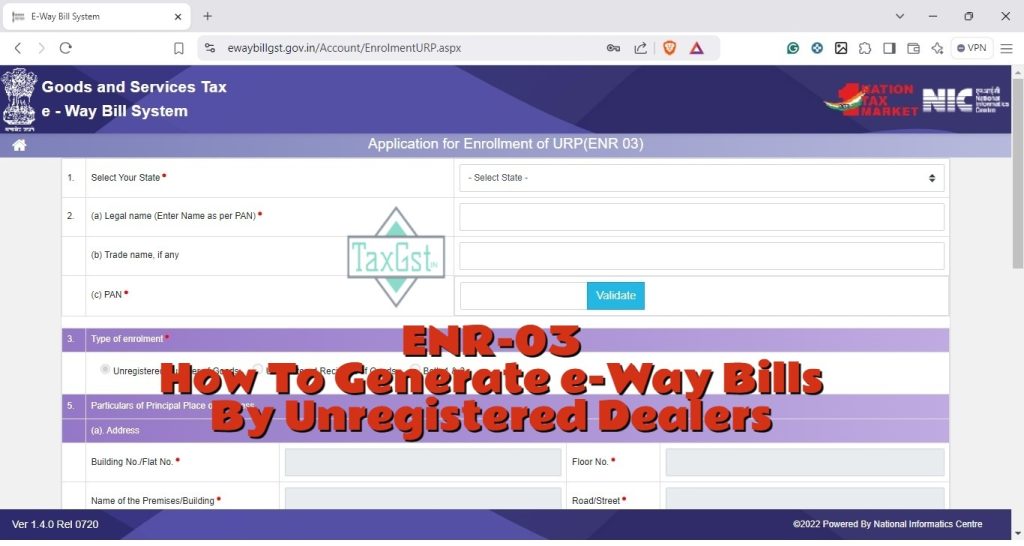
The Central Board of Indirect Taxes and Customs (CBIC) has revolutionized GST compliance for unregistered dealers with the introduction of Form ENR-03, effective from February 11, 2025. This landmark update enables unregistered businesses and individuals to generate e-Way Bills seamlessly, bridging a critical gap in India’s GST framework. Designed under Notification No. 12/2024, Form ENR-03 empowers unregistered persons (URPs) to obtain a unique 15-character Enrolment ID, acting as a substitute for GSTIN during e-Way Bill generation.
Also Read-How to Do Udyam MSME Registration Online: MSME Certificate Download Guide
This initiative addresses long-standing challenges faced by small traders, exempt suppliers, and casual dealers who previously relied on intermediaries for compliance. By simplifying logistics and enhancing transparency, ENR-03 fosters inclusivity in India’s tax ecosystem while curbing tax evasion.
Who Needs ENR-03?
The e-Way Bill system mandates digital documentation for goods movement over INR 50,000. Historically, unregistered dealers faced barriers due to the lack of a GSTIN. ENR-03 resolves this by allowing enrollment for e-Way Bill generation, ensuring adherence to GST norms without bureaucratic hurdles.
- Unregistered suppliers of exempt goods (e.g., agricultural products).
- Small businesses below the GST registration threshold (₹20 lakh/₹40 lakh).
- Government entities and PSUs involved in interstate/intrastate goods movement.
- Casual traders and transporters managing high-value consignments (above ₹50,000).
How Unregistered Dealers Can Generate e-Way Bills.
The process for an unregistered dealer to generate an e-Way Bill involves enrolling on the GST portal. Here’s a step-by-step breakdown:
- Enrollment: The unregistered person needs to enroll on the e-Way Bill portal. During enrollment, they will need to provide basic details such as their name, address, and identity proof.
- Verification: After submitting the enrollment form, the details are verified. Upon successful verification, a unique enrollment number is generated for the unregistered dealer.
- e-Way Bill Generation: Using this enrollment number, the unregistered dealer can then log in to the e-Way Bill portal and generate e-Way Bills by providing the necessary details of the consignment, including:
- Supplier and recipient details
- Invoice or document number
- Value of goods
- HSN code
- Transport details (vehicle number, transporter ID, etc.)
- Following the Rules: Ensure all details are accurate and comply with the GST rules to avoid penalties.
Step-by-Step Enrollment Process for ENR-03(E-Way Bill Generation for Unregistered Dealers).
Step 1. Goto the E-Way Bill Portal: Youw will find Form ENR-03 under the “Registration” tab in the main menu.
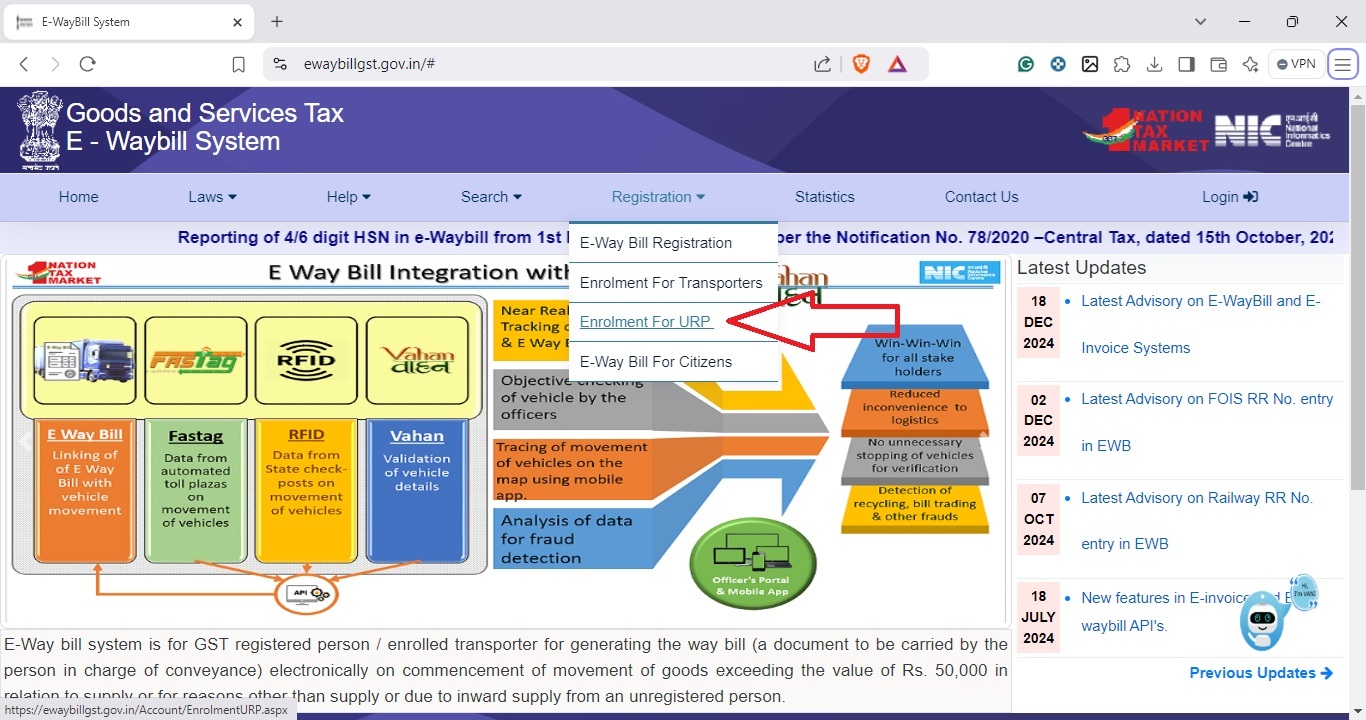
Step-2. Enter PAN and State Details: Provide PAN for verification and select your operational state.
Step-3. OTP Authentication: Validate mobile number via OTP for security.
Step-4. Create Login Credentials: Generate a unique username and password.
Step-5. Obtain Enrolment ID: A 15-digit ID is auto-generated post-submission.
Generating e-Way Bills with Enrolment ID.
Once enrolled, URPs can:
- Log in to the EWB portal.
- Click Generate New to auto-populate the Enrolment ID as Supplier/Recipient.
- Enter consignment details (invoice number, HSN code, vehicle details).
ENR-03 at a Glance: Quick Reference Table.
| Aspect | Details |
|---|---|
| Effective Date | February 11, 2025 |
| Governing Notification | Notification No. 12/2024 (CGST Rules Amendment) |
| Eligibility | Unregistered dealers, small businesses, government bodies, exempt suppliers |
| Key Features | – 15-digit Enrolment ID replaces GSTIN – PAN and mobile verification – OTP authentication |
| Penalties Avoided | Fines up to ₹10,000, goods confiscation, supply chain delays |
Why Unregistered Dealers Need e-Way Bills.
Generally, the responsibility of generating an e-Way Bill falls upon the registered consignor or consignee when the value of the consignment exceeds INR 50,000. However, situations arise where an unregistered dealer needs to move goods, necessitating them to generate an e-Way Bill. This could occur when:
- Supplying goods to a registered person: An unregistered supplier sending goods to a registered buyer needs to generate an e-Way Bill.
- Receiving goods from a registered person: Similarly, if a registered seller is sending goods to an unregistered buyer, the buyer can opt to generate the e-Way Bill.
- Inter-state movement of goods: Regardless of the value, certain goods moved across state lines may require an e-Way Bill, even if the dealer is unregistered.
Benefits of ENR-03 for Unregistered Dealers.
- Legal Compliance: Enables compliance with GST regulations, avoiding potential penalties and legal issues.
- Seamless Transactions: Facilitates smooth movement of goods, especially when dealing with registered entities.
- Business Opportunities: Opens doors to business opportunities with registered dealers who require e-Way Bills for their purchases.
ENR-03 and its Implications.
| Aspect | Details | Relevance to Unregistered Dealers | Career/Professional Information |
|---|---|---|---|
| Definition | Process for unregistered dealers to enroll on the e-Way Bill portal and generate e-Way Bills. | Allows unregistered dealers to legally transport goods, especially when supplying to or receiving from registered persons. | GST Practitioners need to understand this process to assist unregistered clients. Accountants should know it to advise businesses engaging with unregistered dealers. |
| Enrollment Process | Requires providing basic details like name, address, and ID proof on the e-Way Bill portal. Verification leads to the generation of a unique enrollment number. | Ensures unregistered dealers have a recognized identity within the GST system for e-Way Bill generation. | Learning about enrollment procedures enhances the skills of those in tax-related roles. It can be applied to client service and consultancy. |
| e-Way Bill Generation | Involves logging in with the enrollment number and providing consignment details (supplier/recipient, invoice number, value, HSN code, transport details). | Enables the actual generation of the e-Way Bill, making the movement of goods compliant with GST rules. | Professionals involved in logistics and supply chain management can benefit from understanding the data needed and the generation process for efficient operations. |
| Compliance | Accuracy of details is crucial to avoid penalties. Must adhere to GST rules regarding e-Way Bills. | Reduces the risk of fines and legal issues, ensuring smooth business operations. | Legal professionals and compliance officers need expertise to ensure businesses adhere to regulations and avoid penalties. |
| Business Impact | Facilitates transactions with registered entities and opens up new business opportunities. | Expands the potential market for unregistered dealers by allowing them to engage with GST-registered businesses. | Business consultants can advise unregistered dealers on how to leverage e-Way Bill generation to grow their businesses and improve their market reach. |
Latest Studies and Trends.
Recent studies indicate an increasing awareness among unregistered dealers regarding the ENR-03 process. However, challenges remain in terms of:
- Lack of awareness: Many unregistered dealers are still unaware of the procedure.
- Technical difficulties: Some face difficulties navigating the online portal.
- Compliance burden: The perceived complexity of GST compliance can deter some from enrolling.
The government and GST authorities are conducting awareness campaigns and simplifying the process to encourage greater participation. The trend is towards greater integration of the e-Way Bill system with other government portals to streamline compliance.
Transformative Benefits of ENR-03.
- Compliance Without GST Registration: URPs avoid penalties while adhering to e-Way Bill mandates.
- Streamlined Logistics: Direct portal access reduces dependency on transporters for bill generation.
- Enhanced Tracking: Enrolment IDs improve traceability, aiding tax authorities in curbing fraud.
- Cost Efficiency: Eliminates the need for provisional GST registrations for small-scale operations.
- Interstate Flexibility: Facilitates smooth movement of goods across state borders.
Expert Insights: Why ENR-03 is a Milestone.
According to CA Rohit R. Sonar, a prominent GST consultant, “ENR-03 grants autonomy to unregistered dealers, fostering accountability and reducing logistical bottlenecks.” The feature also aligns with the government’s vision of formalizing India’s economy by integrating informal sectors into the digital tax net.
Addressing Common Concerns: FAQs.
- Q: Is ENR-03 mandatory for all unregistered dealers?
- A: No, it’s only required when they need to generate e-Way Bills, such as when supplying to registered persons or in specific cases of inter-state movement.
- Q: What documents are required for enrollment?
- A: Generally, basic identification and address proof are required. Check the e-Way Bill portal for the latest requirements.
- Q: Can an unregistered dealer authorize someone else to generate e-Way Bills on their behalf?
- A: The specifics may vary, and it’s best to consult the GST helpdesk or a tax professional for guidance.
- Q: What if an unregistered dealer makes a mistake on the e-Way Bill?
- A: The e-Way Bill can be canceled within a specific timeframe. It’s crucial to correct the error and generate a new e-Way Bill.
Conclusion: Embracing a New Era of GST Compliance.
Form ENR-03 marks a paradigm shift in India’s GST landscape, democratizing access to compliance tools for unregistered dealers. By simplifying enrollment and bill generation, it empowers small businesses, promotes transparency, and strengthens the supply chain. Stakeholders are advised to leverage this facility to avoid disruptions and align with the evolving tax regime.
Disclaimer:
The information provided in this article is for general informational purposes only and should not be construed as professional advice. While every effort has been made to ensure the accuracy and completeness of the content, the author and publisher make no guarantees regarding its applicability to specific situations. Readers are advised to consult a qualified tax professional or legal advisor for case-specific guidance. The author and publisher disclaim any liability for any loss or damage arising from reliance on the information provided herein.
Discover more from TaxGst.in
Subscribe to get the latest posts sent to your email.


Stay Updated!
Join our community for latest tax updates, GST news & finance tips