
 C.K. Gupta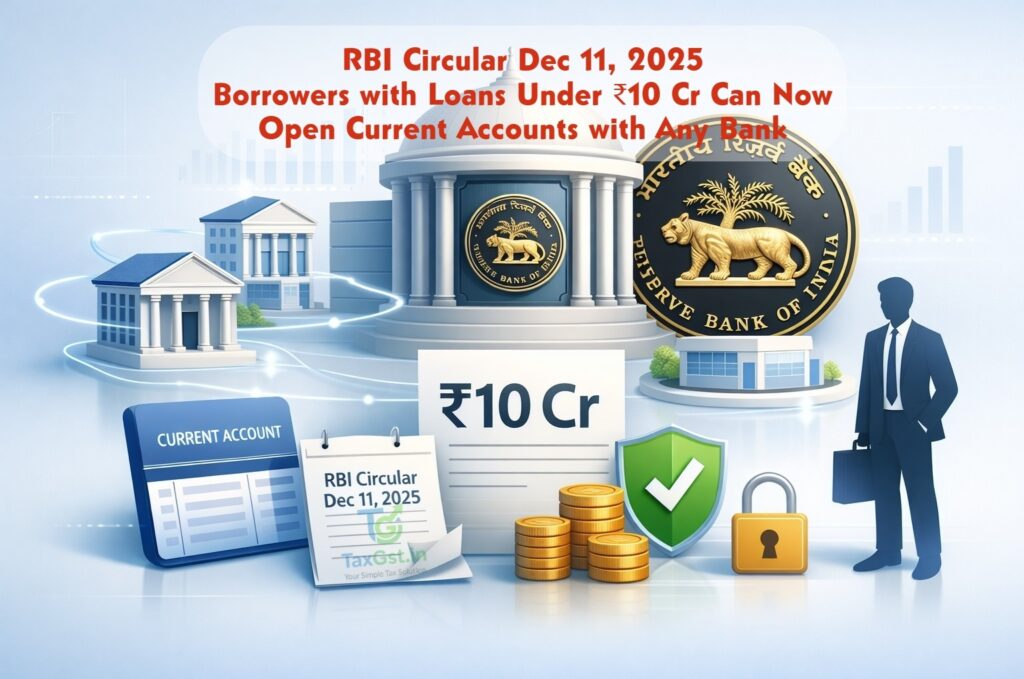
If you run a business in India, you know that dealing with banks can sometimes be a headache. Not because the people are bad, but because the rules are very strict. For the last five years, many small and medium business owners were feeling stuck. They had a loan from one bank, so they were forced to do all their daily work—like paying salaries, paying vendors, and collecting money—with that same bank.
Also Read-Govt Notifies 15th Dec. 2025 for Banking Laws Amendment Enforcement
Even if that bank’s mobile app was slow, or their service was bad, you had no choice. You were “locked” in. But finally, good news has come. The RBI has listened to the complaints of business owners. In a new update this December 2025, they have loosened the ropes. This article will explain everything in simple language, so you know exactly what benefits you can get and how to talk to your bank manager about it.
Why Was the Rule So Strict Before?
To understand the new freedom, we first need to remember why the restriction was there.
Back in 2020, banks were facing a big problem. Some dishonest businessmen were playing a trick. They would take a big loan (Term Loan or Cash Credit) from a government bank (Public Sector Bank). But, they would open a Current Account with a private bank.
They would route all their sales money through the private bank Current Account. The government bank, which gave the loan, had no idea how much money the business was making. The businessman would then say, “Oh, business is bad, I cannot pay the EMI,” while actually, he was sitting on cash in the other bank.
To stop this “diversion of funds” (moving money away), the RBI brought a strict rule in 2020:
“If your total bank exposure (loans) is more than ₹5 Crore, you cannot open a Current Account with any other bank. You must stick to your lender.”
This rule stopped the fraud, but it also punished honest businessmen. A simple garment factory owner with a ₹6 Crore loan was treated strictly, just like a big corporate defaulter. He was not allowed to open a second account for convenience.
What Has Changed Now (December 2025)?
The RBI realized that a loan of ₹5 Crore is not that big anymore. Prices have gone up, machinery costs have gone up. A small factory easily needs ₹6-7 Crore funding. It is unfair to restrict them.
So, on December 11, 2025, the RBI issued a new circular (Press Release 2025-2026/1684). Here is the simple breakdown:
- Old Rule: If your total loan is ₹5 Crore or more, you are restricted.
- New Rule: Now, the restriction starts only if your total loan is ₹10 Crore or more.
This means if your total loan amount is anywhere between ₹5 Crore and ₹10 Crore, you have suddenly become “free.” You can now walk into any bank—HDFC, ICICI, Axis, Kotak, or any other—and open a Current Account to handle your daily payments comfortably.
Let’s Calculate: Are You Eligible?
Many people make a mistake here. When RBI says “Exposure,” they don’t just mean your current loan balance. They mean the Sanctioned Limit.
You need to sit down with your accountant and add up these things:
- Term Loans: The original sanctioned amount (even if you have paid back half, usually the sanctioned amount is considered for grouping, but for exposure check, banks look at the total limits).
- Cash Credit (CC) Limit: The full limit given to you.
- Overdraft (OD) Limit: Any OD against property or FD.
- Non-Fund Based Limits: This includes Bank Guarantees (BG) and Letter of Credit (LC).
Example Calculation:
Imagine you have a factory.
- Machine Loan: ₹4 Crore
- CC Limit: ₹3 Crore
- Bank Guarantee for tenders: ₹1 Crore
Total = ₹8 Crore.
In the Old System: You were above ₹5 Crore. So, you were stuck with your loan bank.
In the New System: You are below ₹10 Crore. You are free! You can open a new Current Account in another bank.
Why Should You Care? (Real Life Benefits).
You might ask, “Why should I open another account? One is enough.”
Well, for smart businessmen, this is very useful. Let me tell you why.
A. Better Technology.
Let’s be honest. Some government banks give great interest rates on loans, but their mobile apps are old. Their websites are slow. Sending money via NEFT/RTGS takes time.
Private banks usually have very fast apps. You can pay 50 salaries in one click. Now, you can keep your loan in the government bank (to save interest) but open a Current Account in a private bank (to save time).
B. Safety in Emergencies.
Sometimes, a bank’s server goes down. If you have only one account, your business stops. You cannot pay your supplier; the truck is waiting at the gate.
If you have a second Current Account in another bank, you can use that to pay. It acts like a backup stepney for your car.
C. Better Forex Rates.
If you are an exporter, you know that dollar rates vary. Some banks give better rates than others. Earlier, you were forced to convert dollars with your loan bank only. Now, you can shop around. You can ask Bank B, “Will you give me a better rate?” and open an account there.
Stories to Help You Understand.
Let’s look at two stories of local businessmen to see how this helps.
Story 1: Ramesh the Contractor.
Ramesh runs a construction company in Pune. He has a CC limit of ₹6 Crore from Bank of India.
Ramesh was very unhappy. Bank of India is a good bank, but their branch was far from his site, and he wanted to use a QR Code scanner for collecting small payments from clients. Bank of India’s process for QR codes was taking too long.
Ramesh wanted to open an account with Paytm Bank or HDFC because they give instant voice notifications for payments. But because his loan was ₹6 Crore (more than the old ₹5 Cr limit), the other banks said, “Sorry Sir, RBI rule says no.”
Now (Dec 2025): Since the limit is ₹10 Crore, Ramesh is free. Next week, he is opening a Current Account with HDFC, getting a QR code stand for his office, and making his life easy. His loan stays with Bank of India.
Story 2: Anita’s Electronics.
Anita has a wholesale electronics shop. Her total loans are ₹9 Crore.
She wanted to give her employees “Salary Cards” from a private bank so they could withdraw cash easily. But her loan was with a Cooperative bank that didn’t have good ATM coverage. She was stuck.
Now: She can walk into ICICI Bank, open a Current Account, transfer the salary amount there every month, and give her staff the best service. She is very happy.
Common Confusions (Don’t Get Fooled!).
Since this news came out, there are many rumors floating on WhatsApp. Let’s clear them up.
❌ MYTH: “RBI has waived collateral for ₹10 Crore loans!”
TRUTH: No, absolutely not. Please do not go to the bank asking for a loan without security. This rule is ONLY about Opening an Account. It has nothing to do with giving you a loan. If you want a loan, the bank will still ask for your property papers or stock details.
❌ MYTH: “My Overdraft limit will automatically double.”
TRUTH: No. The bank decides your limit based on your sales and profit. This new rule does not increase your loan amount. It only lets you open a bank account elsewhere.
❌ MYTH: “I can hide my sales from my loan bank now.”
TRUTH: Be careful. Just because you can open another account doesn’t mean you should hide money. Your loan bank (Lender) will still check your total turnover. If they see that no money is coming into your CC account, they will reduce your CC limit. You must still route enough money to the loan account to keep the manager happy.
Step-by-Step: What Should You Do Now?
If you think this news helps you, follow these simple steps:
Step 1: Check your Papers
Take out your Sanction Letter. Add up all the limits (CC, OD, Term Loan).
Is it less than ₹10,00,00,000 (10 Crore)?
If yes, proceed to Step 2.
Step 2: Choose a New Bank
Think about what problem you are facing. Do you need a better mobile app? Do you need a swipe machine (POS)? Do you need a branch closer to your office?
Visit that bank.
Step 3: Tell Them the News
Sometimes, bank staff at the branch level might not know the latest circular immediately. If they say “Sir, we need NOC from your loan bank,” you can politely tell them:
“Madam/Sir, please check the RBI Press Release dated December 11, 2025. The limit is now ₹10 Crore. My exposure is less than that, so I don’t need an NOC.”
Step 4: Maintain Balance
Once you open the new account, use it for convenience. But remember to transfer money regularly to your main loan account to pay interest. Don’t let your main account go dry.
A Message for Accountants and CAs.
If you are an accountant handling clients, this is a great time to call your clients and give them this good news. They will appreciate it.
- Review the “Credit Monitoring Reports” (CMA Data) of your clients.
- Identify clients in the ₹5 Cr to ₹10 Cr bracket.
- Advise them to diversify their banking.
- However, also warn them about the “Quarterly Statements.” Even if they have multiple accounts, they must submit stock statements on time to the lead bank.
A Good Move for Small Business.
At the end of the day, business is hard enough. You have to worry about sales, staff, taxes, and GST. Banking should not be another worry.
This move by the RBI is very sensible. It treats medium-sized businesses with respect. It says, “We trust you.”
By increasing the limit to ₹10 Crore, the RBI has given power back to the customer. Now, banks will have to work harder to keep you happy. If a government bank wants your deposits, they will have to improve their service. If a private bank wants your business, they can now approach you freely.
Competition is always good for the customer. So, check your limits, talk to your CA, and make the most of this new freedom!
Frequently Asked Questions (FAQs) on RBI Current Account Rules 2025.
What is the new RBI limit for opening a Current Account?
Do I need an NOC from my loan bank to open a new account?
Does this new rule waive collateral for loans up to ₹10 Crore?
Can I use a different bank for QR Code and POS machine?
What counts as “Aggregate Exposure” for this limit?
Will my Overdraft (OD) limit increase automatically?
Is this rule applicable to all banks?
Disclaimer: The information provided in abover article is based on the RBI Press Release dated December 11, 2025. Banking regulations are subject to change. Please consult your professional financial advisor or bank branch for case-specific guidance.
Related Reading
- RBI UDGAM Portal: Find & Claim Forgotten Money from Old Bank Accounts
- RBI Loan Pre-payment Rules 2026: No Pre‑payment Charges on Floating Loans
- RBI AIFI KYC Directions 2025: Stricter AML/CFT Rules for Financial Institutions
Discover more from TaxGst.in
Subscribe to get the latest posts sent to your email.



Never Miss a Tax Deadline Again
Due-date alerts, GST updates and tax tips — free on the app you already use.
event Next: TDS Return (138 / 140) · 31 Oct