
 C.K. Gupta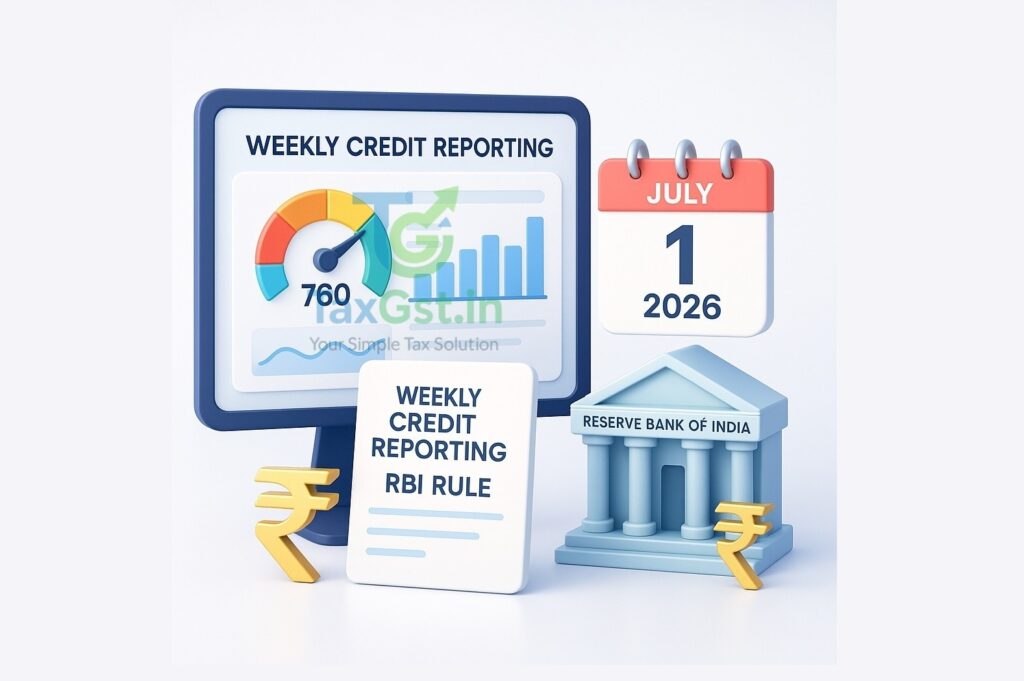
The Reserve Bank of India (RBI) has once again demonstrated that data is the new oil of the financial system—and it expects that oil to flow through the pipes much faster than before.
In a significant move that will reshape how your creditworthiness is calculated, the central bank has mandated that all Credit Institutions (banks, NBFCs) must report borrower data to Credit Information Companies (CICs like CIBIL, Experian, etc.) on a weekly basis. This is a major shift from the current monthly or fortnightly reporting cycles.
Also Read-RBI Cuts Repo Rate to 5.25%: Keeping India’s Economy in the Goldilocks Zone
While the original proposal aimed for an April 2026 rollout, the RBI has been pragmatic, deferring the effective date to July 1, 2026, to give lenders enough time to upgrade their IT infrastructure.
For the average Indian borrower, this is not just backend regulatory jargon. It means your financial behavior—good or bad—will reflect on your credit report almost in real-time. Whether you just cleared a massive credit card bill or missed a home loan EMI by three days, the system will know, and it will know fast.
Notification Details.
RBI released the RBI credit reporting circular 2025 on December 4, 2025. This set of 10 Amendment Directions updates rules for commercial banks, small finance banks, local area banks, regional rural banks, urban and rural co-operative banks, all-India financial institutions, NBFCs, asset reconstruction companies, and CICs.
The effective date moved to July 1, 2026, from the earlier April 1, 2026 proposal. RBI made this deferral based on feedback to give lenders time to adjust systems.
These directions fall under Section 11 of the Credit Information Companies (Regulation) Act, 2005. They build on the Master Direction – Reserve Bank of India (Credit Information Reporting) Directions, 2025.
Key Takeaways.
| Parameter | Old/Current Norms | New Norms (Effective July 1, 2026) |
| Reporting Frequency | Monthly or Fortnightly (15 days) | Weekly (4 times a month) |
| Submission Dates | Varies (usually month-end) | 9th, 16th, 23rd, and Last Day of the month |
| Data Type | Bulk updates | Incremental (Weekly) + Full File (Monthly) |
| Submission Deadline | Often lagged by 7-15 days | 4 days from reference date (for weekly data) |
| Non-Compliance | Internal audit flags | Reporting to RBI via DAKSH Portal |
| Consumer Impact | Lag in score updates (30-45 days) | Near Real-time score updates (approx. 7 days) |
1. The New Reporting Schedule: A Radical Shift.
On December 4, 2025, the RBI issued a decisive notification changing the “Credit Information Reporting Directions.” The central bank has effectively told lenders that stale data is no longer acceptable.
Under the current system, if you pay off a loan on the 5th of the month, your credit score might not reflect that closure until the middle of the next month. This lag creates friction. It prevents good borrowers from getting fresh loans quickly and allows bad borrowers to “game” the system by taking multiple loans from different apps before the first default is reported.
The New Calendar.
Starting July 1, 2026, banks and NBFCs cannot sit on data. They must submit credit information to bureaus on four specific dates every month:
- 9th of the month
- 16th of the month
- 23rd of the month
- Last day of the month
Deadlines are tight:
- For the weekly “incremental” updates (changes that happened in that week), banks have just 4 days to submit the data.
- For the Full Monthly File (a complete dump of all borrower data), the deadline is the 5th of the next month.
This creates a high-pressure environment for compliance teams at banks, but for the ecosystem, it promises an unprecedented level of transparency.
2. Why Is RBI Doing This?
The motivation comes from the top. The RBI has been worried about “blind spots” in lending, especially with the explosion of instant loan apps and Buy Now Pay Later (BNPL) schemes.
RBI Deputy Governor M. Rajeshwar Rao has been a vocal proponent of this shift. He previously highlighted the necessity of moving away from archaic reporting cycles, stating that “real-time monitoring” is essential to improve “underwriting precision.”
When the Deputy Governor speaks of “underwriting precision,” he is referring to the lender’s ability to assess risk accurately.
- The Problem: In a monthly reporting cycle, a borrower could theoretically default on Loan A on the 2nd of the month, and apply for Loan B on the 10th. The lender for Loan B would pull a credit report, see a “clean” record (because the default hasn’t been reported yet), and sanction the money.
- The Solution: With weekly reporting, that default on the 2nd is reported by the 9th. If the borrower applies for Loan B on the 10th, the lender sees the red flag immediately.
This closes the arbitrage window for over-leveraged borrowers and protects the asset quality of Indian banks.
3. Technical Nuances: “Incremental” vs. “Full File”.
For the Chartered Accountants and banking tech professionals reading this, the distinction between “Incremental” and “Full File” is where the operational challenge lies.
The Incremental File (Weekly).
The RBI does not want banks to upload their entire database of millions of customers every week. That would crash the servers of CIBIL and Experian. Instead, on the 9th, 16th, and 23rd, banks only need to upload what changed.
- New Loans: Did a customer open a new credit card?
- Closures: Did a customer close a personal loan?
- Status Change: Did a “Standard” account slip into “SMA” (Special Mention Account) or “NPA” (Non-Performing Asset)?
- Demographics: Did the customer change their address or mobile number?
The Full File (Monthly).
On the last day of the month, however, a complete reconciliation is required. This “Full File” replaces the previous month’s data entirely, ensuring that no errors creep in over time due to missed incremental patches.
The deadline for this full file is strict: The 5th of the next month. If a bank delays, it enters the penalty zone.
4. The Stick: DAKSH Portal and Penalties.
The RBI is known for its “carrot and stick” approach. In this notification, the stick is quite visible. Previously, if a bank was late in reporting data to CIBIL, it was largely an internal compliance matter or a minor operational lapse. Now, it is a regulatory red flag.
The Credit Information Companies (CICs) have been tasked with acting as whistleblowers. They must monitor which banks are meeting the dates (9th, 16th, 23rd).
- If a lender fails to submit data on time, the CIC must record this non-compliance.
- Half-yearly Reporting: On March 31 and September 30, CICs must compile a list of these defaulting lenders and upload it to the RBI’s DAKSH portal.
What is DAKSH?
It is the RBI’s advanced supervisory monitoring system. Landing on a DAKSH list is not something a bank CEO wants. It triggers supervisory scrutiny, potential audits, and can lead to monetary penalties for the bank. This ensures that the “July 2026” deadline is taken seriously by every board room in Mumbai.
5. Impact on the Common Borrower (You and Me).
Now, let’s leave the regulatory side and talk about your wallet. How does this change your life?
A. The Good News: Faster Updates & Corrections.
1. Instant Gratification for Repayments:
Currently, if you pay off a car loan to improve your eligibility for a home loan, you often have to wait 30–45 days for that “Active Loan” to disappear from your CIBIL report. This delay can cost you a good interest rate or delay your home purchase.
- Post-2026: If you close a loan on the 10th, the bank reports it on the 16th. By the 20th, your credit report looks clean. You can apply for that mortgage immediately.
2. Faster Dispute Resolution:
We have all heard horror stories of wrong entries in credit reports (e.g., a loan you never took). Under the current slow cycle, fixing this takes weeks because the bank waits for the next “reporting cycle” to upload the correction.
- Post-2026: Corrections can be pushed through in the very next weekly cycle. The turnaround time for cleaning up your credit history will drop drastically.
B. The Cautionary Note: No Place to Hide.
1. The “Grace Period” Illusion is Gone:
Many borrowers habitually pay a few days late. They think, “My due date was the 5th, I paid on the 12th. It’s fine, they haven’t reported it yet.”
Under the weekly regime, this buffer evaporates. If your due date was the 5th and you haven’t paid by the 9th (the reporting date), your account could be tagged as “Overdue” in that week’s file. Even if you pay on the 10th, that one-week blip might be recorded.
- Advice: Stick to your due dates religiously. Automated clearing (NACH/ECS) is your best friend here.
2. Aggressive Cross-Selling:
With real-time data, banks will know immediately when your credit utilization drops. If you pay off a huge credit card bill on the 14th, expect a call on the 17th offering you a “Pre-approved Personal Loan” or a “Limit Enhancement.” Your financial data will be fresher, making you a more visible target for marketing algorithms.
6. Implementation Challenges for Lenders.
While the RBI’s intent is noble, the execution will be a heavy lift for the banking sector.
1. The Technology Deficit:
Many cooperative banks and smaller NBFCs still operate on legacy systems where “end of day” processes take hours. Generating accurate data cuts four times a month requires a robust, automated Core Banking Solution (CBS). The deferment to July 2026 is largely to accommodate these smaller players who would otherwise struggle to comply.
2. Data Quality vs. Speed:
There is a classic trade-off between speed and accuracy. When banks are forced to report weekly, the time available for “maker-checker” verification shrinks. There is a risk that hasty reporting could lead to more errors initially—wrongly tagging a paid account as overdue because the payment reconciliation server hadn’t synced with the reporting server. Banks will need to build “straight-through processing” (STP) to avoid this.
7. Strategic Advice for Borrowers in the Transition Period.
We have roughly 18 months before this norm kicks in (July 2026). Here is how you should prepare your finances:
- Audit Your Report Now: Do not wait for 2026. Download your full credit report today. Check for “ghost loans” or old dormant accounts that are still showing as “active.” Close them now. You don’t want them cluttering your report when the high-frequency reporting starts.
- Consolidate Payment Dates: If you have 5 credit cards and 3 loans, try to align their due dates or set strict auto-debits. Managing cash flow will become critical because missing a date by a week will no longer be “invisible.”
- Understand “Utilization Ratio”: Since balances will be reported weekly, your “Credit Utilization Ratio” (how much of your limit you use) will fluctuate more on the report.
- Tip: If you plan to apply for a big loan (like a home loan), try to keep your credit card balances low for the entire month prior to the application, not just at the end of the month. You never know which “weekly snapshot” the lender will look at.
What Borrowers Should Do Before July 2026.
With a clear go-live date of July 1, 2026, borrowers have a few months to prepare and position themselves better. Practical steps include:
- Checking your credit report from each major CIC at least once before the new norms kick in and getting errors corrected.
- Ensuring there are no forgotten or inactive credit cards or loan accounts that are still being reported as open.
- Regularising overdue EMIs wherever possible so that your profile is clean when weekly updates start.
- Maintaining low credit utilisation on cards, especially in the months leading up to a planned loan application.
Because updates will flow through more frequently, the impact—positive or negative—of your behaviour will be visible sooner. Treat this as an opportunity to build a strong, consistent credit track record.
Long-Term Direction: Towards Near Real-Time Credit Reporting.
The new framework should be seen as a substantial step towards near real-time credit reporting in India, even if daily reporting is not yet mandated. As digital lending, buy-now-pay-later products, and instant credit models expand, the value of fresh, high-quality credit information will only increase.
Over the medium term, the industry may move to even shorter cycles or event-based reporting, where significant changes in an account are pushed to CICs almost immediately. For now, the RBI credit reporting circular 2025 sets a pragmatic, enforceable midpoint—more frequent than fortnightly cycles, yet operationally manageable for most institutions.
For borrowers and lenders alike, the message is clear: credit data will be watched more closely, updated more frequently, and used more intensively. Discipline, transparency, and accuracy will be the three main pillars of the credit information regime from July 2026 onwards.
As we approach July 2026, the message from the RBI is clear: Credit discipline is not a monthly activity; it is a weekly habit.
Frequently Asked Questions (FAQs) on New RBI Credit Reporting Norms
When will the new weekly credit reporting rules start in India?
How often will my CIBIL score be updated under the new rules?
Will paying a loan EMI a few days late affect my credit score now?
How does weekly reporting benefit borrowers?
What happens if banks fail to report data on time?
What is the difference between “Incremental” and “Full File” submission?
Disclaimer: This article is for informational purposes only and does not constitute financial or legal advice. The dates and regulations mentioned are based on the RBI circular dated December 4, 2025, and are subject to change by the Reserve Bank of India. Readers are advised to consult a certified financial advisor or refer to the official RBI notifications for specific guidance.
Tags: RBI Credit Reporting Circular 2025, Weekly CIBIL Score Update, RBI DAKSH Portal, Credit Information Companies Regulation, Loan Repayment Rules India, CIBIL Reporting Changes 2026, RBI New Circular on Credit Score, Weekly Submission of Credit Data
Trusted Authorities & References
To verify the details mentioned in this article, please refer to the official notifications and circulars below:
- Reserve Bank of India (RBI): Official Website & Notifications
- RBI Master Direction: Master Direction on Credit Information Companies
- CIBIL (TransUnion): Official CIBIL Consumer Portal
- DAKSH System: RBI Press Release on Advanced Supervisory Monitoring System (DAKSH)
Note: The effective date of the new weekly reporting norms is July 1, 2026, as per the RBI notification dated December 4, 2025.
Related Reading
- RBI AIFI KYC Directions 2025: Stricter AML/CFT Rules for Financial Institutions
- SEBI Revises Nomination Rules for Demat Accounts and Mutual Funds
Discover more from TaxGst.in
Subscribe to get the latest posts sent to your email.



Never Miss a Tax Deadline Again
Due-date alerts, GST updates and tax tips — free on the app you already use.
event Next: TDS Return (138 / 140) · 31 Oct