
 C.K. Gupta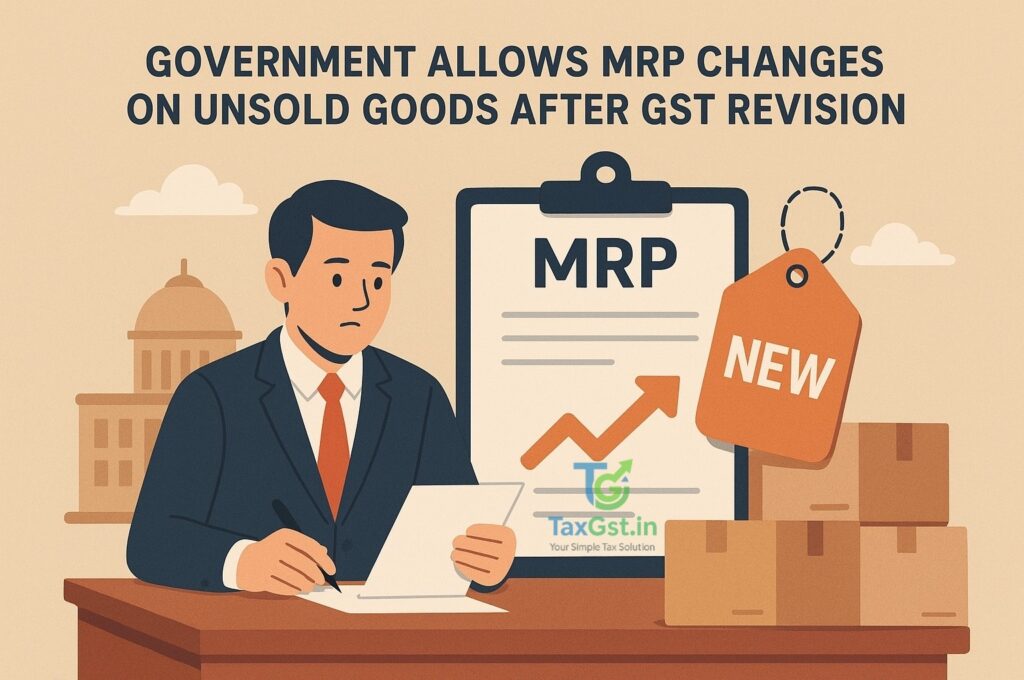
The Indian government has introduced significant relief measures for manufacturers, distributors, and retailers, providing them with more flexibility in managing their unsold inventory. This move, detailed in a circular from the Ministry of Consumer Affairs, allows businesses to change the Maximum Retail Price (MRP) on pre-packaged goods following any revision in the Goods and Services Tax (GST). This is a welcome development for the business community, as it addresses a key operational challenge and is expected to have a positive impact on the overall business environment in India.
Also Read-56th GST Council Meeting: Next-Generation Reforms That Will Impact Every Indian
Understanding the New Rules.
The core of this relief measure is the permission granted to businesses to revise the MRP on their existing, unsold stock. This is particularly important when GST rates are changed by the government. Previously, a change in tax rates would create a difficult situation for businesses holding large amounts of stock with the old MRP already printed on the packaging.
Official Notification Details.
The policy and permissions are based on the following official communication:


- File Number: I-10/14/2020-W&M
- Issuing Authority: Department of Consumer Affairs (Weights and Measures Unit), Ministry of Consumer Affairs, Food and Public Distribution, Government of India.
- Relevant Regulation: The directive is issued under the powers conferred by Rule 33 of the Legal Metrology (Packaged Commodities) Rules, 2011.
- Subject: Permission for manufacturers, packers, or importers to declare a revised retail sale price (MRP) on unsold pre-packaged commodities due to changes in GST rates.
Here are the Key Aspects of the New Directive:
- Permission to Revise MRP: Businesses can now legally change the MRP on unsold products to reflect the new GST rates. This can be done by stamping, putting a sticker, or through online printing.
- Extended Deadline: This provision is available until December 31, 2025, or until the old stock is sold out, whichever comes first. This gives businesses a significant window to clear their inventory without incurring losses.
- Use of Existing Packaging: To prevent wastage, the government has also permitted the use of existing packaging material until the same deadline of December 31, 2025. This is a major cost-saving measure, as it avoids the need to discard large quantities of packaging material.
- Conditions for Price Revision: The government has laid out clear conditions to ensure transparency and protect consumer interests:
- The original MRP must remain visible on the package. The new, revised price cannot overwrite the old one.
- The price change, whether an increase or a decrease, must not exceed the exact amount of the change in tax.
- Businesses are required to advertise these price changes in at least two newspapers to keep the public informed. They must also notify the relevant government authorities.
Impact on the Business Environment.
These measures are set to create a more stable and predictable business environment in India. Here’s how they are expected to help:
- Reduced Financial Loss and Wastage: The most direct benefit is the prevention of financial losses. Businesses will no longer have to worry about being stuck with unsellable inventory or being forced to discard valuable packaging material.
- Smoother Supply Chain: The new rules will lead to a more efficient and smoother supply chain. Distributors and retailers can now manage their inventory with greater confidence, knowing that they have a clear process for handling price changes.
- Benefit to Consumers: These measures also ensure that the benefits of any tax reduction are passed on to the consumers more quickly. When GST rates go down, the revised, lower prices can be immediately reflected on the products, making them more affordable for the public.
- Increased Compliance and Transparency: By providing a clear and legal framework for revising prices, the government is encouraging greater compliance and transparency. The requirement to advertise the price changes ensures that consumers are well-informed and protected from any unfair practices.
A Practical Example.
Imagine a company that manufactures biscuits. They have thousands of packets in their warehouse, all printed with an MRP that includes the old GST rate. Suddenly, the government announces a reduction in GST on biscuits.
- Without the new rules: The company would face a dilemma. They could either sell the old stock at a loss, or they would have to recall all the products and repackage them, which is a costly and time-consuming process.
- With the new rules: The company can simply apply a sticker with the new, lower MRP on the existing packets. They can then run advertisements to inform consumers about the price change and continue to sell their products without any disruption.
This simple example illustrates the practical benefits of the government’s decision, which helps businesses save money, reduce waste, and operate more efficiently.
Conclusion.
The decision to allow for the revision of MRP on unsold stock is a pragmatic and timely move by the Indian government. It provides a significant boost to manufacturers, distributors, and retailers by offering them much-needed flexibility and financial relief. These measures not only help businesses navigate the complexities of a dynamic tax environment but also ensure that consumers receive the benefits of tax cuts promptly. By fostering a more supportive and transparent business ecosystem, these initiatives are a step in the right direction for the Indian economy, creating a win-win situation for both businesses and consumers.
Disclaimer
The information provided in this article is for general informational purposes only. All information is provided in good faith, however, we make no representation or warranty of any kind, express or implied, regarding the accuracy, adequacy, validity, reliability, availability, or completeness of any information. Readers are advised to consult with a professional financial or legal advisor for advice tailored to their specific situation. The rules and regulations mentioned are subject to change, and it is the reader’s responsibility to verify the current status from official government sources.
Related Reading
- What is GST And Why Was It Introduced in India?
- What is a GST Return and Why is it Important to File GST Returns?
- Who Needs to Register for GST and Obtain a GSTIN?
Try the free GST calculator for instant figures.
ITR, GST returns, notices and registrations — fixed fees, human support, on-time filing.
Discover more from TaxGst.in
Subscribe to get the latest posts sent to your email.

Never Miss a Tax Deadline Again
Due-date alerts, GST updates and tax tips — free on the app you already use.
event Next: GSTR-1 · 11 Oct