
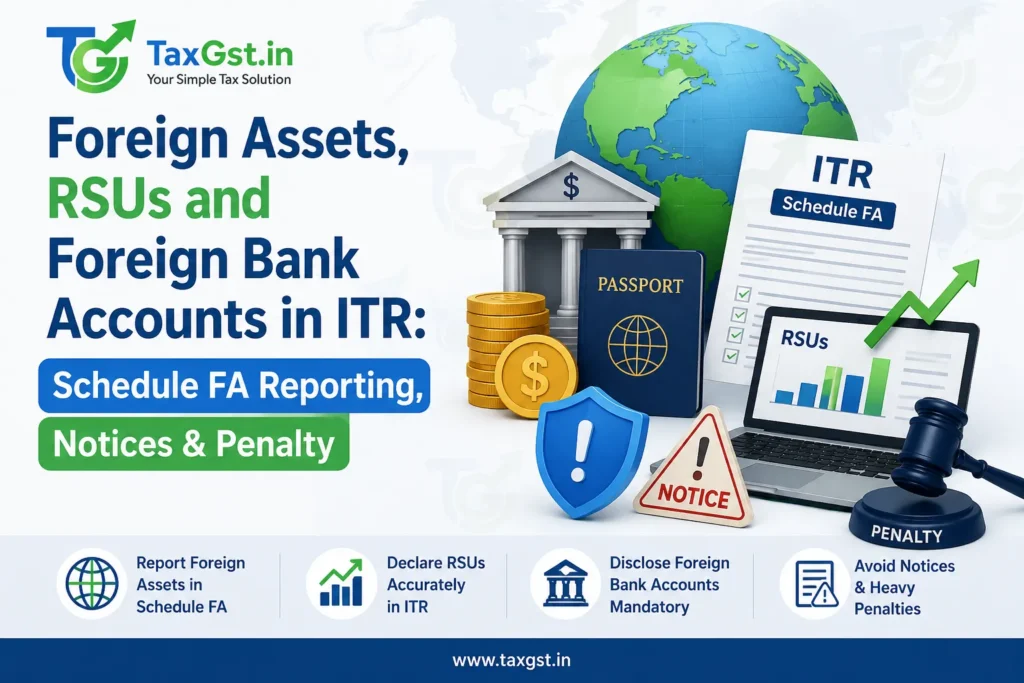
If you are a resident taxpayer in India and hold any foreign asset — including overseas bank accounts, RSUs/ESOPs granted by a global corporate employer, or immovable property abroad — you are mandatorily required to disclose these holdings in Schedule FA of your Income Tax Return.
This disclosure is required even if the asset earned zero income during the year. Failure to disclose can attract a severe penalty of up to ₹10 lakh per assessment year under Section 43 of the Black Money (Undisclosed Foreign Income and Assets) and Imposition of Tax Act, 2015, as per Notification No. 58/2015.
The Income Tax Department now automatically receives granular data on foreign holdings through automated CRS and FATCA agreements, making non-disclosure easily traceable.
What are the key requirements for Schedule FA reporting?
- Who must file Schedule FA: As per Income Tax Rules, Schedule FA is applicable exclusively to Resident and Ordinarily Resident (ROR) individuals in India. Non-residents (NR) and Resident but Not Ordinarily Residents (RNOR) are exempt from this mandatory asset disclosure.
- Which ITR form to use: As per the notified framework for AY 2027-28, Schedule FA is available only in ITR-2 and ITR-3. Simplified forms like ITR-1 and ITR-4 do not contain this schedule and must not be used if you hold any global asset or earn foreign income.
- Calendar year vs. financial year: As per Rule 3(4) of the Black Money Rules, foreign assets are reported based on the calendar year (January 1 to December 31) preceding the assessment period. However, the income earned from those assets must be mapped to the Indian financial year (April 1 to March 31).
- Penalty for non-disclosure: Omissions can attract an absolute penalty of up to ₹10 lakh per assessment year under Section 43 of the Black Money Act, 2015. This rule applies even if the asset generated zero income or if your aggregate domestic income sits below the taxable threshold.
- Relief for taxes paid abroad: Double taxation relief on global streams is preserved through specialized provisions. Taxpayers can claim Foreign Tax Credit (FTC) via **Schedule TR** by ensuring they electronically submit **Form 67** prior to uploading their main tax return.
Also Read-Switched to New Tax Regime? Deductions and Exemptions You Can No Longer Claim
What Exactly Is Schedule FA and Why Does the Income Tax Department Care About It?
Schedule FA — formally titled “Details of Foreign Assets and Income from Any Source Outside India“ — is a highly detailed, scannable control matrix inside the ITR-2 and ITR-3 form architectures. It requires resident taxpayers to disclose every foreign financial asset, equity interest, or property they held at any point during the relevant calendar year. The scope covers foreign depository accounts, custodian holdings, equity/debt interests in foreign corporations, cash value insurance contracts, financial stakes in global entities, overseas real estate, and any offshore accounts where the taxpayer holds legal signing authority.
The Income Tax Department’s scrutiny of Schedule FA has escalated dramatically due to the full operationalization of two international frameworks: the Common Reporting Standard (CRS) and the Foreign Account Tax Compliance Act (FATCA). Under these digital exchange treaties, overseas financial institutions — including banks, stockbrokers, asset management entities, and custodians — automatically stream account balance and ownership profiles back to Indian tax authorities via the central data network.
When data processed from a foreign tax jurisdiction shows that you held an active bank balance or received stock vestings in a specific calendar year, but your corresponding tax return leaves Schedule FA blank, the department’s system flags a non-compliance event. This automatically triggers an automated compliance notice or inquiry via the taxpayer’s e-filing communication dashboard.
As per the Black Money (Undisclosed Foreign Income and Assets) and Imposition of Tax Act, 2015 and its companion instructions (**Notification No. 58/2015**), the reporting mandate is triggered entirely by the *holding* of the asset, not by whether it produces immediate revenue. Consequently, a dormant foreign bank account holding a fractional balance, or corporate RSUs that vested but were never sold, must be itemized. The statute establishes a clear principle: Schedule FA is a transparency tool for wealth ownership tracking, not merely a tax computation grid.
There is a specific statutory carve-out to protect small investors from harsh penal consequences. Under the proviso to Section 43 of the Black Money Act, the ₹10 lakh penalty may not be enforced against foreign assets *(excluding immovable property)* if the cumulative value of all such financial holdings does not exceed ₹20 lakh across the calendar year. However, this relief is strictly a defense against penalties; it does not exempt the asset from the disclosure obligation itself. Furthermore, foreign real estate enjoys no such valuation cushion and must be disclosed even if its value is nominal.
How Do Foreign Bank Accounts, RSUs and ESOPs Get Reported in Schedule FA?
Schedule FA is split into highly structured sub-tables labeled A1 through G. Each section targets a specific asset class. Mapping your assets to the correct table is critical to avoid technical non-compliance flags during processing.
Foreign Bank Accounts — Table A1 (Foreign Depository Accounts): Every checking, savings, or cash-sweep brokerage account located outside India must be detailed here. Taxpayers must input the institutional bank name, full physical address, account number, opening date, your ownership status (beneficial owner, beneficiary, or legal signee), the initial value of the investment, the peak balance touched during the calendar year, the formal closing balance as of December 31, and any gross interest credited during the year.
According to Rule 3(4) of the Black Money Rules, all foreign currency figures must be converted to Indian Rupees (INR) using the State Bank of India’s Telegraphic Transfer Buying Rate (TTBR) on the exact valuation dates. For instance, the peak balance value must be converted using the TTBR of the day that peak was achieved, while the closing balance uses the TTBR of December 31.
RSUs and Foreign Equity Shares — Table A3 (Foreign Equity and Debt Interest): When a foreign parent company awards RSUs or ESOPs to an employee in an Indian subsidiary, those shares transition into a reportable foreign asset the moment they vest—regardless of whether they are sold or held. In Table A3, you must report the corporate name, geographical address, initial investment value (the Fair Market Value on the vesting date, which should align with the perquisite value declared on your formal **Form 131 / Form 130** salary statements), the peak value during the year, the final closing value on December 31, and any dividends or cash proceeds received from partial liquidations.
If your overseas employer executes an automated “sell to cover” transaction at the time of vesting to satisfy tax obligations, only the remaining net shares that actually hit your foreign demat account should be tracked as active equity assets in Table A3.
Income Reporting Integration — Schedule FSI and Main Tax Schedules: While Schedule FA acts as a wealth tracking record, any income generated from those assets must trail through your regular tax schedules. As specified under the modern e-filing portal framework, interest earned on foreign depository balances and dividends distributed by overseas equities must be listed under **Schedule OS (Income from Other Sources)**.
Any capital gains resulting from the sale or transfer of global shares must be declared separately within **Schedule CG**, where tax liability is determined by holding periods and the specific provisions of the relevant Double Taxation Avoidance Agreement (DTAA).
How Should You Convert Foreign Currency Values and Calculate Peak Balances for Schedule FA?
Under Rule 3(4) of the Black Money (Undisclosed Foreign Income and Assets) and Imposition of Tax Rules, 2015, every foreign currency valuation in Schedule FA must be converted into Indian currency using the official Telegraphic Transfer Buying Rate (TTBR) published by the State Bank of India.
This rate must be applied based on the specific date of the transaction or valuation event, rather than using a flat annual average. For peak balances, locate the TTBR on the exact day the account balance maxed out. For closing values, use the TTBR active on December 31 of the reportable calendar year. If you are reporting dividend or interest distributions, secure the TTBR for the last day of the calendar month immediately preceding the month in which the income was credited into your account.
The peak balance for a foreign bank account is identified as the highest closing balance reached on any single day between January 1 and December 31. For equity shares or vested RSUs, calculating the peak value involves multiplying the highest closing market price of the stock during that calendar year by the total volume of shares held on that specific trading day. Consequently, you will need to review complete monthly brokerage ledgers — rather than simple annual tax summaries — to accurately verify peak values.
Where the valuation of an asset is anchored in a permitted foreign currency recognized by the RBI, conversion directly follows the reference rates. For non-permitted or exotic foreign currencies, the asset value must first be translated into US Dollars using the conversion rates defined by the central bank of that asset’s host country, and then translated into INR using the RBI’s standard reference markers, as per the compliance protocols framed under **Notification No. 58/2015**.
What Documents Must You Gather Before Filling Schedule FA and Schedule FSI?
Before accessing the e-filing workspace, ensure you have organized all required underlying financial documents. Filing without these records dramatically increases the risk of manual processing rejections or data mismatches:
- Comprehensive foreign bank statements spanning January 1 to December 31 of the reportable calendar year, showing precise daily transactional flows and interest credits.
- Global brokerage or demat account ledgers showing RSU grant timelines, exact vesting schedules, net shares credited, liquidation transactions, and daily stock price histories.
- Form 130 salary certificates issued by your Indian employer detailing the exact perquisite values of shares that have already been subjected to withholding tax in India.
- Foreign tax withholding summaries (such as US Form 1042-S) detailing tax deducted abroad on dividend distributions, which is mandatory to claim Foreign Tax Credit relief.
- Historical SBI TTBR rate sheets for all applicable peak days, income credit days, and year-end closing dates, cross-verified against official exchange rate boards.
- For foreign immovable properties: executed purchase deeds, clear registration titles, local valuation records, and formal tenancy contracts if generating rental income.
Worked Example: Reporting a US Bank Account and RSUs in Schedule FA for AY 2026-27
Let us look at a practical case study: Arjun is a resident software engineer employed with an Indian entity that operates as a subsidiary of a US multinational corporation. During Calendar Year 2025, Arjun maintained an active US bank account (savings) and had a batch of corporate RSUs vest. Here is how he maps these assets into his return.
Foreign Bank Account — Table A1: Arjun’s US depository savings account opened the calendar year with a balance of $2,000. His peak balance reached $8,500 on August 15, 2025, and his closing balance on December 31, 2025, settled at $6,200. Total interest credited during the calendar year was $45.
Arjun gathers the historical SBI TTBR rates for his valuation dates: the August 15, 2025 rate for peak balance was ₹83.82 per USD, and the December 31, 2025 rate for year-end closing was ₹85.10 per USD. Arjun calculates and inputs: Initial Value = ₹1,65,000 ($2,000 × assumed opening TTBR of ₹82.50); Peak Balance = ₹7,12,470 ($8,500 × ₹83.82); Closing Balance = ₹5,27,620 ($6,200 × ₹85.10); and Gross Interest = ₹3,780 ($45 × assumed rate of ₹84.00 for the preceding month-end). The interest value of ₹3,780 is also added directly to Schedule OS.
RSUs — Table A3: Arjun’s employer processed the vesting of 200 RSUs on June 1, 2025. The Fair Market Value (FMV) on the vesting date was $55 per share (matching the perquisite value already taxed by his employer on his salary slip). The highest closing price of the company’s stock during the calendar year was $60 on October 15, 2025, and the year-end closing price on December 31, 2025, was $58.
Using SBI TTBR conversion factors: the June 1 vesting rate was ₹83.00 per USD, the October 15 peak valuation rate was ₹84.50 per USD, and the December 31 closing rate was ₹85.10 per USD. In Table A3, Arjun reports: Initial Value of Investment = ₹9,13,000 (200 shares × $55 × ₹83.00); Peak Value of Asset = ₹10,14,000 (200 shares × $60 × ₹84.50); and Closing Value = ₹9,87,160 (200 shares × $58 × ₹85.10). Since he held these shares and received no dividend payouts during that calendar window, he reports zero under the income columns for Table A3.
Practical Notes Before You Act
If you are utilizing this guide to execute a compliance filing or evaluate a foreign asset disclosure decision, treat the official income tax e-filing system as your final operational source of truth. Portal labels, document attachment sizes, OTP validation paths, and processing schedules can update without extensive public notice, especially as peak filing dates approach. Before submitting your final return data, download and preserve a complete screenshot or PDF record of the generated XML/JSON summary, the formal IT acknowledgement page, and any electronic verification receipts.
For direct tax matters, the safest compliance approach requires verifying three core points before submission: whether the specific reporting layout is currently active for the target assessment year, whether your residency status fits ROR conditions, and whether your internal employer records match the asset values you are declaring. This extra verification eliminates processing stalls caused by data mismatches between your tax return and your centralized financial profile.
Documents and Details to Keep Ready
- Identity and account parameters – Ensure your PAN, Aadhaar, mobile number linked to Aadhaar, bank account pre-validation profiles, and portal credentials are active before initiating your session.
- Primary reporting records – Collect your Form 130 salary certificates, unified AIS/TIS profile statements, foreign brokerage sheets, and explicit bank interest certificates in a structured digital format.
- System reference tracking – Keep a log of your PAN strings, previously filed acknowledgement numbers, tax challan IDs, and e-Verification confirmation sequences.
- Timeline logs – Document the exact dates you filed your Form 67 and submitted your ITR, as these timelines are critical if you ever need to file a rectification request.
Common Reasons for Delay or Rejection
The vast majority of processing delays occur because the asset values or account numbers typed into Schedule FA do not align with the incoming data streams delivered by foreign institutions via FATCA/CRS exchange networks. Even a slight typographical error in an account number or a minor mismatch in peak balance conversion rates can flag the return for manual inspection. If your return is flagged or if a defect notice is issued, do not resubmit identical information. First analyze the exact nature of the variance, adjust the reporting entry via a revised return, and clear the data conflict.
Another frequent point of failure is submitting multiple conflicting returns or failing to clear data links. If the portal shows your return status as pending, avoid repeatedly submitting correction files without checking system logs. Multiple overlapping entries for the same global assets can stall the processing queue rather than speed it up.
Next Steps Checklist
- Confirm that your residency status for the financial year maps strictly as a Resident and Ordinarily Resident (ROR).
- Download and review all foreign bank and stock statements from January 1 to December 31 of the reportable calendar year.
- Locate and apply the correct SBI TTBR rates for all conversion and peak calculation dates.
- Complete and upload Form 67 on the e-filing portal before finalizing your main ITR data.
- Submit your ITR-2 or ITR-3, download the formal acknowledgement page, and verify that the credit registers in your account history.
Key Details at a Glance
| Reporting Aspect | Compliance Details |
|---|---|
| Governing Law | Section 43 of the Black Money Act, 2015 and modern Income Tax guidelines |
| Filing Eligibility | Mandatory for ROR taxpayers; handled via ITR-2 or ITR-3 forms only |
| Reporting Slabs | Based on Calendar Year holdings; currency converted via SBI TTBR values |
Frequently Asked Questions
What should I do first after reading this?
Log into your foreign bank or brokerage portal and extract the statement history for the full preceding calendar year. Review whether any stock vestings or interest credits occurred, and cross-reference them against your domestic Form 130 records before initiating your return filing.
Does this disclosure requirement apply to my case?
If your residency evaluation marks you as a Resident and Ordinarily Resident (ROR) for the financial year, and you held even a single share of foreign equity or a fractional bank balance outside India at any point during the calendar year, Schedule FA disclosure is completely mandatory.
What happens if I miss the reporting deadline?
Missing the standard filing deadline triggers late fees under Section 234A and strips away your ability to file a standard return, forcing you to use belated return pathways. More importantly, completely omitting a foreign asset can expose you to a ₹10 lakh non-disclosure penalty notice under the Black Money Act.
Where can I secure official support for complex filings?
You can access detailed user manuals directly via the official Income Tax Portal. For multi-jurisdiction accounts, complex DTAA tax credit calculations, or handling past omission notices, we highly recommend consulting a qualified chartered accountant.
Article Information
Published: June 3, 2026
Last Reviewed: June 3, 2026
Category: Income Tax
Regulatory Body: CBDT (Central Board of Direct Taxes)
Written by C.K. Gupta, M.Com & Tax Editor at TaxGST.in — helping 500+ clients navigate IT notices, GST audits, and ITR filings across Delhi NCR since 2009.
Official Resources
Disclaimer: This article is for informational purposes only. For legal advice, consult a qualified tax professional. Always refer to the original source document for authoritative information.
Discover more from TaxGst.in
Subscribe to get the latest posts sent to your email.





Stay Updated!
Join our community for latest tax updates, GST news & finance tips