
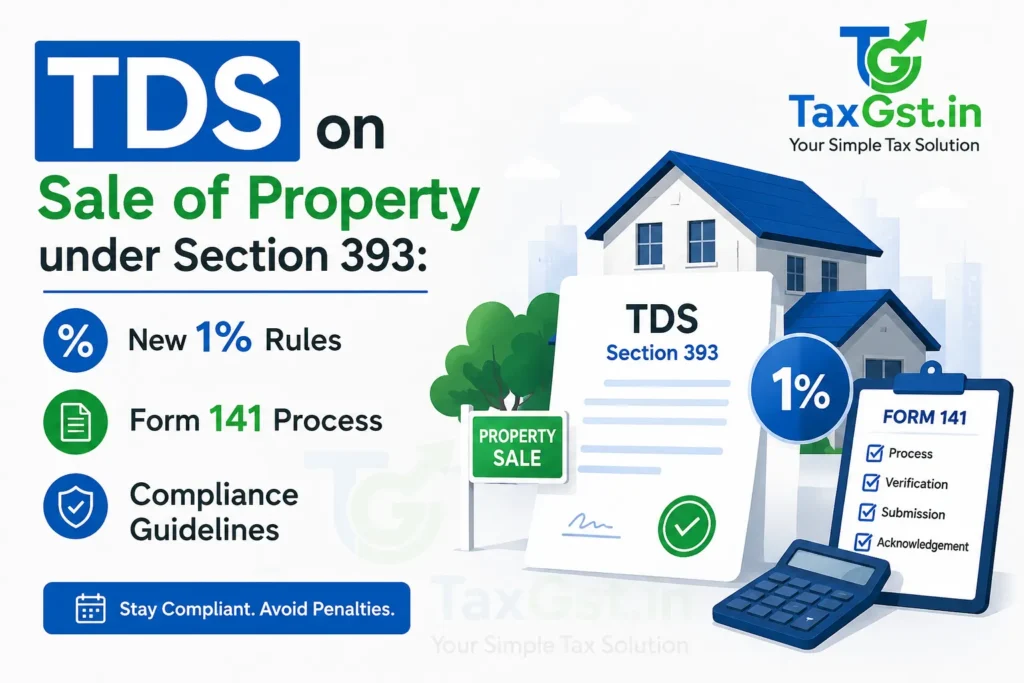
Under Section 393(1) [Table Sl. No. 3(i)] of the new Income-tax Act, 2025, any buyer purchasing an immovable property (other than rural agricultural land) for Rs. 50 lakhs or more must deduct TDS at 1% of the consideration or stamp duty value, whichever is higher, and deposit it using the unified Form 141 (Schedule B) within 30 days from the end of the month of deduction. Failure to comply attracts system-generated late fees, compounding interest penalties, and strict prosecution risks under the Income-tax Rules, 2026.
Also Read-ITR-2 VS ITR-1 VS ITR-4: Which Income Tax Return Form Should You File This Year?
What are the Key Aspects of TDS on Property Sale under the New Rules?
- New TDS Provision: 1% tax on total consideration or stamp duty value, whichever is higher, governed under the consolidated framework of Section 393(1) of the 2025 Act.
- Aggregate Threshold Rule: Applies strictly if both the total consideration and stamp duty value are Rs. 50 lakhs or more on an aggregate basis for the entire property transaction.
- Unified Form 141: Filed online within 30 days from the end of the month of deduction via Schedule B, completely replacing the legacy Form 26QB.
- PAN & Aadhaar Integrity: Both buyer and seller must hold active, linked PAN cards; if the seller’s PAN is invalid or unlinked, the TDS rate automatically escalates to 20% under the new compliance protocols.
- Renumbered Penalties: Rs. 200 per day statutory late fee for delayed form submission, distinct interest slabs for late deduction or non-deposit, and criminal prosecution risks.
What Does Section 393 Require from Property Buyers?
The overhaul of Indian direct tax legislation under the Income-tax Act, 2025 has consolidated all scattered withholding tax provisions into a single master section. Section 393(1) now mandates that any person responsible for paying consideration to a resident transferor for the transfer of immovable property (other than rural agricultural land) must deduct tax at source at the standard rate of 1%. This deduction must be executed at the exact time of credit to the seller’s account or at the time of payment via cash, cheque, draft, or online transfer, whichever is earlier. This system ensures that high-value real estate paths remain transparent directly at the point of sale.
The legal trigger remains tethered to a precise valuation threshold: TDS applies exclusively when both the actual consideration paid and the formal stamp duty value of the immovable asset are Rs. 50 lakhs or more, as set out in the master table guidelines of Section 393. If either value falls entirely below this threshold on a transaction level, no deduction is required. This valuation metric continues to be enforced strictly for the current fiscal year 2026-27 (Assessment Year 2027-28), keeping the reporting baseline uniform for individual and corporate property buyers alike.
What is the Process for Reporting and Depositing TDS on Property Sale?
Under the modernized e-filing ecosystem, buyers are required to submit Form 141 — a centralized challan-cum-statement designed to collect PAN-based deductions. This form is filled out online directly through the main Income Tax e-filing portal (eportal.incometax.gov.in). Property buyers must specifically access and complete Schedule B (TDS on transfer of immovable property) within Form 141. The buyer must execute this dual filing-and-payment workflow within 30 days from the end of the calendar month in which the tax deduction was initially made.
Following successful credit to the Central Government and validation of the statement, the official property TDS certificate can be processed. This certificate has been renumbered from the old legacy Form 16B to **Form 131** under the Income-tax Rules, 2026. The buyer downloads Form 131 directly from the TRACES portal (tdscpc.gov.in), which typically populates within 15 days from the due date of filing Form 141. Providing Form 131 to the seller is an absolute requirement, as it stands as their primary statutory proof to claim corresponding withholding credits in their comprehensive annual tax statements.
What Happens If the Seller Does Not Provide PAN?
The enforcement provisions of the tax code carry immense weight for uncooperative or invalid data submissions. If the seller (deductee) fails to furnish a valid, active PAN to the buyer (deductor), the standard 1% withholding rate is completely overridden. Under the unified penal guidelines embedded in the modern code, the TDS rate immediately jumps to a fixed rate of 20% on the consideration or stamp duty value, whichever is higher. This strict penal rate applies instantly at the portal level, leaving zero operational room for exceptions, waiver requests, or genuine hardship arguments.
Furthermore, if the PAN provided by the seller is inactive, structurally invalid, or fails to pass the automated Aadhaar-linking validation check on the e-filing network, it is legally treated as a total failure to furnish a PAN, enforcing the 20% deduction requirement. The buyer bears the entire legal burden of verifying the seller’s active PAN status before releasing any funds or filing the statement. Having matching, valid PAN details for all parties involved remains a non-negotiable statutory requirement, as consistently emphasized in the Income Tax Department’s updated compliance directives.
How Do TDS Rates and Penalties Vary in Different Scenarios?
| Scenario | Applicable Rate / Penalty | Statutory Legal Reference |
|---|---|---|
| Standard Property TDS (Valid PAN provided by seller) | 1% of the total consideration amount or the stamp duty value, whichever is higher | Section 393(1) [Table Sl. No. 3(i)] |
| Seller fails to furnish an active or linked PAN | Penal rate of 20% applied directly on the higher valuation base | Income-tax Act, 2025 (Unified High-Rate Provisions) |
| Late submission of Challan-Statement Form 141 | Mandatory fee of Rs. 200 per day of ongoing default, capped strictly at the total TDS amount due | Income-tax Rules, 2026 (Late Filing Schedule) |
| Complete failure to deduct TDS at source | Interest at 1% per month calculated from the date tax was deductible to the actual date of deduction | Income-tax Act, 2025 (Deduction Default Slabs) |
| Tax deducted at source but not deposited within 30 days | Compounding interest at 1.5% per month running from the precise date of deduction to actual credit deposit | Income-tax Act, 2025 (Remittance Default Slabs) |
Practical Example: How Much TDS on a Rs. 75 Lakh Property Purchase?
Let us look at a practical, real-world case: Mr. Arjun is purchasing a residential apartment in Pune from Ms. Sita (a resident citizen) for a mutually agreed contract consideration of Rs. 75,00,000. Upon reviewing the property documents, the official stamp duty value assessed by the local sub-registrar office stands at Rs. 78,00,000. Under the absolute rules of Section 393(1), the mandatory 1% TDS cannot be computed on the lower contract price; it must be calculated on the higher stamp value of Rs. 78,00,000.
Applying the standard 1% rate, the required tax deduction works out to exactly Rs. 78,000. If Ms. Sita fails to present an active PAN during the transaction, the buyer is forced to apply the 20% penal rate under the new tax guidelines, shifting the deduction liability to a massive Rs. 15,60,000. This stark contrast highlights why verifying PAN connectivity before releasing any transaction installment is essential. Mr. Arjun must clear this tax amount and submit Form 141 (Schedule B) online within 30 days from the end of the calendar month in which the withholding took place, fully complying with the procedural timeline laid down in the Income-tax Rules, 2026.
What Are the Key Compliance Mistakes Buyers Make?
One of the most frequent operational errors is filling out the “Total Amount Paid/Credited” field incorrectly within the online Form 141 interface. Many individual buyers mistakenly input only their specific installment amount or their fractional share of the contract value rather than reflecting the comprehensive, aggregate property valuation base. This single data entry error causes an automatic system alert for under-deduction, resulting in immediate tax notices. Another common issue happens in joint property transactions: if one co-buyer handles the entire financial transaction from their single bank account, the other co-buyers often assume they are free from any individual tax reporting obligations.
However, the Income Tax Department’s automated compliance system tracks transactions based on ownership percentages declared in the sale deed, not the source bank account. Every individual co-buyer must deduct, deposit, and report tax on their precise share of the property value by submitting an independent Form 141 statement. Buyers also frequently make the mistake of including GST in the base calculation. Directives confirm that GST components must be stripped out before applying the 1% TDS rate. On the flip side, commercial club membership fees, pre-fixed maintenance deposits, advance utility connection assets, and car parking space allocations must be bundled into the transaction base. Entering mismatched or invalid PAN combinations for either the buyer or the seller remains a primary cause for systematic processing delays and invalid credits.
What Documents Must You Keep Ready Before Filing Form 141?
Before logging into the central e-filing portal to submit Form 141, it is best to organize all your core transaction data to eliminate the risk of filing correction statements later. Both the buyer and the seller must hold valid PAN cards that are verified as active on the tax network. You must have the exact PAN string, full legal name matching their PAN card records, complete permanent address, verified mobile number, and active email ID for every buyer and seller involved in the transaction.
If the transaction involves multiple co-buyers or multiple co-sellers, individual details for every single party must be ready. The Form 141 architecture tracks data on a unique buyer-to-seller combination layout. From the property documents, keep the registered sale agreement or draft conveyance deed fully accessible. You must input the complete geographical address of the property, the exact date of the agreement or initial booking, the total agreed sale consideration, and the definitive stamp duty value set by the local sub-registrar. Do not forget that under the modern rules of Section 393, the 1% calculation must lock onto the higher of these two values. Additionally, ensure your digital payment assets are active for instant bank transfer—the portal accepts verified net banking, approved debit cards, RTGS/NEFT protocols, or pre-scheduled bank counter deposits. If the real estate project is under construction, have your complete installment ledger handy, as you must deduct and deposit tax on every partial payment on or before the earlier of the payment date or credit date.
Who Is Liable to Deduct TDS and Under What Conditions?
The absolute legal liability to deduct and deposit TDS under Section 393(1) rests entirely on the **transferee**—meaning the buyer of the immovable property assumes all compliance obligations. This mandate applies universally to individual taxpayers, Hindu Undivided Families (HUFs), partnership firms, corporate companies, and any other entity executing a property purchase. However, the transaction must involve a **resident transferor** (seller). If the seller holds a non-resident status, the standard domestic Section 393 framework ceases to apply entirely. Instead, the buyer must shift to foreign withholding guidelines and deduct tax under specialized non-resident regulations, which require a far more complex capital gains calculation process.
The law applies broadly to all immovable properties, explicitly exempting only rural agricultural land. Based on the statutory definitions, agricultural land is only exempted if it satisfies strict rural zoning parameters—meaning it must sit entirely outside the geographical boundaries or aerial distance limits of a local municipality or cantonment board. For example, land located within 2 kilometers of a municipality with a population between 10,000 and 1,00,000, or within 8 kilometers of an urban center with a population exceeding 10,00,000, is **not** treated as agricultural land. It is classified as urban real estate, meaning standard TDS compliance under Section 393 applies instantly if the transaction price hits the Rs. 50 lakh line.
The core condition requires that either the total consideration or the stamp duty value hits or exceeds the Rs. 50 lakh mark. The modern rules clarify that when dealing with multiple co-owners, this threshold is tested against the **aggregate total value of the entire property transaction**, not against separate split fractions. This means that even if your individual financial contribution or ownership share scales well below Rs. 50 lakhs, if the total property value crosses that mark, tax compliance triggers on your exact share of the payment base. Each co-buyer is required to file their forms independently based on their ownership proportion stated in the deed, an operational detail heavily enforced by the Income Tax Department’s checking systems.
How Do Multiple Buyers and Sellers Change the TDS Calculation?
When real estate transactions involve more than one buyer or seller, applying the threshold rules correctly is vital. Under the statutory guidelines of the Income-tax Act, 2025, testing the Rs. 50 lakh eligibility requires looking at the **aggregate of all amounts paid or payable by all transferees to all transferors**. For instance, if two brothers jointly buy a residential property valued at Rs. 1 crore from a married couple who co-own the asset, the threshold is measured against the full Rs. 1 crore property value—completely ignoring the fact that each individual’s split share might only represent Rs. 25 lakhs or Rs. 50 lakhs.
Under the online architecture of Form 141, the portal tracks data based on individual buyer-to-seller connections. Consequently, if Buyer A and Buyer B are purchasing an asset from Seller X and Seller Y, the compliance workflow requires **four distinct Form 141 (Schedule B) filings**—specifically mapping out independent statements for A-to-X, A-to-Y, B-to-X, and B-to-Y. Each individual form must calculate tax on the exact proportion of the property value moving between those two specific individuals, requiring careful calculation and coordination among all parties to avoid system errors.
| Transaction Ownership Structure | Online Compliance Filing Requirement (Form 141 – Schedule B) |
|---|---|
| 1 Sole Buyer purchasing from 1 Sole Seller | Requires submission of a single Form 141 mapping the sole transaction path |
| 2 Co-Buyers purchasing from 1 Sole Seller | Requires 2 separate Form 141 filings (One distinct form submitted by each co-buyer for their share) |
| 2 Co-Buyers purchasing from 2 Co-Sellers | Requires 4 separate Form 141 filings (Covers every individual buyer-to-seller pathway) |
| Proportional tracking on split ownership | Each buyer files independently based on their exact ownership share declared in the deed |
What Are the Penalties and Consequences of Non-Compliance?
The enforcement mechanisms protecting tax collections under the renumbered code are comprehensive. Any failure to deduct, delay in remittance, or error in filing triggers immediate automated system updates and financial impacts. Under the core recovery provisions of the Act, a buyer who defaults on their property withholding duties is immediately classified as an “assessee in default,” rendering them personally liable to clear the balance tax along with cascading interest charges.
If a buyer successfully deducts the tax from the seller but fails to remit it to the government account within the 30-day window, a compounding interest rate of 1.5% per month applies under the statutory guidelines. This interest runs continuously from the exact date the deduction occurred down to the actual date the funds hit the government account. If a buyer completely overlooks their compliance duty and fails to deduct tax at source, a statutory interest rate of 1% per month accumulates, measured from the date the tax was originally deductible down to the date the withholding is executed.
Beyond interest charges, the penalties carry significant financial impact. The code allows for a penalty equal to the amount of tax left un-deducted—meaning a default on a Rs. 1,50,000 TDS obligation can result in an additional matching penalty of Rs. 1,50,000. For filing delays, missing the 30-day window for Form 141 triggers a mandatory late fee of Rs. 200 per day under the current rules, capped strictly at the total TDS amount due on that specific statement. Furthermore, a failure to generate and issue the renumbered Form 131 certificate to the seller within the required 15-day post-filing window can attract a penalty of Rs. 100 per day for ongoing compliance delay. Finally, commercial property transactions face a major risk: if the required TDS is not handled or deposited before the due date for filing the annual return, **30% of the property payment base is completely disallowed** when calculating the buyer’s business profits, creating a substantial corporate tax hit.
Which Property Transactions Are Exempt from Section 194-IA?
Not every real estate transaction triggers withholding obligations on the buyer. The exclusion parameters are defined precisely within the text of the new code and must be measured carefully before skipping compliance steps.
First, rural agricultural land sits entirely outside the scope of Section 393(1). Under the statutory definitions of the Act, land is denied agricultural exemption if it falls within the boundaries of a local municipality or cantonment board holding a population of 10,00,000 or more, or if it sits within specific aerial distances from urban growth centers—measured as 2 kilometers for areas with a population between 10,000 and 1 lakh, 6 kilometers for locations between 1 lakh and 10 lakhs, and 8 kilometers for areas scaling past 10 lakhs.
Second, if **both** the final contract consideration and the registrar’s stamp duty value sit below the Rs. 50 lakh mark, the transaction is exempt from TDS. Both values must sit below the limit; if even one touches Rs. 50,00,000, compliance triggers instantly.
Third, when the **seller holds a non-resident status (NRI)**, the standard domestic Section 393 framework is bypassed entirely. The buyer is instead required to handle foreign withholding provisions and deduct tax under specialized non-resident guidelines at the active rates in force. Fourth, property transfers resulting from formal compulsory acquisitions by government authorities are completely excluded from this specific framework. Compulsory government land acquisitions follow an independent withholding path and separate rate structure managed under specialized public clauses.
What Documents and Details Do You Need?
To guarantee smooth filing and zero processing defaults, verify that you have collected the following details, completely verified against the Income Tax Department’s active validation standards:
- PAN of all buyers and sellers: Verify every PAN directly on the e-filing portal prior to entering data. An invalid or unlinked PAN breaks the automated credit path, preventing the transaction from populating the seller’s annual tax ledger and triggering system notices to both sides.
- Complete property address and type: Clearly distinguish whether the real estate is classified as residential, commercial, or plotting land (excluding rural agricultural holdings). The asset type determines the reporting layout inside Form 141.
- Final sale consideration and stamp values: Lock onto the highest figure between the two amounts to build your TDS base. Retain copies of the signed sale deed and formal registrar assessment notes for your permanent records.
- Date of agreement execution and payment credit: Tax must be deducted at the earliest of the actual payment date or the date the amount is credited to the seller’s account. Record both dates carefully to ensure accurate compliance timelines.
- Defined ownership shares for joint transactions: Every co-buyer’s exact ownership share must be clearly stated in the text of the sale deed, as tax compliance matches ownership shares rather than who executes the bank transfer.
What Should Property Buyers Do Next?
- Verify the seller’s PAN status immediately: Before processing any initial booking amount or installment, confirm the seller’s PAN is active and properly linked to their Aadhaar card on the portal. Any unlinked records will cause your tax liability to spike from 1% to 20% under the high-rate penal guidelines.
- Calculate your exact tax base: Compare your contract purchase value directly against the formal sub-registrar stamp value notes. Set your 1% deduction against the higher number. Ensure you bundle in ancillary club fees, parking costs, and maintenance assets, while stripping out any GST components.
- Identify all co-owners and map out forms: If dealing with multiple buyers or sellers, calculate your threshold eligibility against the combined aggregate value of the transaction. Organize the individual filing paths needed, as each buyer must report their share independently.
- File Form 141 within the 30-day window: Ensure you complete your online submission within 30 days from the close of the calendar month in which the tax deduction took place. Delayed filing triggers an automated late fee of Rs. 200 per day.
- Deposit tax collections simultaneously with filing: Form 141 acts as a unified challan-cum-statement, meaning data entry and electronic payment happen at the same time. Ensure the funds clear within the 30-day window to avoid interest penalties of 1.5% per month.
- Issue Form 131 to the seller within 15 days: Once your Form 141 finishes processing on the portal, download the formal certificate (Form 131) from the TRACES interface and provide it to your seller. Delays here can trigger additional daily compliance fines.
- Reconcile entries before return filing deadlines: Advise your seller to check their permanent tax account dashboard to confirm that the property credit displays accurately under their unified annual statement. Any data mismatches should be handled via the portal’s correction utility promptly.
- Retain all transaction receipts securely: Maintain permanent records of all signed sale agreements, bank payment statements, processed Form 141 challans, and issued Form 131 certificates for at least 6 years from the end of the matching assessment period.
Frequently Asked Questions
Is TDS under Section 194-IA applicable if I buy agricultural land?
No, the standard domestic property withholding rules do not apply to genuine rural agricultural land. Immovable property definitions under the updated Section 393 framework cover all land layouts and building structures, while explicitly excluding rural agricultural land that sits beyond the municipal population and distance limits. If the land falls within urban town borders or inside the distance boundaries of large urban centers, it is classified as urban real estate, meaning 1% TDS compliance triggers instantly if the value touches the Rs. 50 lakh mark.
Do I need a TAN to deduct and deposit TDS under Section 194-IA?
No, the simplified transaction layout for individual property buyers remains in place. Unlike standard corporate or commercial withholding clauses, buyers handling real estate purchases do not need to apply for or quote a Tax Deduction and Collection Account Number (TAN). The e-filing portal allows individual buyers to use their permanent PAN string as the primary identifier across the entire Form 141 submission process, making it easier for everyday home buyers to comply.
What if the property is purchased through a bank loan — is TDS still required from the buyer?
Yes, funding the transaction via a home loan does not alter or remove the buyer’s legal compliance duties. While the banking institution releases the loan amount directly to the seller’s account, the statutory liability to deduct and remit tax remains with the buyer. The buyer must coordinate with the bank to ensure that 1% of the installment value is withheld and routed to the tax portal via Form 141. Every individual co-buyer remains responsible for checking that tax is filed on their ownership share, regardless of who manages the monthly EMI payments.
Can I correct a mistake in Form 26QB after filing, such as a wrong PAN or consideration amount?
Yes, if you identify a data entry error in your completed statement—such as an incorrect PAN string, wrong transaction values, or errors in property addresses—you can file a correction request. Under the renumbered rules, buyers log directly into the TRACES portal (tdscpc.gov.in) using their credentials, access the statement correction menu, and submit a modification request to fix the inaccurate data fields. It is highly recommended to complete these corrections quickly, ideally before the seller files their annual tax return, to prevent credit mismatches and system notices.
Can I claim a refund if excess TDS was deducted under Section 194-IA?
Yes, any tax deducted and remitted under the property framework updates directly to the seller’s centralized tax credit ledger, which is now tracked under **Form 168** (replacing the legacy Form 26AS). If the seller’s total calculated tax liability for the financial year scales below the total tax withheld, they can claim the excess amount as a refund. This is handled by filing their annual income tax return on the e-filing network. The buyer plays no role in this refund tracking, as it is managed between the seller and the Income Tax Department.
Article Information
Published: June 2, 2026
Last Reviewed: June 2, 2026
Category: Income Tax
Regulatory Body: CBDT (Central Board of Direct Taxes)
Written by C.K. Gupta, M.Com & Tax Editor at TaxGST.in — helping 500+ clients navigate IT notices, GST audits, and ITR filings across Delhi NCR since 2009.
Official Resources
Disclaimer: This article is for informational purposes only. For legal advice, consult a qualified tax professional. Always refer to the original source document for authoritative information.
Discover more from TaxGst.in
Subscribe to get the latest posts sent to your email.




Stay Updated!
Join our community for latest tax updates, GST news & finance tips