
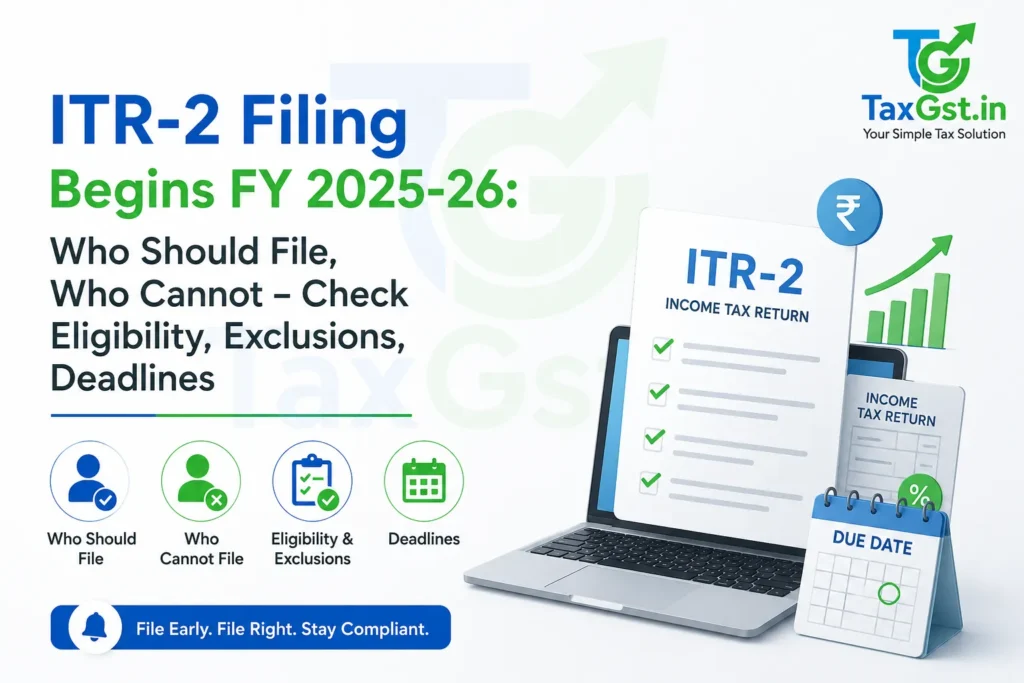
With the start of the income tax return (ITR) filing season for FY 2025-26 (AY 2026-27), taxpayers must carefully assess which ITR form applies to them. ITR-2, designed for individuals and Hindu Undivided Families (HUFs) without business or professional income, is often misunderstood. Choosing the wrong form—or filing it incorrectly—can lead to notices, delays in refunds, or even invalid returns. As per the latest notification by the Central Board of Direct Taxes (CBDT), significant changes have been introduced in ITR-2 for AY 2026-27, including revised capital gains reporting and new disclosure requirements.
Quick Summary
- ITR-2 is for individuals and HUFs without income from business or profession, but with income from salary, house property, capital gains, foreign assets, or other sources.
- You cannot file ITR-2 if you have business or professional income—use ITR-3 instead.
- Key changes in AY 2026-27: Removal of old 15% and 10% capital gain rate fields, new layout to declare late revision fees under Section 234I, and simplified representative assessee details.
- Due date for filing ITR-2 for FY 2025-26 is 31st July 2026 under Section 139(1).
Who Is Eligible to File ITR-2?
ITR-2 applies to individuals and HUFs who do not have income under the head “Profits and Gains of Business or Profession.” This includes taxpayers earning from:
- Salary or pension
- Income from more than one house property
- Capital gains (short-term or long-term) from sale of investments, property, or shares
- Income from other sources (e.g., interest, dividends, lottery winnings)
- Agricultural income exceeding ₹5,000
- Resident Not Ordinarily Resident (RNOR) or Non-Resident Indian (NRI) status
Additionally, if you are a director in a company or have invested in unlisted equity shares, you must file ITR-2 regardless of income size, as per CBDT guidelines. The form also requires strict disclosure of foreign assets and offshore accounts under Schedule FA for ordinary residents.
Who Cannot File ITR-2?
Taxpayers with income from business or profession—even if minimal—must file ITR-3. This includes freelancers, consultants, doctors, lawyers, and intraday stock traders. Even if your primary income is a corporate salary, any side business-related earnings disqualify you from using ITR-2.
Moreover, individuals eligible for ITR-1 (such as those with total income up to ₹50 lakh from a single salary source, one house property, and basic interest) may technically choose to file ITR-2, but it is highly advisable to use ITR-1 for faster processing unless advanced disclosures are needed.
Confused About Complex Capital Gains or Schedule FA?
A single reporting mismatch under the new tax laws can trigger automated direct tax notices or delay your refunds for months. Avoid the stress of manual calculation errors.
Major Changes in ITR-2 for AY 2026-27
The Finance Act and subsequent CBDT notifications under the Income-tax (Third Amendment) Rules, 2026 have introduced key updates:
AY 2026–27 Capital Gains Tax Directory
To prevent reporting mismatches inside Schedule Capital Gains, taxpayers must adhere to the rationalized tax structures introduced by recent structural amendments. Below is the updated asset class directory:
Practical Example: Capital Gains Reporting
Suppose Mr. Sharma, a salaried employee in Delhi, sold equity shares in March 2026 for a long-term capital gain of ₹8 lakh. He also earned ₹6 lakh as salary and ₹1.2 lakh as interest income. Since he has no business income, he files ITR-2. Under the standard regime, his LTCG is taxed at 12.5% (not 10%) and he must report it in Schedule 112A. If he opts for the old regime, he may claim deductions under Chapter VI-A, but HRA exemption will apply only if he chooses the old tax regime explicitly in Part A of ITR-2.
Remember: Verification of the return must be done by the taxpayer themselves (for individuals) or the Karta (for HUFs), as per Section 265 of the Income-tax Act, 2025. Any mismatch in authorized signatory can render the return invalid—as seen in the ITAT Bangalore case of RGUHS vs ACIT (2026), where an appeal was dismissed due to improper verification by a Finance Officer rather than the authorized Principal Officer.
Also Read-Corrigendum to ITR Form 1 and Form 4: What Indian Taxpayers Need to Know After April 11, 2026
High-Value Transaction Mapping: The Seventh Proviso to Section 139(1)
Even if your net taxable income stands below the basic exemption threshold, filing ITR-2 remains legally compulsory if you trigger any criteria listed under the Seventh Proviso to Section 139(1). The system maps these via automated AI routines integrated with banking databases:
- Current Account Deposits: Aggregate cash or electronic deposits exceeding ₹1 Crore across one or more current accounts during the previous year.
- Savings Account Deposits: Total cash deposits exceeding ₹50 Lakh in one or more savings accounts.
- Foreign Travel: Expenditure exceeding ₹2 Lakh for yourself or any other person traveling abroad.
- Electricity Consumption: An aggregate electrical utility bill payment exceeding ₹1 Lakh during the financial year.
Step-by-Step Process to File ITR-2 Online
Filing ITR-2 online through the Income Tax e-Filing portal is simple if you follow the correct sequence. Here’s a step-by-step guide to help you file accurately and avoid common mistakes:
1. Login to the Income Tax Portal
- Visit the Income Tax e-Filing portal and log in using:
- User ID: PAN Number
- Password: Your registered password
- Before proceeding, ensure:
- Your PAN is active
- PAN is linked with Aadhaar
Important: If PAN is not linked with Aadhaar, the system may restrict access or show warnings due to an inoperative PAN status.
2. Start a New ITR Filing
Navigate to: e-File → Income Tax Returns → File Income Tax Return
- Select Assessment Year (AY) 2026–27
- Choose “Online” filing mode
- Click “Start New Filing”
- Select the applicable taxpayer category:
- Individual
- HUF (Hindu Undivided Family)
- From the return list, choose ITR-2
3. Verify General Information (Part A)
Once inside the form, begin with Part A – General Information.
Check and verify pre-filled details such as:
- Name
- PAN details
- Mobile number and email ID
- Address information
Also confirm:
Residential Status
- Resident
- RNOR (Resident but Not Ordinarily Resident)
- Non-Resident (NRI)
Tax Regime Selection
Confirm whether you are opting out of the new tax regime under Section 115BAC(6).
Important: Choosing the Old Tax Regime is necessary if you want to claim benefits like:
- HRA exemption
- Deductions under Chapter VI-A (such as Section 80C, 80D, etc.)
4. Fill the Relevant Schedules Carefully
Schedule Salary
Enter salary or pension income based on Form 16.
- Verify salary breakup and TDS details
- Claim HRA exemption only if the old tax regime is selected
- Under the new regime, HRA-related fields may not appear
Schedule House Property
Report income from one or multiple house properties. Include:
- Rental income (if any)
- Home loan interest
- Self-occupied property details
- Loss from house property, where applicable
Schedule Capital Gains
Disclose capital gains earned from:
- Shares
- Mutual Funds
- Property sale
- Other investments
Include:
- STCG (Short-Term Capital Gains)
- LTCG (Long-Term Capital Gains)
Tax Alert: Gains after July 2024 may attract revised tax treatment:
- STCG under Section 111A – 20%
- LTCG under Section 112A – 12.5%
Schedule FA (Foreign Assets)
This schedule is mandatory for residents having:
- Foreign bank accounts
- Overseas investments
- Foreign financial interests or assets
Schedule AL (Assets & Liabilities)
Applicable if total income exceeds ₹50 lakh. Disclose:
- Immovable assets
- Investments
- Jewellery, vehicles, etc.
- Liabilities, if applicable
5. Review Tax Computation & Payment
Before submission, carefully review:
- Total Income
- Tax Paid
- TDS/TCS credits
- Refund or tax payable amount
If additional tax is payable:
- Pay through Net Banking
- Generate a challan and complete payment
6. Complete e-Verification (Final Step)
Your filing is completed only after successful verification.
You can e-verify using:
- Aadhaar OTP
- Digital Signature Certificate (DSC)
- Pre-validated bank account
Don’t Miss: Complete e-verification within 30 days of return submission to avoid the return being treated as invalid.
This version is more scannable, SEO-friendly, and easier for readers to follow on a blog.
Required Documents and Pre-Filing Checklist
Before starting ITR-2, gather these essential documents:
Note: If you deposited an aggregate amount exceeding ₹1 crore in one or more current accounts during the previous year, disclosure is mandatory under the seventh proviso to Section 139(1).
Common Mistakes That Trigger Notices
Even minor errors can lead to scrutiny. Avoid these pitfalls:
- Wrong Verification Party: As per Section 265 of the Income-tax Act, 2025, only the individual taxpayer themselves or the Karta (for HUFs) can verify the return. Authorizing an incorrect signatory on the portal can render the return completely invalid—as established in the ITAT Bangalore precedent of RGUHS vs ACIT (2026).
- Mismatch Between Form 16 and ITR: Claiming HRA in your ITR when your employer didn’t incorporate it in your Form 16 creates a mismatch that system cross-checks flag automatically.
- Omitting Schedule FA: Residents holding foreign stock options (ESOPs) or overseas bank accounts must disclose them. Failure to do so invites heavy penalty notifications.
- Incorrect Tax Regime Selection: Leaving the default new regime selected blocks access to HRA or standard deductions. Always verify your regime preference in Part A.
- Misinterpreting Section 234I Fee Windows: Remember that revised returns filed before 31st December are completely free. If you revise after 31st December but before 31st March, ensure the corresponding ₹5,000 late revision fee is reported in the designated field to avoid processing delays.
Pro Tips for Smooth ITR-2 Filing
✅ Expert Tip: Always pre-validate your target bank account and make sure your PAN-Aadhaar links are fully established before filing. This ensures refunds are credited seamlessly and avoids “inoperative PAN” flags. Use the offline utility for complex capital gains calculations to automate exemption adjustments.
For NRIs or RNORs, remember that only Indian-sourced income is taxable. However, if you’re an ordinary resident, global income must be reported. Also, if your total income exceeds ₹50 lakh, don’t skip Schedule AL—even movable assets like jewellery or luxury vehicles must be declared.
Next Steps Checklist
- Verify your residential status in Part A of ITR-2—this determines whether you must disclose foreign assets (Schedule FA) or qualify for DTAA benefits.
- Select the correct tax regime before filling out income fields. If claiming HRA or Chapter VI-A deductions, opt out of the default new tax regime under Section 115BAC(6).
- Cross-check capital gains entries with your consolidated broker statements. Ensure post-23 July 2024 gains are reported at 20% (STCG) or 12.5% (LTCG).
- Authorize the correct “Key Person” on the e-filing portal per Section 265: individuals must verify themselves; HUFs require the Karta.
- Pre-validate your primary bank account to prevent systemic electronic payment processing delays on your upcoming tax refunds.
- E-verify within 30 days of submission using Aadhaar OTP, DSC, or net banking to complete the structural filing process.
Frequently Asked Questions
Can I file ITR-2 if I have income from freelance work?
No. Any income under “Profits and Gains of Business or Profession”—including freelance, consulting, or gig work—disqualifies you from using ITR-2. You must file ITR-3 instead, even if your primary income is salary.
What happens if I select the new tax regime but try to claim HRA exemption?
HRA exemption under Section 10(13A) is not available under the new tax regime. If you select the new regime, the HRA field will not appear in the ITR-2 utility. To claim HRA, you must explicitly opt out of the new regime in Part A before entering salary details.
Is Schedule AL mandatory for all ITR-2 filers?
Schedule AL (Asset and Liability Statement) is required only if your total income exceeds ₹50 lakh during the financial year. NRIs and RNORs need to disclose only Indian-situated assets and liabilities.
Who can verify an ITR-2 return for an HUF?
As per Section 265 of the Income-tax Act, 2025, the return of an HUF must be verified by the Karta. If the Karta is absent from India, any other adult member of the family may verify it. Unauthorized verification can render the return completely invalid.
What is the deadline for filing ITR-2 for FY 2025-26?
The due date for filing ITR-2 for FY 2025-26 (AY 2026-27) is 31st July 2026 under Section 139(1). Late filings filed up to 31st December attract late fees under Section 234F and restrict loss carry-forward options.
Do I need to report capital gains from virtual digital assets (VDAs) in ITR-2?
Yes. Income from the transfer of virtual digital assets (cryptocurrency, NFTs) must be reported in Schedule VDA within ITR-2. Such gains are taxable at a flat 30% without indexation benefits or loss offsetting under Section 115BBH.
Can I revise my ITR-2 after filing, and what is the fee?
Yes, you can file a revised return under Section 139(5). Under the new guidelines, you can revise free of charge until 31st December 2026. Revisions made late between 1st January and 31st March 2027 incur a fee of ₹5,000 (₹1,000 if total income ≤ ₹5 lakh) under Section 234I.
Sources
- TaxGuru — Income Tax Return Verification Guidelines
- TaxGuru — HRA Exemption in ITR Filing 2026
- Income Tax Portal — ITR Form Applicability
- Income Tax Portal — Notification No. 46/2026 (ITR-2 Amendment)
- ClearTax — Section 234I Late Fee on Revised Return Rules
- ClearTax — ITR-2 Filing Guide
- Income Tax India — ITR-2 Form Layout (AY 2026-27)
- Income Tax Portal — How to File ITR-2 Online
Choosing the right ITR form and filing it accurately protects your refunds, prevents scrutiny notices, and ensures your tax profile matches PFRDA and CBDT tracking metrics. With key updates in AY 2026-27, from capital gains adjustments to verification protocols, staying informed is your best defense against processing delays.
Article Information
Published: May 28, 2026
Last Reviewed: May 28, 2026
Category: Income Tax
Regulatory Body: CBDT (Central Board of Direct Taxes)
Written by C.K. Gupta, M.Com & Tax Editor at TaxGST.in — helping 500+ clients navigate IT notices, GST audits, and ITR filings across Delhi NCR since 2009.
Official Resources
Disclaimer: This article is for informational purposes only. For legal advice, consult a qualified tax professional. Always refer to the original source document for authoritative information.
Discover more from TaxGst.in
Subscribe to get the latest posts sent to your email.



Stay Updated!
Join our community for latest tax updates, GST news & finance tips