
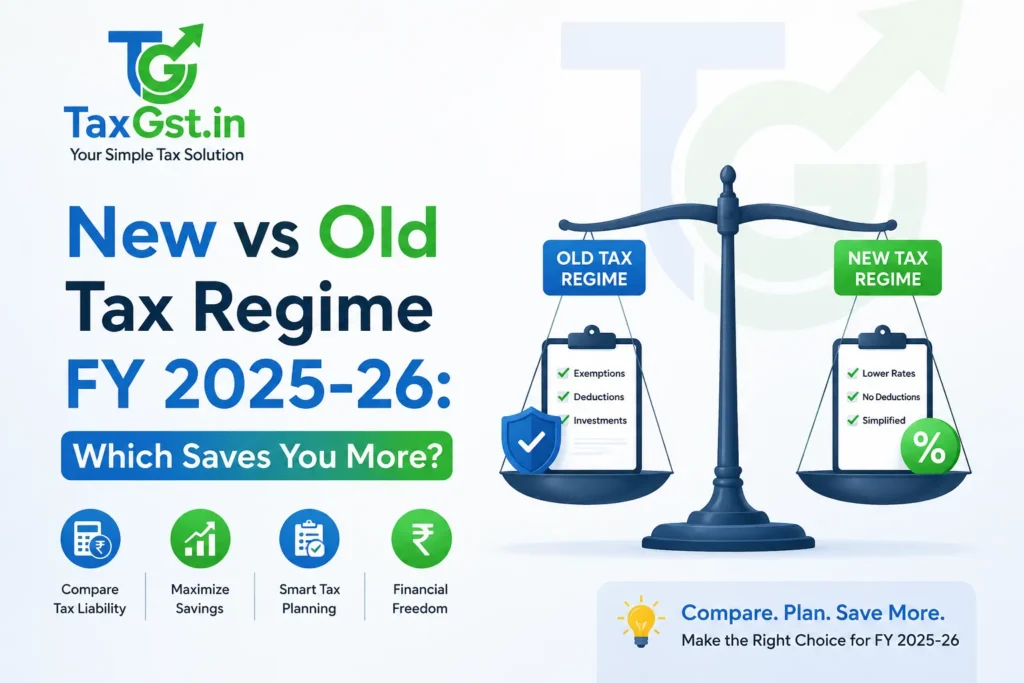
You could save up to ₹37,100 in taxes this year simply by choosing the right regime — but only if you understand the fine print. With the Union Budget 2025 introducing significant tweaks to the new tax regime and leaving the old one largely untouched, taxpayers are once again at a crossroads. As we move into Tax Year 2026–27 (covering income earned from April 1, 2025, to March 31, 2026), the decision between the old and new tax regimes isn’t just about slabs — it’s about your entire financial ecosystem: deductions, exemptions, HRA, LTA, home loan interest, and even how you structure your salary.
Also Read-New TDS Portal TRACES 2.0 Launched: A Major Leap in TDS Compliance
From our experience advising salaried professionals, small business owners, and senior citizens, we’ve seen that over 60% of taxpayers who switched to the new regime in FY 2024–25 ended up paying more tax than necessary because they didn’t factor in the loss of key deductions. This year, the gap has narrowed — but the devil is still in the details. Let’s break down what’s changed, what hasn’t, and how you can make the optimal choice for your situation.
Quick Summary
- New regime is now the default – Unless you explicitly opt for the old regime, your employer will deduct tax under the new slabs.
- No major changes to old regime slabs – The basic exemption limit remains ₹2.5 lakh, with 5%, 20%, and 30% brackets unchanged under Section 115BAC (old).
- New regime gets a boost – Basic exemption raised to ₹3 lakh; 30% slab threshold increased to ₹15 lakh; standard deduction of ₹50,000 now available even under new regime.
- Action required by June 15, 2026 – If you want to claim deductions under the old regime, ensure your employer has your Form 124 declaration before the end of the financial year.
- Senior citizens get relief – Those above 75 years with pension income can now file zero-tax returns under the new regime if income ≤ ₹10 lakh.
How This Affects Your Tax Bill
The new tax regime under Section 115BAC (as amended in Finance Act, 2025) has been made more attractive without dismantling the old structure. For the first time since its introduction in 2020, the new regime offers a meaningful trade-off: lower rates with fewer deductions, but now with a higher exemption base and the reintroduction of the standard deduction — a move that directly benefits salaried individuals. 💡 Note: Thanks to the Section 87A rebate, if your total income after standard deduction is up to ₹7 lakh in the new regime, your net tax liability remains Nil.
Under the old regime (still governed by the Income-tax Act, 1961, as it stood before the 2020 amendment), you retain access to over 70 deductions and exemptions — including Section 80C (₹1.5 lakh), HRA, LTA, home loan interest (Section 24), medical insurance (80D), and more. But the tax slabs are steeper: 5% kicks in at ₹2.5 lakh, 20% at ₹5 lakh, and 30% at ₹10 lakh. In contrast, the new regime delays the 20% slab until ₹12 lakh and the 30% slab until ₹15 lakh — a significant buffer for middle-income earners.
Here’s the kicker: the new regime is now the default. If you don’t submit a declaration to your employer opting for the old regime, your TDS will be calculated under the new slabs — and you won’t be able to claim most deductions at the time of filing your return. While you can still switch regimes when filing ITR, doing so without proper planning often leads to underpayment or overpayment of tax during the year.
Tax Slab Comparison: Old vs New Regime (FY 2025–26)
Note: Surcharge and health & education cess (4%) apply as per income levels in both regimes.
Smart Tax Planning Moves for Tax Year 2026–27
The key to optimizing your tax outgo lies in running a side-by-side computation — not just once, but at least twice during the year: once during budget season (February–March) and again in October–November when you finalize your investment declarations.
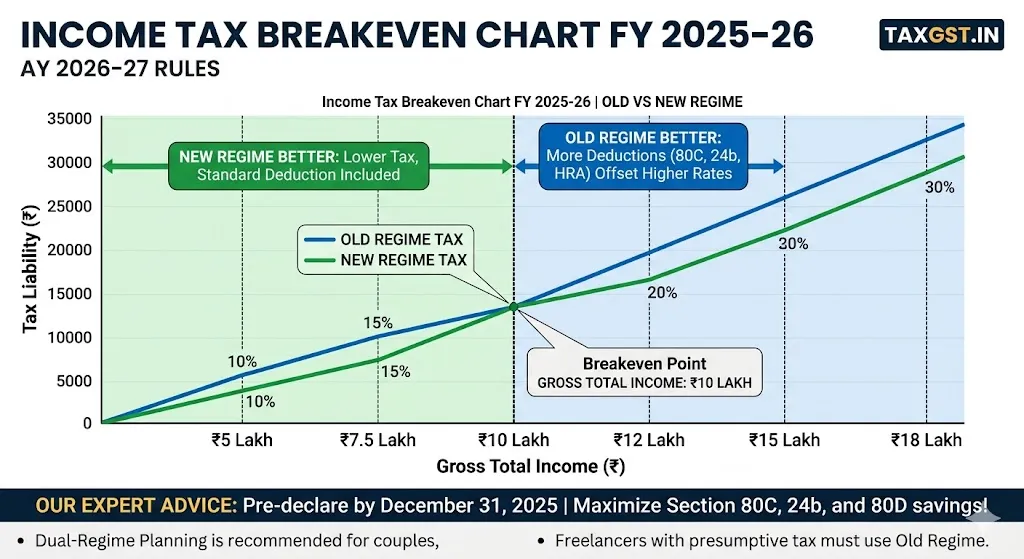
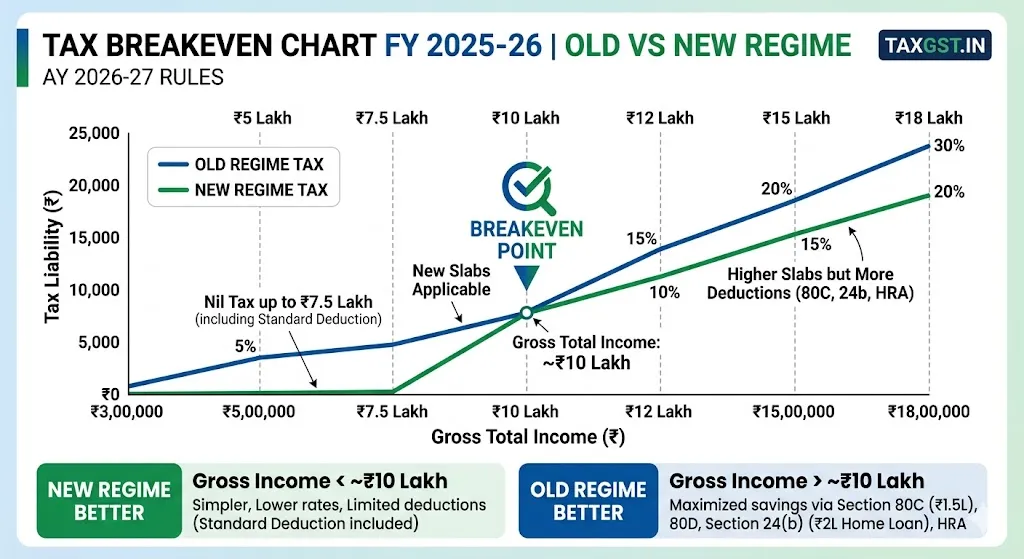
For example, consider a salaried individual earning ₹12 lakh annually. Under the old regime, after claiming ₹1.5 lakh under Section 80C, ₹25,000 under 80D, and ₹50,000 as standard deduction, taxable income drops to ₹9.75 lakh. Tax payable: ~₹78,000. Under the new regime, with ₹50,000 standard deduction (now allowed!), taxable income is ₹11.5 lakh. Tax payable: ~₹70,000. Net saving: ₹8,000.
But if that same person has a home loan with ₹2 lakh interest repayment (Section 24) and HRA of ₹1.8 lakh, the old regime could reduce taxable income to ₹7.95 lakh — bringing tax down to ~₹49,500. Suddenly, the old regime saves ₹20,500 more.
We also recommend pre-declaring your regime choice to your employer by December 31, 2025. While the due date for Form 124 is technically March 31, 2026, many HR departments finalize payroll configurations by January. Submitting late could mean incorrect TDS for 2–3 months, leading to interest under Section 234C if you end up underpaying.
Deductions You Should Not Miss (Old Regime)
If you’re leaning toward the old regime, here are the top deductions that still pack a punch:
- Section 80C: ₹1.5 lakh via PPF, ELSS, life insurance, EPF, NSC, or tuition fees.
- Section 24(b): Up to ₹2 lakh on home loan interest for self-occupied property.
- HRA Exemption: Available if you live in rented accommodation — can save ₹1–3 lakh in taxable income depending on city.
- Standard Deduction: ₹50,000 for salaried individuals (also now available in new regime, but more valuable in old due to higher marginal rates).
- Section 80D: ₹25,000 for self/family health insurance; ₹50,000 if parents are senior citizens.
- LTA: Leave Travel Allowance — claimable twice in a block of 4 years (e.g., 2022–2025 block closed; next block opens April 2026).
Remember: You cannot cherry-pick. Once you choose the old regime, you must forgo all new-regime-exclusive benefits (like the higher 30% slab threshold), and vice versa.
The Optimal Strategy: Who Should Choose What?
Based on our client data from FY 2024–25, here’s a practical guide:
One emerging trend we’re seeing: dual-regime planning for couples. If one spouse has high deductions (e.g., home loan) and the other doesn’t, they may file jointly under the old regime while the lower-earning spouse uses the new regime for their separate income — maximizing household savings.
Common Pitfalls to Avoid
Even seasoned taxpayers trip up on these points:
- The “Automatic Switch” Myth – Some believe that if they don’t claim deductions in ITR, they’re automatically on the new regime. Not true! You must explicitly declare your regime choice in ITR-1 or ITR-2. Failing to do so may lead to scrutiny.
- Ignoring Form 124 When Changing Jobs – If you switch employers mid-year, your new employer will deduct tax based on your declaration. If you don’t submit Form 124 stating your preferred regime and previous salary details, your Form 130 (replacing Form 16) will be incomplete — and you might end up double-taxed or under-deducted.
- Overestimating 80C Utilization – Many assume they’ve maxed out ₹1.5 lakh, but forget that EPF contributions (employee share) are auto-included. If your basic salary is ₹50,000/month, your EPF alone is ₹6,000/month — ₹72,000/year. Add PPF ₹50,000 and ELSS ₹28,000, and you’re at ₹1.5 lakh. But if you’ve only invested ₹30,000 in PPF, you’re leaving money on the table.
- Missing the June 15 Deadline for Form 130 – While the Act says June 15, 2027, for Tax Year 2026–27, we always advise our corporate clients to aim for May 31. TRACES portal traffic spikes in June, and delays can push processing into July — risking late filing penalties under Section 234F.
Related Articles:
Frequently Asked Questions
Q: Can I switch regimes every year?
Yes — but with caveats. Salaried individuals can switch annually. However, if you have business income, you can only switch back to the old regime once in your lifetime (under Section 115BAC(6)). Choose wisely.
Q: Is the standard deduction really available in the new regime?
Yes! From FY 2025–26, the new regime includes a ₹50,000 standard deduction for salaried individuals — same as the old regime. This was a game-changer introduced in the 2025 Budget.
Q: What happens if I don’t declare my regime to my employer?
Your employer will deduct tax under the new regime by default. You can still switch when filing ITR, but you’ll need to reconcile TDS credits and may face interest if tax liability increases.
Q: Are there any new deductions in the new regime?
No. The new regime still disallows most deductions (80C, 80D, HRA, LTA, etc.), except the standard deduction and transport allowance for disabled persons. The benefit comes purely from lower slabs and higher exemption limits.
As we head into Tax Year 2026–27, the message is clear: there is no one-size-fits-all answer. The new regime is simpler and increasingly competitive — especially for those without major deductions. But for homeowners, senior citizens, and high-deduction claimants, the old regime still holds strong value.
Our advice? Run the numbers twice. Declare early. And if you’re unsure, consult a tax professional before March 31, 2026. A ₹500 consultation could save you ₹30,000 — and that’s a return even your best mutual fund would envy.
Article Information
Published: May 12, 2026
Category: Income Tax
Official Resources
Disclaimer: This article is for informational purposes only. For legal advice, consult a qualified tax professional. Always refer to the original source document for authoritative information.
Discover more from TaxGst.in
Subscribe to get the latest posts sent to your email.



Stay Updated!
Join our community for latest tax updates, GST news & finance tips