
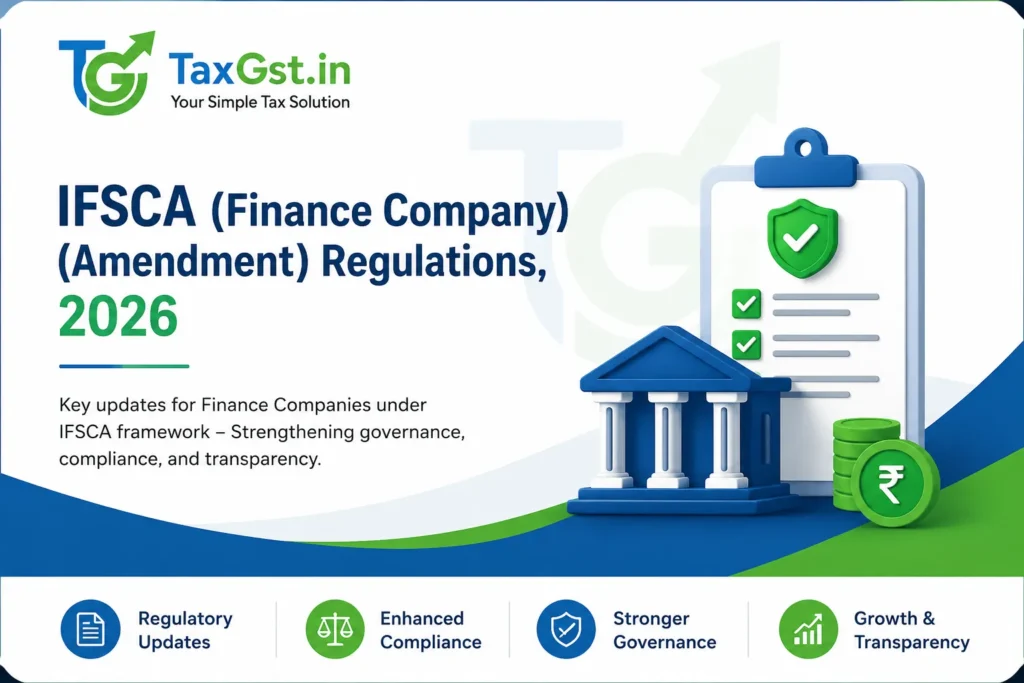
As a finance company operating in or looking to establish a presence within an International Financial Services Centre (IFSC), the IFSCA (Finance Company) (Amendment) Regulations, 2026 are not just another regulatory update—they’re a strategic pivot that could significantly impact your tax planning, compliance burden, and operational flexibility. Whether you’re a fintech startup eyeing GIFT City or an established NBFC expanding into cross-border lending, these amendments bring both opportunities and tighter scrutiny. From revised capital adequacy norms to new reporting mandates under the Income-tax Act, 2025, understanding these changes isn’t optional—it’s essential for staying compliant and competitive in Tax Year 2026–27.
Also Read-DGFT Export Import Policy Updates 2026 – New Trade Regulations
What’s particularly noteworthy this time is how the International Financial Services Centers Authority (IFSCA) has aligned its regulatory framework with global best practices while simultaneously tightening anti-avoidance measures. The amendments aim to bolster investor confidence, enhance transparency, and plug loopholes that were previously exploited through aggressive structuring. For you, this means clearer guidelines on permissible activities—but also stricter documentation and real-time disclosure requirements. In short: more freedom to operate internationally, but with a much heavier compliance backpack.
Quick Summary
- Key Change: Revised definition of “finance company” now includes fintech-enabled lending platforms and excludes pure payment aggregators.
- Who’s Affected: All IFSC-registered finance companies, including those offering digital credit, forex services, or cross-border guarantees.
- Action Required: Update your internal compliance protocols, review capital structure, and ensure Form 130 filings reflect new income categorizations.
- Deadline: Full compliance by March 31, 2027 for Tax Year 2026–27, though we recommend implementation by December 2026 to avoid year-end bottlenecks.
Key Regulatory Shifts Under the 2026 Amendments
The IFSCA (Finance Company) Regulations were first notified in 2020 to provide a unified regulatory framework for entities operating in IFSCs. The 2026 amendments refine several core provisions—most notably around eligible activities, minimum capital requirements, and tax-resident status determination. One of the biggest shifts is the explicit inclusion of algorithm-driven credit underwriting platforms within the definition of a finance company. This means if your entity uses AI/ML models to assess borrower risk and disburse loans—even without physical branches—you’re now squarely under IFSCA’s purview.
Conversely, pure-play payment intermediaries (like those facilitating UPI-to-foreign wallet transfers without assuming credit risk) have been carved out. This exclusion is critical: it prevents regulatory overlap with RBI’s payment guidelines and reduces compliance duplication. However, if your platform offers even incidental credit facilities—say, a 7-day interest-free advance on remittances—you’re back in the finance company bucket.
Another major change relates to minimum paid-up capital. Earlier, the threshold was ₹50 crore for most finance companies. Now, it’s tiered based on activity type:
This tiering reflects IFSCA’s risk-based approach—higher capital for activities with greater systemic exposure. For fintechs focusing on small-ticket lending, the reduced threshold is a welcome relief. But cross-border players must now inject additional capital or restructure their balance sheets ahead of the March 2027 deadline.
Tax Implications: What Changed Under the Income-tax Act, 2025?
While the IFSCA regulations themselves don’t impose taxes, they directly influence how your income is characterized under the Income-tax Act, 2025—especially for entities claiming benefits under Section 80LA (deduction for IFSC units). The 2026 amendments clarify that only income derived from “permissible financial services” qualifies for the 100% deduction in the first five years and 50% thereafter.
Crucially, the term “permissible financial services” now explicitly excludes:
- Income from speculative trading (even if conducted via IFSC platforms)
- Revenue from non-compliant related-party transactions lacking arm’s length documentation
- Fees earned from services not directly linked to core financing activities (e.g., standalone advisory without loan linkage)
This has immediate consequences for your Form 130 filing. Under the new three-part structure, Part C (Annexure-II) now requires detailed bifurcation of income streams attributable to IFSC operations versus non-IFSC activities. If more than 15% of your total revenue comes from excluded activities, the entire deduction under Section 80LA may be disallowed—not just the proportionate amount.
We’ve already seen draft scrutiny notices from the Income Tax Department questioning IFSC units that reported high “other income” without proper segmentation. The message is clear: granular accounting isn’t optional anymore.
Eligibility Criteria Demystified
To qualify as an IFSC-registered finance company post-amendment, you must meet three layered tests:
The PoEM requirement is particularly tricky. Many clients assume that incorporating in GIFT City automatically confers tax residency. Not true. The CBDT has emphasized that board meetings, strategic decisions, and key personnel locations must all point to the IFSC. We recommend maintaining detailed minutes, IP logs of virtual meetings, and payroll records of senior executives to substantiate PoEM claims during audits.
How to Claim Benefits: Documentation & Filing Nuances
Claiming Section 80LA benefits now requires more than just a certificate from IFSCA. You’ll need to submit:
- A Board Resolution certifying that 60%+ of activities are cross-border (retained for 8 years)
- RegTech compliance reports from IFSCA-empanelled vendors (submitted quarterly)
- Arm’s length documentation for all related-party transactions, even if below ₹10 crore (new threshold under Section 92D)
- Form 130, Part C with Annexure-II showing income segregation by activity type
Note: Form 130 must be issued digitally via TRACES only—no physical copies accepted. If you’ve changed jobs mid-year (e.g., moved from a domestic NBFC to an IFSC unit), file Form 124 with your new employer immediately. This ensures your previous salary and TDS details carry forward correctly into the consolidated Form 130. We’ve seen cases where missing Form 124 led to double taxation on transition-year income—a completely avoidable error.
Maximum Benefit Scenarios
Let’s say you run a fintech finance company in GIFT City with ₹200 crore in cross-border loans and ₹30 crore in domestic microcredit. Under the old rules, your entire ₹230 crore book qualified for Section 80LA. Now, only the ₹200 crore portion does—but at a lower capital cost (₹75 crore vs. ₹50 crore previously).
Assuming a 25% effective tax rate, your tax savings look like this:
Tax Savings Calculation (Tax Year 2026–27):
- Qualifying income: ₹200 crore
- Deduction @ 100% (Year 1): ₹200 crore
- Tax saved @ 25%: ₹50 crore
Note: Domestic microcredit income (₹30 crore) is taxed at full rate unless routed through a separate non-IFSC entity.
This is why restructuring your book by activity type—not just by geography—is now a tax optimization imperative.
Common Pitfalls to Avoid
From our practice, these are the three most frequent missteps we see with IFSC finance companies post-amendment:
- The “Blended Income” Trap
Many entities pool all revenues into a single ledger account, making it impossible to segregate permissible vs. non-permissible income. During assessment, the AO disallows the entire Section 80LA claim. Solution: Implement activity-based costing from Day 1. Use separate GL codes for cross-border lending, guarantees, and ancillary services. - Overlooking RegTech Mandates
IFSCA’s approved vendor list changes quarterly. Using an outdated AML tool—even if it worked last year—invalidates your compliance status. We had a client fined ₹25 lakh for using a non-empanelled AI fraud detection system. Solution: Subscribe to IFSCA’s regulatory alert service and assign a compliance officer to track updates. - Misjudging PoEM
Holding board meetings via Zoom from Mumbai while claiming GIFT City as PoEM won’t fly. The recent Blackstone case reinforced that substance over form applies. Solution: Relocate at least two key decision-makers (CEO/CFO) to the IFSC and maintain physical attendance logs.
Related Articles:
Frequently Asked Questions
Q: Am I eligible if my finance company only lends to Indian exporters in foreign currency?
Yes—provided the borrower is an Indian resident but the loan is denominated in USD/EUR and repaid offshore. This qualifies as cross-border lending under the amended definition. Just ensure your loan agreements specify the foreign currency clause and repayment mechanism.
Q: What if my income exceeds the 15% non-permissible threshold due to one-off advisory fees?
You can ring-fence such income by routing it through a separate non-IFSC subsidiary. However, beware of Section 93 (anti-avoidance for artificial separation). The transaction must have commercial substance—not just tax motive.
Q: Can I still claim MAT credit under the new regime?
Yes, but only against non-80LA income. MAT paid on permissible IFSC income cannot be carried forward. Plan your transition carefully—especially if you’re in Year 3 of the 100% deduction window.
Q: How does this affect my GST registration in the IFSC?
GST remains separate. However, ensure your GST registration under Rule 14A aligns with your new activity classification. Mixed supplies now require separate SAC codes for lending vs. advisory.
The IFSCA (Finance Company) (Amendment) Regulations, 2026, mark a maturation of India’s IFSC ecosystem—from experimental sandbox to globally integrated financial hub. For you, this means greater legitimacy and access to international capital markets, but also unforgiving scrutiny on compliance. The key isn’t just to comply, but to embed these requirements into your operational DNA. Start by auditing your current book against the new activity definitions, upgrade your RegTech stack, and revisit your PoEM documentation. And remember: in the world of IFSCs, being “almost compliant” is the same as being non-compliant.


Stay Updated!
Join our community for latest tax updates, GST news & finance tips