
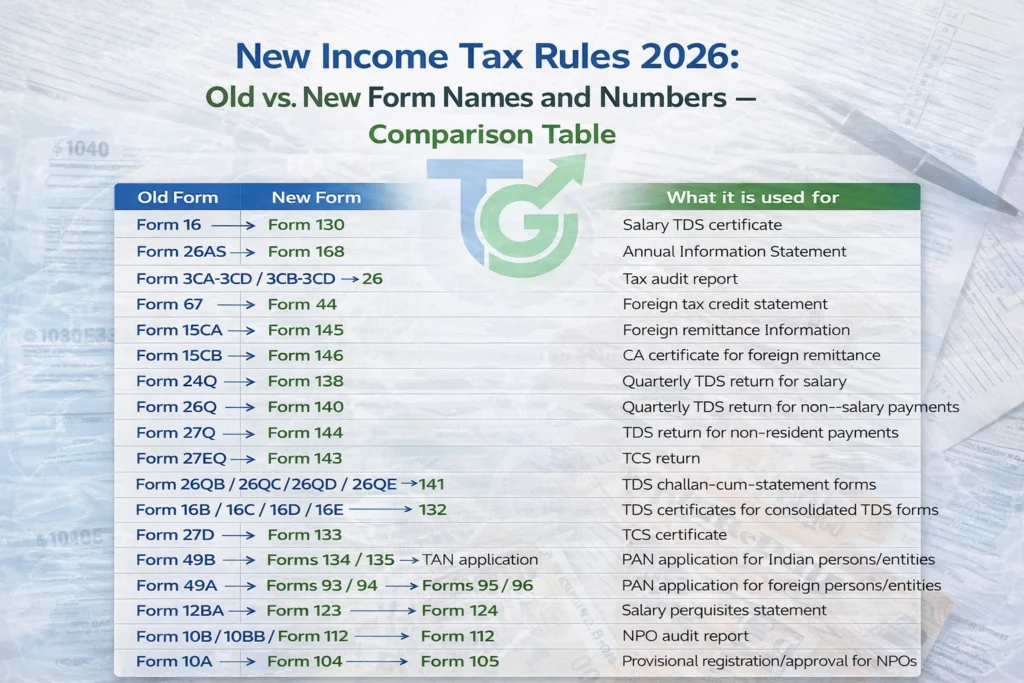
Imagine you’re sitting at your desk in early April 2026, coffee in hand, ready to file your ITR for the financial year 2025–26. You open the income tax portal, expecting the usual forms—ITR-1, ITR-2, Form 16, Form 26AS—but instead, you’re greeted with a completely revamped interface. New form names, updated structures, and unfamiliar workflows greet you. Don’t panic. This isn’t a glitch—it’s the new normal under the Income Tax Rules, 2026, which came into effect on April 1, 2026. If you are a salaried employee, employer, business owner, CA, or tax filer, this migration sheet will help you quickly understand which old form maps to which new form and what changes matter from 1 April 2026 onward.
“The Income Tax Rules 2026 introduce a completely revamped form numbering system across all compliance categories, replacing the legacy structure built over decades.”
The biggest thing to remember is simple: for FY 2025‑26 and earlier, old forms still apply, but for filings from FY 2026‑27 onward, the new form structure will be used. This is especially important for salary certificates, TDS/TCS returns, PAN/TAN applications, audit reports, and foreign remittance forms.
Quick Summary of Key Changes (Effective April 1, 2026):
- Form 26AS is now Form 168 (Financial Diary) – a unified record of all tax-related transactions.
- Form 15G and Form 15H are merged into Form 121 (Unified Declaration) for TDS exemption claims.
- Assessment Year (AY) is replaced by Tax Year (TY) – e.g., AY 2026–27 becomes Tax Year 2026.
- ITR deadlines remain similar but are now aligned with the new Tax Year structure.
- All new forms apply from April 1, 2026; FY 2025–26 filings still use old forms for processing.
What This Means for You
For most taxpayers, form names are not something they think about every day. But when the form number changes, it can create confusion in filing, payroll, and professional reporting.
The 2026 overhaul is not just cosmetic; it is part of the broader shift to the Income‑tax Act, 2025 and the Income‑tax Rules, 2026, notified by the Central Board of Direct Taxes (CBDT) through Notification No. G.S.R. 198(E) dated 20 March 2026. These new rules come into force from 1 April 2026 and are meant to streamline compliance, reduce duplication, and align forms with modern digital workflows.
The Income Tax Department has also published a dedicated set of FAQs and Guidance Notes on Forms as per Income‑tax Rules, 2026, which serves as the official reference for taxpayers and professionals.
Off‑Registry Checks and Visual Cues
As you design articles or tools for your users, keep a simple checkpoint in mind:
- Old regime + FY 2025‑26 and earlier → Old form numbers (Rules, 1962).
- New regime / Tax Year 2026‑27 onward → New form numbers (Rules, 2026).
Think of it like a “software upgrade”: the backend logic (tax law) stays broadly the same, but legacy form numbers are being replaced with a cleaner, more logical numbering system.
Income Tax 2026 Migration Table: Old vs. New Form Name Comparison
Beyond the rule notification, many practitioner sites have published detailed mapping tables that align closely with the department’s stated scheme. Below is a consolidated, human‑readable cheat‑sheet ideal for quick reference.
| Old form | New form | What it is used for | Migration note |
|---|---|---|---|
| Form 16 | Form 130 | Salary TDS certificate | Renumbered under the new rules |
| Form 26AS | Form 168 | Annual Information Statement | Renumbered; AIS/26AS now appears as Form 168 |
| Form 3CA‑3CD / 3CB‑3CD | Form 26 | Tax audit report | Consolidated into one new audit form |
| Form 67 | Form 44 | Foreign tax credit statement | Renumbered; new form adds tighter reporting |
| Form 15CA | Form 145 | Foreign remittance information | Renumbered; purpose remains the same |
| Form 15CB | Form 146 | CA certificate for foreign remittance | Renumbered; purpose remains the same |
| Form 24Q | Form 138 | Quarterly TDS return for salary | Renumbered |
| Form 26Q | Form 140 | Quarterly TDS return for non‑salary payments | Renumbered |
| Form 27Q | Form 144 | TDS return for non‑resident payments | Renumbered |
| Form 27EQ | Form 143 | TCS return | Renumbered |
| Form 26QB / 26QC / 26QD / 26QE | Form 141 | TDS challan‑cum‑statement forms | Consolidated into one form |
| Form 16B / 16C / 16D / 16E | Form 132 | TDS certificates for consolidated TDS forms | Consolidated into one certificate form |
| Form 27D | Form 133 | TCS certificate | Renumbered |
| Form 49B | Forms 134 / 135 | TAN application | Split into two new forms |
| Form 49A | Forms 93 / 94 | PAN application for Indian persons/entities | Renumbered and split by applicant type |
| Form 49AA | Forms 95 / 96 | PAN application for foreign persons/entities | Renumbered and split by applicant type |
| Form 12BA | Form 123 | Salary perquisites statement | Renumbered |
| Form 12BB | Form 124 | Employee deduction declaration | Renumbered; HRA‑related details are more specific |
| Form 10B / 10BB | Form 112 | NPO audit report | Consolidated into one audit report form |
| Form 10A | Form 104 | Provisional registration/approval for NPOs | Renumbered |
| Form 10AB | Form 105 | Registration/approval for NPOs | Renumbered |
| Form 10AC | Form 106 | Order for provisional registration/approval | Renumbered |
| Form 10AD | Form 107 | Order for grant/rejection/cancellation of registration or approval | Renumbered |
| Form 15G / 15H | Form 121 | Declaration for no TDS on certain incomes | Consolidated into one form number |
| Form 10E | Form 39 | Relief claim on salary, gratuity, pension commutation, etc. | Renumbered |
What Changed the most
The most noticeable changes are in salary and TDS compliance. For example, Form 16 becomes Form 130, and Form 26AS becomes Form 168, which means employees and employers will need to get used to the new numbering quickly.
Another major change is the consolidation of related forms. Several old forms that used to be separate (such as various TDS challan‑cum‑statement forms) are now merged into one new form, which should reduce duplication and keep paperwork more organized.
Government‑level citations and key links
The legal and procedural backbone of this migration is:
- Income‑tax Act, 2025 — the new principal Act replacing the Income‑tax Act, 1961.
- Income‑tax Rules, 2026 — notified by CBDT through Notification No. G.S.R. 198(E), dated 20 March 2026, and effective from 1 April 2026.
- Official FAQs and Guidance Notes on Forms as per Income‑tax Rules, 2026, hosted on the Income Tax India portal: https://www.incometaxindia.gov.in/faqs‑and‑guidance‑notes‑on‑forms‑as‑per‑income‑tax‑rules‑2026.
Step-by-Step Guidance for the Transition
If you’re filing your return for FY 2025–26 (due by July 31, 2026, for salaried individuals), you’ll still use the old ITR forms (ITR-1 to ITR-7) because the assessment and processing for that year are governed by the pre-2026 framework. However, starting April 1, 2026, all new filings—such as those for FY 2026–27—will require the new forms under the Income Tax Rules, 2026. The government has provided a clear migration path: old forms will continue to be accepted for past years, but new submissions must use the updated versions. For example, when you file your ITR for FY 2026–27 in 2027, you’ll use the new ITR forms (likely renamed or restructured), and your Form 16 will reference Form 168 instead of Form 26AS.
To avoid confusion, always check the tax portal’s form selector tool, which now includes a toggle between “Legacy Forms (Pre-2026)” and “New Forms (2026 Onward).” When submitting declarations to banks or employers, use Form 121 instead of the old 15G/15H. If you’re a senior citizen earning interest below ₹50,000 annually, you can submit Form 121 once to all institutions to avoid TDS. The form is auto-validated against your PAN and income records, reducing the chance of rejection. Employers, too, must adapt: they’ll now generate Form 16 using data from Form 168, ensuring that all deductions, exemptions, and tax payments are accurately reflected.
Practical Implications for Different Taxpayers
For salaried individuals, the transition is relatively smooth. Your employer will continue to deduct tax under Section 192 using the new tax slabs (e.g., 5% from ₹4–8 lakh, 10% from ₹8–12 lakh, etc.), and your Form 16 will be based on Form 168. However, you must ensure that your investment declarations (for 80C, 80D, etc.) are submitted using the new formats if your company has updated its HR systems. If you’re claiming a rebate under Section 87A, remember that the threshold is now ₹12 lakh (up from ₹7 lakh), and the rebate amount is ₹60,000. So, if your taxable income is ₹12 lakh, your tax liability is ₹60,000, but the full rebate brings it down to zero.
Business owners and freelancers will notice bigger changes. The new ITR forms (ITR-3, ITR-4) now require more detailed disclosures, including digital payment trails and GST reconciliation. If you’re under the presumptive taxation scheme (Section 44AD), you’ll need to upload a summary of your Form 168 data to validate turnover claims. The e-filing portal now auto-populates data from GST returns, bank statements, and AIS, so discrepancies can trigger instant alerts. For example, if your GSTR-3B shows ₹1.2 crore in turnover but your ITR-4 declares only ₹90 lakh, the system will flag it for verification.
Senior citizens and pensioners benefit the most from Form 121. Previously, they had to submit Form 15H to every bank where they held fixed deposits. Now, a single Form 121 submission to the income tax portal auto-shares the declaration with all financial institutions linked to their PAN. This reduces paperwork and ensures consistent TDS treatment. the higher zero-tax limit (₹12 lakh) means many pensioners won’t owe any tax at all, especially if their income is from pensions, interest, and small investments.
Common Mistakes to Avoid
One of the biggest pitfalls is using old form names in official communications. For instance, writing “as per Form 26AS” in a loan application or audit report after April 2026 may cause confusion or rejection. Always refer to Form 168 (Financial Diary) in new documents. Similarly, don’t submit Form 15G to your bank in 2026—use Form 121 instead. Another common error is assuming that the new tax slabs apply retroactively. They don’t. For FY 2025–26, the old slabs (with ₹7 lakh rebate limit) still apply for assessment purposes, even though the new rules are in force.
Taxpayers also often overlook the importance of updating their declarations. If you’ve submitted Form 15G in March 2026 for FY 2025–26, it’s still valid for that year. But for FY 2026–27, you must submit Form 121. Failing to do so could result in unnecessary TDS deductions. don’t assume that all banks and employers have migrated to the new system overnight. Some may still request old forms during the transition period—always confirm with them directly.
Did You Know?
- The new Form 168 includes data from over 30 sources, including banks, mutual funds, and property registrars, making it the most comprehensive financial snapshot ever issued to Indian taxpayers.
- Form 121 can be submitted digitally via the income tax portal, and once approved, it’s automatically shared with all PAN-linked institutions—no need to visit banks individually.
- The shift to “Tax Year” instead of “Assessment Year” aligns India with over 120 countries that use similar terminology, simplifying cross-border tax compliance for NRIs and global businesses.
“The 2026 form migration is less about changing tax liability and more about cleaning up six decades of legacy form numbering into a single, coherent system.”
Key Points to Remember:
- Use Form 168 (Financial Diary) instead of Form 26AS for all post-April 2026 filings and verifications.
- Submit Form 121 (Unified Declaration) to avoid TDS on interest—no more separate Form 15G/15H submissions.
- The Tax Year (e.g., Tax Year 2026) replaces Assessment Year in all new documents and notices.
- Old forms are still valid for FY 2025–26 assessments, but new filings from FY 2026–27 must use updated forms.
- Always verify form names with the income tax portal before submitting to banks, employers, or auditors.
Frequently Asked Questions (FAQs)
Q1: Can I still use Form 26AS after April 2026? No, Form 26AS has been officially replaced by Form 168 (Financial Diary) from April 1, 2026. While old Form 26AS data may still be accessible for past years, all new tax validations, loan applications, and return filings must reference Form 168. The new form includes additional data like GST credits, foreign income, and high-value transactions, making it more comprehensive. As per Notification No. 22/2026, dated March 15, 2026, all institutions must accept Form 168 as the primary tax record.
Q2: What happens if I submit Form 15G in 2026? Submitting Form 15G after April 1, 2026, may result in rejection or delayed processing, as banks and financial institutions are now required to accept only Form 121 (Unified Declaration) for TDS exemption claims. Form 121 is auto-validated against your PAN and income records, reducing errors. If you’ve already submitted Form 15G for FY 2025–26, it remains valid for that year, but for FY 2026–27, you must use Form 121.
Q3: How does the Tax Year change affect my ITR filing? The shift from “Assessment Year” to “Tax Year” is primarily terminological but affects how returns are labeled and processed. For example, income earned in FY 2026–27 will be filed under “Tax Year 2027,” not “AY 2027–28.” This change aligns India with global standards and simplifies cross-border tax reporting. However, the financial year (April–March) and filing deadlines remain unchanged.
Q4: Will my old ITR forms stop working? No, old ITR forms (ITR-1 to ITR-7) will continue to be accepted for filings related to FY 2025–26 and earlier years. However, for FY 2026–27 and beyond, new forms under the Income Tax Rules, 2026, will be mandatory. The e-filing portal will guide you to the correct form based on the financial year selected.
Q5: How do I access Form 168? Form 168 (Financial Diary) can be downloaded from the income tax e-filing portal under “My Account” > “View Financial Diary.” It’s auto-generated based on data from banks, employers, GSTN, and other sources. You can view, download, or share it digitally. It replaces Form 26AS and is required for all post-2026 tax verifications.
Q6: Are there penalties for using old forms after the transition? While there’s no direct penalty for using old form names in informal contexts, official submissions (e.g., to banks, employers, or auditors) may be rejected if they reference outdated forms. The income tax department has issued circulars urging all stakeholders to adopt the new forms. As per CBDT Notification No. 22/2026, non-compliance with form standards may lead to processing delays or scrutiny.
Final Thoughts
The 2026 form migration may look confusing at first, but the logic is straightforward once you see the mapping. Most changes are about renumbering, consolidation, and smoother compliance, not about changing the basic tax obligation itself.
If you keep this cheat sheet handy, you can avoid confusion while filing returns, issuing certificates, or preparing tax documents under the new structure.
The migration to the new income tax forms in 2026 marks a significant step toward a more transparent, integrated, and user-friendly tax system. While the transition may seem daunting at first, the long-term benefits—reduced paperwork, fewer errors, and faster processing—make it worthwhile. By staying informed and adapting early, taxpayers can navigate this change smoothly and avoid common pitfalls. Always refer to the official income tax portal and cited notifications for the latest updates.
Discover more from TaxGst.in
Subscribe to get the latest posts sent to your email.




Stay Updated!
Join our community for latest tax updates, GST news & finance tips