
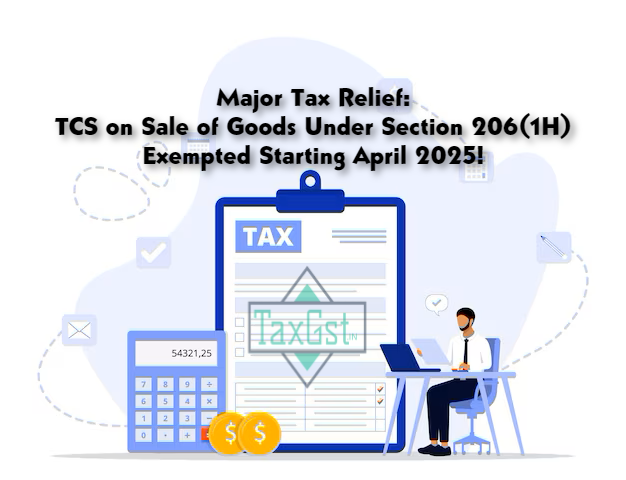
Understanding the Shift: Why Section 206(1H) Is Being Withdrawn.
Introduced in 2020, Section 206(1H) mandated sellers to collect 0.1% TCS on the sale of goods exceeding ₹50 lakhs in a financial year. While intended to enhance tax transparency, the provision faced criticism for complicating cash flow management, especially for SMEs and e-commerce platforms. The government’s decision to revoke this clause reflects feedback from stakeholders and aligns with its broader agenda of fostering ease of doing business.Key Features of Section 206C(1H) (Till March 31, 2025):
- Applied to sellers with ₹10+ crore turnover in the previous year.
- TCS triggered on receipts over ₹50 lakh from a buyer.
- Exemptions for government entities, embassies, and specific goods.
| Aspect | Before April 1, 2025 | After April 1, 2025 |
| Applicability | TCS on goods sales above ₹50L | No TCS under Section 206(1H) |
| Rate | 0.1% | 0% (Exempted) |
| Compliance Burden | Monthly returns and reporting | Reduced paperwork |
| Impact on Sellers | Cash flow constraints | Improved liquidity |
Why Was Section 206C(1H) Removed?
The removal stems from overlapping tax compliance between TCS (seller’s duty) and TDS under Section 194Q (buyer’s duty). Both provisions applied a 0.1% tax on the same transaction, leading to confusion and redundant compliance efforts.Key Issues Addressed:
- Double Taxation: Sellers struggled to verify if buyers had already deducted TDS under Section 194Q.
- Compliance Burden: Tracking TDS/TCS applicability increased operational costs.
- Liquidity Blockage: Businesses faced cash flow issues due to dual tax deductions.
Post-April 2025: What Changes?
| Aspect | Before April 2025 | After April 2025 |
|---|---|---|
| Applicability | Sellers > ₹10 crore turnover | Section 206C(1H) abolished |
| Tax Rate | 0.1% TCS on receipts > ₹50 lakh | No TCS on sale of goods |
| Compliance Check | Verify TDS deduction by buyer | Only TDS under Section 194Q applies |
| Exemptions | Exports, government buyers, specific goods | N/A |
Example:
Impact on Businesses.
- Reduced Compliance: Sellers no longer need to track TDS status of buyers.
- Lower Costs: Savings on administrative efforts and penalties for non-compliance.
- Improved Liquidity: Funds previously locked in TCS are now available for operations.
What Businesses Need to Do Now.
- Update Accounting Systems: Remove TCS modules linked to Section 206(1H).
- Re-educate Teams: Train finance departments on the revised tax framework.
- Monitor Transition: Stay alert for circulars clarifying transitional returns for FY 2024-25.
Latest Studies and Expert Opinions.
A 2024 NITI Aayog study applauds the move, estimating a 12% reduction in tax-related litigation and a ₹8,000 crore liquidity boost for SMEs. Tax expert Rohit Gupta notes, “This exemption will empower businesses to focus on growth rather than bureaucratic compliance.”FAQs: TCS Under Section 206(1H) Withdrawal.
Q1. Does this exemption apply to services or international transactions?
No, only the sale of goods under Section 206(1H) is exempt. TCS on services (Section 206C(1G)) and overseas remittances (Section 206C(1H)) remain unchanged.Q2. Are historical TCS filings still required?
Yes, businesses must file returns for transactions up to March 31, 2025.Q3. Will GST replace TCS on goods?
Indirect taxes like GST remain separate. The TCS withdrawal only affects income tax compliance.Conclusion: A New Era for Indian Businesses.
The exemption of TCS under Section 206(1H) is a landmark decision, signaling the government’s responsiveness to industry needs. By eliminating redundant compliance layers, India moves closer to becoming a global business hub. Companies must leverage this flexibility to innovate, scale, and contribute to the nation’s economic vision.Disclaimer: The information provided in this article is for general informational purposes only and should not be construed as professional tax or legal advice. While we strive to ensure the accuracy and reliability of the content, tax laws and regulations are subject to change. Readers are advised to consult a qualified tax advisor or legal professional for entity-specific guidance. The author and publisher disclaim any liability for actions taken based on the information provided herein.Discover more from TaxGst.in
Subscribe to get the latest posts sent to your email.




Stay Updated!
Join our community for latest tax updates, GST news & finance tips