
 C.K. Gupta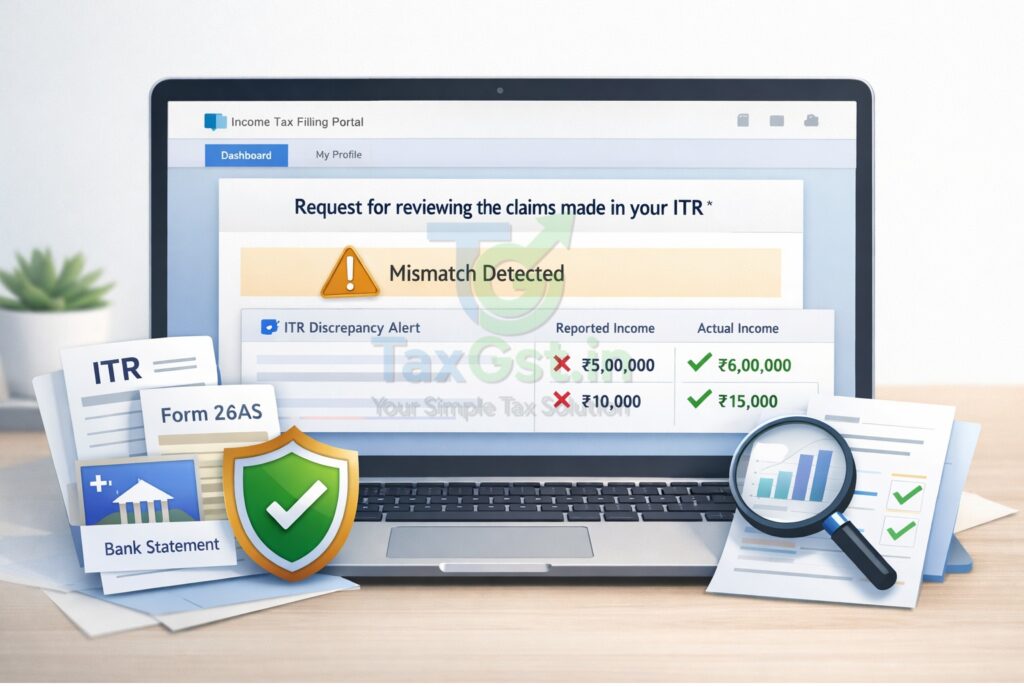
It is a scenario that makes every taxpayer’s heart skip a beat. You have filed your return, verified it, and are patiently waiting for that “refund credited” message. Instead, your phone buzzes with an SMS or an email from the Income Tax Department. The subject line mentions a discrepancy, a “risk,” or a proposal to adjust your claim.
If you have received such an ITR mismatch email recently—specifically one titled “Request for reviewing the claims made in your ITR“—you are not alone. In the last few years, and particularly during the current assessment cycle, the tax department has significantly ramped up its use of technology. They are no longer just processing returns; they are actively comparing them against a massive database of financial transactions.

While these communications can look strict, they are often not formal scrutiny notices. They are part of an automated compliance mechanism designed to alert you about differences between what you declared and what the government already knows. Here is a comprehensive guide on why these emails are being sent, how to verify the data, and the exact steps you need to take to ensure your income tax refund on hold doesn’t turn into a scrutiny case.
Also Read-New Insurance Rules 2025: How the ‘Sabka Bima Sabki Raksha’ Act Affects You
Why the Sudden Surge in Automated Flags?
The Income Tax Department has moved away from manual checking to a system driven by Artificial Intelligence and Machine Learning. The objective is to identify tax evasion or honest mistakes instantly, rather than waiting for years to open a scrutiny case.
As per the specific email alerts sent in December 2025, the department is holding refunds under the “Risk Management Framework.” This system cross-references your ITR data with third-party information available in:
- Annual Information Statement (AIS) and Taxpayer Information Summary (TIS): This includes interest income, dividends, stock market transactions, and mutual fund sales.
- Form 26AS: Details of Tax Deducted at Source (TDS).
- Form 16: Salary details provided by your employer.
- SFT Reports: Statement of Financial Transactions filed by banks, registrars, and credit card companies regarding high-value spends or deposits.
When the computer detects that you have claimed a deduction (like Section 80C or HRA) that is significantly higher than what is reflected in your Form 16, or if you have omitted income that appears in your AIS, it triggers an automated advisory.

This is why you might see a status saying income tax refund on hold. The system pauses the processing to give you a chance to explain the discrepancy or revise your return, rather than immediately issuing a demand notice.
The latest email alerts explicitly warn that inaction “may be construed as a deliberate choice,” potentially leading to a detailed investigation. It is not just a gentle nudge anymore; it is a final opportunity to correct errors before formal legal action begins.
Advisory vs. Scrutiny: Knowing the Difference.
Many taxpayers panic because they confuse a preliminary query with a formal scrutiny assessment. It is crucial to understand the difference to decide your next course of action.
A Mumbai-based Chartered Accountant explains, “Most emails taxpayers are receiving right now are part of the ‘e-Verification’ or ‘e-Campaign’ scheme. These are essentially polite nudges asking, ‘Are you sure you didn’t forget this?’ They are not the same as a Section 143(2) scrutiny notice, which is a formal legal investigation.”
Here is a quick comparison to help you identify what you have received:
| Feature | Advisory / Risk Management Email | Intimation u/s 143(1) | Scrutiny Notice u/s 143(2) |
|---|---|---|---|
| Primary Purpose | To alert you about a data mismatch (e.g., AIS mismatch) and request clarification. | To inform you that the return has been processed and confirm the tax payable or refund due. | To conduct a detailed legal examination of your books and claims. |
| Tone | Informative and cautionary. Warns of “Risk Management” checks. | Factual and computational. Shows “As provided by taxpayer” vs “As computed by Dept”. | Formal and legal. specific questions regarding evidence. |
| Action Required | Verify data on the Compliance Portal. Revise ITR if needed. | No action if you agree. File rectification or pay demand if there is a calculation error. | Mandatory participation in e-proceedings; usually requires professional help. |
| Consequence of Ignoring | Refund withheld; high chance of future scrutiny. | Demand becomes final and recoverable. | Penalty, prosecution, and “Best Judgment Assessment” (ex-parte). |
Common Triggers for Claims Verification.
The automated emails often flag specific areas where deduction claim verification is difficult for the system to validate automatically. Based on the latest communications from the department, here are the top triggers:
1. The Form 16 Mismatch (Annexure-II).
The department is specifically flagging cases where there is a “significant mismatch between the exemption claim in the ITR vis-a-vis amounts reported by the employer in Form 16.”
The Issue: Employees often claim HRA or LTA directly in the ITR without submitting proofs to their HR.
The Fix: If you have genuine proof (rent receipts, travel tickets), you can stand by your claim. The mismatch is merely a flag, not a rejection.
2. High Refund relative to TDS.
Another specific flag mentioned in recent emails is: “You have claimed significant refund out of TDS deducted on receipt of Salary Income.”
The Issue: This suggests that your final tax liability is drastically lower than what your employer calculated, likely due to new deductions (like 80G donations or 80D insurance) added at the time of filing.
The Fix: Ensure you have receipts for every single new deduction added.
3. Missing Bank Interest.
Many taxpayers overlook savings account interest or Fixed Deposit interest, assuming “TDS has already been cut, so I don’t need to report it.” This is incorrect. The gross interest must be reported. Since banks report this interest in the SFT and AIS, any omission in the ITR leads to an immediate AIS mismatch flag.
Step-by-Step: What to Do After Receiving the Email.
Do not ignore the email, and do not rush to file a revised return without checking the facts. Follow this routine:
Step 1: Check the Deadline.
The recent emails contain a strict deadline. You are typically requested to file a Revised Return on or before 31st December 2025. If you miss this, you may have to file an “Updated Return” (ITR-U) which comes with additional tax liability.
Step 2: Login and Check the Compliance Portal.
The email usually directs you to the “Compliance Portal” or “e-Campaign” tab.
- Log in to the Income Tax e-filing portal.
- Go to the “Pending Actions” tab.
- Select “Compliance Portal”.
- Look for “e-Verification” or “High Value Transactions”.
Here, you will see the specific transaction or claim the department is questioning.

Step 3: Compare with Your AIS.
Download your latest Annual Information Statement (AIS). The AIS is dynamic and is updated frequently. It is possible that when you filed your return in July, the interest income was shown as ₹10,000, but the bank later updated it to ₹15,000. This difference causes the flag.
Step 4: Revise Your Return (If Needed).
If you realize you made a mistake—such as claiming an exemption you aren’t eligible for—you should file a Revised Return under Section 139(5).
- Procedure: In the ITR form, select “Revised u/s 139(5)” and quote the acknowledgement number of the original return. Correct the data and re-verify.
- Important: If you have already filed a Revised Return addressing these issues, the email says you can “kindly ignore this message.”
When Should You Consult a CA?
While simple mismatches like forgotten bank interest can be handled by the taxpayer, some situations require professional help.
If the email refers to “Risk Management” regarding complex capital gains, foreign assets, or massive variances in turnover (for business owners), it is safer to consult a Chartered Accountant. As per Section 143(1)(a) of the Income-tax Act, the department can make “prima facie” adjustments, but responding to specific queries regarding the source of funds or legal interpretation of exemptions requires expertise.
Furthermore, if your income tax refund on hold status persists even after you have responded to the communication, a professional can help raise a grievance or check if there is an outstanding demand from previous years that is being adjusted against your current refund.
Frequently Asked Questions (FAQs) on ITR Mismatch Emails.
Why did I get an email about a “mismatch” in my ITR claims?
Is the ITR mismatch email a formal scrutiny notice?
My income tax refund is on hold. Will responding to this email help?
What is a “Form 16 mismatch” mentioned in the email?
What should I do if the information flagged in the email is actually correct?
What is the deadline to take action after receiving this email?
What happens if I ignore the ITR mismatch email?
Do I need a Chartered Accountant (CA) to respond to this email?
Disclaimer: The information provided in this article is for educational purposes only and is based on the current income tax rules and recent department communications. Tax laws are subject to change. Readers are advised to consult with a qualified Chartered Accountant or tax professional before making any decisions based on this information. Taxgst.in is not responsible for any actions taken based on this article.
Trusted Authorities & References.
To ensure the accuracy of this article, we have referred to the following official sources:
- Income Tax Department Communication: Official email alerts regarding the ‘Risk Management Framework’ and ITR Claims Review (December 2025).
- Central Board of Direct Taxes (CBDT): Guidelines on the ‘e-Verification Scheme, 2021’ and Risk Management Strategy.
- The Income-tax Act, 1961: Specifically Section 139(5) (Revised Return), Section 143(1) (Intimation), and Section 143(2) (Scrutiny).
- Official Portal: www.incometax.gov.in (For accessing AIS and e-Proceedings).
Related Reading
- Extension of ITR Filing Deadline? 11 Glitches on E-Filing ITR Portal
- New Income Tax Return Filing Portal Features for AY 2026-27
- Last Call: No Extension for I.T.R Filing Deadline – Hurry Up!
Discover more from TaxGst.in
Subscribe to get the latest posts sent to your email.



Never Miss a Tax Deadline Again
Due-date alerts, GST updates and tax tips — free on the app you already use.
event Next: TDS Return (138 / 140) · 31 Oct