C.K. Gupta
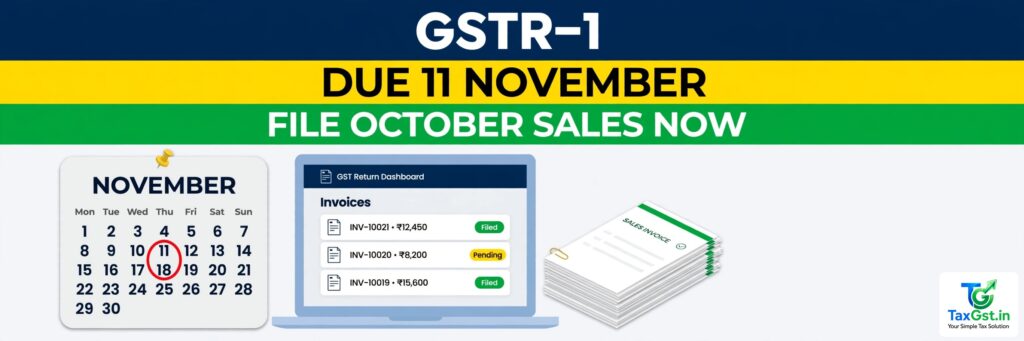
Monthly filers must file GSTR-1 for October 2026 by 11 November 2026. A late GSTR-1 costs ₹50 a day (₹20 for a nil return), capped at ₹500–₹10,000 by turnover under Notifications 19/2021 and 20/2021-Central Tax — but the real cost is downstream: until your invoices are on the portal, your buyers cannot claim their ITC, and their GSTR-2B for October is generated on 14 November from what you file. And 30 November is the last day to correct any FY 2025-26 invoice. Verified November 2026 · TaxGST.in
It is 10 November, your October sales are billed, and GSTR-1 is due tomorrow. Plenty of businesses treat it as the “easy” return — no tax is paid with it, so a day late feels harmless. Here’s the catch: GSTR-1 is the return your customers’ input tax credit depends on. File late, and their 2B comes up short; file wrong, and the mismatch notice lands on both of you. This is the one return where your delay becomes somebody else’s problem.
For the full November picture, see the complete November compliance calendar with every GST, income-tax and ROC deadline in one place — GSTR-3B follows on 20 November, and the 30 November ITC cut-off closes the FY 2025-26 books for good.
Who files by 11 November, and who gets longer
Every regular monthly filer reports October’s outward supplies in GSTR-1 by 11 November 2026. That covers B2B invoices, exports, credit and debit notes, advances and the HSN summary. Quarterly (QRMP) filers report the whole October–December quarter by 13 January 2027 instead — but they still pay tax monthly, and they can push individual months’ invoices through the Invoice Furnishing Facility (IFF) by the 13th of the following month if their buyers need the credit sooner.
One hard rule catches first-time defaulters: under Rule 59(6) of the CGST Rules, the portal will not let you file GSTR-1 for October if your GSTR-3B for September is still pending. Clear the backlog first — the sequence is enforced, not advisory.
What a late GSTR-1 actually costs
The late fee under Section 47 of the CGST Act is notified at ₹50 a day (₹25 CGST + ₹25 SGST), or ₹20 a day for a nil return. The total per return is capped by your aggregate turnover in the preceding financial year:
| Your turnover last year | Late fee per day | Maximum per return |
|---|---|---|
| Nil return (no outward supplies) | ₹20 | ₹500 |
| Up to ₹1.5 crore | ₹50 | ₹2,000 |
| ₹1.5 crore to ₹5 crore | ₹50 | ₹5,000 |
| Above ₹5 crore | ₹50 | ₹10,000 |
A worked example: a business with ₹80 lakh turnover files 12 days late. The fee is 12 × ₹50 = ₹600 — inside the ₹2,000 cap, so ₹600 is what the portal charges. File 45 days late and the same business pays the full ₹2,000 cap, not ₹2,250. Note that GSTR-1 itself carries no tax payment, so no interest runs on it — but a late GSTR-1 usually means a late GSTR-3B too, and that is where 18% interest and the GSTR-3B late fee and interest bill start piling up.
The cost nobody puts on the invoice: your buyers’ ITC
Since the October 2025 tax period, GSTR-2B is generated from the Invoice Management System (IMS): your invoice reaches your buyer’s IMS the moment your GSTR-1 is filed, and the buyer’s 2B for October is generated on 14 November. If your GSTR-1 is late, the invoice simply is not there when the buyer’s 2B is drawn — their ITC for October shrinks, their 3B payment rises, and the first call they make is to you.
In practice, this is the conversation that costs more than the late fee: a regular buyer who cannot claim ITC on your invoices starts asking for the credit in the price, or starts looking for a supplier whose paperwork arrives on time. If your ITC is already missing from your own 2B for another reason, these 7 real reasons and the fix for each cover the usual causes, from supplier GSTR-1 timing to amendment errors.
Your 11 November checklist
- Reconcile books with GSTR-1 before filing. Every October invoice, credit note and debit note must be in the return — a missed invoice is a missing ITC for your buyer and a mismatch notice for you.
- Check the HSN summary (Table 12). Wrong HSN codes are the single most common GSTR-1 error, and they are expensive to fix later.
- File credit and debit notes in the right month. A credit note for an October supply belongs in October’s GSTR-1, not whenever you get around to it.
- Confirm September’s GSTR-3B is filed. If it is pending, the portal blocks October’s GSTR-1 under Rule 59(6).
- After filing, check IMS. Confirm your buyers have your invoices in their IMS so their 2B on 14 November is complete.
30 November: the deadline behind the deadline
Two separate clocks stop on 30 November 2026. First, it is the last day to claim or correct input tax credit on FY 2025-26 invoices under Section 16(4) — miss it and the credit lapses for good, as the 30 November ITC cut-off guide explains. Second, it is the last day to amend any FY 2025-26 invoice in GSTR-1 under Section 37(3). An error in a 2025-26 invoice that you spot in December cannot be corrected in a later return — the window is closed. If your October GSTR-1 is the last return before that wall, use it to sweep up every pending FY 2025-26 correction now.
And a final warning for chronic defaulters: returns more than three years past their due date can no longer be filed at all on the portal. The system enforces that bar from January 2026, so old pending GSTR-1s are not just late — they are unfileable.
FAQs
What is the last date for GSTR-1 for October 2026?
11 November 2026 for monthly filers. QRMP quarterly filers report the October–December quarter by 13 January 2027, and can use IFF monthly if buyers need the invoices sooner.
What is the late fee for GSTR-1?
₹50 a day (₹20 for a nil return), capped at ₹500 for nil returns, ₹2,000 for turnover up to ₹1.5 crore, ₹5,000 up to ₹5 crore, and ₹10,000 above ₹5 crore — per Notifications 19/2021 and 20/2021-Central Tax, Section 47 of the CGST Act.
Can I file GSTR-1 if my previous GSTR-3B is pending?
No. Under Rule 59(6), the portal blocks GSTR-1 until the GSTR-3B for the preceding tax period is filed. File the pending 3B first.
Why does my buyer care if my GSTR-1 is late?
Their GSTR-2B for October is generated on 14 November from your filed GSTR-1 via IMS. A late GSTR-1 means your invoices are missing from their 2B, so they cannot claim that ITC in October’s 3B.
Can I still correct a FY 2025-26 invoice in GSTR-1?
Yes, but only until 30 November 2026 — the last day for FY 2025-26 amendments under Section 37(3) and for ITC claims under Section 16(4). After that the window closes.
Sources
- Section 47, CGST Act read with Notifications No. 19/2021–Central Tax and No. 20/2021–Central Tax (CBIC) — GSTR-1 late fee ₹50/day (₹20 nil) with turnover-based caps of ₹500/₹2,000/₹5,000/₹10,000.
- Rule 59(6), CGST Rules — GSTR-1 cannot be furnished if GSTR-3B for the preceding tax period has not been furnished.
- Section 16(4), CGST Act and Section 37(3), CGST Act — 30 November 2026 as the last date for FY 2025-26 ITC claims and GSTR-1 amendments.
- GSTN advisories on the Invoice Management System (IMS) — GSTR-2B generated from IMS actions from the October 2025 tax period; October 2026 2B generated 14 November 2026. For the full GST picture, see the GST hub guides and updates.
Discover more from TaxGst.in
Subscribe to get the latest posts sent to your email.