C.K. Gupta
In short
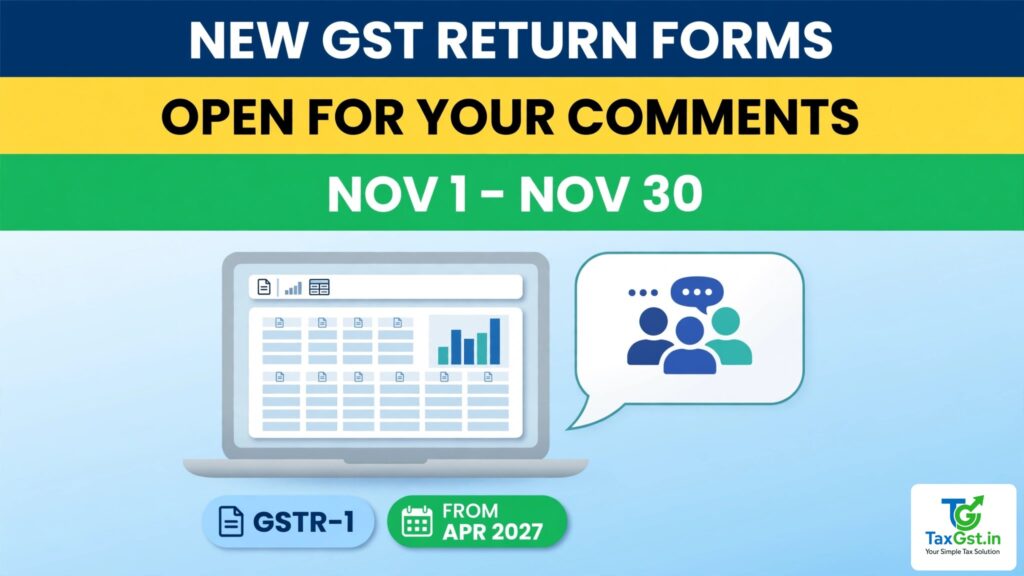
The Finance Ministry will put draft amended GST return forms on the MyGov portal for public comments from 1 November to 30 November 2026. The revamped GSTR-1/1A/IFF will reconcile outward-supply details with GSTR-3B automatically and cut the mismatch notices — which, per the CBIC, account for nearly 80% of all GST notices. The new forms apply from 1 April 2027. Verified October 2026 · TaxGST.in
If you file GST returns, you know the monthly ritual of dread: the auto-generated notice that your GSTR-1 and GSTR-3B do not match. A typo in a HSN total, an amendment entered in the wrong month, a credit note your customer reported differently — and weeks later, an intimation lands on the portal. The government has now admitted the scale of this problem publicly: at a briefing on 22 October 2026, CBIC Commissioner (GST Policy Wing) Gaurav Singh said almost 80% of GST notices are issued because of return mismatches. His fix: redesign the return forms themselves, and — unusually — ask businesses to comment on the drafts before they go live.
This article covers what the draft forms change, how the new in-return amendment mechanism works, and exactly how to submit your comments before the 30 November deadline. For the full backdrop of the reforms driving this change, see our 57th GST Council meeting breakdown, and track every GST deadline on our tax compliance calendar hub.
What was announced on 22 October 2026
According to reports by The Hindu BusinessLine, The Hindu and Deccan Herald (all 22 October 2026, quoting PTI), Commissioner Gaurav Singh said the Finance Ministry will invite comments from businesses on the proposed changes in monthly GST return forms beginning 1 November, with the consultation window open till 30 November 2026 on the MyGov portal.
The draft forms flow from a decision of the 57th GST Council meeting (8 October 2026), which approved an alternate mechanism for amending liabilities and input tax credit (ITC) inside the GST return system — instead of the current workaround where businesses edit their GSTR-3B directly, creating the very mismatches that trigger notices. Singh also said the department is working on streamlining the GST audit process so taxpayers face “no harassment”, and flagged that businesses operating in more than one state currently face multiple audits.
What the draft forms actually change
The headline changes approved by the Council and now heading for consultation:
- GSTR-1, GSTR-1A and IFF get an overhaul. The forms in which businesses report outward supplies (and the Invoice Furnishing Facility used by QRMP-scheme quarterly filers) will be enhanced so the details they carry reconcile automatically with the monthly tax payment form, GSTR-3B.
- An in-return amendment mechanism. Today, if you need to correct a liability or ITC figure, the practical route is editing GSTR-3B — which is precisely what creates the mismatch with GSTR-1. The Council approved an alternate mechanism so corrections happen within the return system, with statutory backing, instead of as off-book 3B edits.
- A better Invoice Management System (IMS). The IMS — the tool buyers use to accept, reject or keep pending the invoices their suppliers report — has been improved based on industry responses about why businesses felt compelled to edit GSTR-3B. The logic, in Singh’s words: “If the need does not arise, there won’t be any case for notice based on mismatches.”
- No GSTR-3B editing culture, no mismatch notices. This is the stated endgame. The 80% figure is the giveaway — the department knows most notices are process noise, not evasion, and wants the redesign to stop generating them.
The timeline: what happens between now and April 2027
| Date | Milestone |
|---|---|
| 8 Oct 2026 | 57th GST Council approves the return-system reforms |
| 23 Oct 2026 | Notifications and circulars on the Council decisions — vetted by the Law department — placed in the public domain |
| 1–30 Nov 2026 | Draft amended return forms on MyGov for public comments (30-day window) |
| 1 Apr 2027 | Amended return forms become applicable |
The consultation matters because this is a genuine design question: the CBIC explicitly built the tweaks on industry responses about why businesses edit their GSTR-3B. If your business has a recurring reason — amendments that straddle months, credit notes that customers book differently, RCM liabilities reported on one form but paid on another — the MyGov window is the place to put it on record.
How to submit your comments (Nov 1–30)
- Log in to mygov.in and watch the consultations section from 1 November — the draft forms will be posted there by the CBIC.
- Download the draft GSTR-1/1A/IFF formats and compare them against the mismatches your business actually faces. The single most useful comment is a concrete one: “we edit 3B because X, and the draft does/doesn’t fix it.”
- Comment before 30 November. The window is 30 days, and the forms go live on 1 April 2027 — there is unlikely to be a second public round.
- Prepare your systems anyway. The April 2027 go-live coincides with several other 57th-Council reforms (ITC reversal-and-reclaim statements, RCM reporting changes, the ARQP scheme). ERP and accounting-software updates take months; start the conversation with your vendor now, not in March.
Small sellers on e-commerce platforms should read this alongside our coverage of GSTN’s new e-invoicing facility for reverse charge transactions (RCMDOM/RCMIMP) — the return-system rebuild touches RCM reporting too, and the details are still being finalised.
What this does NOT change (yet)
- Your current filing stays as-is until April 2027. November, December and all monthly/quarterly filings through March 2027 follow the existing forms and the existing mismatch-notice regime. File on time, reconcile GSTR-1 with 3B the way you always have.
- The notifications are still arriving. The Council-decision notifications hit the public domain on 23 October — read those, not headlines, for the fine print of each approved reform.
- Audit reform is aspirational for now. The “no harassment” audit streamlining and the single-audit question for multi-state businesses were flagged as under review, not decided.
FAQs
Where exactly will the draft forms be published?
On the MyGov portal (mygov.in), the government’s citizen-consultation platform, from 1 November 2026. The CBIC Commissioner confirmed the 30-day comment window runs till 30 November.
Which forms are being changed?
GSTR-1, GSTR-1A and the Invoice Furnishing Facility (IFF) — the outward-supply reporting forms. The changes add an in-return mechanism to amend liabilities and ITC, with better reconciliation against GSTR-3B and an improved Invoice Management System.
When do the new forms become mandatory?
From 1 April 2027, per the CBIC announcement. Filings up to March 2027 use the current forms.
Will this stop GSTR-1 vs GSTR-3B mismatch notices?
That is the stated objective. The CBIC says nearly 80% of GST notices arise from such mismatches, and the redesign aims to remove the need to edit GSTR-3B — the main mismatch source. Existing notices and the current regime remain in force until the switch.
Should a small business bother commenting?
If you have ever edited your GSTR-3B to fix a liability or ITC figure, yes. The CBIC built these tweaks from industry responses on exactly that behaviour — a concrete comment describing your case is more useful than a generic complaint about notices.
Sources
- PTI reports, via The Hindu BusinessLine, The Hindu and Deccan Herald — “Finance Ministry to invite comments on amended GST return forms from November 1” (22 October 2026). Key facts: MyGov consultation 1–30 November 2026; GSTR-1/1A/IFF enhancements; applicability from 1 April 2027; ~80% of notices arise from mismatches; audit-streamlining under review; Law-department-vetted notifications in public domain from 23 October. Quotes attributed to CBIC Commissioner (GST Policy Wing) Gaurav Singh.
- 57th GST Council meeting press release (8 October 2026) — approved the alternate mechanism for amendments to liabilities and ITC in GST returns to minimise mismatches and reduce notices/intimations.
Discover more from TaxGst.in
Subscribe to get the latest posts sent to your email.