
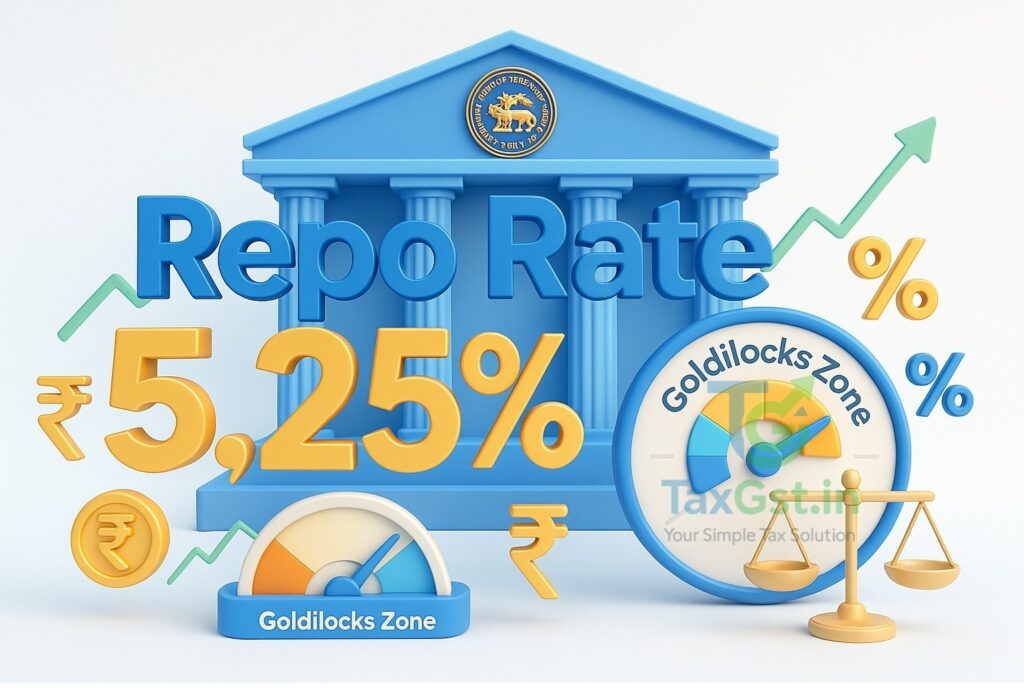
The Reserve Bank of India (RBI) has reduced the key policy repo rate by 25 basis points to 5.25% in its latest Monetary Policy Committee (MPC) meeting held from December 3 to 5, 2025. This unanimous decision by the six-member MPC, headed by Governor Sanjay Malhotra, aims to support growth while inflation remains low and stable, creating a “Goldilocks” situation where the economy is neither overheating nor slowing down too much.
Also Read-Small Company Thresholds Hiked By MCA to ₹10 Cr & ₹100 Cr: MCA Notification G.S.R. 880(E) Dec 2025
Key Decisions of the December 2025 MPC Meeting.
In this policy, the MPC cut the repo rate from 5.50% to 5.25% and decided to maintain a neutral policy stance, which means RBI has kept space open for both future rate cuts and pauses depending on economic data. The committee highlighted that the Indian economy continues to show strong momentum, and policy needs to support growth without allowing inflation to rise again.
RBI also adjusted the Standing Deposit Facility (SDF) rate to 5.00% and the Marginal Standing Facility (MSF) and Bank Rate to 5.50%. Along with the rate cut, RBI announced that it will use tools like open market operations (OMO) and a dollar–rupee swap to inject durable liquidity into the banking system, so that banks have enough money to lend at lower rates.
Key Highlights of the Policy.
The policy meeting, held from December 3 to 5, 2025, concluded with several major decisions:
- Repo Rate Cut: The repo rate (the rate at which RBI lends money to banks) is now 5.25%.
- Neutral Stance: The MPC has decided to maintain a “neutral” policy stance. This means the RBI is keeping its options open to either cut or hold rates in the future depending on how the economy performs.
- Liquidity Measures: To ensure there is enough cash flow in the market, the RBI announced:
- Open Market Operations (OMO) purchases worth ₹1 lakh crore.
- A $5 billion dollar-rupee swap scheduled for December.
What Is Repo Rate and Why It Matters for You.
The repo rate is the interest rate at which RBI lends short-term funds to commercial banks against government securities. When RBI cuts the repo rate, banks can borrow money at a lower cost, and over time they usually pass on this benefit to customers through lower lending rates on home loans, car loans, personal loans and business loans.
Reverse repo rate is the rate at which banks park surplus funds with RBI, and SDF is another tool that allows RBI to absorb extra liquidity from banks. Together with MSF and Bank Rate, these policy rates form the core framework through which RBI influences interest rates in the entire banking system, affecting EMIs, deposit rates and overall borrowing costs in the economy.
How This Rate Cut Affects Home, Car and Personal Loans.
For Indian borrowers, the most direct impact of a repo rate cut is on EMIs of floating-rate loans, especially home loans linked to the external benchmark such as the repo rate or Treasury bill yields. As banks start reducing their lending rates, existing borrowers may see a reduction in EMIs or a shortening of loan tenure over the next few months, depending on how their loan agreements are structured.
New borrowers planning to take home, car or personal loans may get slightly cheaper interest rates as banks compete for customers in a low-rate environment. However, the speed and extent of the benefit will differ from bank to bank, so it is important for customers to compare effective interest rates, processing fees and reset frequency before choosing a lender.
Impact on Fixed Deposits and Savings.
A cut in repo rate generally puts downward pressure on deposit rates over time, as banks’ cost of funds comes down. This means that new fixed deposits may start offering slightly lower interest rates if the easing cycle continues, though banks may move gradually depending on their liquidity position.
The comfort for savers is that retail inflation has fallen sharply and is projected around 2% for FY 2025–26, which is below RBI’s 4% target. Because of this, even if nominal FD rates soften a bit, the real return (FD rate minus inflation) can remain positive, especially in longer-tenure deposits.
Effect on Real Estate, Stock Market and Business Borrowers.
Lower interest rates are usually positive for the housing sector because they improve affordability and sentiment for homebuyers, particularly in cities where ticket sizes are large. Developers also benefit from cheaper project financing and better demand, which can support new launches in both metro and tier-2 cities.
Equity markets tend to welcome rate cuts as they reduce borrowing costs for companies and support consumption and investment demand. Rate-sensitive sectors such as banks, NBFCs, auto, and real estate often see higher investor interest after such policy decisions, though actual performance depends on earnings and broader market conditions.
Why RBI Is Talking About a “Goldilocks” Economy.
India is currently in a rare phase where GDP growth is strong while inflation is low and stable, which is often described as a “Goldilocks” situation. Recent data show real GDP growth at above 8% in the latest quarter, driven by investment, services and government capital spending.
At the same time, headline retail inflation has eased sharply due to lower food prices and soft global commodity prices, allowing RBI to support growth by cutting rates without worrying about immediate inflationary risks. Governor Sanjay Malhotra has indicated that the growth–inflation balance currently provides policy space, but RBI will stay watchful of global uncertainties and currency movements.
The “Goldilocks Zone”: A Sweet Spot for the Economy.
Governor Sanjay Malhotra described the current state of the Indian economy as being in a “rare Goldilocks period.” In economic terms, a Goldilocks economy is not too hot (which causes high inflation) and not too cold (which causes a recession)—it is just right.
Despite facing tough global challenges, including a record-low rupee and high US tariffs, India is enjoying a unique combination of high growth and low inflation.
- GDP Growth: The RBI has raised India’s GDP growth projection to 7.3% for the fiscal year, up from the earlier estimate of 6.8%.
- Inflation: The inflation forecast for FY26 has been lowered to 2%, significantly down from the previous 2.6%.
This “headroom” provided by low inflation allowed the RBI to focus on supporting growth by cutting rates, rather than keeping them high to fight price rises.
Key Takeaways for Indian Households.
- Floating-rate home loan borrowers should track their bank’s external benchmark linked rates (EBLR) and check when the next reset date is due, as the benefit of the repo cut usually flows at the reset date.
- Borrowers with high-interest personal loans or credit card dues can explore balance transfers or consolidation loans if banks reduce rates, to lower their interest burden.
- Individuals planning to buy property or vehicles in the next few months can monitor offers from different banks and housing finance companies, as competition may intensify after the policy.
- Savers who depend heavily on FD interest can consider laddering deposits across different maturities so that not all their money is locked at one rate.
What Small Businesses and Entrepreneurs Should Note.
Micro, small and medium enterprises (MSMEs) and self-employed professionals may benefit from lower working capital and term loan rates as banks reset their marginal cost of funds-based lending rate (MCLR) and external benchmark-based rates. This can ease pressure on cash flows, especially for businesses that depend on bank finance for inventory, expansion or equipment purchases.
However, credit availability also depends on each borrower’s credit profile, collateral and banking relationship, so it is important to maintain a good repayment track record and proper documentation to fully benefit from a soft interest rate cycle. Entrepreneurs should also factor in the possibility that rate cuts may not continue indefinitely and plan their investments with some margin of safety.
Future Outlook: Will Rates Fall Further?
With cumulative rate cuts in 2025, RBI has already provided substantial support to the economy after keeping rates high during the earlier inflation phase. Many analysts believe there might be limited room for aggressive cuts from here, and future decisions will depend on inflation, global interest rate trends and rupee movements.
If inflation stays below or around the 4% target and growth remains steady, there could be scope for one more small cut in 2026, but RBI has clearly signalled that it will move cautiously and data-dependently. For households and businesses, the practical approach is to treat the current environment as a window to optimise loans and investments rather than expecting very sharp further declines in interest rates.
Frequently Asked Questions (FAQs) on RBI Monetary Policy.
What is the current RBI Repo Rate as of December 2025?
Will my Home Loan EMI decrease after this rate cut?
What does the term “Goldilocks Zone” mean in this policy?
How will the repo rate cut affect Fixed Deposit (FD) interest rates?
Why did RBI cut rates despite the falling Rupee?
What is the RBI’s GDP and Inflation forecast for India?
Disclaimer: The information provided in this article is based on the latest RBI policy announcement and is intended for general informational purposes only. It does not constitute professional financial advice. Interest rates on loans and deposits are subject to individual bank policies. Please consult a financial advisor before making investment decisions.
Trusted Authorities and Reference Links.
- Reserve Bank of India – Official Press Releases and Monetary Policy Statements:
https://www.rbi.org.in - RBI Monetary Policy (Common Man Section):
https://www.rbi.org.in/commonman/English/Scripts/PressReleases.aspx - All India Radio / NewsOnAir – Policy repo rate cut and GDP growth update:
NewsOnAir report - NDTV Business – RBI repo rate cut to 5.25% and impact on loans:
NDTV Business article - Economic Times / ET Markets – Key highlights of RBI’s December 2025 monetary policy:
https://economictimes.com - Upstox News – RBI MPC December Meeting 2025 Highlights:
Upstox policy highlights - ClearTax – Explanation of Repo Rate and Its Impact:
ClearTax repo rate guide
- Reserve Bank of India – Official Press Releases and Monetary Policy Statements:
Discover more from TaxGst.in
Subscribe to get the latest posts sent to your email.




Stay Updated!
Join our community for latest tax updates, GST news & finance tips