
 C.K. Gupta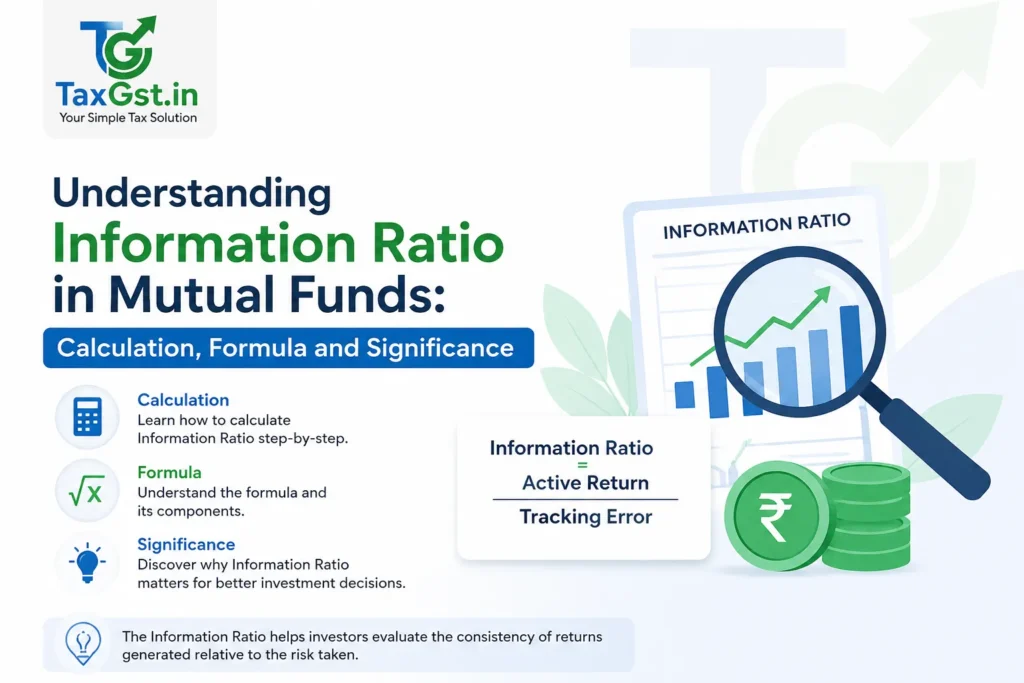
SEBI now mandates that all equity-oriented mutual fund schemes disclose the Information Ratio (IR) daily on AMC websites and on AMFI’s portal in a standardized, downloadable format. The IR measures risk-adjusted return by dividing the excess return of a portfolio over its benchmark by the standard deviation of that excess return, giving investors a consistent way to compare fund manager skill across schemes.
Also Read-SEBI Simplifies Mutual Fund Rules for Easier Compliance
Quick Summary
- SEBI has mandated daily disclosure of Information Ratio for all equity-oriented mutual fund schemes.
- IR = (Portfolio Return minus Benchmark Return) divided by Standard Deviation of Excess Return.
- Daily portfolio returns are calculated using the arithmetic function of NAV, and standard deviation is annualized by multiplying by the square root of 252 (as per SEBI Circular SEBI/HO/IMD/IMD-PoD-2/P/CIR/2025/6 dated January 17, 2025).
- The circular applies only to equity-oriented schemes; ETFs and index funds continue with existing Tracking Error and Tracking Difference disclosures.
- AMFI must provide IR data in a comparable, machine-readable spreadsheet format on its website.
What Exactly Is the Information Ratio and Why Should You Care?
Think of the Information Ratio as a report card for your fund manager’s skill, not just the fund’s returns. Two funds might both deliver 12% returns, but one might swing wildly between gains and losses while the other climbs steadily. The IR captures that difference. Formally, the IR is the ratio of Tracking Difference to Tracking Error. Tracking Difference is simply how much the fund’s portfolio return exceeds or falls short of its benchmark return. Tracking Error measures how volatile or inconsistent that excess return has been over time. A higher IR means the fund manager delivered more excess return for each unit of risk taken relative to the benchmark.
As per Circular No. SEBI/HO/IMD/IMD-PoD-2/P/CIR/2025/6 dated January 17, 2025, SEBI has mandated this disclosure specifically because raw returns alone do not tell the full story. Two funds beating the same benchmark by the same margin can have very different risk profiles, and IR helps you distinguish between them.
How Does SEBI Mandate the Information Ratio to Be Calculated?
SEBI has laid down a precise, uniform methodology so that every AMC calculates IR the same way, allowing you to compare apples to apples across schemes. The formula is straightforward: IR equals Portfolio Rate of Returns minus Benchmark Rate of Returns, divided by the Standard Deviation of Excess Return. The benchmark used is the Tier 1 benchmark currently assigned to each equity-oriented scheme.
Daily portfolio returns are calculated using the arithmetic function, specifically Rt equals NAV on day t divided by NAV on day t minus 1, minus 1. The same method applies to benchmark returns (as per SEBI Circular SEBI/HO/IMD/IMD-PoD-2/P/CIR/2025/6 dated January 17, 2025). The standard deviation of daily excess returns is then annualized by multiplying it by the square root of 252, representing the typical number of trading days in a year. The Tracking Difference itself is annualized by multiplying the average daily excess return by 252.
SEBI mandates that annualized IR be calculated separately for 1-year, 3-year, 5-year, and 10-year periods. For schemes older than six months but younger than one year, IR based on annualized returns for the past six months may be disclosed. Schemes younger than six months are exempt from IR disclosure altogether (as per SEBI Circular SEBI/HO/IMD/IMD-PoD-2/P/CIR/2025/6 dated January 17, 2025). All disclosures must appear daily on AMC websites alongside performance data, and AMFI must host the same information in a downloadable, machine-readable spreadsheet format for easy comparison.
How Should You Interpret the Information Ratio When Comparing Funds?
A higher IR is generally better, but context matters. An IR of 0.5 means the fund manager generated 0.5 units of excess return for every unit of tracking error. An IR above 0.5 is considered strong for actively managed diversified equity schemes, while an IR consistently above 1.0 is rare and indicates exceptional consistency. Here is a practical way to read IR values when you are comparing two funds within the same category and benchmark.
| IR Range | What It Tells You | Investor Takeaway |
|---|---|---|
| Below 0 | The fund is underperforming its benchmark on a risk-adjusted basis. | Review whether the fund’s strategy justifies staying invested. |
| 0 to 0.3 | Modest excess return relative to the risk taken. | Acceptable but not compelling; compare with category average. |
| 0.3 to 0.5 | Reasonable consistency in generating excess returns. | A solid performer worth considering for long-term allocation. |
| 0.5 to 1.0 | Strong risk-adjusted performance with good consistency. | Indicates a skilled fund manager delivering steady outperformance. |
| Above 1.0 | Exceptional and rare; high excess return per unit of risk. | Verify across multiple periods; sustained IR above 1.0 is uncommon. |
Remember, IR is a relative measure. It is meaningful only when you compare funds within the same category using the same Tier 1 benchmark. Comparing a large-cap fund’s IR with a mid-cap fund’s IR is like comparing two students who wrote different exams; the scores are not directly comparable.
A Practical Worked Example in INR
Suppose a large-cap equity fund has an annualized portfolio return of 14.5% and its Tier 1 benchmark, the Nifty 50 TRI, returned 12.0% over the same 3-year period. The annualized standard deviation of daily excess returns is 4.0%.
Step 1: Calculate Tracking Difference, which is 14.5% minus 12.0%, giving 2.5%.
Step 2: Divide Tracking Difference by Tracking Error, which is 2.5% divided by 4.0%, giving an IR of 0.625. This means the fund manager generated 0.625 units of excess return for every 1% of tracking error.
If another large-cap fund in the same benchmark category shows an IR of 0.35 over the same period, the first fund delivered meaningfully better risk-adjusted performance, even if both funds reported similar headline returns. As per the methodology prescribed in Circular No. SEBI/HO/IMD/IMD-PoD-2/P/CIR/2025/6 dated January 17, 2025, daily returns are calculated using the arithmetic function of NAV, and standard deviation is annualized by multiplying by the square root of 252. This ensures that the IR you see on the AMFI portal is computed uniformly across all AMCs, giving you a reliable basis for comparison.
What Are the Key Differences Between Information Ratio and Sharpe Ratio?
Both IR and Sharpe Ratio measure risk-adjusted returns, but they answer fundamentally different questions. The Sharpe Ratio tells you how much return you earned per unit of total risk taken, using the risk-free rate as the reference point. The IR tells you how much excess return the fund manager generated per unit of risk taken relative to the benchmark.
Think of it this way: Sharpe Ratio asks, ‘Was the return worth the volatility compared to doing nothing risky?’ IR asks, ‘Was the fund manager’s stock-picking skill worth the extra volatility compared to simply buying the benchmark index?’ For an investor choosing between two actively managed funds tracking the same benchmark, IR is the more relevant tool. Sharpe Ratio is more useful when you are deciding whether to invest in a fund at all versus keeping money in a fixed deposit or government bond.
A fund can have a high Sharpe Ratio but a low IR if its excess returns are inconsistent, meaning the manager takes large bets that sometimes pay off dramatically and sometimes fail. Conversely, a fund with a modest Sharpe Ratio but a high IR is delivering steady, reliable outperformance relative to its benchmark, which is often what long-term investors value most.
What Are the Limitations of the Information Ratio That Every Investor Should Know?
IR is a powerful tool, but it has real limitations that can mislead you if you rely on it alone. First, IR is based on arithmetic averages of daily returns, not compounded returns. This means a fund with a negative IR can still outperform its benchmark over a specific period, and a fund with a higher IR can sometimes lag the benchmark in absolute terms.
Second, IR is sensitive to the time period you examine. A fund might show an IR of 0.8 over three years but only 0.2 over five years if recent performance has deteriorated. This is why SEBI mandates IR disclosure across multiple periods, specifically 1-year, 3-year, 5-year, and 10-year windows, so you can assess consistency rather than relying on a single snapshot.
Third, IR does not capture the magnitude of returns. A fund beating its benchmark by 0.1% with very low tracking error can show a high IR, but that marginal outperformance may not justify the expense ratio and active management fees you are paying. Always pair IR with absolute return analysis and expense ratio comparison.
Fourth, IR can be misleading during periods of extreme market volatility when tracking errors spike across the board. A fund with a historically stable IR may show a temporarily depressed ratio during a market crash, not because the manager lost skill, but because the denominator in the formula expanded sharply. Use IR as one input among several, not as the sole basis for investment decisions.
What Are the Key Pitfalls When Using Information Ratio for Investment Decisions?
Despite being a powerful metric, IR has real limitations that can mislead investors if used in isolation. The most common mistake is comparing IR values across different categories or benchmarks. A mid-cap fund benchmarked against the Nifty Midcap 150 TRI and a large-cap fund benchmarked against the Nifty 50 TRI will have IRs that are not directly comparable because the underlying benchmarks carry different risk and return characteristics.
Another critical pitfall is ignoring the time period. A fund may show a spectacular IR over one year due to a few lucky quarters but deliver mediocre IR over three or five years. SEBI’s mandate to disclose IR across 1-year, 3-year, 5-year, and 10-year windows, as per Circular No. SEBI/HO/IMD/IMD-PoD-2/P/CIR/2025/6 dated January 17, 2025, exists precisely to prevent this kind of cherry-picking. Always look at IR consistency across multiple periods rather than a single snapshot.
Finally, a negative IR does not always mean you should exit immediately. It simply means the fund underperformed its benchmark on a risk-adjusted basis during the measurement window. If the fund’s investment thesis remains intact and the underperformance is due to temporary market conditions, a negative IR may be a buying opportunity rather than a sell signal.
How Does Information Ratio Apply to Different Types of Equity Schemes?
SEBI’s IR disclosure mandate applies only to equity-oriented mutual fund schemes, as specified in the circular. This includes large-cap, mid-cap, small-cap, multi-cap, flexi-cap, focused, value/contra, and sectoral/thematic schemes that maintain at least 65% equity allocation. For ETFs and index funds, the existing framework of Tracking Error and Tracking Difference disclosure is considered sufficient, since these are passive products designed to replicate an index rather than outperform it. Requiring IR for a fund that is explicitly built to match a benchmark would be redundant. Debt-oriented schemes are also excluded from the IR mandate, as the circular specifies applicability only for equity-oriented schemes.
| Scheme Type | IR Disclosure Required? | Reason |
|---|---|---|
| Large-Cap Fund | Yes | Equity-oriented; active management comparison relevant. |
| Mid-Cap / Small-Cap Fund | Yes | Equity-oriented; higher volatility makes IR especially useful. |
| Multi-Cap / Flexi-Cap Fund | Yes | Equity-oriented; fund manager allocation decisions are key. |
| Sectoral / Thematic Fund | Yes | Equity-oriented; benchmark comparison is meaningful within category. |
| Index Fund (Nifty 50) | No | Passive; Tracking Error and TD disclosure is sufficient (IR mandate applies only to equity-oriented schemes). |
| Exchange Traded Fund (ETF) | No | Passive; existing TE and TD framework applies (IR mandate applies only to equity-oriented schemes). |
| Debt Fund (Gilt, Bond) | No | Not equity-oriented; high-grade corporate bond structures are evaluated via alternative credit metrics. |
| Hybrid Fund (Balanced Advantage) | Depends | Only if classified as equity-oriented under SEBI categorization (i.e., minimum 65% equity allocation). |
Suppose you are comparing two mid-cap funds, Fund X and Fund Y, both benchmarked against the Nifty Midcap 150 TRI over a 5-year period. Fund X has an annualized portfolio return of 18.2% and the benchmark returned 15.0%. The annualized standard deviation of daily excess returns for Fund X is 6.5%. Fund Y has an annualized portfolio return of 17.0% with the same benchmark return of 15.0% and an annualized standard deviation of daily excess returns of 3.8%.
For Fund X, Tracking Difference is 18.2% minus 15.0%, which equals 3.2%. IR is 3.2% divided by 6.5%, giving 0.492. For Fund Y, Tracking Difference is 17.0% minus 15.0%, which equals 2.0%. IR is 2.0% divided by 3.8%, giving 0.526. Fund X delivered higher absolute excess returns, but Fund Y delivered better risk-adjusted returns with an IR of 0.526 compared to Fund X’s 0.492.
If you are a conservative investor who values consistency and lower volatility, Fund Y may be the more suitable choice despite its lower headline outperformance. If you are comfortable with higher volatility in exchange for higher absolute returns, Fund X might appeal more. This is exactly the kind of comparison that SEBI’s standardized IR disclosure is designed to enable. Before this mandate, different AMCs used different calculation methods, making such comparisons unreliable. Now, with daily returns calculated using the arithmetic function and standard deviation annualized by multiplying by the square root of 252, as prescribed in the circular, you can trust that the data is uniform across all AMCs.
How Should You Use Information Ratio Alongside Other Metrics?
IR works best as part of a toolkit, not as a standalone decision-maker. Combine it with Alpha, which measures the absolute excess return over the benchmark, and the Sharpe Ratio, which measures return per unit of total risk. Together, these three metrics give you a three-dimensional view of fund performance.
Start by checking the IR to assess the fund manager’s consistency. Then look at Alpha to see how much actual excess return was generated. Finally, check the Sharpe Ratio to understand whether the total risk taken was justified by the returns. If all three metrics are strong and consistent across multiple time periods, you likely have a fund worth holding for the long term.
For investors in the small-cap and mid-cap space, where volatility is inherently higher, IR is especially valuable. A small-cap fund with a high IR is not just returning more than its benchmark; it is doing so with relatively controlled drawdowns, which matters enormously when the underlying asset class can swing 20-30% in a single quarter.
What Should You Do Next?
- Check the IR on AMFI’s website before your next SIP installment. AMFI is required to host IR data in a downloadable, machine-readable format. Download the spreadsheet for your scheme category and compare your fund’s IR against peers over 1-year, 3-year, and 5-year periods.
- Compare IR within the same category and benchmark. A large-cap fund’s IR is only meaningful against other large-cap funds using the same Tier 1 benchmark, such as the Nifty 50 TRI. Do not compare across categories.
- Look for consistency, not just a single high number. A fund with an IR of 0.6 over three consecutive years is far more reliable than one that spiked to 1.2 in a single year and then dropped to 0.1.
- Use IR alongside other metrics, not in isolation. Combine IR with absolute returns, expense ratio, and the risk-o-meter disclosed by the AMC to get a complete picture before making allocation decisions.
- Verify the calculation methodology. As per Circular No. SEBI/HO/IMD/IMD-PoD-2/P/CIR/2025/6 dated January 17, 2025, daily returns must be calculated using the arithmetic function and standard deviation annualized by multiplying by the square root of 252. If a fund’s disclosed IR seems unusually high, cross-check with the raw data available on the AMC’s website.
- Review IR disclosures for new schemes carefully. Schemes younger than six months are exempt from IR disclosure. For schemes between six months and one year, IR is based on annualized six-month data, which may not be representative of long-term consistency.
Frequently Asked Questions
Is Information Ratio mandatory for all mutual fund schemes?
No. As per Circular No. SEBI/HO/IMD/IMD-PoD-2/P/CIR/2025/6 dated January 17, 2025, IR disclosure applies only to equity-oriented mutual fund schemes. Debt-oriented schemes, ETFs, and index funds are not covered under this mandate. For ETFs and index funds, the existing requirements for Tracking Error and Tracking Difference disclosures continue to apply.
Can a fund have a negative Information Ratio?
Yes. A negative IR means the fund’s portfolio return has fallen below its benchmark return over the measurement period. The Tracking Difference is negative, which makes the entire ratio negative. This signals that the fund manager’s active decisions have destroyed value relative to simply holding the benchmark index.
How often must AMCs disclose the Information Ratio?
AMCs must disclose IR on their websites on a daily basis alongside performance disclosures. AMFI must also make this data available on its website in a comparable, downloadable, and machine-readable format. The provisions came into force three months from the date of the circular, which was January 17, 2025.
Should I exit a fund just because its Information Ratio is low?
Not necessarily. A low IR in a single period may result from temporary market conditions or a fund manager’s contrarian strategy taking time to play out. Evaluate IR over multiple periods, ideally 3 to 5 years, and compare it with the category average. If a fund consistently underperforms its benchmark on a risk-adjusted basis over several years while charging a higher expense ratio, then it may be worth considering a switch to a better-performing peer or a passive index fund in the same category.
Sources
- TaxGuru — SEBI Mandates Disclosure of Information Ratio for Mutual Fund Schemes
- TaxGuru — SEBI Consultation Paper on Disclosure of Risk Adjusted Return by Mutual Funds
- ClearTax — Information Ratio Definition and Formula
- TaxGuru — SEBI Issues Updated Master Circular to Streamline Mutual Fund Regulations
- SEBI — Disclosure of Expenses, Half Yearly Returns, Yield and Risk-o-meter of Schemes of Mutual Funds
- TaxGuru — SEBI (Mutual Funds) Regulations, 2026
Take action today: Pull up the AMFI website, download the IR disclosure spreadsheet for the equity funds on your shortlist, and compare their 3-year and 5-year IR values within the same category. This single step can save you from chasing headline returns and help you pick funds that deliver consistent, risk-adjusted outperformance over time.
Related Reading
Discover more from TaxGst.in
Subscribe to get the latest posts sent to your email.


Never Miss a Tax Deadline Again
Due-date alerts, GST updates and tax tips — free on the app you already use.
event Next: GSTR-3B · 20 Oct