
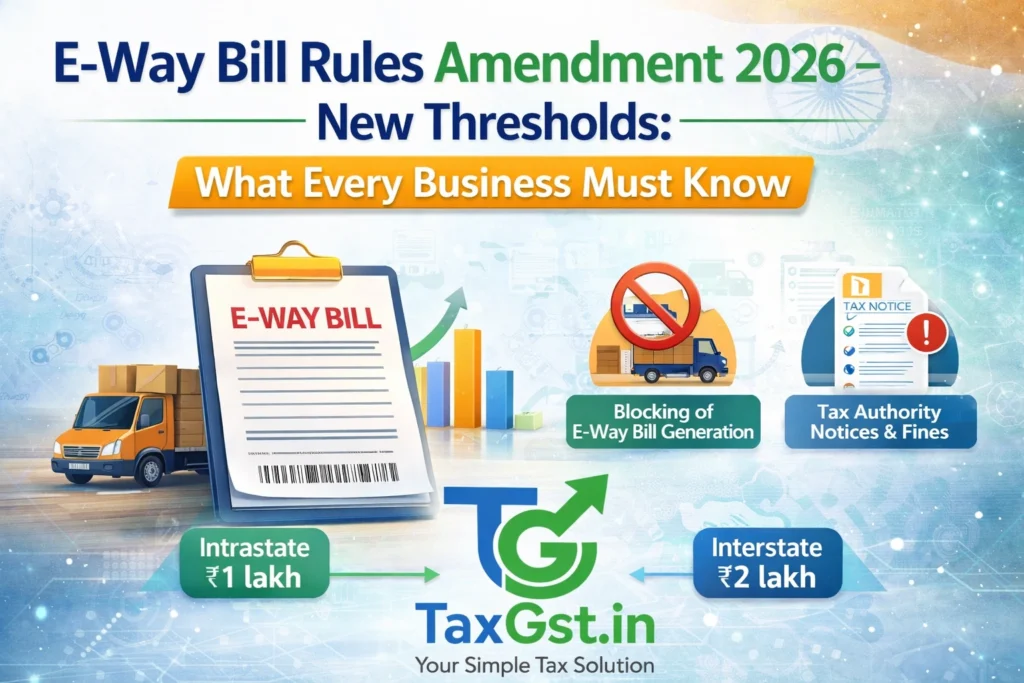
The Goods and Services Tax (GST) regime in India has always been dynamic—constantly evolving to balance compliance rigor with ease of doing business. On March 28, 2026, the Central Board of Indirect Taxes and Customs (CBIC) issued a landmark notification amending the e-way bill rules under GST, introducing significant changes that will reshape how businesses handle inter-state and intra-state movement of goods. With the new financial year just around the corner and the first Monetary Policy Committee (MPC) meeting of FY27 scheduled for April, these amendments couldn’t have come at a more critical time.
For businesses across sectors—from FMCG and manufacturing to e-commerce and logistics—this update isn’t just another compliance tweak. It’s a strategic shift that could reduce paperwork, lower operational friction, and even impact working capital cycles. But with great relief comes great responsibility: missing the nuances could land you in non-compliance territory faster than you can say “GSTR-1.”
Let’s break down what’s changed, why it matters, and how you can stay ahead.
What Is an E-Way Bill—And Why Does the Threshold Matter?
An e-way bill is an electronic document required under GST for the movement of goods valued over a specified limit. It contains details of the consignment, transporter, and vehicle, and must be generated before goods are dispatched—whether by road, rail, air, or ship.
The “threshold” refers to the value of goods above which an e-way bill becomes mandatory. Until now, the inter-state threshold stood at ₹50,000. But effective April 1, 2026, this has been revised upward to ₹1 lakh for most goods. For certain exempted or low-risk categories (like agricultural produce or handicrafts), the threshold remains at ₹50,000 unless otherwise notified.
This change stems directly from the 56th GST Council Meeting held in February 2026, where members acknowledged that inflation, rising input costs, and digital maturity had rendered the old threshold outdated. The goal? Reduce compliance burden on small traders while maintaining audit trails for high-value shipments.
“In my practice, I’ve seen mom-and-pop retailers get penalized for generating e-way bills on consignments worth ₹52,000—something that added zero value but consumed hours of their time,” says CA Ramesh Iyer, a Pune-based GST consultant with 18 years of experience. “The new ₹1 lakh threshold is a breath of fresh air for micro and small enterprises.”
Background and Context: Why the Change Now?
To understand the significance of this amendment, we need to look at three key drivers:
1. Economic Realignment Post-GST 2.0
With the abolition of the 12% and 28% GST slabs in favor of a simplified three-slab structure (5%, 18%, and 40%), the average transaction value has shifted. Many mid-value goods previously taxed at 12% now fall into the 5% or 18% brackets, altering pricing dynamics and shipment sizes.
2. RBI’s Accommodative Stance
RBI Governor Sanjay Malhotra has maintained a repo rate of 5.25% since January 2026, signaling support for business liquidity. Reducing compliance overhead aligns with this pro-growth stance—especially as FY27 GDP is projected at 7.1–7.2%, slightly below FY26’s 7.4–7.6%.
3. Digital Infrastructure Maturity
The e-way bill portal now integrates seamlessly with GSTN, FASTag, and VAHAN databases. Real-time tracking and AI-driven anomaly detection mean the system can handle higher thresholds without compromising tax integrity.
The CBIC notification (No. 12/2026-GST, dated March 28, 2026) explicitly cites “reducing compliance fatigue among small taxpayers” and “leveraging technology for smarter enforcement” as primary objectives.
Key Provisions Explained: What’s In, What’s Out?
The amendment modifies Rule 138 of the CGST Rules, 2017, specifically clauses (1), (3), and (7). Here’s a detailed breakdown:
✅ New Inter-State Threshold: ₹1 Lakh
- Applies to all taxable goods except those specifically exempted.
- Valid for both registered and unregistered persons when supplying to a registered recipient.
- Does not apply if the consignor or consignee is located in a Special Category State (e.g., Jammu & Kashmir, Himachal Pradesh)—there, the threshold remains ₹50,000 until further notice.
🚫 Intra-State Thresholds Vary by State
While the central rule sets the inter-state baseline, states retain autonomy over intra-state movements. As of April 1, 2026:
- Maharashtra, Gujarat, Karnataka: ₹1 lakh
- Delhi, Tamil Nadu, West Bengal: ₹75,000
- Uttar Pradesh, Bihar, Rajasthan: ₹50,000 (no change)
⚠️ Important: Always check your state’s latest notification. Non-compliance with intra-state rules can still attract penalties under Section 129 of the CGST Act.
📦 Exemptions Remain Targeted
Goods like fresh vegetables, milk, bread, handloom products, and items covered under Schedule III of the CGST Act continue to be exempt from e-way bill requirements—regardless of value.
🔄 Validity Period Unchanged
The validity of an e-way bill still depends on distance:
- Up to 20 km: 1 day
- 20–100 km: 2 days
- Every additional 100 km (or part thereof): +1 day
No extension is allowed beyond 15 days without valid reasons (e.g., natural calamity, vehicle breakdown).
Practical Implications for Businesses
For Small & Medium Enterprises (SMEs)
If your average monthly inter-state shipment value is below ₹1 lakh, you’re off the e-way bill hook—for now. This means:
- Fewer returns to file (no GSTR-1 entries for exempted movements)
- Reduced risk of detention at checkposts
- Lower administrative costs
But don’t celebrate too soon. If you occasionally ship high-value consignments (e.g., machinery parts worth ₹1.2 lakh), you must generate an e-way bill for that specific transaction.
For Logistics & Transport Companies
Transporters must now verify thresholds more carefully. Under Section 129, if a vehicle is intercepted with goods valued above the threshold but without a valid e-way bill, the penalty is 2% of the invoice value or ₹10,000, whichever is higher.
💡 Pro Tip: Update your TMS (Transport Management System) to auto-flag shipments crossing ₹1 lakh inter-state. Many ERP systems like TallyPrime and Zoho Inventory already support this via GSTN API integration.
For E-Commerce Operators
Marketplaces like Amazon, Flipkart, and Meesho must ensure that sellers using their platform comply with the new threshold. Since they’re liable for tax collection at source (TCS) under Section 52, any mismatch between declared value and e-way bill data can trigger scrutiny.
Real-World Example: How the Change Plays Out
Scenario: Rajesh Traders (Mumbai) supplies ceramic tiles to a retailer in Bengaluru.
- Before April 1, 2026: Invoice value = ₹85,000 → E-way bill mandatory (since >₹50,000)
- After April 1, 2026: Same invoice = ₹85,000 → No e-way bill required (since <₹1 lakh inter-state)
Result: Rajesh saves ~15 minutes per shipment, avoids potential ₹10,000 penalty for accidental omission, and reduces GSTR-1 filing complexity.
Now consider a second case:
Scenario: Same trader ships tiles worth ₹1.15 lakh to Hyderabad.
→ E-way bill is required, even under the new rule. Failure to generate one could lead to goods being detained at the Maharashtra-Telangana border.
This duality—freedom for small consignments, vigilance for large ones—is the core of the 2026 amendment.
Visual Comparison: Old vs. New E-Way Bill Thresholds
Critical Deadlines & Compliance Calendar
With the new rules kicking in on April 1, 2026, here’s your action timeline:
- March 31, 2026: Update internal SOPs and train staff on threshold changes.
- April 1, 2026: New thresholds apply. Ensure ERP/GST software reflects the change.
- April 11, 2026: First GSTR-1 due date under new regime (for March 2026 supplies).
- April 20, 2026: GSTR-3B due date—ensure no e-way bill-related mismatches.
🛑 Warning: The GSTN portal will not auto-generate e-way bills for consignments below ₹1 lakh inter-state. But if you manually generate one (e.g., for internal tracking), it’s valid—just not mandatory.
Practitioner Insights: What We’re Telling Our Clients
At our firm, we’ve already conducted three webinars for clients in manufacturing and retail. The top three questions we hear:
1. “Can we still generate e-way bills voluntarily below ₹1 lakh?”
→ Yes! It’s allowed and often recommended for high-risk goods or insurance purposes.
2. “What if my state hasn’t updated its intra-state threshold?”
→ Follow the lower of central or state rule. When in doubt, generate the bill.
3. “Will this affect input tax credit (ITC)?”
→ No. ITC eligibility under Section 16 remains unchanged. However, mismatched e-way data can delay ITC claims during audits.
As one client put it: “It’s like getting a tax-free allowance—use it wisely, but don’t assume you’re invisible.”
Key Points:
- The inter-state e-way bill threshold has doubled to ₹1 lakh effective April 1, 2026.
- Intra-state thresholds vary by state—always verify locally.
- Penalties for non-compliance remain strict: up to 2% of invoice value.
- Technology integration (ERP + GSTN) is now essential for seamless compliance.
- Small businesses gain relief, but vigilance is still required for high-value shipments.
Frequently Asked Questions
Is the ₹1 lakh threshold applicable to all goods?
No. The ₹1 lakh threshold applies only to taxable inter-state movements of goods not specifically exempted under GST. Exempt goods (like fresh fruits, handloom items) remain outside the e-way bill net regardless of value.
What happens if I transport goods worth ₹90,000 inter-state without an e-way bill after April 1, 2026?
You are compliant! Since the value is below the new ₹1 lakh threshold, no e-way bill is required. However, ensure your invoice and delivery challan are in order.
Do I need to update my accounting software for this change?
Yes. Most modern ERP systems allow you to set custom e-way bill thresholds. Update your configuration by March 31, 2026, to avoid manual errors.
Will the amendment impact GSTR-1 and GSTR-3B filing?
Indirectly, yes. Fewer e-way bills mean fewer line items in GSTR-1 for exempted movements. However, all taxable supplies must still be reported—only the e-way bill requirement is relaxed.
The 2026 e-way bill amendment isn’t just a number change—it’s a signal that India’s GST ecosystem is maturing. By raising thresholds, the government acknowledges the real-world challenges faced by small businesses while trusting technology to do the heavy lifting in enforcement.
But remember: compliance isn’t just about avoiding penalties. It’s about building trust with tax authorities, streamlining operations, and staying audit-ready.
So as you gear up for FY27, take 30 minutes this week to:
- Review your average shipment values
- Update your compliance protocols
- Train your logistics team
Because in GST, as in life, the devil—and the deduction—is in the details.
Stay compliant. Stay ahead.
— TaxGST.in Team
Article Information
Published: March 28, 2026
Category: GST
Official Resources
Disclaimer: This article provides general information based on official notifications. For legal purposes, always refer to the original government notification. Consult a qualified tax professional for specific advice.
Discover more from TaxGst.in
Subscribe to get the latest posts sent to your email.



Stay Updated!
Join our community for latest tax updates, GST news & finance tips