
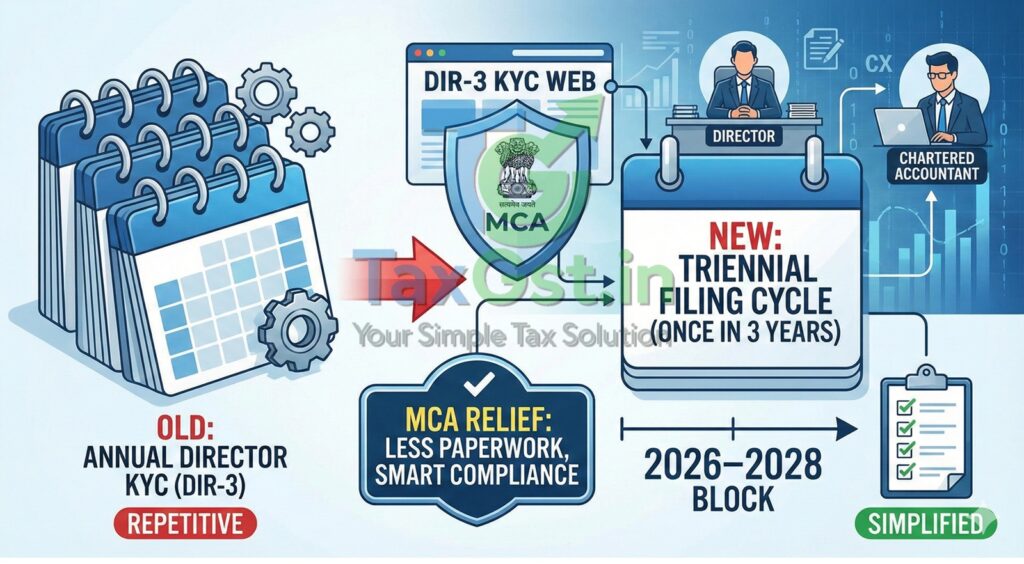
In a significant move to reduce the compliance burden on corporate India, the Ministry of Corporate Affairs (MCA) has overhauled the director verification regime. The Ministry has effectively replaced the annual Director KYC requirement with a triennial filing cycle, meaning holders of a Director Identification Number (DIN) will now only need to file their routine KYC once every three years.
This sweeping change was notified under the Companies (Appointment and Qualification of Directors) Amendment Rules, 2025, which amends the existing Rule 12A of the Companies (Appointment and Qualification of Directors) Rules, 2014. For lakhs of directors, start-up founders, and professionals across India, this amendment signals a shift from repetitive annual paperwork to a more streamlined, logic-based compliance calendar.
Annual Filings to a 3-Year Block.
For years, directors have been accustomed to the annual ritual of filing the DIR-3 KYC or DIR-3 KYC Web form by 30th September. While necessary to weed out shell companies and “ghost” directors, the annual frequency was often viewed as repetitive, especially for directors whose details (address, mobile, email) rarely changed year-on-year.
Under the new framework, the MCA has discontinued the mandatory annual filing for all. Instead, it has introduced a triennial KYC intimation framework.
What does this mean effectively?
If you hold a valid DIN, you are no longer required to confirm your details every single financial year. You must now perform this compliance only once in a block of three consecutive financial years. This move directly supports the government’s broader “Ease of Doing Business” initiative, aiming to keep regulatory oversight intact while cutting down on low-value repetitive tasks.
“Corporate governance is about maximising shareholder value legally, ethically, and on a sustainable basis while ensuring fairness to every stakeholder.”
— N.R. Narayana MurthyBy simplifying the frequency of director verification, the MCA allows professionals and business leaders to focus more on governance and execution rather than administrative repetition.
Earlier Annual Regime vs. New Triennial Regime.
To help you understand exactly how the landscape has shifted, here is a direct comparison of the old rules versus the amended provisions.
| Aspect | Earlier Annual System | New Triennial System |
|---|---|---|
| Frequency | Every Financial Year. Mandatory for every DIN holder. | Once in 3 Years. Mandatory only once per triennial block. |
| Due Date | Generally 30th September of the immediately next Financial Year. | 30th June of the relevant third financial year in the block. |
| Forms Used | DIR-3 KYC (Comprehensive) or DIR-3 KYC Web (OTP based). | DIR-3 KYC Web is now the single standard mechanism for routine filings. |
| Trigger Point | Holding a DIN on 31st March of each financial year. | Holding a DIN on 31st March of the relevant financial year in the cycle. |
Who Has to File and When?
The amendment to Rule 12A clarifies the specific timelines. The confusion for many directors often lies in the “cut-off dates.”
According to the Companies (Appointment and Qualification of Directors) Amendment Rules, 2025, the obligation to file generally arises for any person who holds a DIN as on 31st March of a financial year.
Under the new triennial cycle:
- The Check: Do you hold a DIN on 31st March?
- The Action: You must file DIR-3 KYC Web on or before 30th June of the relevant third financial year.
This is a tightening of the deadline (June vs. the old September), but a relaxation of the frequency. By shifting the deadline to June, the MCA ensures that the director database is updated early in the financial year, allowing for cleaner master data for subsequent company filings (like Annual Returns) that occur later in the year.
DIR-3 KYC Web.
Another critical rationalization in this amendment is the standardization of the form. Previously, there was often confusion between the full e-form DIR-3 KYC (which required heavy attachments and professional certification) and the web-based service.
The MCA has now prescribed DIR-3 KYC Web as the primary standard mechanism for all routine director KYC filings. This web-based service typically verifies the director via One Time Password (OTP) sent to their registered mobile number and email ID. This eliminates the need for affixing Digital Signatures (DSC) of professionals for routine confirmations where data remains unchanged, further reducing compliance costs for MSMEs and small private limited companies.
Event-Based KYC is Now Critical.
While the routine cycle has been relaxed to three years, the responsibility to keep data current has effectively increased.
The amended rules insert a strict proviso regarding changes in personal details. If there is any change in your:
- Mobile Number,
- Email ID, or
- Residential Address,
You cannot wait for the triennial cycle to come around. You must make an event-based KYC filing through DIR-3 KYC Web within 30 days of such a change.
Why is this important?
In the annual regime, many directors would simply wait until September to update their new address or phone number. Under the triennial regime, waiting is a violation. Since the regulator is trusting you for three years, the onus is on you to report changes immediately. Failure to do so could arguably lead to penalties or difficulties in receiving official regulatory notices.
💡 Did You Know?
The Director Identification Number (DIN) was first introduced in India through the Companies (Amendment) Act, 2006. Before this, there was no unique identity code for directors, making it difficult to track individuals who were directors in multiple defaulting companies. Today, the DIN database is one of the most robust corporate registries in the world.
Practical Impact for Indian Businesses.
How does this play out in the real world? Let’s look at a few scenarios.
Scenario 1: The Dormant Director
Mr. Sharma obtained a DIN five years ago for a venture that never took off. He is not currently on any board but keeps his DIN active.
Impact: Previously, he paid a professional every year to file KYC. Now, he only needs to attend to this once every three years. This significantly reduces his “maintenance cost” for holding a DIN.
Scenario 2: The Active Start-up Founder
Ms. Anjali is a director in three tech start-ups and moves cities often for work.
Impact: While she enjoys the break from annual filings, she must be vigilant. If she moves her permanent residence from Bengaluru to Gurugram, she must file the update within 30 days. She cannot wait for the 3-year block to end.
Consequences of Non-Compliance.
Despite the relaxation in frequency, the MCA has maintained its strict stance on non-compliance. The integrity of the DIN database is non-negotiable for the Ministry.
If a director fails to file the DIR-3 KYC Web by the 30th June deadline of their applicable triennial block:
- Deactivation: The DIN will be marked as “Deactivated due to non-filing of DIR-3 KYC.”
- Prohibition: The director cannot be appointed to new companies or sign documents for existing companies.
- Late Fees: Reactivation will only be possible after filing the overdue KYC along with a late fee. As per the Companies (Registration Offices and Fees) Rules, 2014, this penalty has historically been ₹5,000, serving as a strong deterrent against negligence.
Frequently Asked Questions (FAQs) on New Triennial Director KYC.
Is Director KYC still mandatory every year in 2026?
What is the due date for the new triennial DIR-3 KYC?
What if my mobile number or address changes during the 3-year gap?
Who is required to file DIR-3 KYC Web?
What happens if I miss the 30th June deadline?
Do I need a Digital Signature (DSC) for the new triennial KYC?
Disclaimer: The content provided above is based on the Companies (Appointment and Qualification of Directors) Amendment Rules, 2025. Compliance rules are subject to change. Please verify specific due dates on the MCA portal or consult a professional Company Secretary.
Trusted Regulatory References.
For further verification, readers may refer to the official notifications released by the Ministry of Corporate Affairs:
- Primary Amendment: Companies (Appointment and Qualification of Directors) Amendment Rules, 2025 (Notified Dec 2025)
- Governing Section: Section 153-159 of the Companies Act, 2013 (Provisions regarding DIN)
- Official Portal: Ministry of Corporate Affairs (MCA) E-Filing Services
Discover more from TaxGst.in
Subscribe to get the latest posts sent to your email.




Stay Updated!
Join our community for latest tax updates, GST news & finance tips