
 C.K. Gupta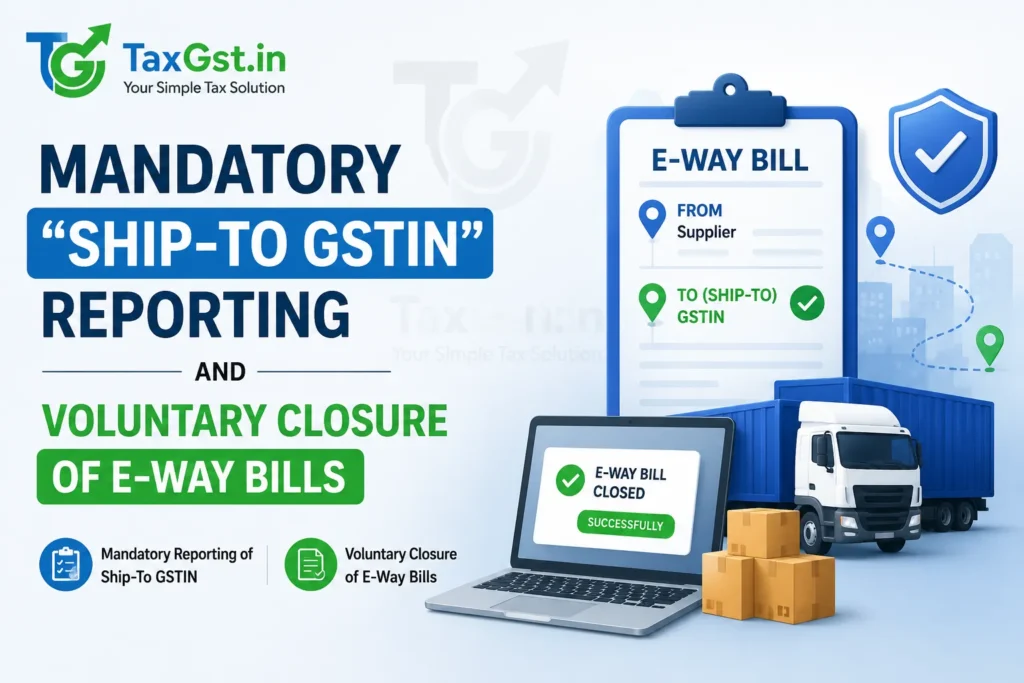
Effective August 1, 2026, the GST e-Way Bill system introduces two pivotal changes: mandatory capture of “Ship-To GSTIN” in Bill-To/Ship-To transactions and a new voluntary facility for closing e-Way Bills after goods movement. These enhancements, initially planned for June 15, 2026, were extended to allow businesses ample time for system modifications and training, as per GSTN Advisory No. 663 dated June 9, 2026. Businesses must update their ERP and accounting software to ensure compliance and avoid disruptions in goods movement.
Also Read-New E-Way Bill Rules 2026: Mandatory Ship-To GSTIN & Closure Facility
What are the Key Changes to E-Way Bills?
- The GSTN has mandated the capture of “Ship-To GSTIN” in e-Way Bills for all Bill-To/Ship-To transactions, effective from August 1, 2026, as per GSTN Advisory dated May 20, 2026, and its extension on June 9, 2026.
- For unregistered recipients, “URP” (Unregistered Person) must be entered in the “Ship-To GSTIN” field.
- A new, voluntary facility allows suppliers, recipients, transporters, or authorized drivers to close e-Way Bills post-delivery or discontinuation of movement, as detailed in GSTN Advisory dated May 20, 2026.
- This closure can be done e-Way Bill-wise, date-wise, or via mobile OTP, and must occur on the day of delivery or the immediately succeeding day, as per GSTN Advisory No. 661 (dated May 21, 2026).
- Businesses need to update their systems and train staff to comply with these changes to prevent e-Way Bill generation failures and potential penalties under Section 122(1)(xiv) of the CGST Act, 2017.
Must Check – GST Return Troubleshooting: Fixing ITC Mismatch, E-invoice Errors, and Late Fee Penalties
What is the Mandatory “Ship-To GSTIN” Requirement for E-Way Bills?
The GST system now requires mandatory capture of the “Ship-To GSTIN” in e-Way Bills for all Bill-To/Ship-To transactions, effective from August 1, 2026, as per GSTN Advisory dated May 20, 2026, with the implementation date extended by GSTN Advisory No. 663 dated June 9, 2026. This change aims to enhance transparency and traceability of goods movement, ensuring a complete audit trail from supplier to the actual recipient.
In such transactions, where the person placing the order (Bill-To party) is different from the person receiving the goods (Ship-To party), the GSTIN of the actual Ship-To party must be provided. If the goods are delivered to an unregistered person or location, taxpayers must enter “URP” (Unregistered Person) in the “Ship-To GSTIN” field, as clarified in the GSTN Advisory dated May 20, 2026. This ensures that even deliveries to end consumers or unregistered warehouses are properly documented within the e-Way Bill system.
The system will apply validations to ensure that the Ship-To GSTIN is valid and distinct from the Bill-To GSTIN in Bill-To/Ship-To scenarios, as per the GSTN Advisory dated June 17, 2026, on e-Invoice & e-Way Bill APIs. Non-compliance will result in the failure to generate the e-Way Bill, attracting consequences under Section 122(1)(xiv) of the CGST Act, 2017, for moving goods without proper documentation.
How Can Businesses Voluntarily Close E-Way Bills?
The GSTN has introduced a voluntary e-Way Bill closure facility, allowing taxpayers and authorized persons to formally close an e-Way Bill after the completion or discontinuation of goods movement, as per GSTN Advisory dated May 20, 2026. This functionality aims to reduce the number of old and inactive e-Way Bills in the system, providing a clearer status of consignments.
The facility can be utilized by the supplier, recipient, transporter involved in the transaction, or any authorized person whose mobile number is declared in the e-Way Bill. The voluntary closure facility can be accessed through the e-Way Bill portal, where users can select the relevant e-Way Bill number and opt for closure after authentication.
Closure can be performed e-Way Bill-wise or date-wise, and a mobile number-based OTP authentication is available for drivers or authorized persons, as detailed in GSTN Advisory dated May 20, 2026. It is crucial to note that closure must be effected on the same day of delivery or on the immediately succeeding day, as per GSTN Advisory No. 661 (dated May 21, 2026). While currently voluntary, this facility provides a useful mechanism for maintaining accurate records and may become important during future GST audits.
What Preparations Are Essential for These E-Way Bill Changes?
To ensure a smooth transition and avoid compliance pitfalls, businesses must proactively update their systems and train personnel before the August 1, 2026, implementation date. Begin by reviewing existing accounting software, ERP systems, and logistics modules to confirm they can capture the “Ship-To GSTIN” for Bill-To/Ship-To transactions, as highlighted in the GSTN Advisory dated May 20, 2026. Contact your software vendors immediately to confirm updates and deployment timelines, especially for API integrations, which are crucial for seamless e-Way Bill generation.
Next, prioritize updating your customer master data to include the correct “Ship-To GSTIN” for all regular Bill-To/Ship-To transactions. For deliveries to unregistered persons, configure your systems to auto-populate “URP” in the “Ship-To GSTIN” field, as mandated by the GSTN Advisory dated May 20, 2026. Conduct thorough testing in the NIC Sandbox environment for both the mandatory “Ship-To GSTIN” field and the new e-Way Bill closure API to ensure full system readiness before the production rollout on August 1, 2026, as advised by GSTN.
Finally, establish clear Standard Operating Procedures (SOPs) for the voluntary closure of e-Way Bills. Train your dispatch and logistics teams, as well as authorized drivers, on the process for closing e-Way Bills within the stipulated window—on the day of delivery or the immediately succeeding day, as per GSTN Advisory No. 661 (dated May 21, 2026). Ensure that the mobile numbers of drivers or authorized persons are declared during e-Way Bill generation to enable OTP-based closure, enhancing record-keeping and reducing the number of open e-Way Bills in the system.
What Key Actions Ensure E-Way Bill Compliance Readiness?
Failure to comply with the mandatory “Ship-To GSTIN” requirement will result in the inability to generate an e-Way Bill, leading to consequences under Section 122(1)(xiv) of the CGST Act, 2017, for moving goods without prescribed documents. For instance, if taxable goods valued at ₹80,000 (assuming 18% GST, i.e., ₹14,400 tax payable) are moved without a valid e-Way Bill and the owner comes forward, the penalty applicable under Section 129(1)(a) of the CGST Act, 2017, would be 200% of the tax payable, i.e., ₹28,800.
If the value of taxable goods was ₹15,00,000 (assuming 18% GST, i.e., ₹2,70,000 tax payable), the penalty would be 200% of the tax payable, resulting in a penalty of ₹5,40,000. The penalty applicable under Section 122(1)(xiv) of the CGST Act, 2017, for movement of goods without prescribed documents, is ten thousand rupees or the tax sought to be evaded, whichever is higher. Therefore, meticulous adherence to the new “Ship-To GSTIN” mandate is critical.
How to Generate E-Way Bills with Mandatory ‘Ship-To GSTIN’ Details from August 1, 2026?
To generate e-Way Bills for Bill-To/Ship-To transactions, you must accurately capture the “Ship-To GSTIN” in the designated field, effective August 1, 2026, as per GSTN Advisory No. 663 dated June 9, 2026. This is crucial for both direct portal generation and through API integrations. If the actual recipient of the goods is an unregistered person or entity, you must enter “URP” (Unregistered Person) in the “Ship-To GSTIN” field, as clarified in the GSTN Advisory dated May 20, 2026.
The system will apply stringent validations to ensure data integrity. It will verify that the entered “Ship-To GSTIN” is valid and distinct from the “Bill-To GSTIN” in Bill-To/Ship-To scenarios, as detailed in the GSTN Advisory dated June 17, 2026, on e-Invoice & e-Way Bill APIs. Furthermore, the “Ship-To State Code” must match the GSTIN’s State Code, and the “Ship-To PIN Code” must belong to that State Code, ensuring geographical consistency.
For B2B and SEZ transactions, any “Ship-To” details provided during IRN generation cannot be altered when subsequently generating the e-Way Bill, as per GSTN Advisory No. 664 dated June 17, 2026. Failure to meet these mandatory requirements will result in the e-Way Bill generation request being rejected by the system, potentially leading to penalties for non-compliance under Section 122(1)(xiv) of the CGST Act, 2017.
What is the Process and Timeline for Voluntary E-Way Bill Closure?
The voluntary e-Way Bill closure facility allows various stakeholders to update the status of goods movement in the system, as introduced by GSTN Advisory dated May 20, 2026. This facility can be used by the supplier, the recipient, the transporter involved in the transaction, or any authorized person whose mobile number was declared during the e-Way Bill generation. Drivers or authorized persons can also close e-Way Bills using an OTP-based authentication process via their registered mobile number, without needing full portal login credentials.
The closure must be completed within a specific timeframe: on the same day of delivery or on the immediately succeeding calendar day, as stipulated in GSTN Advisory No. 661 (dated May 21, 2026). Beyond this window, the option to voluntarily close the e-Way Bill will lapse. You can close e-Way Bills either individually (e-Way Bill-wise) or for multiple consignments (date-wise) through the e-Way Bill portal.
For businesses using API integration, the closure requires transmitting the e-Way Bill number, the closure date, and relevant remarks, as outlined in the GSTN Advisory dated May 20, 2026. While currently voluntary, adopting this practice is advisable for better record-keeping and may prevent adverse inferences during future GST audits, as an unclosed e-Way Bill could be presumed misused, inviting proceedings under Section 129 of the CGST Act, 2017, for detention and seizure.
What are the Consequences of Non-Compliance with Ship-To GSTIN?
Failure to comply with the mandatory “Ship-To GSTIN” requirement will directly prevent the generation of an e-Way Bill, effective from August 1, 2026, as per GSTN Advisory dated May 20, 2026, and its extension on June 9, 2026. Moving goods without a valid e-Way Bill constitutes a contravention of the CGST Rules, leading to severe penalties. Specifically, such non-compliance attracts consequences under Section 122(1)(xiv) of the CGST Act, 2017, for movement of goods without cover of prescribed documents.
Furthermore, incorrect declaration of the “Ship-To GSTIN” may be construed as a misstatement under Section 122, potentially attracting a penalty of ten thousand rupees or the tax sought to be evaded, whichever is higher, as per the GSTN Advisory dated May 20, 2026. If goods are moved without a valid e-Way Bill, Section 129 of the CGST Act, 2017, allows for their detention and seizure. For detained goods, if the owner comes forward, a penalty of 200% of the tax payable on such goods is applicable. In the case of exempted goods, the penalty is 2% of the value of goods or ₹25,000, whichever is less.
Where the owner does not come forward, the penalty is 50% of the value of the goods or 200% of the tax payable on such goods, whichever is higher. For exempted goods, this penalty is 5% of the value of goods or ₹25,000, whichever is less. An unclosed e-Way Bill, even if voluntary, may lead to adverse inference during verification by a Proper Officer.
Understanding the distinction between e-Way Bill cancellation and the newly introduced voluntary closure facility is crucial for accurate compliance. E-Way Bill cancellation, governed by Rule 138 of the CGST Rules, 2017, is primarily intended to nullify an e-Way Bill that was generated with incorrect details or where the movement of goods did not take place. It is a mandatory action if the conditions for cancellation are met, typically within 24 hours of generation if goods have not been moved.
In contrast, the voluntary e-Way Bill closure facility, introduced via GSTN Advisory dated 20 May 2026, serves to update the system status after the actual movement of goods has been completed or discontinued. This facility is optional and does not replace the legal requirement for cancellation under Rule 138 where applicable. While there is no direct penalty for not closing an e-Way Bill, maintaining proper records through closure can provide a clear audit trail and prevent adverse inferences during future GST audits, as per the GSTN Advisory dated 20 May 2026.
Key Differences: E-Way Bill Cancellation vs. Voluntary Closure
What Should You Do Next?
To navigate these critical e-Way Bill system changes effectively, consider the following immediate actions:
- Update Software Systems: Contact your ERP, accounting software, and GSP vendors to ensure your systems are updated to support the mandatory “Ship-To GSTIN” field and the new e-Way Bill closure API before August 1, 2026, as per GSTN Advisory dated 9 June 2026.
- Review Master Data: Systematically update your customer master data to include the correct “Ship-To GSTIN” for all Bill-To/Ship-To transactions. Configure your software to automatically populate “URP” for unregistered recipients, as specified in GSTN Advisory dated 20 May 2026.
- Conduct API Testing: If you use direct API integration, utilize the NIC Sandbox environment to test the updated API specifications for both mandatory “Ship-To GSTIN” and e-Way Bill closure, ensuring readiness before the production rollout on August 1, 2026.
- Train Your Teams: Provide comprehensive training to your dispatch, logistics, and transportation teams, including drivers, on the new “Ship-To GSTIN” requirements and the step-by-step process for voluntary e-Way Bill closure within the stipulated timeline.
- Implement SOPs for Closure: Establish clear Standard Operating Procedures (SOPs) for the timely voluntary closure of e-Way Bills, ideally on the day of delivery or the immediately succeeding day, as per GSTN Advisory No. 661. Maintain proper logs and acknowledgements of closed e-Way Bills.
- Ensure Mobile Number Registration: For mobile-based e-Way Bill closure, ensure that the mobile numbers of drivers or authorized persons are accurately declared during e-Way Bill generation or updated subsequently, as per GSTN Advisory dated 20 May 2026.
- Verify GSTINs: Before generating an e-Way Bill, validate the “Ship-To GSTIN” on the GST Portal to prevent rejections due to invalid details, as advised by GSTN.
Frequently Asked Questions
What is the effective date for the mandatory “Ship-To GSTIN” requirement and voluntary closure facility?
The mandatory capture of “Ship-To GSTIN” in Bill-To/Ship-To transactions and the voluntary e-Way Bill closure facility are both effective from August 1, 2026. This date was extended from the original implementation date of June 15, 2026, as per GSTN Advisory dated 9 June 2026, to allow businesses sufficient time for system modifications and preparedness.
What happens if the “Ship-To GSTIN” is not provided for Bill-To/Ship-To transactions?
If the mandatory “Ship-To GSTIN” is not provided for Bill-To/Ship-To transactions from August 1, 2026, the e-Way Bill generation request will fail, as per GSTN advisories. Moving goods without a valid e-Way Bill constitutes a contravention of the CGST Rules and can attract penalties under Section 122(1)(xiv) of the CGST Act, which may include a penalty of ten thousand rupees or the tax sought to be evaded, whichever is higher.
Who is authorized to use the voluntary e-Way Bill closure facility?
The voluntary e-Way Bill closure facility can be used by the supplier, the recipient, the transporter involved in the transaction, or any authorized person whose mobile number has been declared in the e-Way Bill. This allows various stakeholders to update the status of goods movement after completion or discontinuation, as per GSTN Advisory dated 20 May 2026.
Is the voluntary e-Way Bill closure facility mandatory, and what is its timeline?
The e-Way Bill closure facility is currently voluntary, and non-closure by itself will not attract a penalty merely because the e-Way Bill expires naturally. However, from a compliance and record-keeping perspective, it is a recommended best practice. The closure must be done on the same day of delivery or on the immediately succeeding day, as per GSTN Advisory No. 661; thereafter, the option to close will lapse.
What are the penalties for non-compliance with e-Way Bill rules?
Failure to comply with e-Way Bill requirements, such as moving goods without a valid e-Way Bill, constitutes a contravention of the CGST Rules and attracts penalties under Section 122(1)(xiv) of the CGST Act. If goods are moved without a valid e-Way Bill, and the owner comes forward, a penalty of 2% of the value of goods or ₹25,000, whichever is less, is applicable. If the owner does not come forward, the penalty increases to 5% of the value of goods or ₹25,000, whichever is less.
Additionally, incorrect declaration of the “Ship-To GSTIN” may be construed as a misstatement under Section 122 of the CGST Act, potentially attracting a penalty of ten thousand rupees or the tax sought to be evaded, whichever is higher, as per the GSTN Advisory dated 20 May 2026.
Can Ship-To details be modified after IRN generation for B2B/SEZ transactions?
No, for Business-to-Business (B2B) and Special Economic Zone (SEZ) transactions, the “Ship-To” details captured during Invoice Reference Number (IRN) generation will be considered final and cannot be altered or overridden while subsequently generating the e-Way Bill, as per GSTN Advisory No. 664 dated 17 June 2026. This means that consistency between e-Invoice and e-Way Bill data is paramount from the initial IRN generation stage.
If the required “Ship-To” information is not provided or is inconsistent during IRN generation, the system will automatically reject the e-Way Bill generation request, as highlighted in the advisory on e-Invoice & e-Way Bill APIs. Therefore, businesses must ensure accurate “Ship-To” details are provided at the time of IRN generation itself.
What details are required for e-Way Bill closure through API?
For system integrators and API users, the e-Way Bill closure facility is available through an API. To close an e-Way Bill via API, the following three details are required to be transmitted: the e-Way Bill number, the closure date, and relevant remarks, as per the GSTN Advisory dated 20 May 2026. NIC has released the API specifications for closure in the Sandbox environment, and businesses should test their integrations before the production implementation on August 1, 2026.
This API-based closure allows for automated processing of e-Way Bill statuses, which is particularly useful for businesses with high transaction volumes. While the facility is voluntary, maintaining a proper record of closed e-Way Bills through API integration can streamline compliance and internal record-keeping.
Sources
- TaxGuru — Mandatory -“Ship-To GSTIN” Reporting and Voluntary Closure of E-Way Bills
- ClearTax — E-Way Bill Changes from 1st August 2026: Mandatory Ship-To GSTIN and New EWB Closure Facility
- TaxGuru — GSTN Advisory on Mandatory ‘Ship To GSTIN’ & Voluntary e-Way Bill Closure Facility
- TaxGuru — GSTN Updates e-Invoice & e-Way Bill APIs: Ship-to GSTIN Mandatory, Voluntary EWB Closure
- TaxGuru — GSTN Extends Timeline for ‘Ship To GSTIN’ & E-Way Bill Closure Implementation
- TaxGuru — India’s E-Way Bill System Change Effective From August 1, 2026: Summary
- TaxGuru — GSTN Advisory on Enhancements in e-Way Bill (EWB) Portal
- TaxGuru — Recent GST Related Advisories on Key GSTN, GSTAT & Compliance Changes
Article Information
Published: June 30, 2026
Last Reviewed: June 30, 2026
Category: GST
Regulatory Body: CBIC (Central Board of Indirect Taxes and Customs)
Written by C.K. Gupta, M.Com & Tax Editor at TaxGST.in — helping businesses navigate GST compliance, ITC reconciliation, and return filing across Delhi NCR since 2009.
Official Resources
- GST Portal (e-Filing)
- CBIC Portal (Circulars)
- Income Tax Portal
- GST Council Updates
- E-Way Bill Portal
- E-Invoice Portal
Disclaimer: This article is for informational purposes only. For legal advice, consult a qualified tax professional. Always refer to the original notification for authoritative information.
Try the free GST calculator for instant figures.
Discover more from TaxGst.in
Subscribe to get the latest posts sent to your email.



Never Miss a Tax Deadline Again
Due-date alerts, GST updates and tax tips — free on the app you already use.
event Next: TDS Return (138 / 140) · 31 Oct