
 C.K. Gupta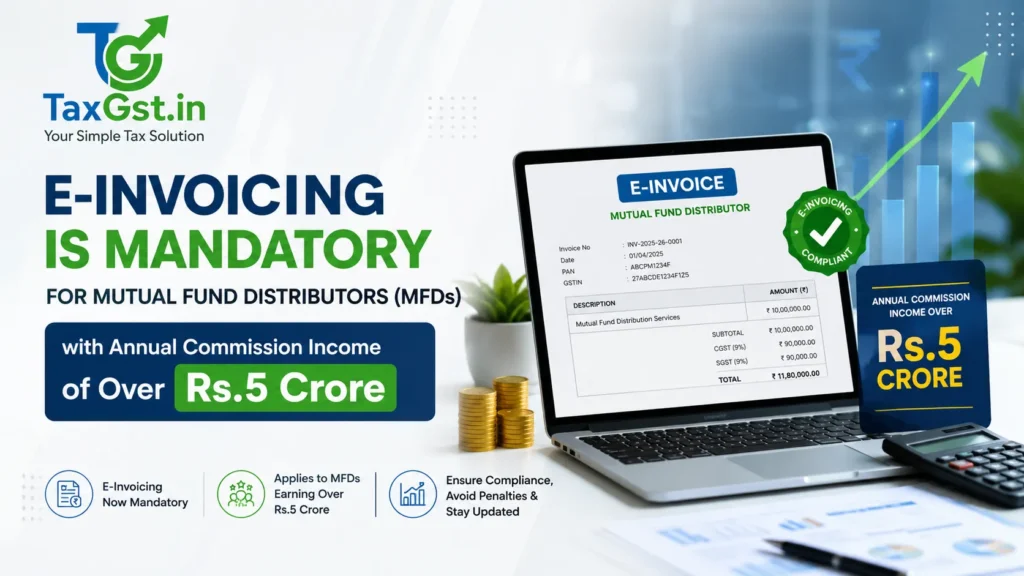
E-invoicing is mandatory for Mutual Fund Distributors (MFDs) whose aggregate annual turnover exceeds Rs. 5 crore in any preceding financial year from 2017-18 onwards, as per Notification No. 10/2023-Central Tax. With SEBI’s restructuring of mutual fund expense disclosure (replacing the Total Expense Ratio with the Base Expense Ratio and Statutory Expense Ratio), GST-registered MFDs must raise valid e-invoices on Asset Management Companies (AMCs) to recover the GST component separately. Generating an Invoice Reference Number (IRN) under Rule 48(4) of the CGST Rules, 2017 is now a critical compliance requirement for commission income recovery.
Quick Summary: E-Invoicing for MFDs
- The e-invoicing threshold is Rs. 5 crore aggregate turnover in any preceding FY from 2017-18 onwards.
- SEBI’s BER and SER framework makes GST recovery invoice-dependent for MFDs.
- GST-registered MFDs above the threshold must generate an IRN for B2B invoices and debit notes.
- Non-registered and composition scheme MFDs face a severe income drop, as they cannot issue tax invoices to recover GST from AMCs.
What Does the E-Invoicing Mandate Mean for Mutual Fund Distributors?
If you are a Mutual Fund Distributor (MFD) earning commission income from Asset Management Companies (AMCs), a significant compliance shift is underway. The intersection of SEBI’s commission restructuring and existing GST e-invoicing rules creates a new operational reality that directly impacts your net earnings.
Under Rule 48(4) of the CGST Rules, 2017, notified classes of registered persons must prepare invoices by uploading prescribed particulars in FORM GST INV-01 on the Invoice Registration Portal (IRP) and obtain an Invoice Reference Number (IRN). The aggregate turnover threshold has been progressively reduced by the CBIC, currently sitting at Rs. 5 crores.
For MFDs, this means that if your aggregate turnover — computed on an all-India PAN basis (including taxable supplies, exempt supplies, and inter-State supplies) — exceeded Rs. 5 crore in any financial year from 2017-18 onwards, you must generate e-invoices for your Business-to-Business (B2B) transactions with AMCs.
How Does SEBI’s Commission Restructuring Change GST Compliance for MFDs?
Under SEBI’s proposed framework, the Total Expense Ratio (TER) is set to be replaced with the Base Expense Ratio (BER) and Statutory Expense Ratio (SER). Earlier, AMC commissions were often inclusive of GST. The AMC paid a lump sum, and the GST component was embedded inside it. Under the new framework, GST is expected to be payable separately only if the distributor raises a valid tax invoice.
This proposed change is expected to reduce base commissions by approximately 15.25% for GST-registered MFDs. However, those registered under regular GST can recover this 15.25% amount by raising proper tax invoices on the AMCs.
The critical link to e-invoicing is this: If your turnover exceeds Rs. 5 crore, that tax invoice must carry a valid IRN generated through the IRP portal. Without it, the invoice is not valid under Rule 48(5) of the CGST Rules, 2017, and the AMC will legally refuse the GST reimbursement because they cannot claim Input Tax Credit (ITC).
How Does Your GST Registration Status Determine Your Income Impact?
The financial impact of SEBI’s commission restructuring depends entirely on your GST registration category. There are three distinct scenarios:
1. Non-Registered MFDs
MFDs with annual commission income below the GST registration threshold (Rs. 20 lakh, or Rs. 10 lakh for special category states) do not charge GST. Under the new BER/SER framework, their base commission is expected to drop by approximately 15.25%. Because they cannot issue tax invoices, they have no mechanism to invoice GST separately, making this income reduction permanent.
2. Regular GST-Registered MFDs
These MFDs face the same base commission reduction but can recover the GST component by raising valid tax invoices on AMCs. If their aggregate turnover exceeds Rs. 5 crore, they must simply generate the IRN to secure full recovery, resulting in minimal net income impact.
3. Composition Scheme MFDs
Service providers opted into the composition scheme (turnover up to Rs. 50 lakh) face the most adverse outcome. By law, they cannot issue GST tax invoices. Therefore, they cannot recover the GST component from AMCs. They will receive reduced base commissions while continuing to pay the composition levy out of their own pockets.
| MFD Category | GST Registration Status | Can Issue Tax Invoice to AMC? | E-Invoicing Mandatory? | Estimated Income Impact |
|---|---|---|---|---|
| Non-Registered | Turnover below ₹20L threshold | No | No | Severe reduction (~15-20%) |
| Regular GST | Registered under regular scheme | Yes (IRN needed if AATO > ₹5Cr) | Yes, if AATO > ₹5Cr | Minimal (full GST recovery) |
| Composition Scheme | Registered under composition levy | No GST tax invoice permitted | No | Severe reduction (No recovery possible) |
Worked Example: The Rs. 10 Lakh Commission Scenario
Consider an MFD earning Rs. 10,00,000 in annual commission income from AMCs. Under the old TER system, this was the gross amount received.
Under the new BER/SER framework, the base commission drops to approximately Rs. 8,47,500. For a non-registered MFD, this is the final amount — a permanent loss of Rs. 1,52,500. For a composition scheme distributor, the loss is even steeper after factoring in the exit load removal.
However, for a GST-registered MFD (with turnover above Rs. 5 crore), the base commission is also Rs. 8,47,500. But by generating a valid e-invoice with an IRN, they claim GST reimbursement of approximately Rs. 1,52,500 from the AMC. This restores their income to the original Rs. 10,00,000.
How Does the E-Invoicing Process Work for MFDs?
The process of raising a valid tax invoice to an AMC involves mandatory IRN generation through the Invoice Registration Portal (IRP). The workflow begins when the MFD prepares invoice particulars in FORM GST INV-01 format, either directly on the IRP portal or through integrated accounting software.
The prescribed particulars include the MFD’s GSTIN, invoice number, date of issue, HSN code for financial services (usually 997159), taxable value, applicable GST rate (18%), and the recipient AMC’s GSTIN. Once uploaded, the IRP validates the data, generates a unique 64-character Invoice Reference Number (IRN), and returns a digitally signed e-invoice with a QR code. The AMC will use this QR code to verify the invoice and process the GST reimbursement.
How Does the Rs. 5 Crore Threshold Apply to MFDs with Multiple ARNs?
Many MFDs operate across multiple states or hold separate ARN (AMFI Registration Number) registrations. A common misconception is that each ARN or branch is evaluated independently for the e-invoicing threshold. This is incorrect.
Aggregate Annual Turnover (AATO) is computed on an all-India PAN basis. This means all taxable supplies, exempt supplies, and inter-State supplies across every branch and GSTIN under your PAN are combined. If this combined figure exceeds Rs. 5 crore in any financial year since 2017-18, e-invoicing becomes mandatory for all B2B invoices you issue — regardless of which specific branch generated the commission.
For example, if an MFD has a Maharashtra branch (Rs. 2.20 Cr turnover), a Karnataka branch (Rs. 1.80 Cr), and a Tamil Nadu branch (Rs. 1.10 Cr), the aggregate PAN turnover is Rs. 5.10 crore. E-invoicing is mandatory for all three branches.
What Steps Should MFDs Take Next?
- Verify your aggregate turnover across all GSTINs under the same PAN since FY 2017-18 to determine if e-invoicing applies to you.
- If you are a regular GST registrant above the Rs. 5 Crore threshold, integrate your invoicing system with the IRP portal immediately. Do not rely on manual invoicing.
- If you operate under the composition scheme, urgently evaluate whether surrendering composition status and migrating to regular GST would allow GST recovery that offsets the compliance costs.
- Ensure you maintain a reconciliation statement matching the commission income booked in your ledger with the invoices raised on the IRP portal, as mismatches are the primary trigger for GST audits.
Frequently Asked Questions (FAQs)
Is e-invoicing mandatory for all Mutual Fund Distributors?
No. E-invoicing applies only to GST-registered MFDs whose aggregate turnover exceeded Rs. 5 crore in any preceding financial year from 2017-18 onwards, as per Notification No. 10/2023-Central Tax. Non-registered MFDs are not required to generate IRNs.
Can composition scheme MFDs issue e-invoices to recover GST from AMCs?
No. Composition scheme distributors cannot legally issue GST tax invoices. Therefore, they cannot recover the GST component from AMCs, making them the worst-affected category under SEBI’s BER/SER framework.
What happens if a GST-registered MFD issues an invoice to an AMC without an IRN?
Under Rule 48(5) of the CGST Rules, 2017, the invoice is legally invalid. The AMC cannot claim Input Tax Credit (ITC) on it, and will therefore reject the invoice and withhold your ~15.25% GST reimbursement.
Can MFDs with multiple ARN registrations evaluate the Rs. 5 Crore threshold per branch?
No. Aggregate Annual Turnover (AATO) is computed on an all-India PAN basis. The turnover from all branches and ARNs under a single PAN is combined to determine if the Rs. 5 Crore threshold is breached.
Sources & References
Article Information
Published: August 23, 2026
Last Reviewed: August 23, 2026
Category: GST
Regulatory Body: Central Board of Indirect Taxes and Customs (CBIC)
Written by C.K. Gupta, M.Com & Tax Editor at TaxGST.in — helping businesses navigate GST compliance, ITC reconciliation, and e-invoicing since 2009.
Official Resources
Disclaimer: This article provides general guidance on GST e-invoicing requirements for Mutual Fund Distributors. Interpretation of the CGST Rules, specifically regarding multi-state ARN turnover calculations, can be complex. Always consult a practicing Chartered Accountant to set up your invoicing ERP integration.
Try the free income tax calculator for instant figures.
Discover more from TaxGst.in
Subscribe to get the latest posts sent to your email.


Never Miss a Tax Deadline Again
Due-date alerts, GST updates and tax tips — free on the app you already use.
event Next: GSTR-1 (IFF) · 13 Oct