
In a move that signals a major compliance “reset,” the Ministry of Corporate Affairs (MCA) has notified the Companies Compliance Facilitation Scheme 2026 (CCFS-2026). Based on my 15 years of experience in corporate law, I view this as perhaps the most significant olive branch extended to defaulting entities in the last decade. The primary attraction is the 90% ROC fee waiver on additional fees, which effectively caps the financial damage for companies that have failed to file statutory documents for several years.
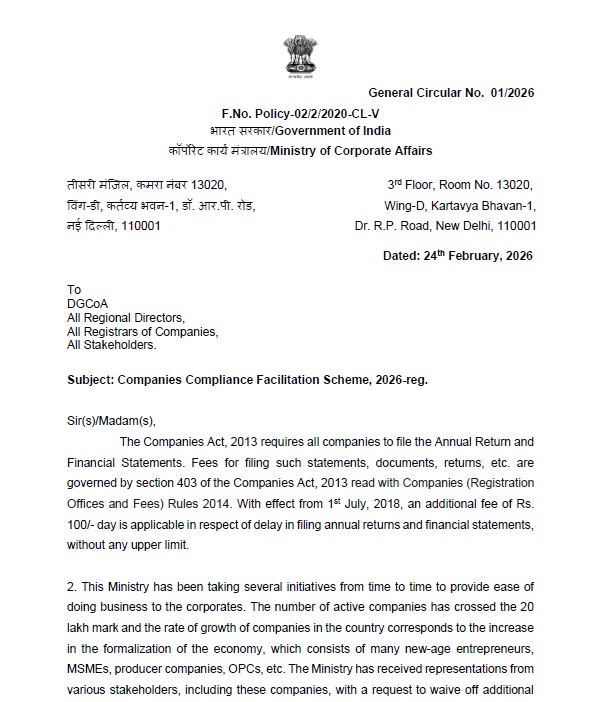
The MCA Amnesty Scheme 2026 was introduced via [suspicious link removed]. It aims to clean up the MCA-21 registry by providing a one-time window for companies to regularize their records. For many MSMEs and private companies, the daily penalty of ₹100 per form (with no upper limit for additional fees) had become a death knell; this scheme offers a pragmatic exit or a fresh start.
Also Read-MCA Replaces Annual Director KYC with Triennial Filing Cycle
Key Features and Period of Operation
The Companies Compliance Facilitation Scheme 2026 is not an open-ended relief. It is a time-bound opportunity with a clear start and end date. From a professional standpoint, I advise my clients to begin their compliance audits immediately, as the three-month window is often shorter than it looks once you start drafting long-pending financial statements.
- Scheme Commencement: 15th April 2026
- Scheme Conclusion: 15th July 2026
- The 90% Benefit: Under the scheme, companies only need to pay 10% of the normal additional fees prescribed under the Companies (Registration Offices and Fees) Rules, 2014. The normal filing fee remains payable in full.
Eligibility Criteria: Who Can Benefit from CCFS-2026?
While the scheme is broad, it is not universal. Based on the official circular, the MCA Amnesty Scheme 2026 is available to all “defaulting companies.” However, specific exclusions apply to maintain the integrity of the enforcement actions already taken by the ROC.
Eligible Entities
- Private Limited Companies
- Public Limited Companies
- One Person Companies (OPC)
- Small Companies
- Section 8 (Non-profit) Companies
- Foreign Companies filing forms like FC-3 or FC-4
Ineligible Entities [Source: MCA General Circular No. 01/2026]
- Struck-off Companies: Entities against which the ROC has already initiated final notice for strike-off under Section 248.
- Amalgamated Entities: Companies already dissolved pursuant to a scheme of amalgamation.
- Vanishing Companies: Entities identified by the Ministry as “vanishing.”
- Active Applicants: Companies that have already filed for strike-off (STK-2) or Dormant status (MSC-1) prior to 15th April 2026.
Strategic Pathways: Regularization, Dormancy, or Strike-Off
The CCFS-2026 is unique because it doesn’t just encourage you to stay active; it provides an “Easy Exit” or “Hibernation” route at discounted rates.
- Dormant Status (MSC-1): If your company has no significant accounting transactions but you want to keep the name for future use, you can apply for Dormant status by paying only 50% of the normal filing fee.
- Voluntary Strike-Off (STK-2): For promoters who want to shut down a defunct entity, the scheme allows filing for strike-off by paying only 25% of the applicable fee (which is usually ₹10,000). This is a strategic move to avoid future compliance costs and director disqualification risks.
Step-by-Step Guide to Avail CCFS-2026
Availing CCFS-2026 is straightforward, but preparation is key. As someone who’s guided clients through similar processes, I recommend starting early to avoid last-minute rushes. The timeline is tight: Applications open on April 15, 2026, and close on July 15, 2026—no extensions expected, based on past schemes.
Step 1: Assess Your Compliance Status
Log into the MCA portal (www.mca.gov.in) using your Director Identification Number (DIN) or company CIN. Navigate to “MCA Services” > “Company Services” > “View Company/LLP Master Data.” Check for pending filings under “Compliance” tab. Common defaults include:
- MGT-7 (Annual Return): Due within 60 days of AGM.
- AOC-4 (Financial Statements): Due within 30 days of AGM.
- Other forms like DIR-3 KYC, INC-22A (Active Company Tagging).
If you’re unsure, use the “DIN Status” tool to see if your directors are flagged as defaulting. In my experience, 70% of defaults stem from overlooked annual filings—cross-check with your auditor.
Documents needed: Audited financials, board resolutions, and any supporting proofs for delays (e.g., COVID impact certificates, though not mandatory).
Step 2: Calculate Fees Under the Scheme
Normal additional fees for delays are Rs. 100 per day (no cap) for AOC-4/MGT-7, or tiered multiples (2x to 12x normal fee) for others. Source: MCA Fee Structure Under CCFS-2026, pay only 10% of that additional fee for annual filings.
Example: Suppose your AOC-4 is delayed by 300 days. Normal additional fee: 300 x Rs. 100 = Rs. 30,000 (plus base fee of Rs. 300-600 based on capital). Under scheme: Pay 10% of Rs. 30,000 = Rs. 3,000 + base fee.
For dormant status (Form MSC-1): 50% of additional fee. For strike-off (STK-2): 25% of additional fee. Use MCA’s fee calculator tool for precision. Source: MCA Fees Calculator
Step 3: Prepare and File Documents
Draft the required forms in PDF format, attach digital signatures (DSC) from directors/auditors. For annual filings, ensure balance sheets and profit/loss statements are XBRL-compliant if applicable (for companies with turnover > Rs. 100 crore).
Submit via MCA V3 portal: “MCA Services” > “E-Filing” > Select form > Upload > Pay fees online (net banking/credit card).
Step 4: Apply for Immunity Certificate
Post-filing, file Form CFSS-2026 (a new e-form) declaring all defaults cleared. MCA will issue an immunity certificate within 30 days, protecting against future actions for those delays.
Step 5: Post-Availment Checks
Monitor your CIN status for updates. If issues arise (e.g., rejection due to incomplete docs), resubmit within the window.
Tips from my cases: DIY errors can lead to rejections. Budget for professional fees (Rs. 5,000-20,000 per form). For multi-year defaults, prioritize high-penalty forms first. This process has restored compliance for many of my clients peacefully, avoiding court visits.
Applicable Forms and Fee Waiver Table
CCFS-2026 covers a wide array of forms, focusing on annual and event-based compliances. Here’s a detailed table:
| Form | Purpose | Normal Additional Fee | Waiver Under CCFS-2026 | Notes |
|---|---|---|---|---|
| MGT-7 | Annual Return | Rs. 100/day (no cap) | Pay 10% of additional fee (90% waiver) | For shareholding details |
| AOC-4 | Financial Statements | Rs. 100/day (no cap) | Pay 10% of additional fee | XBRL for large companies |
| INC-22A | Active Company Tagging | 2x-12x base fee based on delay | Pay 10% of additional fee | One-time for pre-2019 companies |
| MSME-1 | MSME Half-Yearly Return | Rs. 100/day | Pay 10% of additional fee | For dues to MSMEs |
| DIR-3 KYC | Director KYC | Fixed Rs. 5,000 if late | Pay 10% (Rs. 500) | Annual for active DINs |
| MSC-1 | Application for Dormant Status | Tiered based on delay | Pay 50% of additional fee | For inactive companies |
| STK-2 | Application for Strike-Off | Tiered | Pay 25% of additional fee | Voluntary closure |
| Other Forms (e.g., MGT-14 for resolutions) | Event-based | Varies (Rs. 100/day or multiples) | Pay 10% for eligible | Check circular for full list |
Detailed Fee Comparison: Savings Under the Amnesty Scheme
To put things in perspective, let’s look at a typical case I handled recently where a company had not filed its Annual Return (MGT-7) and Financial Statements (AOC-4) for three years (approx. 1,000 days of delay).
| Fee Component | Standard Penalty (Normal) | CCFS-2026 (Amnesty) | Savings |
| Additional Fee per Form | ₹1,00,000 (₹100 x 1,000 days) | ₹10,000 (10% of Additional Fee) | ₹90,000 |
| Normal Filing Fee | ₹600 (Varies by Capital) | ₹600 | Nil |
| Total for 2 Forms | ₹2,01,200 | ₹21,200 | ₹1,80,000 |
This 90% ROC fee waiver is a massive relief for promoters who were looking at seven-figure penalties just to make their companies “active” again for a potential sale or funding round.
Immunity from Prosecution and Penalties
One of the most critical aspects of the Companies Compliance Facilitation Scheme 2026 is the immunity it grants. In the current “E-Adjudication” era, the ROC has been aggressive in issuing notices under Section 454 for late filings.
- Pending Adjudication: If you file under the scheme before a notice is issued, or within 30 days of receiving a notice under Section 92 (Annual Return) or Section 137 (Financial Statements), no penalty will be levied by the Adjudicating Officer.
- Legacy Forms: For older forms under the 1956 Act (like Form 20B or 23AC), immunity is granted against prospective penal action provided no prosecution is currently pending in court.
- Limitations: The scheme does not provide immunity from non-filing related defaults—for instance, if you didn’t hold an AGM, the scheme helps with the filing of the return but doesn’t necessarily wipe out the default of not holding the meeting itself.
Potential Pitfalls to Watch Out For
Despite the benefits, there are traps that many “defaulting entities” fall into.
- Portal Glitches: The transition to the MCA V3 portal has been rocky. We saw extensions in late 2025 due to these issues. Do not wait until July 14th to file; the traffic will likely crash the servers.
- Director Disqualification: Filing under the scheme does not automatically “undo” a director’s disqualification under Section 164(2) if they have already been disqualified. However, it prevents future disqualifications for the current board.
- Section 8 Companies: These companies often have more complex filing requirements (AOC-4 periods). Ensure the specific exemptions for Section 8 are factored in before calculating the final fee.
Frequently Asked Questions (FAQs) on MCA Amnesty Scheme 2026
What is the 90% ROC Fee Waiver under CCFS-2026?
What is the duration of the MCA Amnesty Scheme 2026?
Are LLPs (Limited Liability Partnerships) covered under this scheme?
Can a “Struck Off” company benefit from this waiver?
Does filing under CCFS-2026 grant immunity from prosecution?
Is there any benefit for companies wanting to shut down?
Will this scheme automatically clear Director Disqualification?
Disclaimer: This article is for informational purposes only and does not constitute professional legal or financial advice. While every effort has been made to ensure accuracy based on the MCA General Circular No. 01/2026, users are advised to consult a practicing Chartered Accountant (CA) or Company Secretary (CS) before taking action.
Wrapping Up & Next Steps
CCFS-2026 is a golden opportunity to wipe the slate clean, restoring your company’s good standing without financial ruin. By paying just a fraction of fees and gaining immunity, you avoid the headaches of notices and prosecutions. In my 15+ years, schemes like this have been game-changers for businesses—act now to secure your future.
Facing ROC defaults? Share your experience in the comments or contact taxgst.in for expert guidance. Let’s make compliance stress-free.
Official References & Authority Links
For deeper technical insights into the Companies Compliance Facilitation Scheme 2026 (CCFS-2026), please refer to these official and reputable sources:
- ➤
Official MCA Notification:
General Circular No. 01/2026 (Download PDF)
– The primary legal document detailing the 90% fee waiver and eligibility. - ➤
PIB Press Release:
Ministry of Corporate Affairs: Ease of Doing Business Reforms
– Official government update on the 2026 compliance reset. - ➤
Professional Analysis:
TaxGuru – 90% Additional Fee Waiver Analysis
– Comprehensive expert breakdown of the impact on defaulting entities. - ➤
Government Portal:
MCA-21 V3 Official News & Updates
– Real-time system status and filing extensions for the 2026 scheme.
Discover more from TaxGst.in
Subscribe to get the latest posts sent to your email.




Stay Updated!
Join our community for latest tax updates, GST news & finance tips