
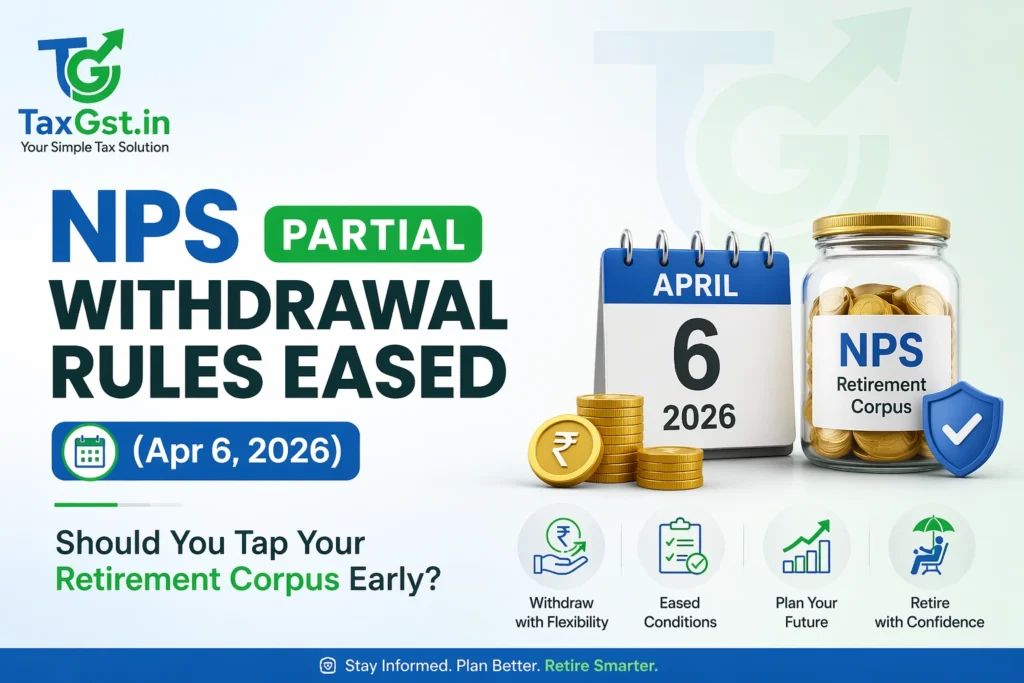
Should you dip into your National Pension System (NPS) corpus before retirement for emergencies like medical treatment or your child’s higher education? This is one of the most common dilemmas faced by salaried individuals and self-employed professionals who’ve diligently built their retirement nest egg over years. Until recently, the rules were restrictive—partial withdrawals were allowed only under narrow conditions and after a long lock-in period. But on April 6, 2026, the Pension Fund Regulatory and Development Authority (PFRDA) announced a significant relaxation in partial withdrawal norms, offering much-needed flexibility to subscribers.
Also Read-EPFO 3.0: The Future of PF Withdrawals is Here – ATM & UPI Access Explained
The new rules, issued under PFRDA Circular No. PFRDA/2026/04, now permit up to 25% of the subscriber’s own contributions (not the total corpus) to be withdrawn after just three years from the date of joining NPS—down from the earlier five-year threshold. This change applies to both Tier-I and Tier-II accounts, though Tier-I remains the primary retirement-focused account with tax benefits under Section 80CCD(1B). While this move enhances liquidity and financial resilience during crises, it also raises concerns about long-term retirement security. We’ll compare the old vs. new rules, weigh the pros and cons, walk through real-life scenarios, and help you decide whether tapping into your NPS early is the call.
| Factor | Old Rules (Pre-April 2026) | New Rules (Post-April 2026) |
|---|---|---|
| Minimum Lock-in Period | 5 years from joining | 3 years from joining |
| Maximum Withdrawal Limit | 25% of subscriber’s contributions | 25% of subscriber’s contributions |
| Eligible Purposes | Higher education, marriage, illness, home purchase | Expanded to include critical illness, disability, education (incl. vocational), and home renovation |
| Number of Withdrawals Allowed | Maximum 3 times during entire tenure | Maximum 3 times, but no minimum gap required between withdrawals |
| Tax Treatment | Tax-free if used for specified purposes | Remains tax-free if used for approved purposes |
Old Rules: The Pros
The pre-2026 NPS partial withdrawal framework wasn’t entirely without merit. Its strict five-year lock-in period was designed to reinforce the core purpose of NPS: long-term retirement savings. By discouraging early access, it helped subscribers build disciplined habits and avoid impulsive withdrawals that could derail their post-retirement income.
- Encouraged long-term financial discipline by imposing a longer waiting period
- Limited exposure to market volatility during early career stages
- Reduced risk of premature depletion of retirement corpus
- Clear documentation requirements minimized misuse
- Tax-free withdrawals for genuine emergencies added a layer of protection
Old Rules: The Cons
Despite its intentions, the old regime often left subscribers in a bind during genuine financial emergencies. A five-year wait was impractical for young professionals facing sudden medical bills or unexpected educational expenses. Many found themselves unable to access funds even when they had contributed significantly over three or four years.
- Five-year lock-in was too rigid for life’s unpredictable events
- Delayed access during critical phases like early parenthood or career transitions
- No provision for partial liquidity during economic downturns or job loss
- Complex documentation process discouraged legitimate claims
- Missed opportunity to support subscribers during genuine hardships
New Rules: The Pros
The April 2026 reforms mark a pragmatic shift toward subscriber-centric flexibility. Reducing the lock-in to three years acknowledges that life doesn’t always follow a linear path—especially in India, where family obligations and healthcare costs can arise unexpectedly. The expanded list of eligible purposes now includes vocational training, mental health treatment, and home renovations for accessibility (e.g., ramps for elderly parents), reflecting modern realities.
- Three-year eligibility enables faster access during genuine emergencies
- Broader coverage of life events (e.g., skill development, disability support)
- No mandatory gap between withdrawals offers greater control
- Maintains tax-free status for compliant withdrawals
- Aligns NPS with other retirement products like EPF in terms of liquidity
- Empowers subscribers to manage cash flow without compromising long-term goals entirely
New Rules: The Cons
However, easier access isn’t without trade-offs. Allowing withdrawals after just three years may tempt some subscribers to treat NPS as a quasi-savings account rather than a dedicated retirement vehicle. Behavioral finance studies show that early access increases the likelihood of repeated withdrawals, potentially eroding compounding benefits. since only the subscriber’s contributions (not employer or government co-contributions) are eligible, the actual usable amount may be smaller than expected.
- Risk of undermining retirement discipline among younger subscribers
- Potential reduction in final corpus due to lost compounding on withdrawn amounts
- Misuse possible if documentation isn’t rigorously verified
- Only 25% of personal contributions available—may not cover large expenses
- Could lead to regret if market conditions improve post-withdrawal
Who Should Choose What
The decision to use the new partial withdrawal facility hinges on individual circumstances. Young professionals with stable incomes and robust emergency funds may still prefer to leave their NPS untouched. But those facing acute financial pressure—like a parent whose child needs urgent surgery or a mid-career worker pursuing upskilling after job loss—may find the new rules lifesavers. Importantly, the withdrawal is not an “all-or-nothing” choice; it’s a strategic tool to be used sparingly.
Decision Guide:
- Choose to withdraw under new rules if: You face a verified emergency (medical, educational, disability-related), have exhausted other liquidity sources (FDs, insurance), and can replenish contributions later.
- Avoid withdrawal if: Your expense is discretionary (e.g., vacation, luxury purchase), you’re under 30 with decades of compounding ahead, or you already have adequate emergency savings.
Real Example: Riya’s Medical Emergency
Riya, a 32-year-old software engineer in Bengaluru, joined NPS in April 2023 through her employer. By March 2026, she had contributed ₹2.8 lakh personally (plus ₹2.8 lakh from her company). In February 2026, her father was diagnosed with stage-2 cardiac disease requiring surgery costing ₹4.5 lakh. Her health insurance covered only ₹2 lakh. Under the old rules, she’d have to wait until 2028 to access any NPS funds. But thanks to the April 2026 easing, she became eligible in April 2026—just three years after joining. She applied for a partial withdrawal of ₹70,000 (25% of her ₹2.8 lakh contributions), submitted hospital bills and doctor certificates via the NPS Trust portal, and received the amount within 10 days. “It wasn’t enough to cover everything,” she says, “but it bridged the gap until my bonus came in.”
Real Example: Arjun’s Career Pivot
Arjun, a 29-year-old marketing executive in Delhi, lost his job in December 2025 during industry downsizing. With savings running low, he considered withdrawing from his NPS (joined in January 2023; personal contributions: ₹1.9 lakh). Under the old five-year rule, he’d be locked out until 2028. But the new three-year window allowed him to access ₹47,500 in May 2026. He used it to enroll in a certified data analytics course (₹45,000), which led to a new job within four months. “Without that upskilling, I’d still be unemployed,” he notes. “The withdrawal wasn’t a setback—it was an investment.”
Step-by-Step: How to Apply for Partial Withdrawal (2026 Process)
The process has been streamlined under the new circular. Here’s how to do it:
- Log in to your NPS account via the CRA portal (NSDL) using your PRAN and password.
- Navigate to “Partial Withdrawal Request” under the Transaction tab.
- Select the purpose (e.g., “Critical Illness,” “Higher Education”) and upload supporting documents (e.g., medical certificate, admission letter).
- Specify the amount (max 25% of your total personal contributions across all years).
- Submit the request. The CRA verifies documents within 5 working days.
- Upon approval, funds are credited directly to your registered bank account within 3–5 days.
Note: You can track status via SMS/email alerts. No physical forms required.
Tax Implications: What You Need to Know
One of the biggest advantages of NPS partial withdrawals remains unchanged: they are completely tax-free if used for the approved purposes listed in PFRDA Circular No. PFRDA/2026/04. This includes:
- Treatment of critical illnesses (cancer, renal failure, stroke, etc.)
- Higher education or vocational training for self, spouse, children, or dependent parents
- Marriage of children
- Purchase or construction of residential house (including renovation for disability access)
- Disability support (physical or mental)
However, if you withdraw and later cannot prove the funds were used for these purposes during an audit, the amount may be treated as taxable income. Always retain receipts and certificates for at least six years.
Compound Interest Cost: A Hidden Trade-off
While the immediate relief is real, consider the long-term cost. Suppose you withdraw ₹1 lakh at age 30. Assuming an average annual return of 9%, that ₹1 lakh would grow to nearly ₹7.6 lakh by age 60. By withdrawing early, you lose not just the principal but decades of compounding. Use this rule of thumb: only withdraw if the emergency’s cost outweighs the future value loss.
My Recommendation
As someone who’s advised hundreds of clients on retirement planning, I see the April 2026 easing as a net positive—but with caveats. The reduced lock-in period brings NPS in line with global best practices (e.g., UK’s pension freedoms) and acknowledges India’s unique socio-economic challenges. However, treat partial withdrawal as a last resort, not a first option. Build a separate emergency fund covering 6–12 months of expenses before relying on NPS. If you must withdraw, document everything meticulously and aim to resume contributions immediately. Remember: NPS is your golden years’ safety net—don’t pull threads unless absolutely necessary.
FAQs
Q1: Can I withdraw more than 25% of my contributions if I have a severe medical condition? No. Even for critical illnesses like cancer or organ transplants, the maximum remains 25% of your total personal contributions made to the NPS Tier-I account. This cap is fixed under PFRDA Circular No. PFRDA/2026/04 and cannot be exceeded, regardless of expense magnitude. However, you can make up to three such withdrawals over your lifetime, provided each meets eligibility criteria. Always consult your nodal officer or CRA if unsure about documentation.
Q2: Does the three-year rule apply from the date of first contribution or PRAN activation? The three-year period is calculated from the date of your first contribution to the NPS Tier-I account, not the PRAN issuance date. For example, if you opened your PRAN in January 2023 but made your first contribution in April 2023, your eligibility begins in April 2026. This clarification was explicitly stated in the April 6, 2026 circular to avoid confusion among subscribers who delay initial investments.
Q3: Can I use the withdrawn amount for my sibling’s education or my in-laws’ medical treatment? The eligible beneficiaries are strictly defined: self, spouse, children, and dependent parents. Siblings, in-laws, or other relatives are not covered unless they are legally dependent on you and declared as such in your NPS profile. For instance, if your brother is disabled and fully dependent on you, you may qualify—but you’ll need proof of dependency (e.g., income certificate, court order).
Q4: What happens if I withdraw and later rejoin NPS after a break? Your previous contributions and withdrawal history remain on record. The three-year clock resets only if you close your Tier-I account entirely and open a new one (which is rare and discouraged). Partial withdrawals count toward your lifetime limit of three, even across employment changes. Rejoining doesn’t reset eligibility or increase your withdrawal ceiling.
Q5: Is the withdrawal amount adjusted for inflation or market gains? No. The 25% is calculated purely on your gross personal contributions, excluding any investment returns, employer contributions, or government co-contributions (for govt employees). For example, if you’ve contributed ₹4 lakh personally and your corpus is worth ₹6.2 lakh due to market growth, you can still withdraw only ₹1 lakh (25% of ₹4 lakh). Gains are locked until retirement.
Q6: Can I reverse a partial withdrawal if my financial situation improves? Unfortunately, no. Unlike EPF, NPS does not allow re-deposit of withdrawn amounts. Once funds are taken out, they’re gone from your retirement corpus permanently. This underscores the importance of careful planning—consider borrowing from family or taking a short-term loan before tapping NPS. Some subscribers opt for Tier-II withdrawals (which are flexible but lack tax benefits) as a buffer.
Source & References
- Refer to official government notification for complete details
Note: Always refer to the original government notification for legal purposes. This article is for informational purposes only.
Discover more from TaxGst.in
Subscribe to get the latest posts sent to your email.




Stay Updated!
Join our community for latest tax updates, GST news & finance tips